

When you’re injured in a car accident, calculating what your pain and suffering is actually worth becomes one of the most confusing parts of your claim. Insurance companies use specific methods to assign dollar amounts to your physical pain, emotional trauma, and lost quality of life-and understanding how they work puts you in a stronger position.
At Schaar & Silva LLP, we’ve seen how pain and suffering evaluation directly impacts what accident victims receive. This guide walks you through the real formulas insurers use, what evidence matters most, and how to build a claim that reflects your actual damages.
What Counts as Pain and Suffering After a Car Accident
Pain and suffering in an auto accident claim covers far more than just the immediate physical injury. It includes your physical pain during recovery, the emotional toll the accident takes on you, and the ways your life changes while you heal. Insurance companies recognize these non-economic damages as separate from your medical bills and lost wages, but they fight hard to minimize what they’ll pay. The key to winning fair compensation is understanding exactly what falls into this category and documenting it thoroughly from day one.
Physical pain demands measurable proof
Your physical pain isn’t abstract. When you file a claim, insurers want to see how long your recovery actually takes and what that recovery looks like. A broken bone with a clear 12-week healing timeline is easier to value than soft tissue damage that might linger for months. Medical records showing your treatment progression matter enormously here. If your doctor prescribed physical therapy twice weekly for eight weeks, that’s concrete evidence of pain severity. Keep every imaging report, every prescription, and every treatment note. The per diem method assigns a daily dollar value to your pain and multiplies it by your recovery time. If your recovery spans 90 days at $150 per day, that calculation yields $13,500 in pain and suffering alone. But here’s what many accident victims miss: your pain often doesn’t end neatly on a calendar. You might reach maximum medical improvement and still have persistent symptoms. That ongoing discomfort should factor into your claim, not disappear when your doctor declares you healed.
Emotional distress reshapes your entire life
The psychological impact of a serious accident gets underestimated constantly. You might develop anxiety about driving, sleep disturbances from trauma, or depression as your recovery stalls. These aren’t minor inconveniences. Therapy records, psychiatric evaluations, and counseling notes prove this damage exists. If you attend therapy weekly for six months following your accident, that’s documentation insurers can’t dismiss. Keep records showing when anxiety or depression started and how it affected your work performance or family relationships. A daily pain journal that tracks not just physical pain but emotional state helps quantify this subjective experience. Loss of enjoyment of life happens when injuries prevent you from activities that matter. If you’re a runner sidelined for months, if you can’t play with your children the way you did before, if you stop attending social events because of pain or anxiety, these losses are real damages. Collect statements from family members or close friends describing changes they’ve observed in your mood, activity level, or participation in life. These personal accounts carry weight in settlement negotiations because they show how the accident genuinely altered your daily existence.
How insurers value what you’ve lost
Insurance companies don’t assign pain and suffering values randomly. They apply two primary calculation methods-the multiplier method and the per diem approach-each producing different results depending on your injury type and recovery timeline. Understanding which method works in your favor requires knowing your injury details and the evidence you’ve collected. The multiplier method takes your economic damages and applies a multiplier ranging from 1.5 to 5 based on injury severity. A $50,000 medical bill with a 3× multiplier could support $150,000 in pain and suffering. The per diem method works differently, assigning a daily dollar amount and multiplying it by your recovery days. Both methods rely on the documentation you’ve gathered, which means your medical records, therapy notes, and personal journals directly influence the final number insurers will offer. The stronger your evidence, the harder it becomes for them to undervalue your claim.
How Insurers Calculate Your Pain and Suffering
Insurance companies rely on two primary methods to assign dollar values to your pain and suffering, and understanding the difference between them directly impacts what offer you’ll receive. The multiplier method takes your documented economic damages-medical bills, lost wages, property damage-and multiplies that total by a factor ranging from 1.5 to 5 depending on injury severity. If your medical expenses total $40,000 and your injury is moderate, an insurer might apply a 2.5 multiplier, yielding $100,000 in pain and suffering. For catastrophic injuries like spinal cord damage or amputation, multipliers can reach 4 or 5, pushing pain and suffering calculations substantially higher.
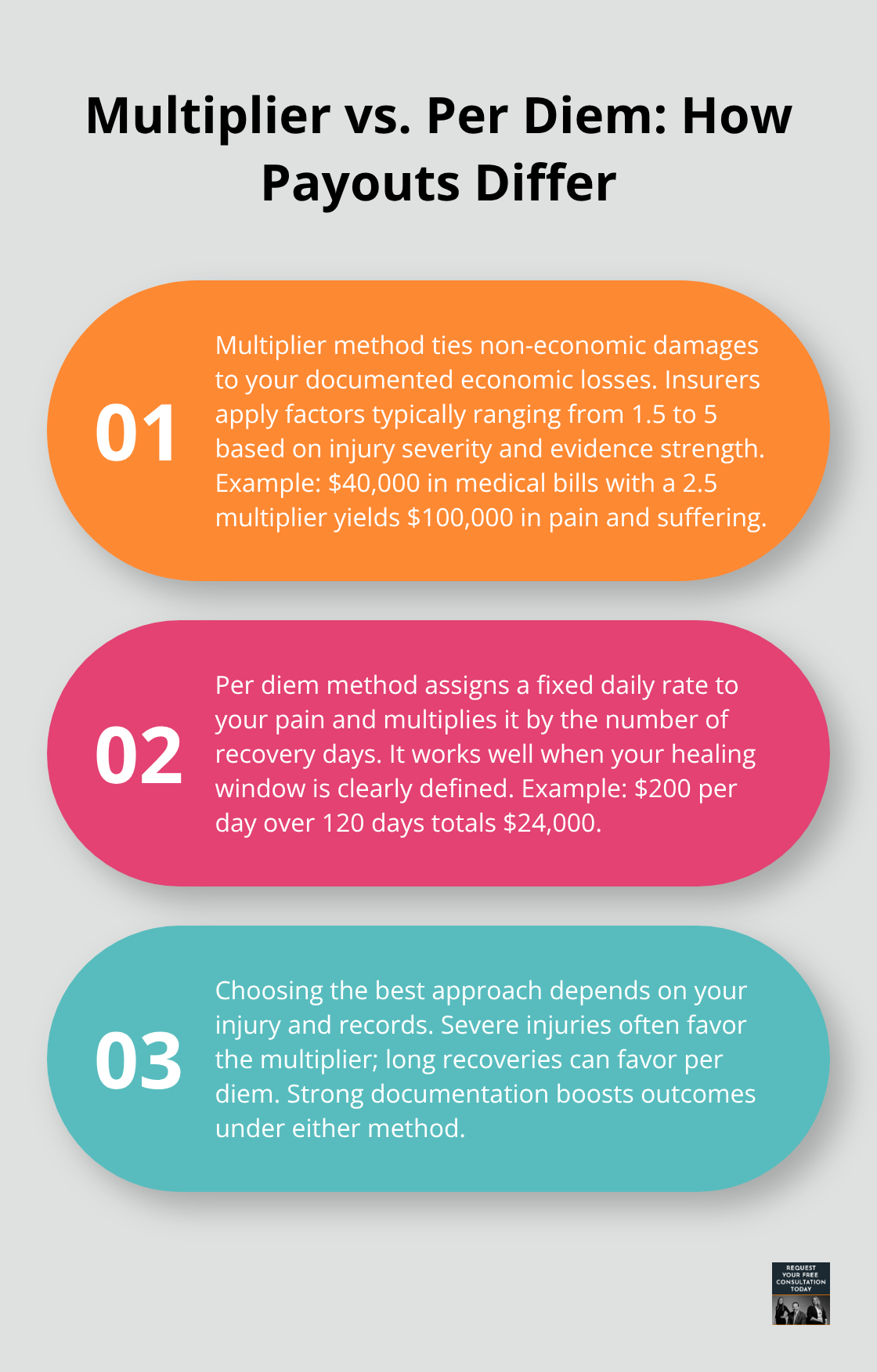
The per diem method works differently: it assigns a fixed daily dollar amount to your pain and multiplies that amount by the number of days you experience pain or impairment. A $200 daily rate across 120 days of recovery produces $24,000 in pain and suffering.
When Per Diem Works Best
Per diem works best for injuries with clearly defined recovery windows, like fractures or straightforward soft tissue injuries. However, it falters when your symptoms persist beyond typical healing timelines. Insurers prefer the multiplier method for severe injuries because it ties pain and suffering directly to your actual medical costs, making the calculation feel more objective. That said, the per diem approach can yield higher awards if your recovery period is lengthy, which makes it worth considering for your specific situation.
Factors That Shift Your Claim’s Value
Several factors shift how aggressively an insurer values your claim within either method. Injury severity matters most: a concussion receives lower multipliers than a traumatic brain injury with lasting cognitive effects. The length and intensity of your medical treatment signals severity to insurers-six months of physical therapy suggests worse damage than two weeks of treatment. Permanent symptoms or residual pain after reaching maximum medical improvement strengthen your case considerably because they prove the accident created lasting harm.
Your age and pre-injury health status influence calculations too; younger people with longer life expectancies typically receive higher awards since their pain and suffering spans more years. Comparative fault reduces your award proportionally under California law, so if you’re found 20% at fault, your $100,000 pain and suffering award drops to $80,000. The location where your case would be filed matters significantly because different counties and juries view damages differently. Santa Cruz County juries, for example, may value non-economic damages differently than Sacramento or Oakland juries based on local attitudes and jury composition.
How Insurers Undervalue Claims
Insurers use software to estimate values, but they consistently undervalue claims during initial settlement offers. Your documented evidence-medical records, therapy notes, daily pain journals, family testimony about lifestyle changes-directly counteracts their software calculations and forces higher settlement discussions. The stronger your documentation, the harder it becomes for insurers to justify their low offers. This is where the evidence you’ve already started collecting becomes your most powerful tool in negotiations.
Documentation and Evidence That Strengthens Your Claim
Medical records form your foundation
Medical records form the backbone of any pain and suffering claim, and you need far more than just your hospital discharge summary. Insurers scrutinize treatment patterns to assess injury severity, so you must gather every single document from your care providers: emergency room reports, imaging results, surgical notes, physical therapy assessments, and follow-up visit summaries. Each treatment session creates a timestamp proving you experienced pain serious enough to require professional intervention. If you attended physical therapy twice weekly for twelve weeks, that’s twenty-four documented sessions showing your recovery wasn’t quick or simple.
You should keep prescription records too, especially for pain medication, muscle relaxants, or anti-inflammatory drugs. The specific medications your doctor prescribed tell insurers exactly how your medical team classified your injury’s severity. Insurance adjusters intentionally work with incomplete files to justify lower settlement offers, so completeness becomes your competitive advantage in negotiations. Request complete medical records in writing from your doctor’s office and verify you have every page rather than assuming your provider will send everything automatically.
Your personal documentation carries equal weight
Your personal documentation matters equally to medical records, and this is where most accident victims fail themselves. Start a daily pain journal immediately after your accident, recording specific pain levels, which activities triggered discomfort, how many hours you slept, and emotional struggles like anxiety or frustration. Write concrete details: you couldn’t lift your child for three weeks, you missed work on Tuesday because your back pain spiked after physical therapy, you avoided driving for a month due to panic attacks.
Photographs of visible injuries, bruising, or swelling across multiple days show progression and healing. If your injury required mobility aids like a neck brace, crutches, or a sling, photograph yourself using them. Request written statements from family members, close friends, or coworkers describing specific changes they observed in your behavior, mood, or physical capabilities. A statement from your spouse noting that you stopped attending your weekly soccer games or couldn’t help with household tasks carries substantial weight because it documents lifestyle disruption from a neutral observer’s perspective.
Social media poses serious risks to your claim
Social media activity during your recovery period can devastate your claim, so you must avoid posting photos of activities that contradict your pain claims. Insurance adjusters routinely search social media looking for evidence to minimize your damages, and a single image of you appearing to enjoy yourself can undermine months of documented suffering. Claims with robust personal documentation (medical records, therapy notes, pain journals, and witness statements) consistently settle higher than those relying solely on medical records, sometimes by thirty to forty percent or more.
Final Thoughts
Pain and suffering evaluation requires more than understanding the multiplier and per diem methods-it demands thorough documentation that forces insurers to recognize your actual damages rather than their software estimates. Medical records, therapy notes, daily pain journals, and witness statements work together to build an undeniable case for fair compensation. Insurers count on accident victims abandoning this documentation effort or making social media mistakes that undermine their claims, so your commitment to evidence collection directly determines whether you receive a lowball offer or a settlement reflecting your genuine losses.
The multiplier method ties your pain and suffering directly to your medical expenses, while the per diem approach rewards longer recovery periods, and both methods depend entirely on the evidence you’ve collected. At Schaar & Silva LLP, we handle the legal complexities while you focus on healing, and we serve Santa Cruz County, Sacramento, and Oakland with a deep understanding of how local juries and insurers approach pain and suffering valuations in your area. We’ve seen how proper documentation transforms settlement negotiations, and we know which evidence carries the most weight with adjusters.
Your next step is straightforward: gather your medical records, start documenting your daily experience if you haven’t already, and contact our team for a case evaluation. We’ll review your evidence, assess your claim’s value, and explain exactly what your pain and suffering is worth under California law.