
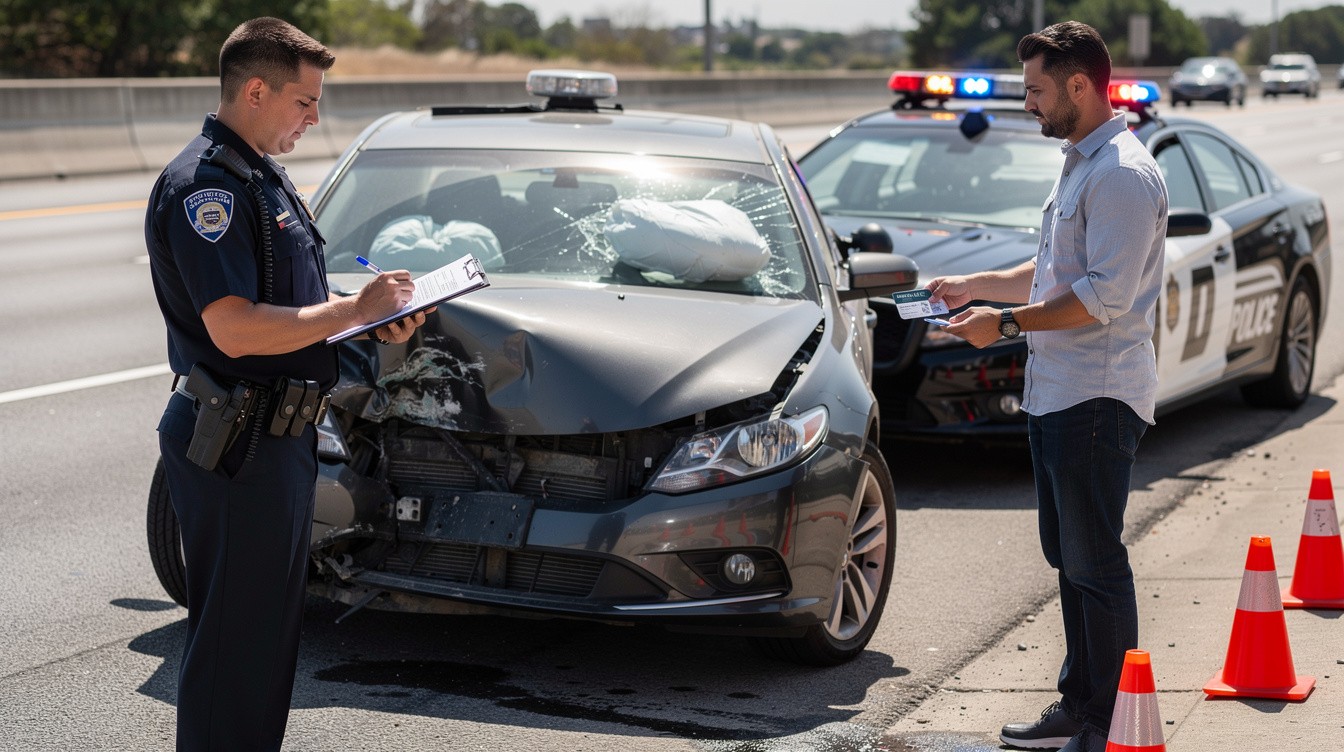
A car crash police report is one of the most important documents you’ll need after an accident. This report becomes the foundation for your insurance claim and any legal action that follows.
At Schaar & Silva LLP, we’ve seen how a single error in a police report can derail a legitimate claim. That’s why understanding what’s in your report-and how to challenge inaccuracies-matters so much.
What Police Reports Actually Contain and Why Insurers Use Them Against You
A police report documents the officer’s observations from the accident scene, including vehicle positions, weather conditions, road hazards, and statements from drivers and witnesses. The report assigns a primary cause code to the crash, such as unsafe speed or failure to yield. California Vehicle Code Section 20008 requires drivers to provide information at the scene, and officers file these reports with their agencies. However, what many accident victims don’t realize is that police reports contain the officer’s opinions about fault, not definitive legal findings. Insurance adjusters treat these reports as near-gospel when deciding liability, often using them to deny claims or reduce payouts before any investigation occurs.
The Reality: Insurers Ignore Police Findings to Protect Their Bottom Line
The reality is harsh: insurers conduct independent investigations and frequently disregard police findings to save money, affecting both fault determinations and the compensation you receive. A favorable police report helps your claim, but a denial based solely on the report doesn’t end your case in California. Civil courts operate under different rules than traffic enforcement, and police reports are generally inadmissible hearsay under Evidence Code Section 1200. This means your fault determination ultimately rests on independent evidence, not the officer’s account.
How Insurers Weaponize Police Reports
Insurance companies use police reports as a starting point to minimize their exposure. If an officer cited the other driver or noted clear violations like running a red light, the adjuster faces stronger liability exposure.
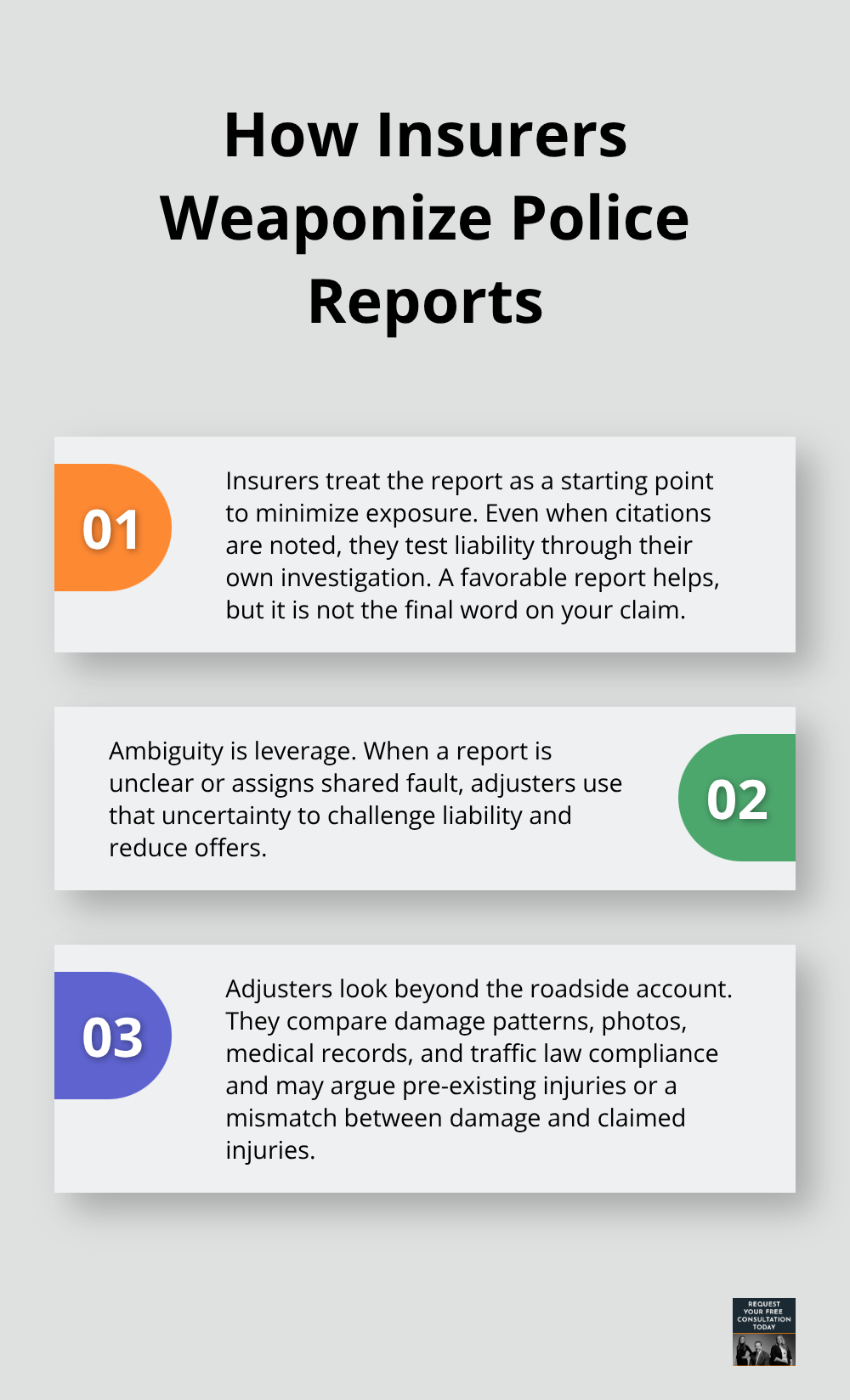
Conversely, if the report is ambiguous or assigns shared fault, insurers exploit that ambiguity to challenge your claim. Don’t assume a favorable report guarantees payment. Adjusters examine factors far beyond the roadside account: vehicle damage patterns, scene photographs, medical records, and driver compliance with traffic laws under California Vehicle Code. They may argue that injuries are pre-existing or that damage severity doesn’t match injury claims.
Comparative Negligence Gives You Options Even With an Unfavorable Report
Under California’s pure comparative negligence rules under Civil Code Section 1714, you can recover damages even if partially at fault, but your award gets reduced by your percentage of responsibility. This is where challenging an inaccurate police report becomes actionable. If the report contains factual errors like a wrong license plate or misspelled names, you can request a supplemental report with proof. Disputed fault determinations-the officer’s opinion on who caused the crash-are harder to overturn without new evidence such as witness statements, accident reconstruction analysis, or black box data from Event Data Recorders (EDRs) that show exact speed and braking patterns seconds before impact.
What Evidence Overturns a Police Report’s Fault Finding
Independent investigations uncover evidence police missed, including accident reconstruction, black box data, and cell phone records. Witness statements and affidavits secured after the scene carry more weight than a single officer’s account and help rebut the police report. If the other driver lied to police, physical evidence and witness testimony prove the truth despite the officer’s account.

Police reports may not include complete witness contact information; investigators can locate additional witnesses to strengthen your position. The evidence you gather and present to the court matters far more than what the officer wrote down at the scene.
Getting Your Police Report From Santa Cruz County
Contact the Right Agency and Gather Your Information
After a car crash in Santa Cruz County, you need the police report to file an insurance claim or build a legal case. The Santa Cruz County Sheriff’s Office or local police department holds this document, and obtaining it requires following specific steps. Contact the law enforcement agency that responded to your accident. You’ll need the incident report number (also called the DR number) if you have it, or the date, time, and location of the crash. If you don’t have the report number, the agency can search using your name and the accident details.
Call the Santa Cruz County Sheriff’s Office non-emergency line or visit in person at their Records Division. Bring your driver’s license and prepare to answer questions about your involvement in the accident, your relationship to the case (involved party, insurance representative, or authorized representative), and proof of your authority to access the report if you request it on behalf of someone else.
Understand the 45-Day Review Timeline
The timeline matters more than most people realize. Law enforcement agencies typically need 45 days minimum from the collision date to review and approve the report for release. Requesting a report immediately after the crash won’t speed up the process, but waiting longer will only delay your claim. Once the report is ready, Santa Cruz County offers two retrieval methods: in-person pickup at the Records Division or mail request.
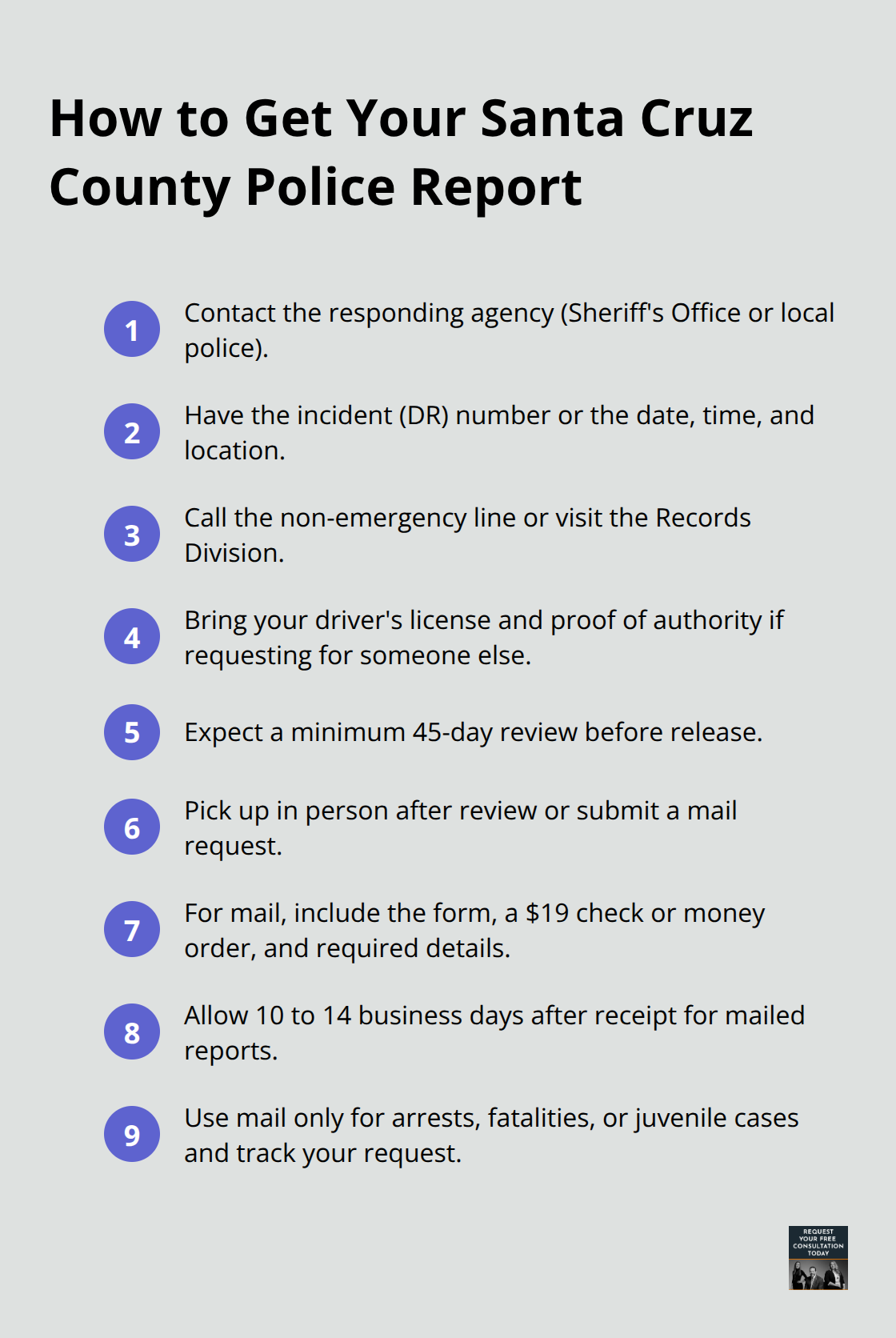
In-person pickup is faster, usually available within a few days after the 45-day review window closes.
Submit Your Mail Request With Required Documentation
For mail requests, send your completed Traffic Collision Report Request Form to the Santa Cruz County Sheriff’s Office Records Division with a check or money order for $19 payable to the Sheriff’s Office. Do not send cash. Include your name, address, phone number, the incident number or date and location, your interest in the report, and a signed declaration stating the information is true and correct. Mail requests typically take 10 to 14 business days after the Records Division receives your envelope.
Handle Special Circumstances and Track Your Request
If your accident involved an arrest, fatality, or a juvenile, online or expedited release is not available, and you must use the mail process. For status updates on a mailed report, contact the Santa Cruz County Sheriff’s Office Records Division directly and reference your request. Keep copies of everything you submit, including the check number and mailing receipt, so you can follow up if needed.
The $19 fee is a small investment because the report becomes critical evidence for your claim. Having it in hand allows an attorney to begin challenging inaccuracies immediately rather than waiting weeks into the process. Once you obtain your report, the next step involves reviewing it carefully for errors that could harm your case.
Police Report Errors That Derail Claims and How to Fix Them
Factual Mistakes That Insurance Adjusters Exploit
Factual errors in police reports happen more often than you’d think, and they sabotage your claim if left unchallenged. Officers miswrite license plate numbers, misspell driver names, confuse vehicle colors, or record incorrect addresses. These aren’t minor details-insurance adjusters use them to question the report’s reliability or to deny claims outright. If your report contains a factual mistake, request a supplemental report from the Santa Cruz County Sheriff’s Office Records Division. Provide written proof of the correct information, such as a copy of your driver’s license for name corrections or your vehicle registration for plate numbers.
The agency will issue a supplemental report that corrects the error, and this becomes part of the official record. This process typically takes two to three weeks. Act quickly; the longer you wait, the harder it becomes to gather supporting documentation and convince the agency to amend the report.
Disputed Fault Determinations Require Independent Evidence
Disputed fault determinations are far tougher to overturn because they rest on the officer’s opinion rather than objective fact. The officer’s conclusion about who caused the crash-written as a primary cause code-shapes how insurance adjusters view liability from day one. However, California’s Evidence Code Section 1200 means that opinion is inadmissible hearsay in civil court, so you’re not stuck with it.
Event Data Recorder data from the at-fault driver’s vehicle proves exact speed and braking patterns seconds before impact, often contradicting the officer’s narrative. Cell phone records with timestamp analysis and activity logs demonstrate distracted driving. Witness statements obtained after the scene carry substantial weight because they’re sworn accounts, not casual roadside comments.
How Accident Reconstruction Challenges Police Conclusions
Accident reconstruction experts analyze vehicle damage patterns, road conditions, and physics to establish what actually happened. If the officer’s report assigns you partial blame that you dispute, gather this independent evidence and present it through your attorney. Insurance companies frequently settle when faced with black box data or expert reconstruction reports that contradict their initial position based on the police report.
Final Thoughts
A car crash police report shapes your insurance claim from the moment it’s filed, but it doesn’t determine your outcome. The report provides a starting point for investigation, not a final verdict on fault or compensation. Understanding what’s in the report, recognizing where errors occur, and knowing how to challenge inaccuracies puts you in control of your claim rather than leaving you at the mercy of insurance adjusters who exploit ambiguous language to deny payment.
Request your report within 45 days of the collision, review it carefully for factual mistakes and disputed fault determinations, and gather independent evidence like black box data, witness statements, and accident reconstruction analysis if the report works against you. California’s comparative negligence law means you can recover even with an unfavorable report, provided you present stronger evidence to support your position. Don’t accept an insurer’s denial based solely on what an officer wrote at the scene.
We at Schaar & Silva LLP help clients in Santa Cruz County navigate the claims process by challenging police findings with solid evidence and negotiating with insurers on your behalf. Contact us for a free consultation to discuss your accident case and learn how we can help you move forward.
