
A personal injury accident can turn your life upside down in seconds. Medical bills pile up, lost wages add stress, and you’re left wondering what comes next.
We at Schaar & Silva LLP understand how overwhelming California personal injury claims can feel. This guide walks you through the types of cases, your legal rights, and the concrete steps to take after an accident.
What Personal Injury Cases Look Like in California
Car Accidents and the Numbers Behind Them
Car accidents dominate California’s injury landscape, and the numbers show why they matter. California Highway Patrol data reveals that vehicle collisions cause thousands of injuries annually across Santa Cruz County, Sacramento, and Oakland. A single distracted driver checking their phone at 55 miles per hour travels the length of a football field blind-long enough for everything to go wrong. In Oakland alone, the Transportation Injury Mapping System recorded an average of 49.2 pedestrian-involved crashes with injuries or fatalities per year over the past five years, with distracted and speeding drivers as primary culprits.
Truck Accidents and Commercial Vehicle Collisions
Truck accidents carry even higher stakes than standard vehicle collisions. Commercial vehicles weigh 20 to 30 times more than standard cars, which means the force behind a collision multiplies dramatically. When a fully loaded semi-truck hits you, the injuries tend to be catastrophic. Medical bills from truck accident cases often exceed six figures within the first year alone, and many victims face lifetime care costs that insurance companies systematically undervalue.
Wrongful Death and Catastrophic Injuries
Wrongful death claims arise when negligence or intentional harm results in someone’s death, and California law recognizes this as a separate civil action from any criminal case. The surviving family members-spouses, children, or dependents-can pursue compensation for lost wages, funeral expenses, and the loss of companionship. Brain injuries and spinal cord injuries represent some of the most devastating outcomes. The National Spinal Cord Injury Statistical Center reports that lifetime costs for spinal cord injury victims can exceed five million dollars depending on severity and age.
Pedestrian Accidents in Urban Areas
Pedestrians in California face particular danger in urban areas; the National Safety Council data shows that 83 percent of pedestrian fatalities occur in cities, where foot traffic, limited sightlines, and vehicle density create perfect conditions for tragedy. Older adults face disproportionate risk-in Oakland, pedestrian crashes involving seniors jumped from 7 in 2021 to 13 in 2022.

Building Your Case Requires Tailored Legal Strategies
Each case type demands different evidence, different professional testimony, and different legal approaches. Car accidents require accident reconstruction analysis and traffic data. Truck cases need commercial safety records and driver logs. Wrongful death and catastrophic injury cases require comprehensive medical documentation and life care planning from qualified professionals. Understanding which evidence matters most for your specific situation determines whether you recover fair compensation or accept an inadequate settlement. The next section walks you through California’s legal framework and the rules that govern how much you can recover.
How California’s Laws Shape Your Recovery
The Two-Year Deadline That Changes Everything
California’s statute of limitations gives you a two-year window from the date of your accident to file a personal injury claim, but this deadline applies differently depending on who caused your injury. For claims against government entities like a city or county, the window shrinks to six months, and you must file a notice of claim before pursuing litigation. The discovery rule can extend these timelines if your injury wasn’t immediately apparent, but courts apply this narrowly. Victims miss deadlines every year because they waited too long to consult an attorney or assumed they had more time.
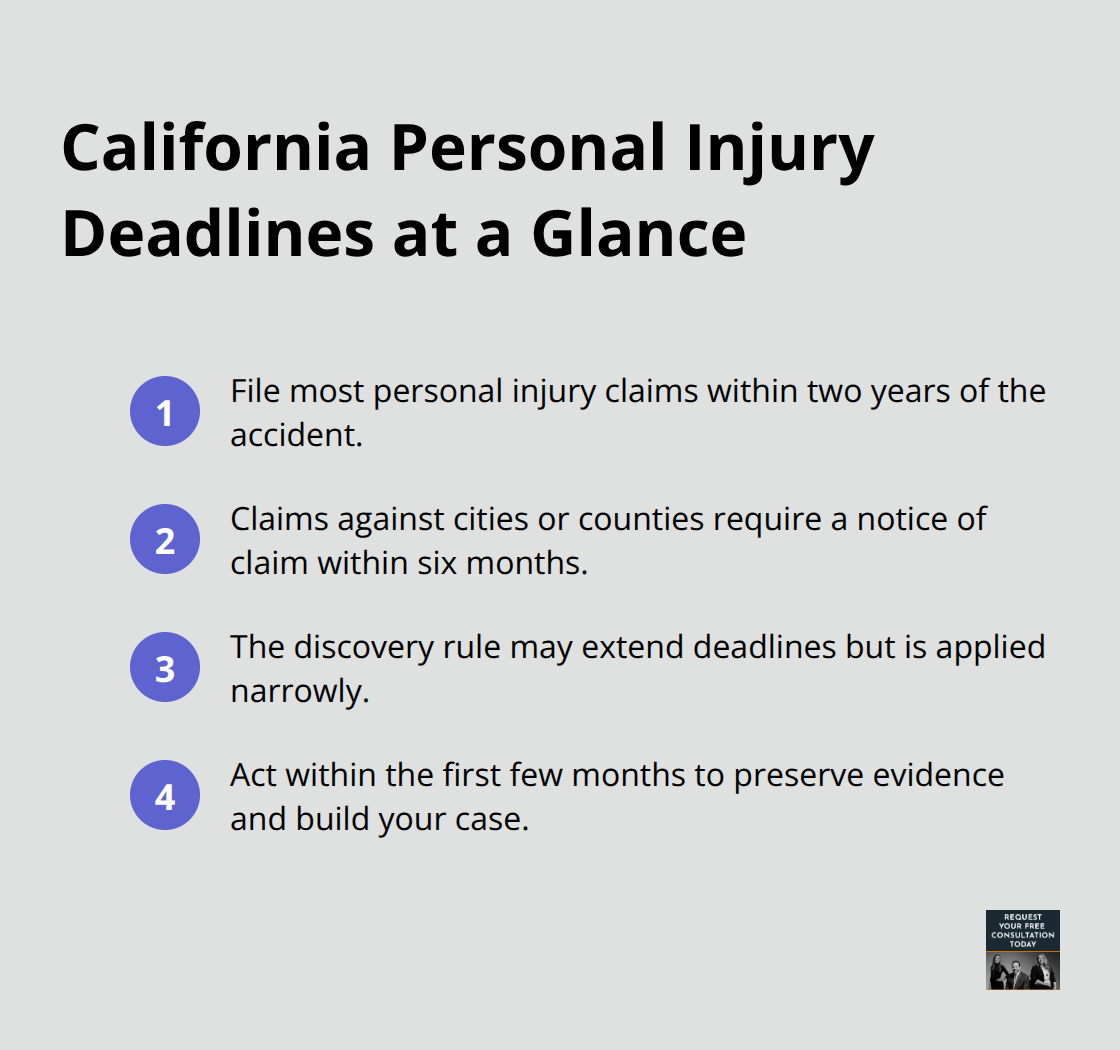
Acting within the first few months after your accident preserves evidence, secures witness statements while memories are fresh, and gives your legal team time to build a strong case.
Once the two-year deadline passes, California courts will dismiss your claim regardless of its merit. This reality makes early action non-negotiable.
Comparative Negligence: You Can Still Recover Even If You’re Partially at Fault
California’s comparative negligence rule allows you to recover compensation even if you were partially at fault for the accident. If you were 40 percent responsible and the defendant was 60 percent responsible, you recover 60 percent of your damages. However, if you’re found more than 50 percent at fault, you recover nothing. This rule fundamentally changes how insurance companies evaluate settlements and how you should present your case. The difference between a 49 percent fault finding and a 51 percent fault finding can mean hundreds of thousands of dollars in your pocket or nothing at all.
Economic and Non-Economic Damages: What You Can Actually Recover
Damages in California fall into two distinct categories. Economic damages cover medical expenses, lost wages, property damage, and costs for home or vehicle modifications. Non-economic damages address pain and suffering, emotional distress, loss of enjoyment of life, and loss of companionship. In wrongful death cases, surviving family members can pursue both a wrongful death claim for their own losses and a survival action for the deceased’s pre-death medical bills and suffering.
The National Spinal Cord Injury Statistical Center reports that lifetime costs exceed five million dollars for severe injuries, yet insurance companies routinely offer settlements far below actual long-term care needs. Building a credible damages claim requires comprehensive medical documentation, vocational assessments for lost earning capacity, and life care plans from qualified professionals who can testify about future medical costs and ongoing treatment. These professionals strengthen your position during settlement negotiations and at trial.
Why Evidence Collection Happens Now, Not Later
The strength of your damages claim depends entirely on documentation you gather in the weeks and months following your accident. Medical records must show the full scope of your injuries and treatment trajectory. Wage loss documentation requires pay stubs, tax returns, and employer statements confirming lost income and diminished earning capacity. Property damage appraisals need to reflect fair market value, not the insurance company’s lowball estimate. Life care plans from medical professionals project your future treatment costs with specificity that generic settlement offers cannot match.
Insurance adjusters know that victims without solid documentation accept lower offers. They count on incomplete medical records, missing witness statements, and vague injury descriptions to justify inadequate settlements. Your documentation strategy determines whether you recover fair compensation or accept what the insurance company wants to pay. The next section walks you through the concrete steps to take immediately after your accident to protect your rights and build the foundation for maximum recovery.
What to Do Right After Your Accident
Seek Medical Care First, Document Everything Second
Medical care comes first, evidence collection comes second, and everything else follows. Within hours of your accident, your priorities shift dramatically. Get to a hospital or urgent care facility immediately, even if you feel fine-adrenaline masks injuries that emerge days later. The emergency room visit creates the first official medical record linking your injuries directly to the accident, and this documentation becomes foundational to your entire claim. Photograph your injuries at the hospital and continue documenting them weekly for the first month; these images show progression that insurance adjusters cannot dismiss. Request copies of all medical records, imaging results, and physician notes before you leave the facility.
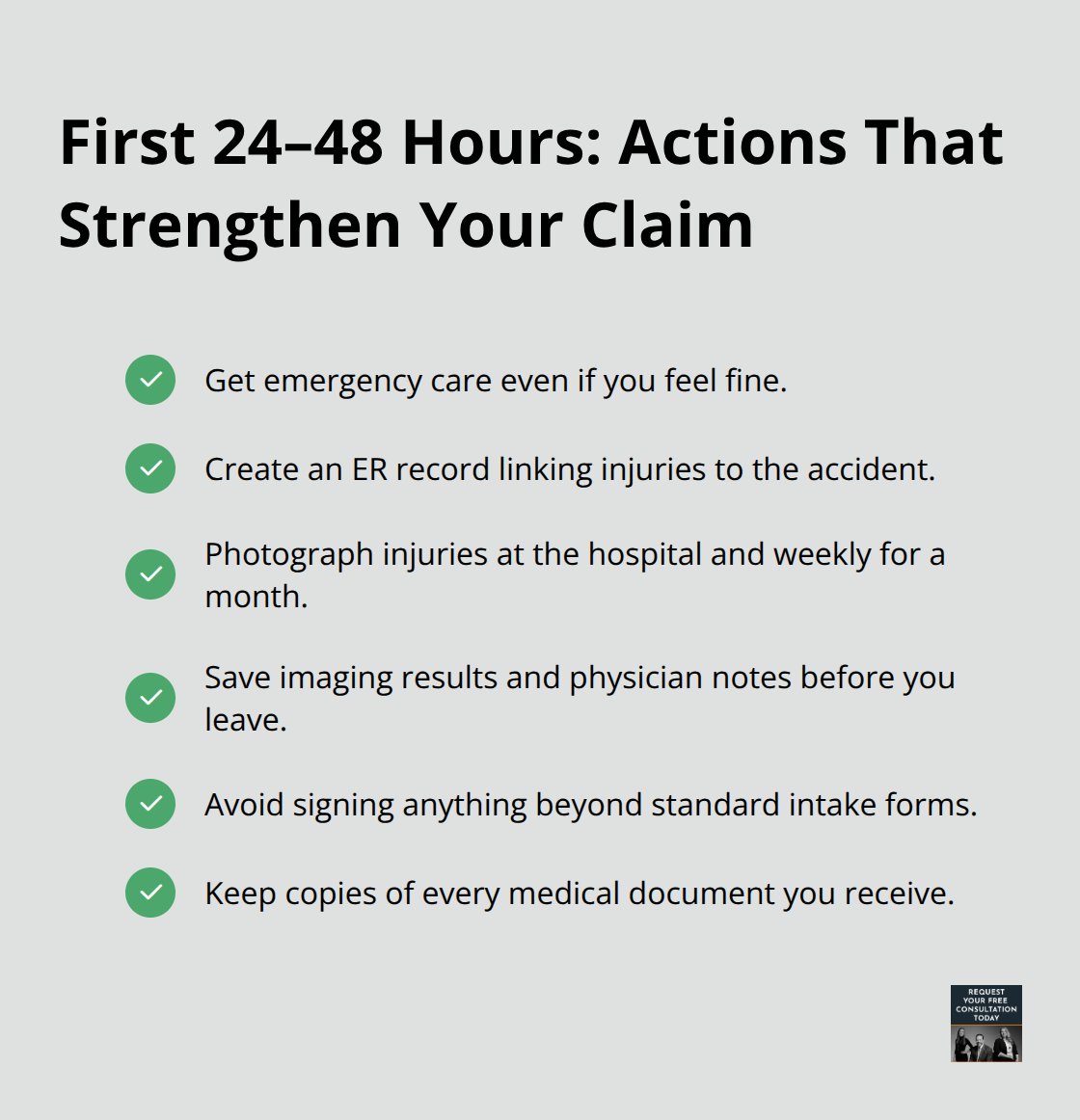
Do not sign anything the hospital presents except standard intake forms-insurance companies sometimes embed liability waivers in hospital paperwork.
Capture the Scene and Collect Witness Information
While still at the accident scene, photograph everything: vehicle damage from multiple angles, road conditions, traffic signals, street signs, debris, and skid marks. Capture wide shots showing the overall scene and close-ups revealing specific damage. Write down the exact time, weather conditions, and lighting. Collect names, phone numbers, and addresses from all witnesses-not just those who saw the accident, but anyone nearby who heard it or saw the immediate aftermath. Photograph the other driver’s license and insurance card rather than relying on handwritten information. If police responded, obtain the report number and officer’s name; you can request the full report later from the local police department.
Handle Insurance Communication Strategically
Do not admit fault or apologize for the accident, even if you believe you caused it-any statement you make becomes evidence in the insurance claim. Report the accident to your insurance company within 24 hours, but keep your statement factual and brief. Insurance adjusters will contact you within days; do not accept their first settlement offer, do not sign medical releases allowing them direct access to your providers, and do not provide recorded statements without consulting an attorney first. Adjusters use recorded statements to identify language you can be contradicted on later.
Build Your Damages Foundation Immediately
Within two weeks of your accident, contact an attorney with deep personal injury experience in your county. The two-year statute of limitations creates urgency, but the real deadline is now-evidence disappears, witnesses move away, and memories fade. An attorney preserves evidence through formal preservation letters to the defendant and their insurance company, preventing them from destroying dashcam footage, maintenance records, or other critical materials. Your attorney also begins calculating actual damages by gathering pay stubs, tax returns, and employer statements for lost wages, ordering medical records from all providers, and connecting you with life care planners who project your long-term treatment costs (these professionals strengthen your position during settlement negotiations and at trial). This foundation determines whether you settle for what the insurance company offers or hold out for fair compensation that reflects your actual losses.
Final Thoughts
A California personal injury claim demands immediate action and sustained focus. The two-year statute of limitations feels distant until it arrives, and by then, critical evidence has vanished. Insurance companies count on victims navigating this process alone, accepting settlements that fall short of actual damages.
We at Schaar & Silva LLP understand how insurance adjusters operate, what evidence strengthens your position, and how to calculate damages that reflect your actual losses. Our experience in personal injury law across Santa Cruz County, Sacramento, and Oakland means we connect you with medical professionals who project your long-term care costs, assist with property damage claims to ensure fair valuation, and help direct you to medical lien services that manage your bills until your case resolves. We also connect you with psychological support when emotional trauma from accidents requires professional care.
Moving forward with your claim starts with a free consultation at Schaar & Silva LLP to discuss your accident, understand your rights, and learn what fair compensation looks like for your specific injuries. The difference between settling quickly and pursuing full compensation often amounts to hundreds of thousands of dollars. Your case deserves that level of attention.
