

A commercial vehicle accident involves far more complexity than a typical car crash. Multiple insurance policies, federal regulations, and business-related damages create a legal landscape that demands a different approach.
At Schaar & Silva LLP, we’ve seen how standard auto accident strategies fall short in these cases. The stakes are higher, and the rules are different.
Who Pays When Multiple Vehicles and Companies Are Involved
Commercial vehicle accidents create a web of liability that personal car crashes simply don’t. When a truck owned by Company A, operated by Driver B, carrying cargo loaded by Company C, and maintained by Service Shop D collides with your vehicle, determining who pays becomes a legal maze. The federal government mandates minimum liability insurance of at least $750,000 for interstate trucking operations, and California enforces these same federal minimums, but this coverage often proves inadequate when serious injuries occur.
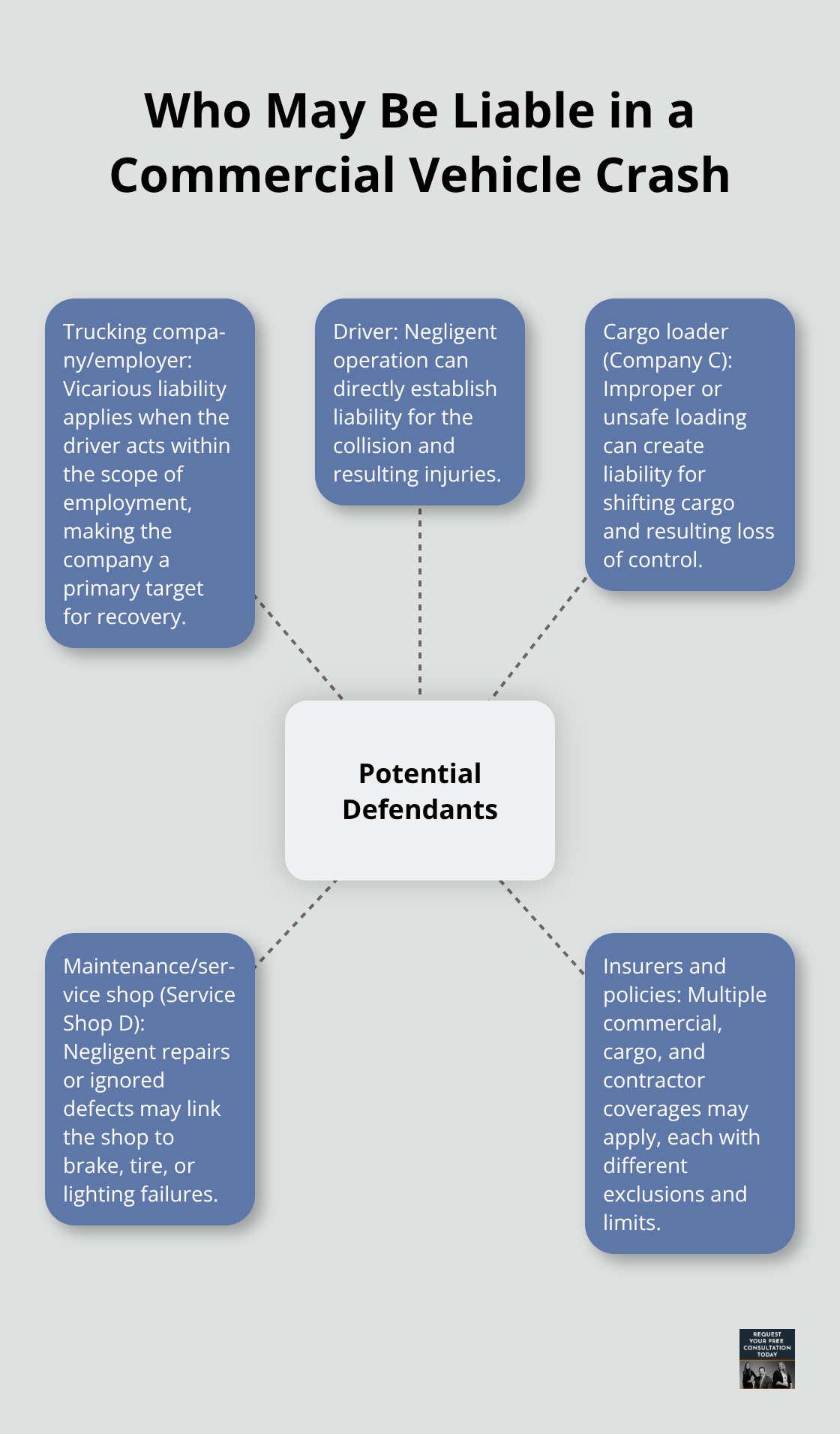
What makes commercial cases fundamentally different is that you’re not just pursuing the driver’s personal auto policy. You navigate multiple commercial policies, employer liability, cargo liability, and potentially third-party contractor coverage. The driver’s employer becomes liable under the doctrine of respondeat superior when the driver acts within the scope of employment, meaning the company’s deeper pockets become the real target. A delivery driver working for a logistics company clearly falls within the scope of employment. An independent contractor relationship complicates this analysis, but courts look beyond labels and examine actual control over work hours, tools, training, and scheduling to determine true employment status.
Insurance Coverage Gaps That Leave Victims Short
Commercial insurance policies contain exclusions and limits that differ sharply from personal auto coverage. A commercial vehicle policy might exclude coverage for certain types of cargo, mechanical failures, or driver negligence that falls outside specific parameters. California weight and size violations-including exceeding the 80,000-pound gross weight limit or violating the 55 mph speed restriction for trucks with three or more axles-trigger coverage disputes because insurers argue the driver’s violation of California Vehicle Code sections voids coverage or reduces their obligation.
Federal Hours of Service regulations cap driving at 11 hours after 10 hours off-duty within a 14-hour window, plus a mandatory 30-minute break after 8 hours, with a 70-hour limit over 8 days. When electronic logging device data shows a driver violated these rules, the insurer may claim the violation constitutes a material misrepresentation of risk. Meal and rest break requirements under California Labor Code section 512 mandate a 30-minute meal break every five hours and a 10-minute rest break every four hours.
How Fatigue Claims Become Denial Tactics
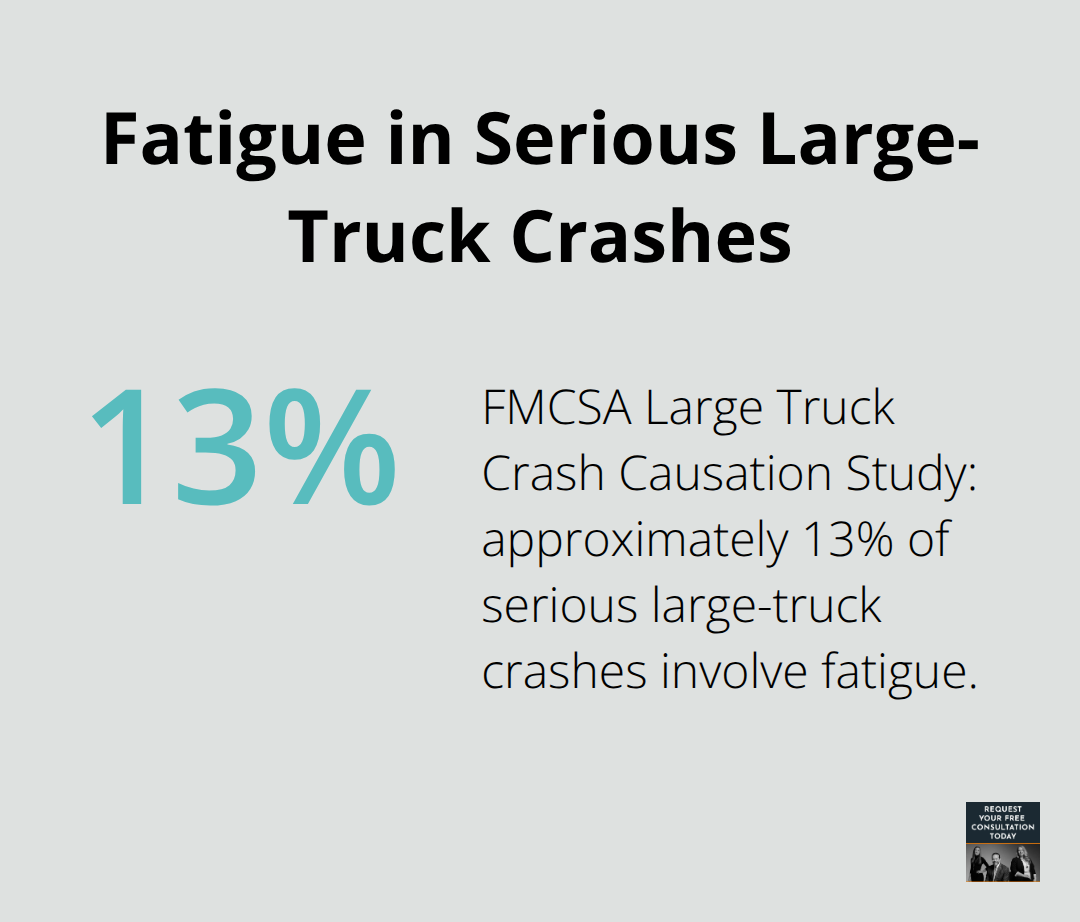
Fatigue-related crashes account for approximately 13 percent of serious large-truck crashes according to the FMCSA Large Truck Crash Causation Study. Insurers leverage this data to deny claims or reduce payouts when hours-of-service violations appear in the record.
Commercial insurers defend aggressively and often deny claims outright, making early legal action essential to preserve evidence before records are destroyed or overwritten. The investigation phase determines whether you recover full compensation or face a prolonged battle with multiple insurers.
How Much Money Can You Actually Recover After a Commercial Vehicle Crash
Commercial vehicle crashes generate compensation far beyond what typical car accidents produce. When a truck or commercial van collides with your vehicle, the damages extend into territory that personal injury cases rarely touch. Lost wages accumulate faster because commercial operations often involve higher-speed impacts and catastrophic injuries. California’s pure comparative negligence rule allows you to recover even if you’re partially at fault, with damages reduced only by your percentage of fault, not eliminated entirely. This matters tremendously in commercial cases where multiple parties share responsibility.
Why Commercial Insurance Limits Fall Short
The federal minimum liability insurance of $750,000 for interstate operations sounds substantial until medical bills exceed half a million dollars within the first year of treatment. Serious spinal injuries, traumatic brain damage, and permanent disability create lifetime care costs that settlement negotiations must address.
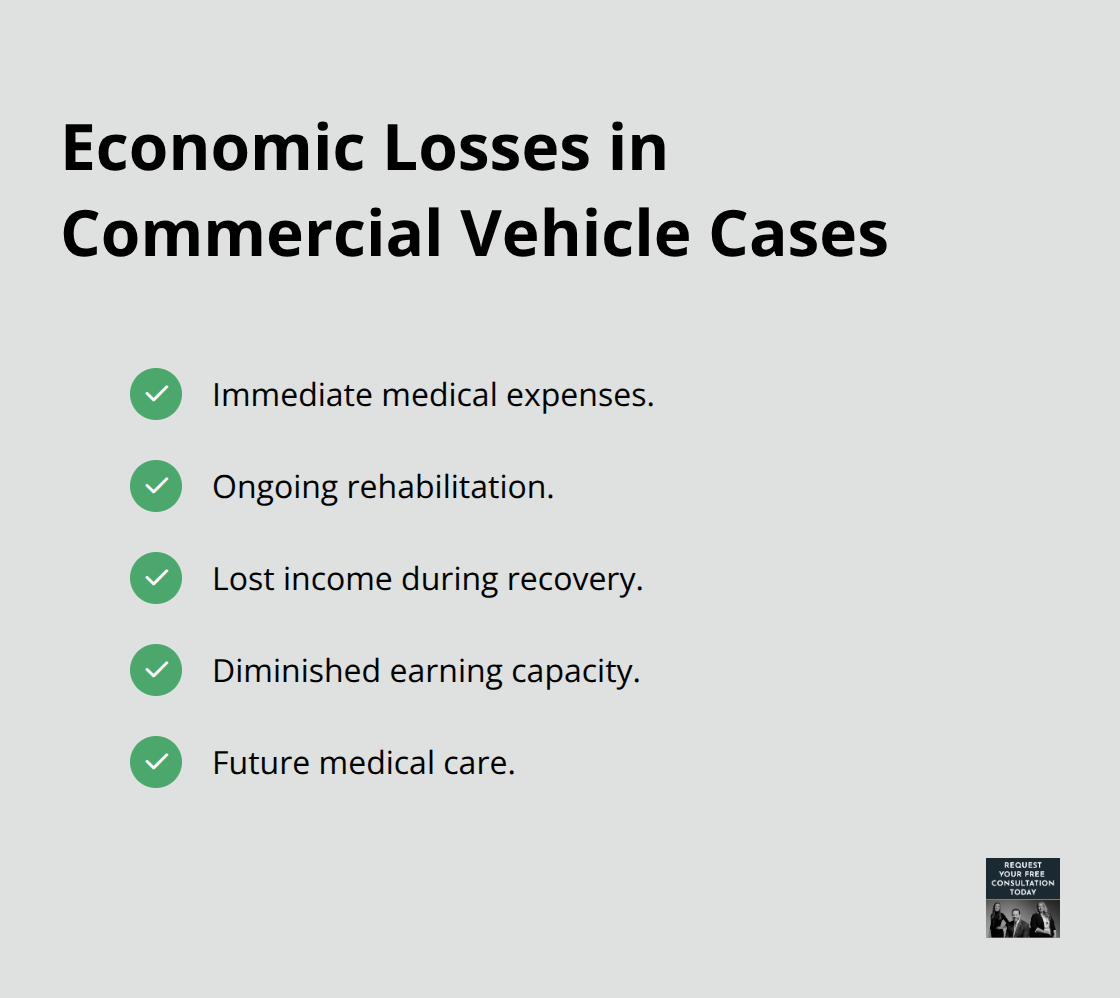
Economic losses in commercial vehicle cases include immediate medical expenses, ongoing rehabilitation, lost income during recovery, diminished earning capacity if you cannot return to your previous job, and future medical care.
A victim earning $60,000 annually who cannot work for six months faces $30,000 in lost wages before considering medical bills and property damage. If the injury prevents returning to that job, the loss calculation extends across decades of reduced earning potential. Courts recognize business interruption damages when the accident forces a victim to close a business or abandon self-employment.
Business Income and Lost Earning Potential
If you operated a small contracting business and the accident sidelined you for a year, you can pursue compensation for lost business income, not just personal wages. This distinction matters because business losses often exceed personal salary calculations. The accident transforms your financial recovery from a simple wage-loss calculation into a complex analysis of what your business would have earned during your absence.
When Recklessness Opens the Door to Punitive Damages
Punitive damages remain available under California law when a commercial driver or carrier’s conduct demonstrates reckless disregard for safety. A truck driver operating 16 hours straight in violation of federal hours-of-service regulations shows reckless behavior, not mere negligence. A carrier knowingly operating overweight trucks that exceed the 80,000-pound California limit and fail the Biennial Inspection of Terminals program demonstrates corporate recklessness.
However, punitive damages require clear and convincing evidence of intentional misconduct or gross negligence, a higher standard than ordinary negligence. You need solid documentation: electronic logging device records showing hours violations, maintenance records revealing ignored brake defects, drug and alcohol testing results from the FMCSA Clearinghouse, and weigh-station violation reports. The distinction between ordinary negligence and recklessness determines whether you recover compensatory damages alone or receive the additional punishment damages that punitive awards provide.
A driver momentarily distracted by a phone receives compensatory damages. A driver operating on stimulants to meet unrealistic delivery schedules, verified through FMCSA drug testing records, opens the door to punitive damages. The difference in total recovery can reach hundreds of thousands of dollars. These distinctions shape how investigators and attorneys approach evidence collection and liability strategy.
What Evidence Wins Commercial Vehicle Cases
Evidence in commercial vehicle accidents differs fundamentally from personal car crashes because regulatory violations and corporate records create a documentary trail that standard accidents lack. When investigating a commercial vehicle crash, the first priority is preserving electronic logging device data before it overwrites itself. Federal law requires all commercial trucks to use ELDs that automatically record hours of service, and this data typically cycles every 30 days. The FMCSA Large Truck Crash Causation Study found that fatigue contributes to approximately 13 percent of serious large-truck crashes, making hours violations central to establishing liability.
Electronic Logging Devices and Hours-of-Service Violations
If a driver’s ELD shows 16 consecutive hours of driving when federal regulations cap driving at 11 hours after 10 hours off-duty within a 14-hour window, that evidence alone can establish negligence. Maintenance records prove equally critical because they reveal whether a carrier ignored brake defects, tire problems, or lighting failures that contributed to the crash. California’s Biennial Inspection of Terminals program conducted by the California Highway Patrol inspects carrier terminals for brake, tire, and lighting compliance, and any failures appear in searchable records that demonstrate a pattern of neglect.
Drug Testing and Weigh-Station Records
Post-accident drug and alcohol testing results stored in the FMCSA Clearinghouse can be obtained through discovery and show whether stimulant use or impairment played a role. Weigh-station violation reports document whether the truck exceeded California’s 80,000-pound gross weight limit, a violation that affects vehicle stability and braking ability. Driver qualification files maintained by the carrier contain hiring records, training documentation, and prior violations that can establish inadequate supervision or negligent retention of an unsafe driver.
Event Data Recorders and Accident Reconstruction
Modern trucks contain event data recorders that capture speed, braking force, throttle position, and steering inputs in the seconds before impact, providing objective evidence of driver behavior that contradicts insurance company narratives. Police accident reports provide initial observations but represent only the officer’s perspective at the scene and should not be treated as the final determination of liability. California’s pure comparative negligence rule means that even if you share partial fault, you can recover damages reduced only by your percentage of responsibility, making thorough evidence collection essential to minimize your fault percentage.
Vehicle Code Violations and Citation Evidence
Vehicle code violations appearing in the police report strengthen your case when they directly caused the crash, but a ticket alone does not guarantee compensation without proving the violation actually caused the accident and your injuries. Conversely, the absence of a citation does not mean no wrongdoing occurred because officers may lack sufficient information at the scene to issue one. The distinction between a case supported by ELD data, maintenance records, and drug testing results versus one relying solely on witness statements determines whether you recover the full compensation you deserve or face a prolonged settlement negotiation where the carrier minimizes damages.
Final Thoughts
Commercial vehicle accident claims demand a fundamentally different legal approach than standard auto crashes because the stakes, regulations, and responsible parties multiply exponentially. A collision involving a truck or delivery van triggers federal compliance investigations, multiple insurance policies, corporate liability questions, and evidence preservation demands that personal car accidents never require. The federal minimum liability insurance of $750,000 for interstate operations often proves inadequate when serious injuries occur, leaving victims undercompensated unless their attorney aggressively pursues all available parties and damages.
Electronic logging device data, maintenance records, drug testing results, and weigh-station violation reports create a documentary foundation that determines whether you recover full compensation or face insurer denials. California’s pure comparative negligence rule allows recovery even when you share partial fault, but only if your attorney preserves evidence before records disappear or get overwritten. A commercial vehicle accident investigation that begins weeks after the crash loses critical data and leverage against carriers who aggressively defend their interests.
If you’ve been injured in a commercial vehicle accident in Santa Cruz County, Sacramento, or Oakland, the window for evidence preservation closes quickly. We at Schaar & Silva LLP understand the regulatory landscape, insurance tactics, and liability theories that govern these cases. Contact us to discuss your case and protect your right to full compensation.
