
After a car, truck, or pedestrian accident, medical documentation injury claims often fail because records are incomplete or scattered across different providers. Insurance companies exploit these gaps to deny or reduce payouts, leaving you with less compensation than you deserve.
We at Schaar & Silva LLP have seen countless cases where missing medical records cost our clients thousands of dollars. This blog post shows you exactly how to build a complete medical record that protects your claim from the start.
What Happens When Medical Records Fall Apart
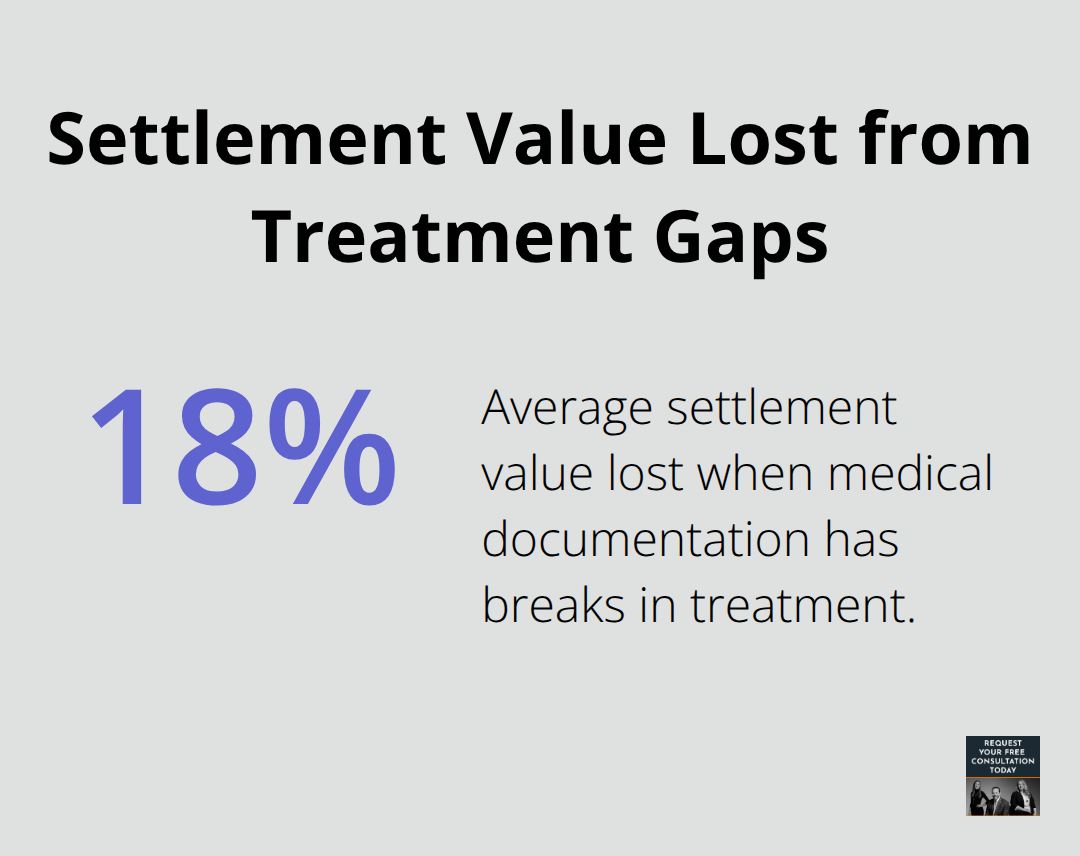
Incomplete medical records hand insurance adjusters a roadmap to deny your claim. When treatment information scatters across providers or goes missing entirely, adjusters exploit those gaps as evidence that your injuries were either minor or unrelated to the accident. Documented cases show that clients lost 18% or more of their settlement value simply because their medical documentation had breaks in treatment. One client suffered a back injury but waited three weeks before seeing a physical therapist; the insurance company used that delay to argue the injury wasn’t serious. Another case involved a patient who switched doctors midway through treatment, leaving no continuity notes-the adjuster claimed the original provider never confirmed ongoing pain.
These aren’t edge cases; they’re patterns that repeat across claims. Insurance companies train adjusters to spot these disconnects and use them as leverage. A missing imaging report, a gap between emergency room discharge and follow-up care, or incomplete prescription records all signal to the adjuster that your claim lacks credibility. The longer the gaps in your treatment timeline, the weaker your position becomes.
Settlement delays multiply when records are incomplete
Adjusters request missing records repeatedly, stretching settlements from months into years. Each request adds delays because providers take 15 to 30 days to respond under California law. If you’re missing records from three providers, you’re looking at 45 to 90 days just waiting for documents. During this time, statutes of limitations tick forward-California gives you two years from your injury date to file a claim, and incomplete documentation forces you to spend that time chasing paperwork instead of building your case. Settlements also shrink when records arrive late because adjusters become skeptical of retroactive documentation. They wonder why treatment notes appear months after the injury. Additionally, if your case reaches trial, incomplete records weaken your testimony because you cannot point to objective medical findings that support your account. The defendant’s attorney will highlight every missing document as proof that your injuries were exaggerated or fabricated.
Proving injury severity without complete documentation becomes nearly impossible
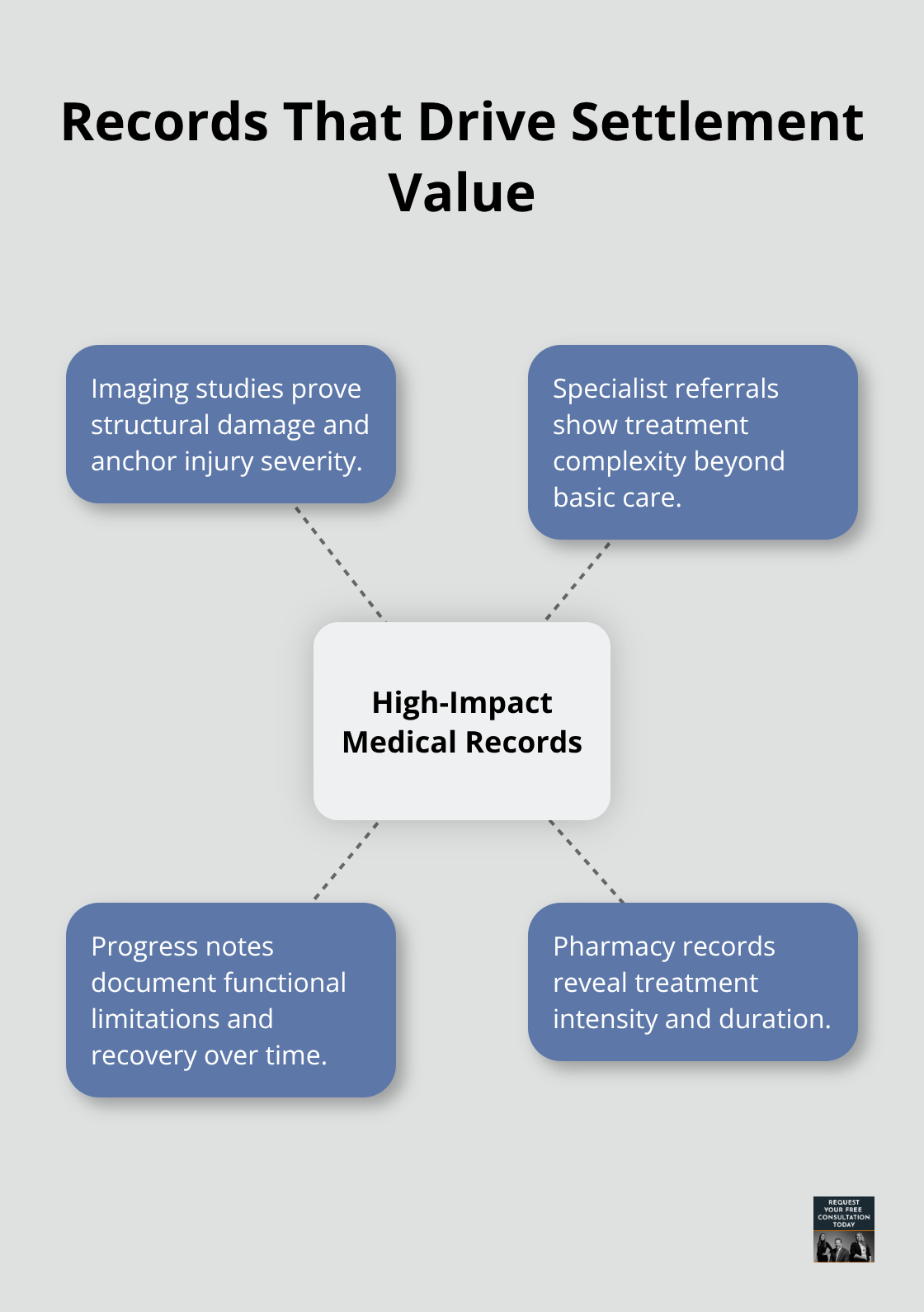
Non-economic damages like pain, suffering, and permanent disability require medical records that show how the injury changed your daily life. Imaging results prove structural damage. Specialist notes document limitations in movement or cognitive function. Physical therapy progress notes show whether you improved or plateaued. Pharmacy records reveal the medications you needed and for how long. Without these documents, you’re asking a judge or jury to accept your word against an insurance company’s data. Medical records are objective proof; your testimony alone is not. Courts and adjusters weight objective evidence far more heavily than personal accounts. This is why building a complete record from your first medical visit matters so much-it establishes the foundation that protects your claim before gaps can form.
How to Organize Your Medical Records Right After an Accident
Start collecting records within 48 hours
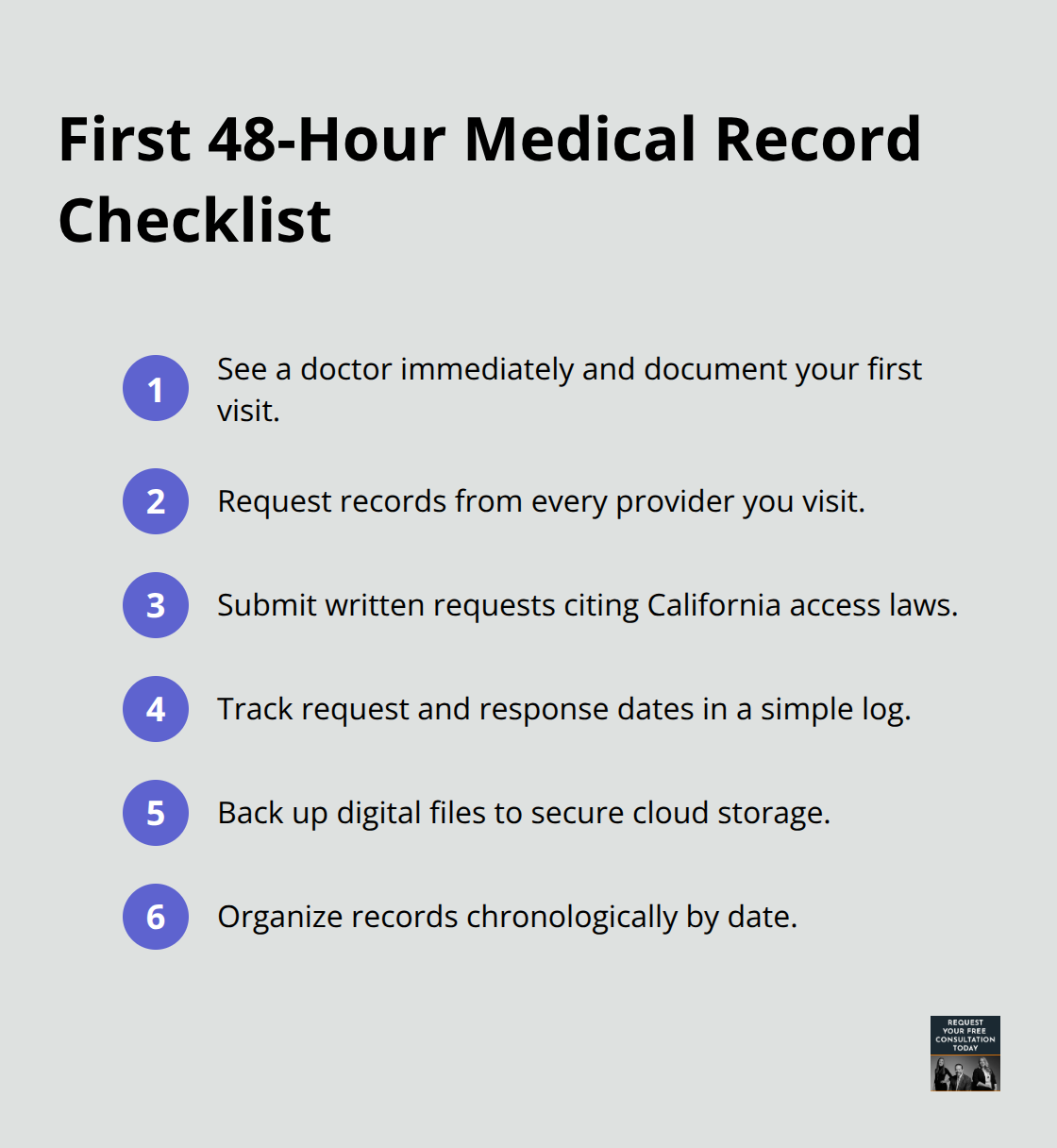
Collect medical records within 48 hours of your accident. This timing matters because treatment timelines form the backbone of your claim, and delays between the accident and your first medical visit signal to insurers that your injuries were minor. Request records from every provider you see, including emergency rooms, primary care doctors, orthopedists, neurologists, physical therapists, and mental health professionals. Under California’s Patient Access to Health Records Act, providers must respond to written requests within five business days and deliver copies within 15 days. Copy fees cap at 25 cents per page for standard copies, plus reasonable clerical fees for locating and producing records.
Create a detailed tracking system
Create a personal folder-physical or digital-that logs every provider’s name, treatment dates, and the dates you requested records. Track when each provider responds and what documents arrive. This log becomes evidence that you acted diligently if your case reaches trial. Back up all digital files to cloud storage immediately; device failure or loss could destroy months of documentation. Organize records chronologically by date, not by provider, so you can see the complete timeline of your recovery.
Gather all types of medical documentation
Include imaging results like CT scans or MRIs, surgical notes, specialist referrals, pharmacy records showing medications and dosages, and progress notes documenting changes in your symptoms and limitations. Each document serves a specific purpose: imaging proves structural damage, progress notes show whether you improved or stalled, pharmacy records reveal treatment intensity, and specialist referrals establish that your injuries required professional attention beyond basic care.
Maintain uninterrupted treatment and document expenses
Maintain uninterrupted medical treatment because gaps weaken your claim significantly. Documented cases show that clients with treatment breaks lose an average of 18% of their settlement value. If you must pause treatment due to financial constraints, communicate this to your doctor and request that they document the reason in your medical record. Include records of lost wages, out-of-pocket expenses for medications or medical equipment, and transportation costs to appointments. Ask your employer for written confirmation of missed work days and lost income. Request itemized medical bills from each provider showing the date of service, treatment provided, and amount charged. These documents quantify economic damages and prevent insurers from undervaluing your claim.
Request objective medical findings
For physical therapy, ask your therapist to document specific functional improvements or plateaus in detailed progress notes-not just exercise lists. For mental health treatment related to accident trauma, ensure your provider documents how the injury affected your emotional state and daily functioning. Request that all providers include objective findings in their notes: range-of-motion measurements, strength tests, cognitive assessments, or imaging interpretations. Objective findings carry far more weight than subjective complaints because they cannot be disputed. If a provider resists providing complete notes or charges excessive fees, escalate to their privacy or compliance officer. Federal law protects your right to access your records, and most providers comply once you follow the formal process. Keep all originals and make backup copies for your attorney and your personal records.
With your medical documentation organized and complete, the next step involves understanding how insurance companies evaluate your claim and what additional evidence strengthens your position against their tactics.
How We Help You Gather and Use Your Medical Records
When you hire an attorney to handle your accident claim, one of the first tasks involves reviewing every medical record you’ve collected to identify gaps that insurers will exploit. At Schaar & Silva LLP, we request records directly from all your providers using formal HIPAA release forms, which often speeds up responses beyond the standard 15-day California timeline. Providers respond faster to attorney requests because they understand legal liability for delays. We cross-reference your records against the police report and accident scene documentation to spot inconsistencies or missing treatment dates. If your records show a three-week gap between your accident and your first medical visit, we request written explanation from your doctor about why you delayed care and include that in your file. This proactive documentation prevents insurers from claiming you exaggerated your injuries.
Identifying records that carry the most weight
We identify which records carry the most weight in settlement negotiations: imaging studies like CT scans or MRIs prove structural damage, specialist referrals show treatment complexity, and progress notes document functional limitations over time. We organize these documents chronologically with annotations that explain how each piece supports your damages claim, making it impossible for adjusters to dismiss your case as incomplete. Each document serves a specific purpose in your claim (imaging proves structural damage, progress notes show whether you improved or stalled, pharmacy records reveal treatment intensity).
Medical lien services remove financial barriers to treatment
Many accident victims cannot afford ongoing medical treatment while waiting for settlement, which forces them to stop care and creates the exact documentation gaps that weaken claims. We connect you with medical lien providers who agree to defer payment until your case resolves, allowing you to continue uninterrupted treatment without paying out of pocket. This means you maintain the continuous treatment timeline that insurance companies use to calculate fair compensation. Medical lien providers typically receive payment directly from your settlement, so you avoid upfront costs while building stronger documentation. We handle all communication between you, your providers, and lien companies, preventing confusion or missed deadlines. We also ensure that lien amounts remain reasonable and do not inflate your medical bills beyond what providers actually charged.
Complete records accelerate settlement negotiations
Once your medical documentation is complete and organized, we present it to insurance adjusters as evidence of your injury severity and treatment necessity. Adjusters process hundreds of claims monthly and respond faster to organized, comprehensive files than to scattered documents. When we submit a file showing unbroken treatment from the emergency room through specialist care and physical therapy, with imaging results, pharmacy records, and progress notes all cross-referenced to your accident date, adjusters recognize that your claim is well-supported and difficult to challenge in court. This typically accelerates settlement offers because insurers know that incomplete claims are easier to deny, but complete claims require actual negotiation. We also use your medical records to calculate both economic damages like medical expenses and lost wages, and non-economic damages like pain, suffering, and permanent disability. Courts in California allow non-economic damages alongside economic ones, and complete medical records provide the foundation for arguing higher values in both categories.
Final Thoughts
Complete medical documentation forms the backbone of your accident claim, and insurance adjusters will exploit any gaps to reduce your payout. The cases we’ve handled at Schaar & Silva LLP show that clients with fragmented records lose thousands compared to those with organized, comprehensive files. Your medical records prove your injuries are real, that treatment was necessary, and that you deserve full compensation for your losses.
Start requesting records within 48 hours of your accident, create a tracking system for every provider, and maintain uninterrupted treatment even if medical lien services help cover costs. Back up all files to cloud storage, organize records chronologically, and include imaging results, specialist referrals, pharmacy records, and progress notes that demonstrate how your injury affected your daily life. This foundation prevents adjusters from claiming your injuries were minor or unrelated to the accident.
We at Schaar & Silva LLP handle the heavy lifting once you’re ready to move forward. We request records directly from your providers, identify which documents carry the most weight in negotiations, connect you with medical lien services if treatment costs strain your finances, and present your complete file to insurance adjusters in a format that accelerates settlement offers. Contact us today to protect your case and ensure your medical documentation works in your favor.
