

A truck accident can turn your life upside down in seconds. Medical bills pile up, your vehicle needs repairs, and insurance companies start calling-often with offers that don’t reflect what you’ve actually lost.
We at Schaar & Silva LLP have guided hundreds of people through the truck claim process in Santa Cruz County, Sacramento, and Oakland. This guide walks you through each stage, from protecting your rights at the scene to negotiating a settlement that covers your real damages.
What to Do Right After a Truck Accident
Move to Safety and Call for Help
The first hour after a truck accident is when most people make costly mistakes. You’re shaken, possibly injured, and the truck driver or their company may already be documenting the scene in ways that protect their interests, not yours. The California Highway Patrol responds to roughly 8,000 injury collisions annually across the state, and in many cases, the evidence collected at the scene determines whether you recover fairly or get lowballed by insurance adjusters. Start by moving to safety if possible. Call 911 immediately if anyone is injured or if property damage appears to exceed $750, since California law requires you to report accidents meeting these thresholds to the DMV within 10 days or risk license suspension.
Provide Information to Police Without Admitting Fault
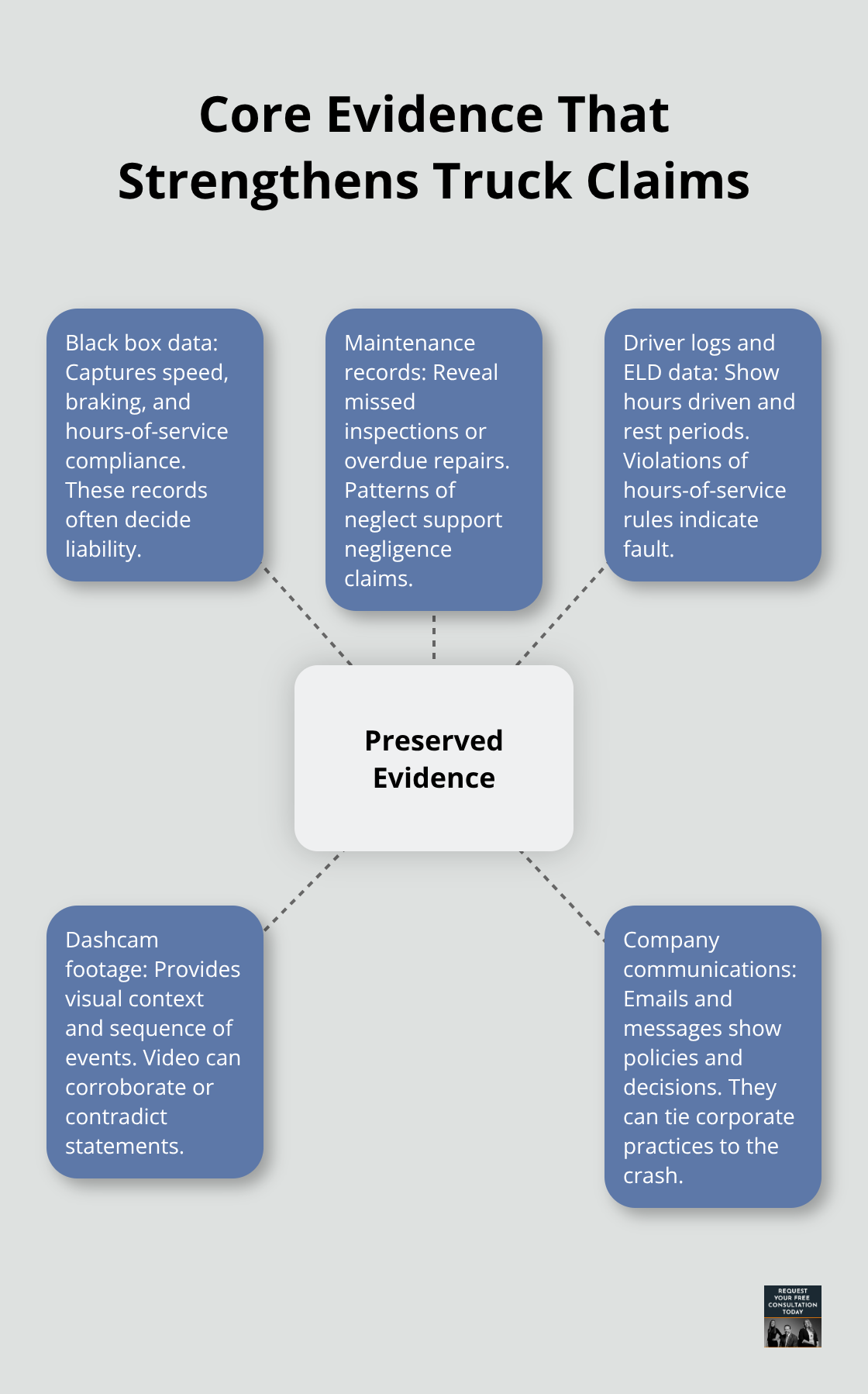
Once emergency responders arrive, provide factual information to police but avoid admitting fault or speculating about what happened. Get the police report number before leaving the scene. The truck driver’s company will launch their own investigation immediately, reviewing logbooks, electronic logging devices, maintenance records, and dashcam footage. Federal rules limit truck drivers to 11 hours of driving in a 14-hour workday and require 10 consecutive hours off between shifts. If the truck driver violated these hours-of-service rules, that’s powerful evidence of negligence. The truck’s black box records speed, braking patterns, and hours-of-service compliance, and this data often proves the case.
Document Everything at the Scene
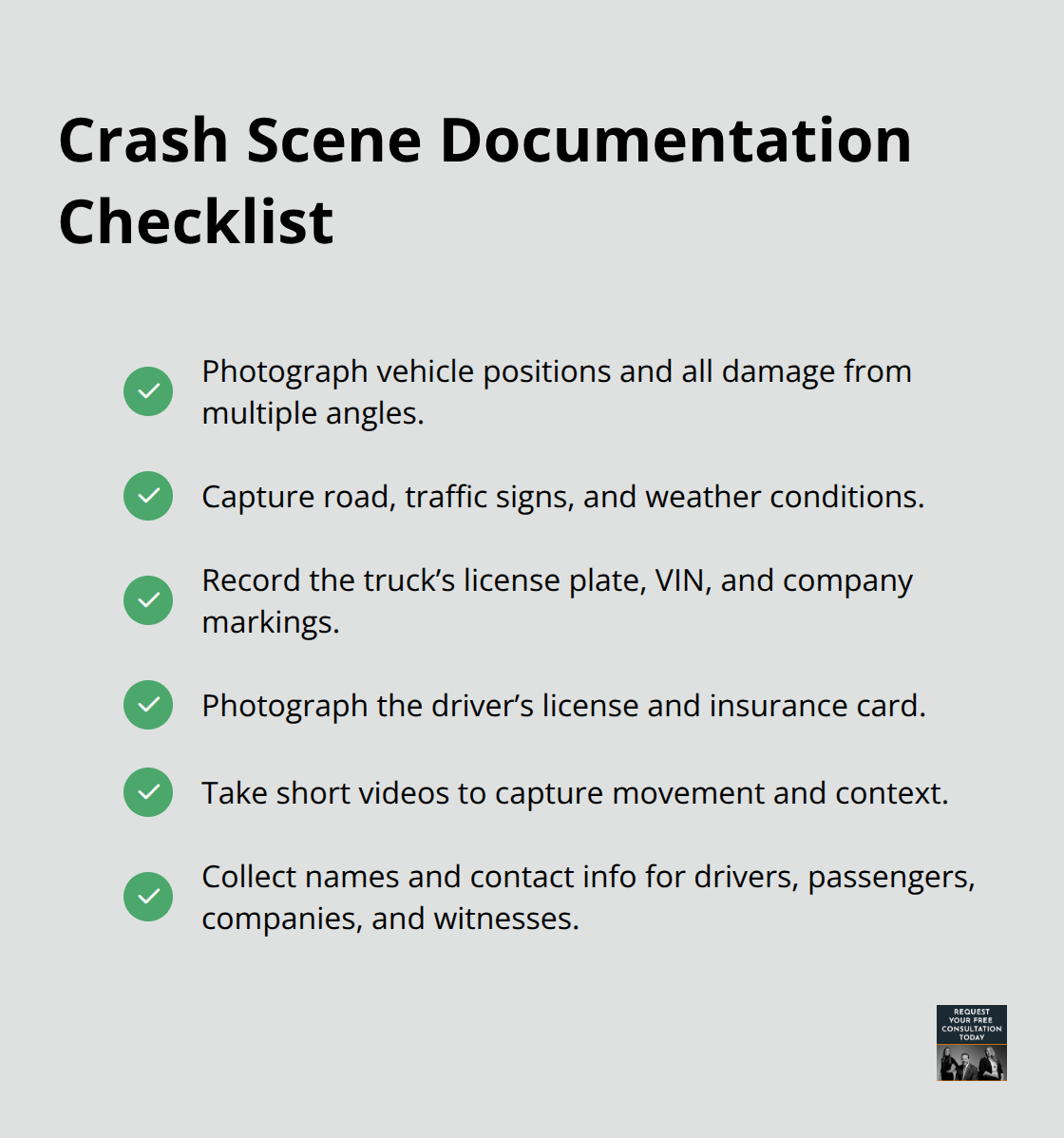
Photograph everything: the truck’s position, all vehicle damage from multiple angles, the surrounding road conditions, traffic signs, and weather conditions. Capture the truck’s license plate, VIN, and any visible company markings. Photograph the driver’s license and insurance card. Take videos of the scene if possible, as video footage captures details photos miss. Gather names, phone numbers, and addresses from the truck driver, any passengers, the truck company, and all witnesses.
Ask witnesses for their account of what happened and record it on your phone if they consent.
Report the Accident Accurately to Your Insurance Company
When you report the accident to your insurance company, stick to facts only. Say what happened, where it happened, and when. Do not speculate about fault or injuries. Insurance adjusters will contact you within 15 days, sometimes longer, and their job is to minimize what they pay. Do not accept their first offer or sign anything without understanding what you’re giving up. Request copies of the police report, your medical records, repair estimates, and all communications with insurance. Keep a detailed log of your injuries, medical appointments, lost wages, and expenses. Insurance adjusters use gaps in documentation to argue your damages are lower than they actually are.
Preserve Critical Evidence Early
If you hire legal representation early, an attorney can send a preservation letter to the trucking company, requiring them to keep all evidence intact. This step matters because trucking companies sometimes destroy or lose critical data. The evidence you preserve now-black box data, maintenance records, driver logs, and communications-becomes the foundation for your claim and determines what you ultimately recover.
What Your Claim Actually Covers
Economic and Non-Economic Damages
Your truck accident claim covers two categories of damages: economic and non-economic. Economic damages are straightforward-medical bills, lost wages, vehicle repairs, and rental car costs while your vehicle is being fixed. Non-economic damages are harder to quantify but often worth more: pain and suffering, permanent scarring or disfigurement, loss of enjoyment of life, and diminished earning capacity if your injuries prevent you from working at your previous level. In California’s pure comparative negligence system, you can recover damages even if you’re partially at fault, though your recovery gets reduced by your percentage of fault.
How Insurance Adjusters Minimize Your Payout
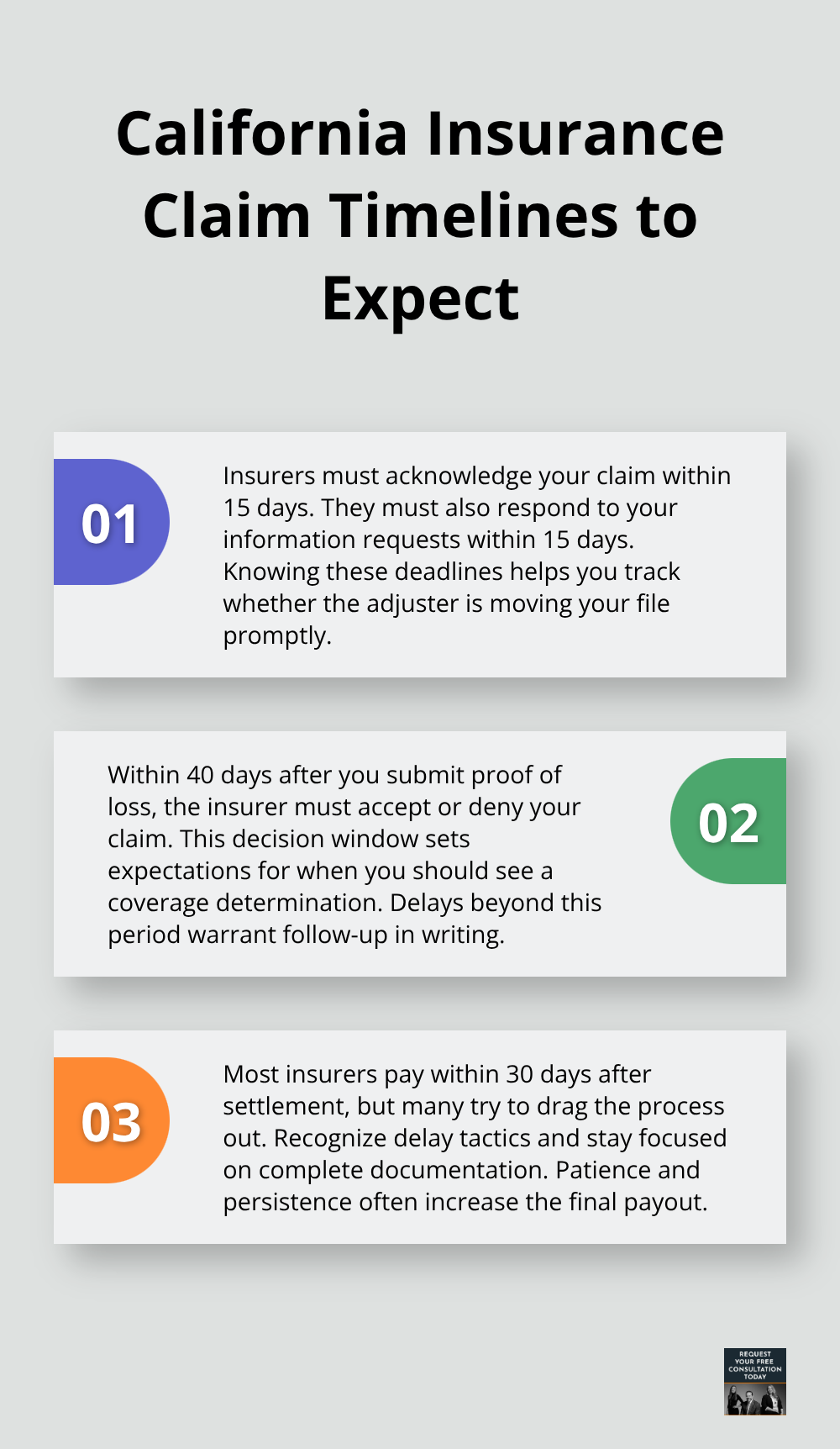
Insurance adjusters know the comparative negligence rules and will aggressively argue you bear some responsibility to shrink their payout. The California Department of Insurance requires insurers to acknowledge your claim within 15 days, respond to requests within 15 days, and accept or deny your claim within 40 days after you submit proof of loss. Most insurers pay within 30 days after settlement, but many drag out the process hoping you’ll accept less.
Documentation That Protects Your Recovery
You must document every expense: medical appointments, prescriptions, physical therapy sessions, travel costs to medical providers, and any wages lost due to your injuries or medical treatment. Insurance adjusters will scrutinize gaps in your documentation and use them to argue your damages are inflated. Keep receipts, medical records, pay stubs showing lost income, and written statements from your employer confirming time missed. These records form the foundation of what you ultimately recover.
How Adjusters Evaluate Vehicle and Injury Damages
Adjusters evaluate your claim differently depending on the type of damage. For vehicle damage, they send a qualified adjuster to inspect your truck and determine whether to pay the repair cost or the vehicle’s actual cash value, whichever is less. Actual cash value means what a knowledgeable buyer would pay for your vehicle in its current condition-not what you paid for it or what you owe on a loan. If the repair shop finds additional damage during repairs that wasn’t visible in the initial inspection, the insurer must approve the extra costs.
For injury claims, adjusters use medical records, treatment providers’ opinions, and comparable settlements to calculate pain and suffering. They multiply your medical expenses by a factor of 1.5 to 5, depending on injury severity, though this multiplier is just a starting point-not a ceiling. A serious spinal cord injury or traumatic brain injury justifies damages far exceeding these multipliers.
Resolving Valuation Disputes
If you disagree with the insurer’s valuation, you can invoke an appraisal provision where each side selects an appraiser, they choose an umpire, and a binding amount is agreed if the appraisers can’t reach a joint figure. The timeline from accident to resolution typically spans three to twelve months for straightforward claims, but catastrophic injuries or disputed liability can extend well beyond that. Understanding how adjusters calculate damages and what documentation supports your claim positions you to negotiate from strength rather than accept whatever offer arrives first.
Settling Your Claim for What You Actually Deserve
The First Offer Is Never the Final Number
The first settlement offer from an insurance company sits well below what they will ultimately pay. Adjusters open low because most people accept immediately out of desperation, medical debt, or exhaustion. The California Department of Insurance found that claimants who wait and negotiate recover substantially more than those who sign quickly. Your job is to understand what your claim truly warrants, recognize when an offer falls short, and know exactly when to hold firm versus when to accept. Most truck accident claims take three to twelve months to resolve, and rushing that timeline costs you money.
An adjuster will contact you with a settlement offer once they review your medical records, repair estimates, and documentation. That first number typically sits 30 to 50 percent below what the claim actually warrants, especially in cases involving serious injuries like spinal cord damage or traumatic brain injury. You have no obligation to respond immediately.
Request Written Justification and Counter with Evidence
Request the adjuster’s settlement calculation in writing, showing how they arrived at their figure for medical expenses, lost wages, pain and suffering, and any other damages. Compare their numbers to your actual expenses and the multipliers they used for pain and suffering. If they multiplied your medical bills by 1.5 when your injury severity justifies a 4 or 5 multiplier, their offer is inadequate.
Document why their valuation is wrong, gather additional medical opinions if needed, and respond in writing with a counter-offer that reflects your actual damages. Include copies of receipts, medical records, wage loss documentation, and any expert opinions supporting your position. Insurance companies count on you not knowing that you can invoke an appraisal provision if valuations conflict.
Use Appraisal to Force Fair Evaluation
Under California law, when you and the insurer cannot agree on the value of property damage or the extent of your losses, each side selects an appraiser, those two appraisers choose an umpire, and if the appraisers cannot reach agreement, the umpire’s decision becomes binding. This process removes emotion and forces a neutral third party to evaluate the evidence. Threatening to invoke appraisal often motivates adjusters to improve their offers because they know the process is expensive and unpredictable from their perspective.
Shift the Dynamic with Legal Representation
In cases involving serious injuries, comparative negligence arguments, or disputes over liability, hiring legal representation shifts the entire dynamic. Insurance companies negotiate differently when they know an attorney is involved because they understand that litigation costs them far more than a fair settlement. We at Schaar & Silva LLP handle the full negotiation process, from demanding the adjuster’s written valuation to filing suit if settlement talks stall.
Our team obtains black box data, maintenance records, driver logs, and expert testimony that proves negligence and quantifies your damages precisely. Adjusters know that a lawyer will uncover violations of federal hours-of-service rules, unsafe company policies, or inadequate driver training that dramatically increase liability. They also know we will present catastrophic injury claims with the full weight of medical evidence and economic projections that justify six or seven figure settlements. The difference between settling alone and settling with representation typically ranges from tens of thousands to hundreds of thousands of dollars in your favor.
Final Thoughts
The truck claim process demands your attention at every stage, from the accident scene through settlement. You now understand what happens immediately after impact, how insurance adjusters calculate damages, and why your first offer will fall short of what you actually deserve. Insurance companies negotiate harder when they know an attorney will uncover hours-of-service violations, maintenance failures, or unsafe company policies that prove negligence.
Many people settle their truck accident claims alone and later discover they accepted 40 to 60 percent less than they should have. The difference between handling this yourself and working with legal representation often reaches tens of thousands of dollars, sometimes far more. We at Schaar & Silva LLP serve Santa Cruz County, Sacramento, and Oakland with experience handling truck accident claims, obtaining black box data, driver logs, and expert testimony that proves liability and quantifies your damages precisely.
Your recovery matters more than speed. Contact Schaar & Silva LLP for a confidential consultation about your truck accident claim, and we handle the legal complexities so you can focus on healing.
