

The moments after a car accident are chaotic. Your priority should be gathering the right information at the scene and understanding what goes into your official accident report.
We at Schaar & Silva LLP know that many people miss critical details or file reports too late, which weakens their claims. This guide walks you through exactly what to document, what to include in your report, and the California deadlines you need to meet.
What Information You Must Collect at the Accident Scene
Exchange Driver and Vehicle Details
At the accident scene, you have a narrow window to gather information that will shape your entire claim. Exchange driver’s license numbers, vehicle license plate numbers, names, addresses, and phone numbers with all drivers involved. Obtain your insurance company name and policy number from every party as well. If passengers were present, record their full names, addresses, and phone numbers too. This exchange takes five minutes but prevents hours of frustration later when your insurance company or attorney needs to contact the other driver. Don’t rely on memory or verbal promises to exchange information later-write it down on your phone or notebook right then.

Photograph Damage and Scene Conditions
Photograph everything before anyone leaves the scene. Take pictures of vehicle damage from multiple angles, the accident location from several perspectives, road signs and traffic signals, skid marks or debris on the pavement, and weather conditions if relevant. Use your phone’s timestamp feature so photos have date and time recorded automatically. Photographs taken within minutes of an accident carry far more weight than descriptions written days later.
Weather conditions matter significantly-if it was raining, foggy, or icy, document that visually. Road conditions like potholes, debris, or poor visibility also belong in your photos (these details often influence liability determinations).
Record Time, Location, and Witness Information
Note the exact time, date, and location of the accident on your phone or paper immediately. Include street names, intersections, or landmarks so there’s no confusion later. If witnesses were present, obtain their full contact information and a brief summary of what they saw. Their statements often become critical if fault is disputed (especially in cases involving serious injuries or wrongful death).
Don’t wait for police to arrive and collect this information for you-you collect it yourself first. The details you gather at the scene form the foundation for your official accident report, which you’ll file with your insurance company and potentially with California authorities.
Building Your Accident Report with the Right Details
Your official accident report is the document that insurers, attorneys, and potentially courts will reference when determining liability and damages. Unlike the quick notes you jotted down at the scene, your formal report must be organized, thorough, and accurate.

Start with Personal and Vehicle Information
Include your full legal name, driver’s license number, address, phone number, and email in your report. Add your vehicle’s make, model, year, VIN, license plate number, and insurance company with your policy number. The other driver’s information goes here as well. This section forms the foundation that ties the accident to you and your vehicle.
Document Every Injury and Medical Treatment
If you were injured, list every injury by location and type, even minor ones like neck stiffness or headaches that appeared hours after the crash. The Judicial Council of California notes that you have two years to file a personal injury lawsuit after a car accident, but waiting too long to document injuries weakens your position because memory fades and medical records become harder to organize.
Medical treatment details matter tremendously for your claim’s value. Document every medical visit, treatment type, provider name, and dates. Include emergency room care, physical therapy, chiropractic treatment, or mental health counseling. Insurance companies and attorneys need this information to assess damages accurately. For cases involving serious injuries or wrongful death, these details become even more critical because they establish the accident’s severity and your losses.
Describe the Accident Sequence and Conditions
Describe the accident sequence chronologically: what you were doing before impact, the moment of collision, and what happened immediately after. Include road conditions like rain, fog, or debris; traffic signal status; vehicle speeds if known; and any evasive actions you took. Be factual and avoid admitting fault, but state what happened clearly. If the other driver ran a red light or was speeding, say so with supporting details.
Include Property Damage Details and Repair Estimates
Property damage should be described specifically: broken windows, crushed bumpers, frame damage, or mechanical issues that arose post-accident. If you obtained repair estimates, attach them to your report. This documentation supports your claim for vehicle restoration costs.
File Your Report Promptly and Keep Copies
File your report with your insurance company within 24 to 48 hours whenever possible (most insurers require notification within a specific window, often stated in your policy). Delays can result in claim denials. Keep copies of everything you file for your records and provide them to your attorney if you decide to pursue legal action. When injuries are significant or liability is unclear, organizing this documentation properly makes the difference between a strong claim and a weakened one.
When to File and What California Requires
Insurance Company Deadlines
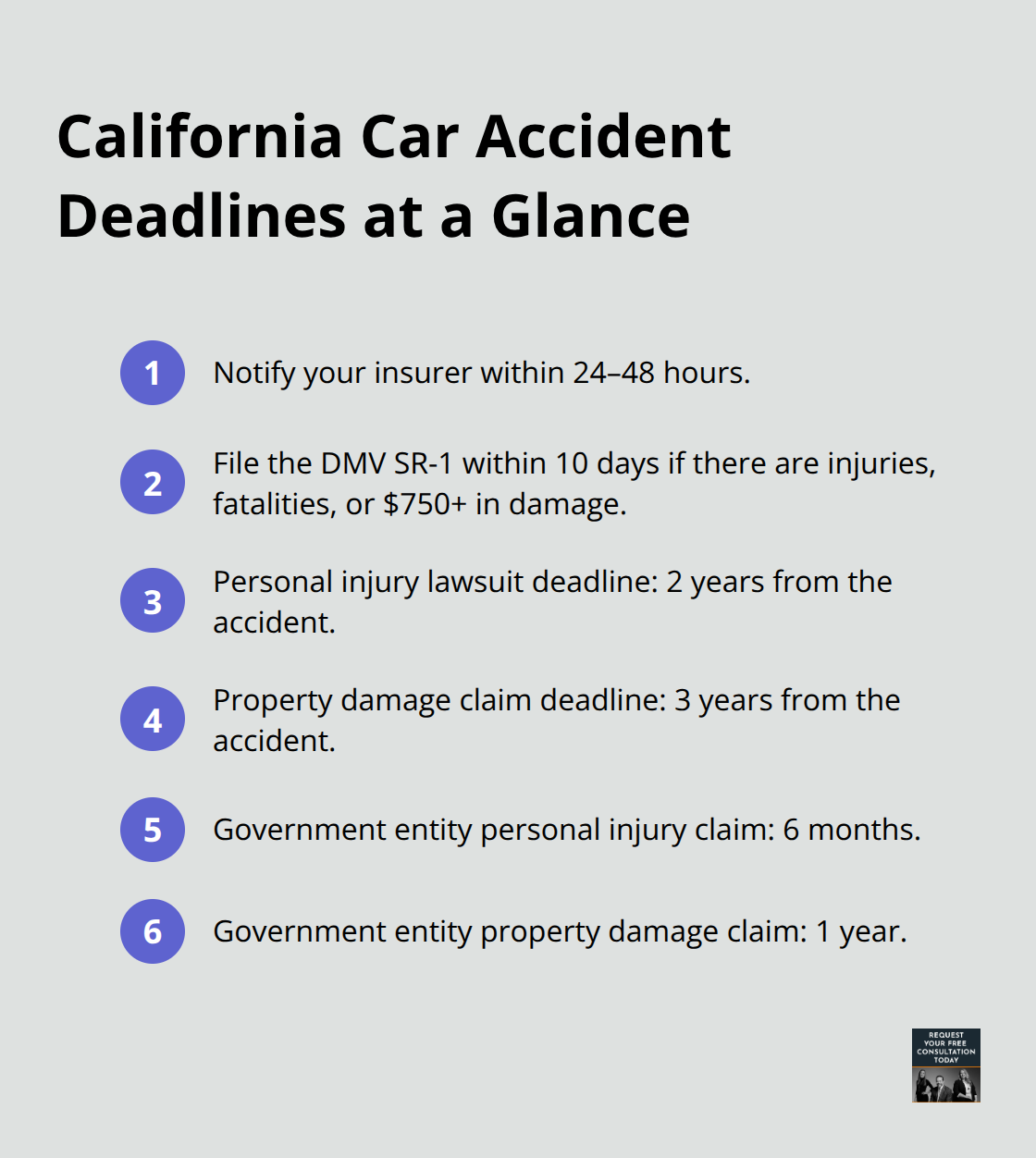
California gives you specific windows to report accidents, and missing these deadlines costs you money and weakens your claim significantly. Your insurance company typically requires notification within 24 to 48 hours of the accident, though some policies tighten this to immediate notification. Delays can result in claim denials. File your report with your insurance company within this window whenever possible to maintain your coverage and protect your position.
State Filing Requirements for the SR-1
The state of California has stricter rules depending on the accident’s severity. If anyone was injured or killed, or if property damage exceeds $750, you must file a California DMV Report of Traffic Accident (SR-1) within 10 days of the accident. This is a separate filing from your insurance claim and your police report. Many people assume the police report satisfies state requirements, but it does not. The SR-1 documents the accident officially with the DMV and must be completed by you or your authorized agent, which includes your insurance company, broker, or attorney.
You can file it online through the DMV’s Start an SR-1 option, which processes faster than paper submissions. Paper submissions often take significantly longer and increase the risk of processing errors that delay your claim. Online filing protects you by creating an official timestamp and reducing administrative delays.
Statute of Limitations: Know Your Deadlines
The statute of limitations in California is firm but varies by injury type. The Judicial Council of California sets the deadline for personal injury lawsuits at two years from the accident date, while property damage claims have a three-year window. If a government vehicle is involved, these timelines shrink dramatically to six months for personal injury and one year for property damage under California Government Code sections 905 and 911.2. This compressed timeline means you must document everything immediately for government vehicle cases.
Why Speed Matters for Your Claim
Acting quickly protects you in multiple ways: it preserves evidence before witnesses forget details, it keeps medical records organized while treatments are fresh, and it prevents insurers from denying claims based on late reporting. If you sustained serious injuries, wrongful death circumstances, or spinal or brain damage, waiting to file costs you exponentially because memory degradation and missing documentation make settlement negotiations harder. File your insurance report within 24 hours and your SR-1 within the first week to maintain maximum leverage on your claim.
Final Thoughts
The foundation of a strong accident claim rests on what you do in the first hours after impact. Collect contact information from all parties, photograph damage and scene conditions, and document injuries immediately, no matter how minor they seem. Your car accident report becomes the official record that insurers and attorneys reference, so accuracy and completeness matter far more than speed alone.
File your insurance claim within 24 to 48 hours and submit your SR-1 to the California DMV within 10 days if injuries or property damage exceeds $750. Missing these deadlines weakens your position significantly, and organizing all documentation in one place-medical records, repair estimates, photographs, witness statements, and police reports-prevents critical details from slipping through the cracks as your claim progresses. If you sustained serious injuries, brain or spinal damage, or face wrongful death circumstances, the documentation you gather now directly impacts the compensation you receive later.
We at Schaar & Silva LLP understand that navigating accident claims while recovering from injuries is overwhelming. Contact us today to discuss your case and learn how we protect your rights throughout the claims process.
