
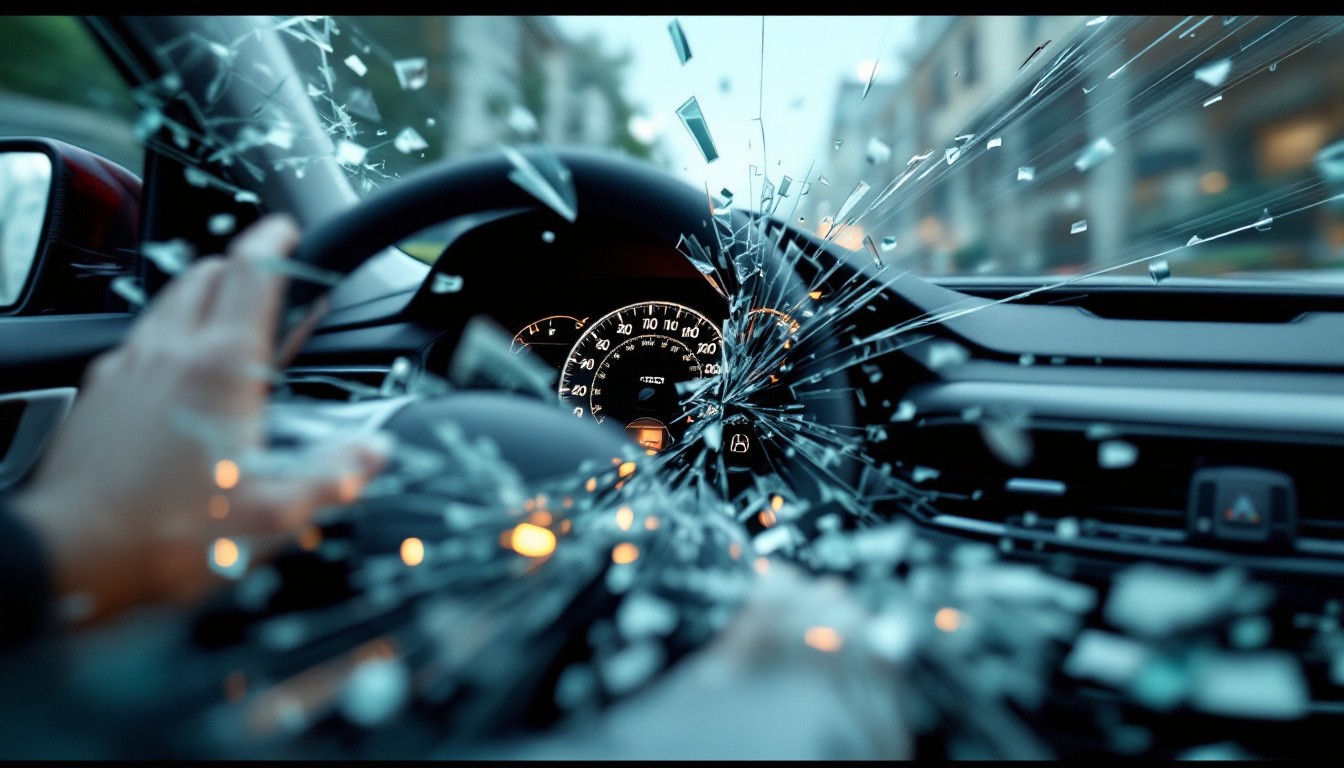
Physics plays a major role in every car crash that happens on Santa Cruz County roads. When vehicles collide, the laws of motion don’t pause – they create forces that can cause serious injuries to drivers and passengers.
Understanding inertia in car accidents helps explain why crashes cause such devastating harm. We at Schaar & Silva LLP see firsthand how these physical forces affect accident victims and their legal cases.
What Forces Drive Car Accident Injuries?
Newton’s First Law states that objects in motion stay in motion until an external force stops them. This fundamental principle governs every car crash in Santa Cruz County. When your vehicle hits another car or fixed object, the crash forces act on your car but not immediately on your body. Your body continues to move at the original speed until something stops it – often the steering wheel, dashboard, or windshield.
Mass Creates Devastating Impact Forces
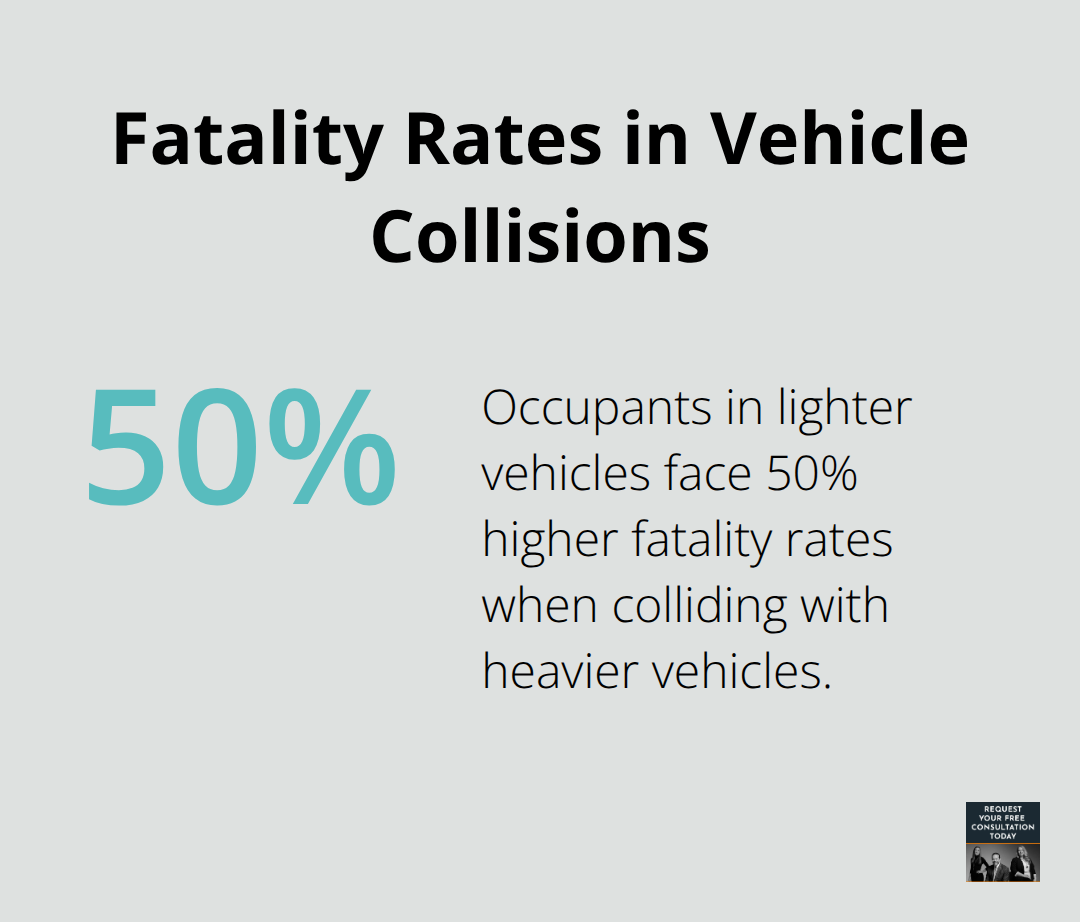
Vehicle weight dramatically affects crash severity. A 4,000-pound SUV that travels at 35 mph carries twice the kinetic energy of a 2,000-pound compact car at the same speed. The National Highway Traffic Safety Administration data shows that occupants in lighter vehicles face 50% higher fatality rates when they collide with heavier vehicles. Truck accidents prove particularly deadly because an 80,000-pound commercial truck requires 525 feet to stop from 65 mph (compared to 316 feet for passenger cars).
Speed Multiplies Injury Risk Exponentially
Velocity increases crash forces exponentially, not linearly. When you double your speed from 30 to 60 mph, you quadruple the kinetic energy that occurs in a crash. Insurance Institute for Highway Safety research demonstrates that fatal crash risk increases by 400% when speeds rise from 40 to 65 mph. Santa Cruz County recorded 19 speed-related collisions in 2021, but these crashes often produce the most severe injuries because high-speed impacts overwhelm safety systems that manufacturers design for lower-velocity crashes.
How Physics Affects Your Body During Impact
The moment of impact creates a chain reaction of forces that affect every part of your body. Your torso, head, and limbs each respond differently to sudden deceleration because they have different masses and attachment points. Internal organs continue to move forward even after your ribcage stops, which causes blunt force trauma to vital organs like the liver, spleen, and brain.
These physical forces directly influence how occupants experience different types of collisions, from head-on crashes to side impacts and rollovers.
How Does Your Body React in Different Crash Types
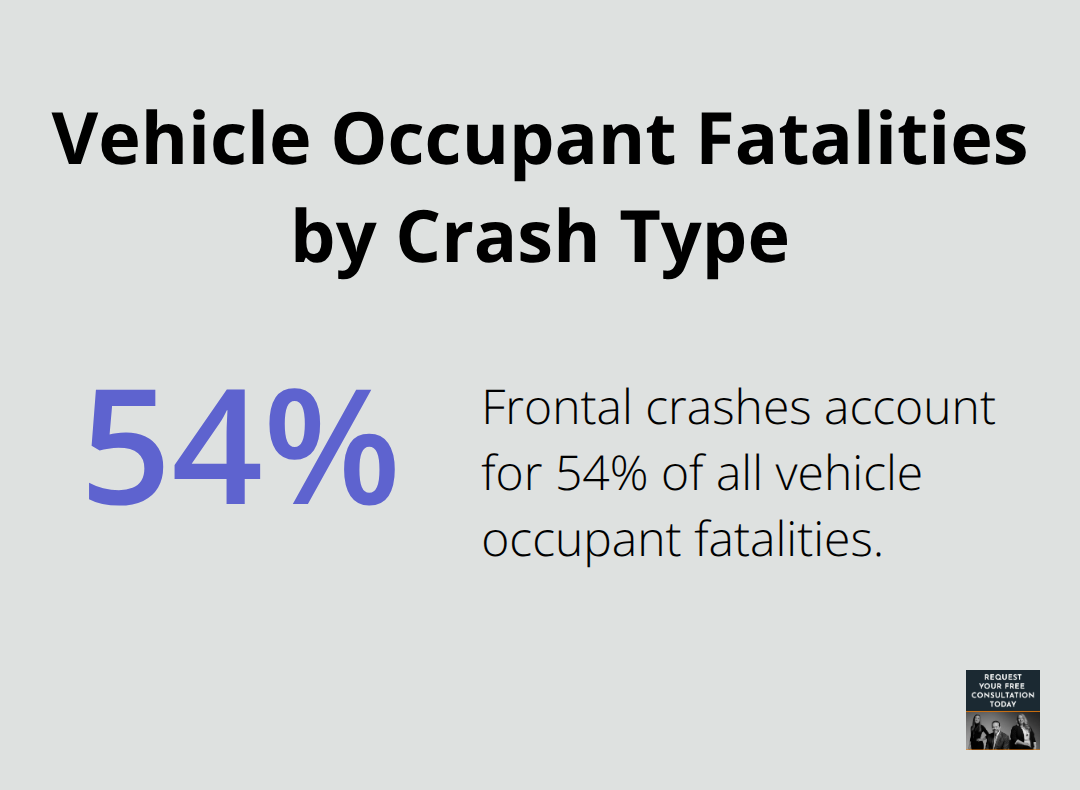
Front-end collisions create the most predictable injury patterns because your body moves straight forward into the steering wheel, dashboard, or airbag. The Insurance Institute for Highway Safety reports that frontal crashes account for 54% of all vehicle occupant fatalities, primarily because the human torso can withstand forward forces better than lateral impacts. Your spine compresses during frontal impacts, which often causes herniated discs and compression fractures. The brain slams against the front of the skull during the initial impact, then rebounds backward during the second phase of deceleration. This creates the classic coup-contrecoup brain injury pattern that produces both immediate trauma and delayed symptoms that appear days after the accident.
Side Impact Forces Cause the Most Severe Injuries
Lateral crashes produce devastating injuries because your body lacks structural protection against sideways forces. The National Highway Traffic Safety Administration data shows that side impacts cause 25% of all traffic fatalities despite representing only 20% of crashes. Your ribs, pelvis, and skull cannot absorb lateral energy effectively, which means the force transfers directly to internal organs. The liver and spleen rupture more frequently in side impacts because these organs slide across their attachment points during lateral acceleration. Santa Cruz County recorded significant side-impact injuries in 2021, particularly along Highway 1 where T-bone collisions occur at intersections. Your head whips sideways during side impacts, which tears brain tissue and causes traumatic brain injuries that often go undiagnosed for weeks.
Rollover Accidents Create Multiple Impact Points
Vehicle rollovers subject occupants to rotational forces that change direction constantly as the car tumbles. Each rotation creates a new impact point where your body strikes the roof, doors, or windows. Unbelted occupants face ejection risks that increase with each rotation (the National Highway Traffic Safety Administration reports that 75% of occupants who get ejected during rollovers die from their injuries). Your spine twists and bends in unnatural directions during rollovers, which causes complete spinal cord injuries more frequently than other crash types.
Modern vehicles incorporate multiple safety systems that work together to counteract these destructive forces and protect occupants from the worst effects of inertia.
How Do Safety Systems Protect You From Crash Forces
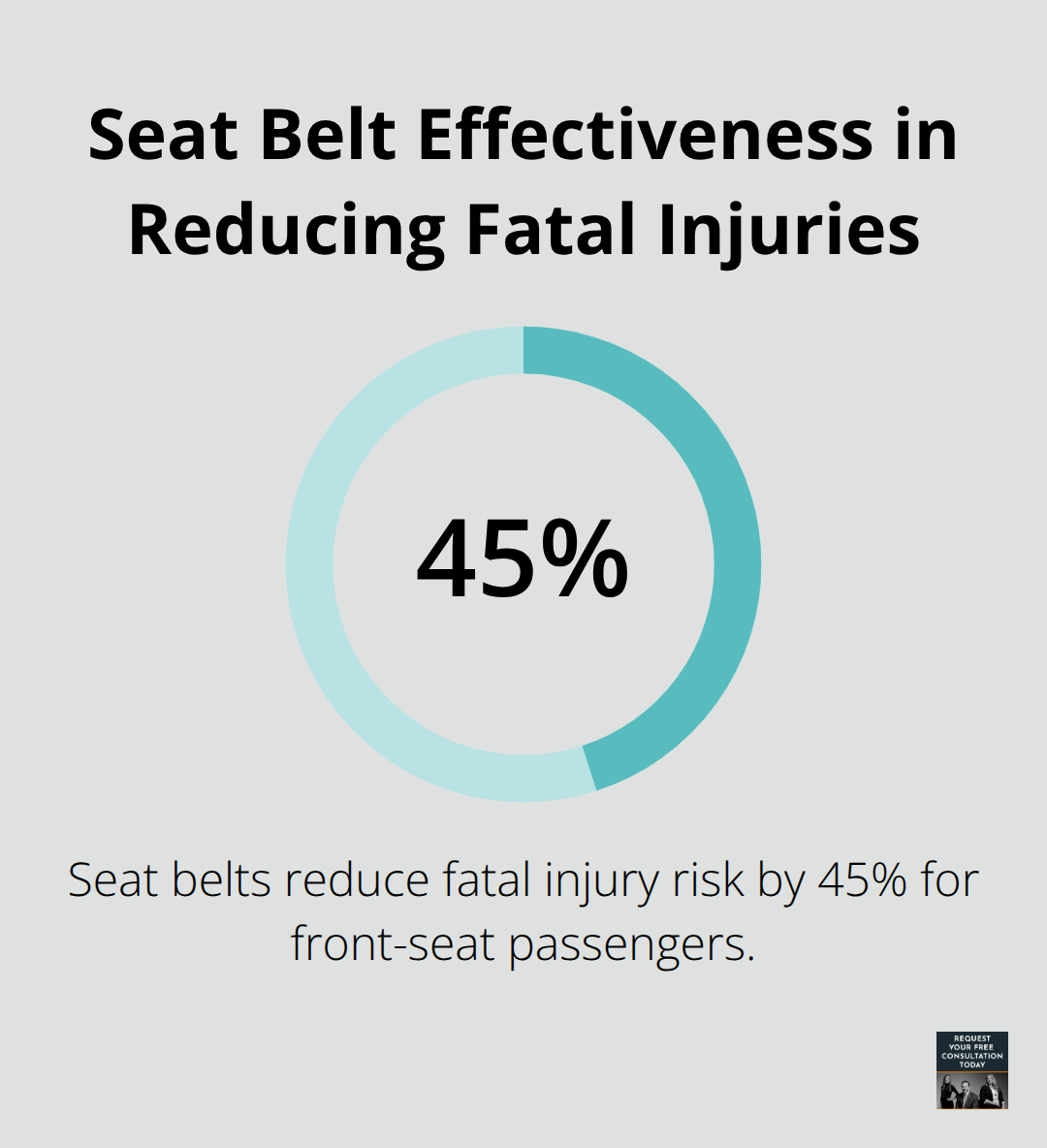
Vehicle safety systems work as an integrated defense network that redirects inertial forces away from your body during crashes. Seat belts serve as the primary restraint system that keeps your torso connected to the vehicle’s deceleration rate instead of allowing your body to continue at its original speed. The National Highway Traffic Safety Administration reports that seat belts reduce fatal injury risk by 45% for front-seat passengers because they distribute crash forces across your chest and pelvis rather than concentrate impact at a single point like the steering wheel or dashboard. Modern three-point seat belts include pretensioners that tighten within milliseconds of impact detection, which eliminates slack that would otherwise allow your body to build momentum before the belt engages. Load limiters then control the force applied to your chest and prevent the belt itself from causing internal injuries during severe crashes.
Airbags Create Controlled Deceleration Zones
Airbag systems deploy at speeds that reach 200 mph to create a cushioned barrier between your body and hard vehicle surfaces. Front airbags reduce driver fatality risk by 29% and passenger fatality risk by 32% according to Insurance Institute for Highway Safety data, but only when combined with seat belt use. Side-curtain airbags protect against the lateral forces that cause traumatic brain injuries during T-bone collisions. These systems use accelerometers that detect crash forces within 15 milliseconds and inflate bags to full size in just 30 milliseconds. The bags then immediately begin to deflate and prevent your body from bouncing back into dangerous positions during the secondary impact phase.
Crumple Zones Absorb Energy Before It Reaches You
Vehicle crumple zones transform kinetic energy into controlled structural deformation that occurs over a longer time period (which reduces the peak forces transmitted to occupants). Modern cars feature front and rear crumple zones that collapse in predetermined patterns to absorb maximum energy while they maintain passenger compartment integrity. The time extension that crumple zones create reduces crash forces by up to 40% compared to rigid vehicle designs. European New Car Assessment Programme testing shows that vehicles with optimized crumple zones reduce serious injury risk by 60% in frontal crashes at highway speeds. When these safety systems fail to prevent car accident injuries, understanding your legal options becomes crucial for recovery.
Final Thoughts
The physics of inertia in car accidents creates predictable injury patterns that affect every crash victim in Santa Cruz County. When vehicles collide, Newton’s laws don’t bend – they generate forces that overwhelm the human body within milliseconds. Your body maintains its original speed and direction during sudden stops, which produces the traumatic injuries we see in emergency rooms across our community.
Modern safety equipment works to counteract these inertial forces through seat belts, airbags, and crumple zones that form an integrated system. These systems extend the time over which your body decelerates and reduce peak forces by up to 40%. However, even the most advanced safety systems cannot eliminate all injuries when crashes occur at high speeds or involve heavy vehicles.
Insurance companies often dispute injury claims by arguing that low-speed crashes cannot cause serious harm (but the science of inertia proves otherwise). Even minor collisions can produce significant injuries when safety systems fail or occupants are positioned incorrectly. We at Schaar & Silva LLP help Santa Cruz County accident victims navigate these complex cases by connecting the physics of their crashes to their medical injuries and financial losses.
