

A rear-end collision can leave you with neck pain that lingers for months. Many people in Santa Cruz County underestimate how serious whiplash injuries are, which often leads to settlements that don’t cover their actual costs.
We at Schaar & Silva LLP have helped accident victims understand what a fair whiplash settlement in Santa Cruz should look like. This guide walks you through the steps to build a strong claim and get the compensation you deserve.
How Whiplash Happens and Why It’s Worse Than You Think
The Mechanics of Whiplash in Rear-End Collisions
Whiplash occurs when your neck experiences rapid back-and-forth movement during a collision, most commonly in rear-end crashes. The National Highway Traffic Safety Administration reports over 1.2 million whiplash incidents annually across the United States, making it one of the most frequent car accident injuries. In Santa Cruz County, rear-end collisions happen frequently on Highway 1 and local intersections where traffic patterns create vulnerable situations. When another vehicle hits you from behind, your body accelerates forward while your head lags momentarily, then snaps forward violently. This cervical acceleration-deceleration injury, known medically as CAD, strains the neck’s muscles, ligaments, and discs in ways that aren’t always visible on initial X-rays.
Why Symptoms Appear Later and Damage Your Claim
The problem intensifies because many people feel minimal pain immediately after the crash, then wake up the next day with severe neck stiffness and headaches. This delayed onset of symptoms leads many Santa Cruz residents to postpone medical care, which actually weakens their settlement claims. Insurance companies capitalize on this underestimation by arguing that low vehicle damage means a minor injury-a tactic we at Schaar & Silva LLP see repeatedly in Santa Cruz cases. They’ll claim you’re exaggerating or that your symptoms are unrelated to the crash.
The Long-Term Reality of Whiplash Injuries
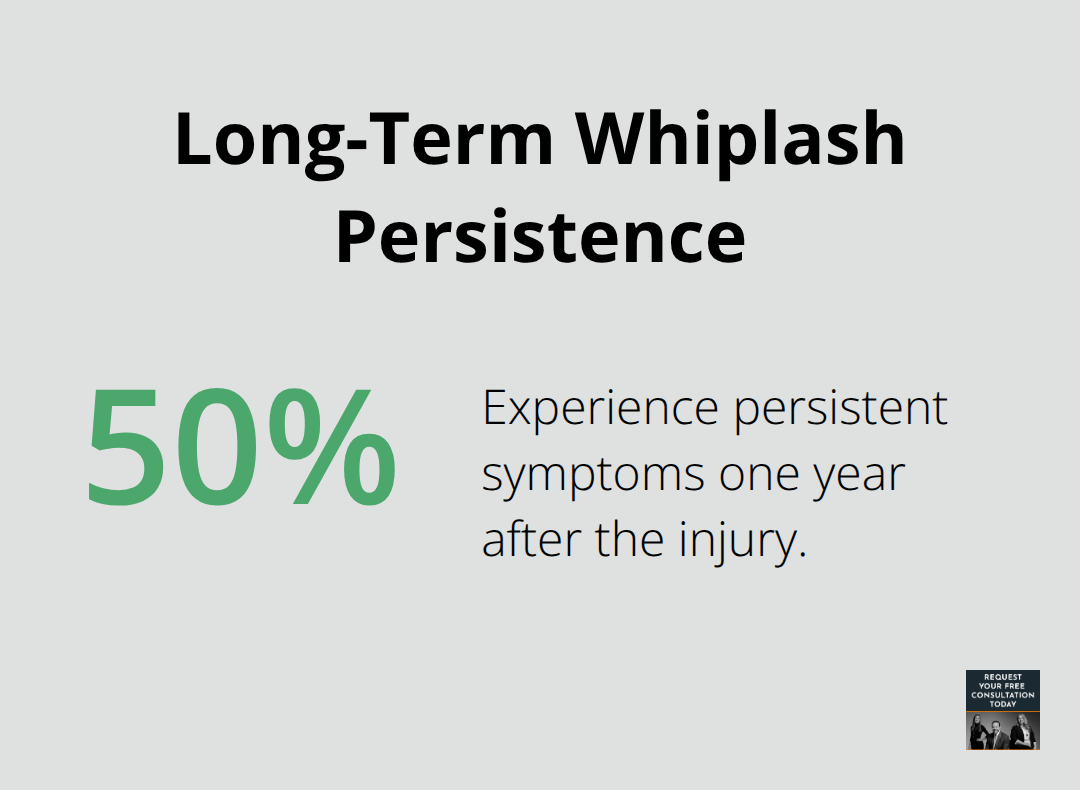
Up to 50 percent of whiplash patients experience persistent symptoms one year after the injury, according to medical research on cervical acceleration-deceleration cases. You might develop chronic neck pain, limited range of motion, persistent headaches, or even nerve damage that radiates into your arms. These long-term consequences are far more serious than most people realize when they first leave the accident scene.
How Medical Documentation Determines Settlement Value
Immediate medical documentation matters enormously. You should get evaluated by a physician within 48 hours, obtain MRI imaging if recommended, and follow through with physical therapy. This creates a medical record that proves the injury’s severity. Without this documentation, settlement amounts plummet. A WAD Grade I whiplash case might settle for $2,500 to $10,000, while a WAD Grade III case with comprehensive medical records can reach $30,000 to $100,000 or more. The difference often comes down to how thoroughly you document what happened to your body after the crash.
Insurance adjusters commonly use tactics to minimize value, such as disputing delayed treatment or blaming pre-existing conditions. Strong medical evidence-including specialty care from physicians trained in orthopedic or neurological assessment, advanced imaging, and ongoing physical therapy-counters these arguments effectively. The medical record you build in the weeks and months after your accident directly determines whether you receive fair compensation or a lowball settlement offer.
Understanding the true severity of your injury sets the stage for the next critical step: identifying which factors actually influence how much your whiplash settlement will be worth.
What Actually Determines Your Settlement Amount
Medical Records Form the Foundation of Your Claim
Your whiplash settlement hinges on three concrete factors that Santa Cruz insurance adjusters will scrutinize: the medical evidence you accumulate, the documented severity of your injury, and the measurable financial losses you incur. Medical records are not optional-they form the foundation of your entire claim’s value. When you visit a physician within 48 hours of the crash and follow through with imaging like MRI scans and physical therapy appointments, you create an undeniable paper trail that proves your injury exists. Insurance adjusters will attempt to downplay your claim if your medical file is sparse or inconsistent.
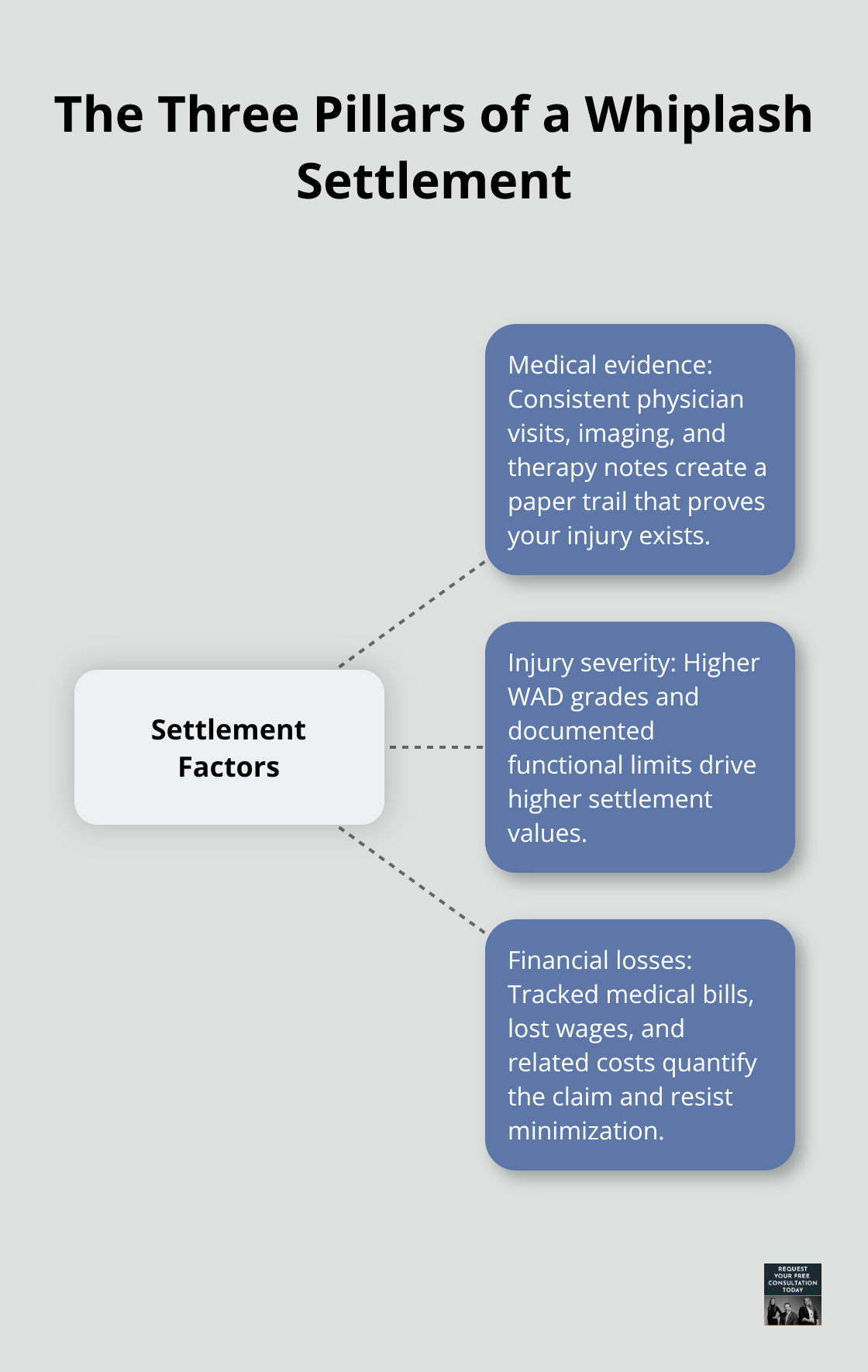
The Quebec Task Force Classification of Whiplash-Associated Disorders grades injuries from 0 to IV, and higher grades correspond directly to higher settlement amounts. A WAD Grade I case typically settles between $2,500 and $10,000, while a WAD Grade II reaches $10,000 to $30,000. WAD Grade III cases jump to $30,000 to $100,000 or beyond. The difference between these tiers depends almost entirely on what your medical records show.
Adjusters will also scrutinize gaps in your treatment. If you stop physical therapy after two weeks, they will argue your injury was minor. If you continue consistent treatment for three months, the medical record supports a serious injury claim.
Lost Wages and Earning Capacity Increase Settlement Value
Your lost wages and lost earning capacity create the second major lever for settlement value. If the whiplash injury forces you to miss work for two weeks, you can quantify that loss with pay stubs and employer statements. If the injury prevents you from returning to your previous job-perhaps you worked in construction and now cannot perform physical labor-your claim value increases substantially.
Document every missed work day, every reduced hour, and every job opportunity you lost due to your injury. Request written statements from your employer about the impact on your employment. These documents transform abstract losses into concrete numbers that adjusters cannot ignore.
Pain and Suffering Multiplies Your Economic Damages
The impact on your daily life matters more than most people realize. Chronic pain that prevents you from sleeping, lifting your children, or performing household tasks has monetary value under California law. This non-economic damage is calculated using either the multiplier method, where economic damages are multiplied by 1.5 to 5, or the per-diem method, where you assign a daily dollar amount for pain and suffering.
A Santa Cruz resident with $15,000 in medical bills and lost wages, multiplied by a factor of 3 due to chronic pain and limited mobility, reaches a $45,000 settlement range. Insurance companies will resist these calculations aggressively, which is why the strength of your medical documentation and treatment consistency directly impacts the multiplier they will accept.
The next step involves taking concrete action to protect these settlement factors before insurance adjusters attempt to dismantle your claim.
Building Your Whiplash Claim Step by Step
The moment another vehicle hits you from behind, your actions in the next 48 hours determine whether you’ll receive fair compensation or a fraction of what you deserve. Most Santa Cruz residents make critical mistakes immediately after the crash that permanently weaken their settlement position. The insurance adjuster counting on you to act carelessly starts their damage-control strategy the second the collision occurs. Your job is to move faster and smarter than they expect.
Protect Your Claim at the Accident Scene
Start at the accident scene itself. Photograph the front and rear of both vehicles from multiple angles, capturing the point of impact clearly. Take photos of the road conditions, traffic signals, and any skid marks. Collect the names, phone numbers, and addresses of at least two witnesses who saw the collision happen, not just bystanders who arrived afterward. Call the Santa Cruz County Sheriff or local police non-emergency line and file an official accident report, then request the report number for your records. Do not accept the other driver’s insurance information as final proof of coverage; verify their policy with their insurance company directly.
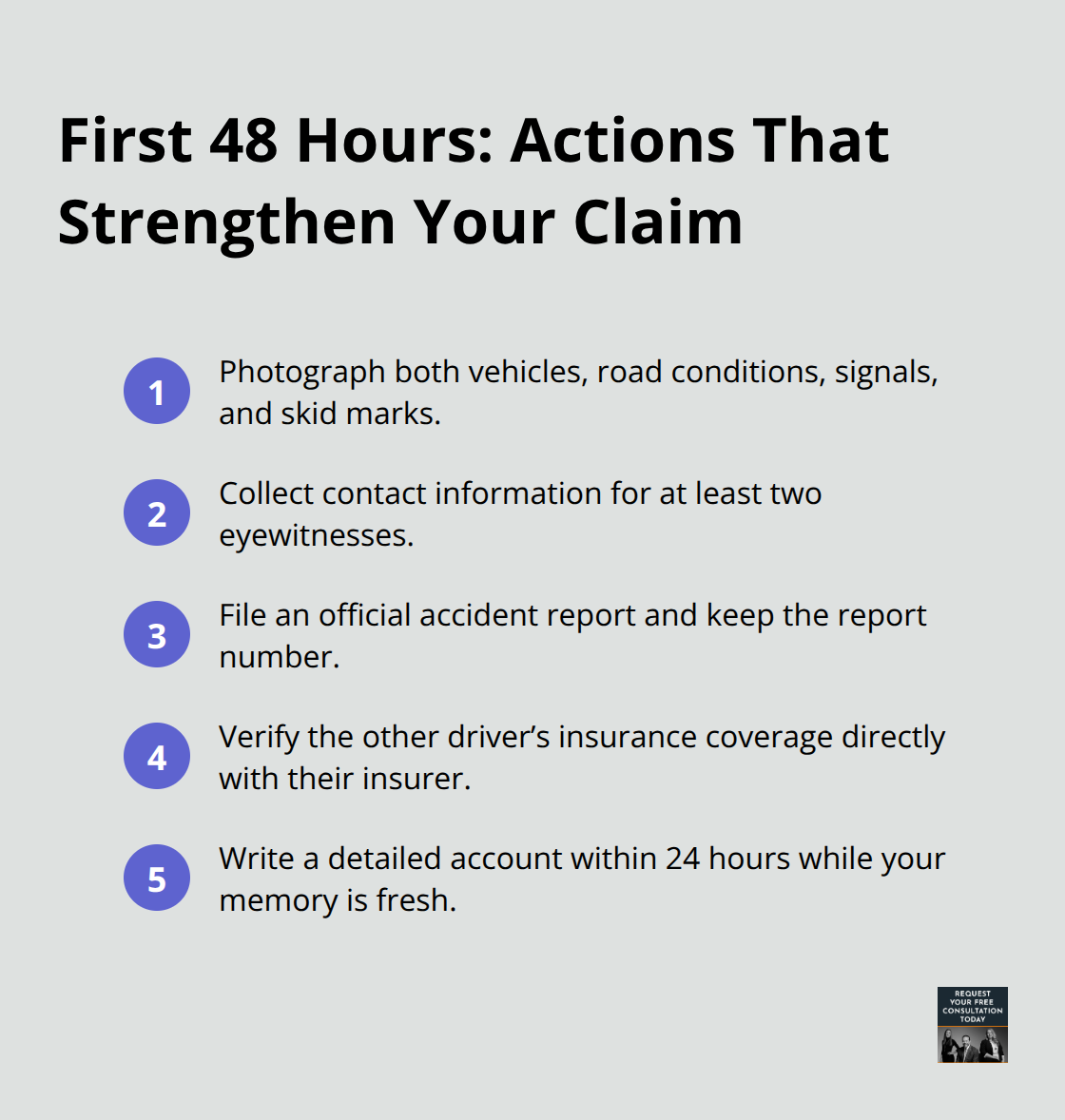
Insurance adjusters will later argue that witness statements are unreliable or that road conditions were irrelevant, but photographs and official police reports are nearly impossible to dismiss. Within 24 hours, write down everything you remember about the collision, including the exact sequence of events, the force of impact, and your immediate physical sensations. This written account, created while your memory is fresh, carries significant weight in settlement negotiations.
Establish Medical Documentation Immediately
Seek medical evaluation within 48 hours, even if you feel fine. Schedule an appointment with your primary care physician and explicitly state that this visit is related to a car accident. Request that they document the date of the collision, your symptoms, and their clinical observations in your medical record. If your physician recommends MRI imaging or physical therapy, proceed immediately rather than waiting.
Insurance adjusters weaponize treatment delays against you, claiming that symptoms appearing days later prove the injury was minor. Consistent medical documentation from the first week onward builds an unassailable record. Keep copies of every medical bill, prescription receipt, and therapy invoice in a dedicated folder. Create a simple spreadsheet tracking the date, type of expense, amount paid, and what it was for.
Document Your Financial and Work Losses
Document every missed work day with written confirmation from your employer stating the dates you were absent and the reason. If your injury forces you to decline work opportunities or reduces your hours, request a written statement from your supervisor explaining the impact. These documents transform abstract losses into concrete numbers that adjusters cannot ignore.
Control Communication with Insurance Companies
When insurance adjusters contact you, do not provide recorded statements without consulting an attorney first. They use these statements to trap you into contradictions later. Instead, respond to insurance requests in writing only, keeping copies of everything. Do not accept quick settlement offers made in the first three weeks after your accident, regardless of how reasonable they seem.
The adjuster is betting you’ll accept pennies on the dollar before you understand your injury’s true severity. Countless Santa Cruz residents leave substantial compensation on the table by settling too early, before their medical picture becomes clear. The strongest claims take time to develop as your medical treatment progresses and the full scope of your injury emerges.
Final Thoughts
Your whiplash settlement in Santa Cruz depends on the actions you take in the weeks immediately following your accident. The three concrete steps that maximize your recovery are straightforward: build an ironclad medical record through treatment within 48 hours and consistent documentation, quantify your financial losses with pay stubs and employer statements, and protect your claim through evidence collection and controlled communication with insurance adjusters. Insurance companies count on you to make mistakes during this critical window-they expect delayed medical care, quick acceptance of lowball offers, and recorded statements that contradict your later claims.
Santa Cruz County residents face unique challenges because local traffic patterns create frequent rear-end collisions, yet many people underestimate how serious these injuries become. The delayed onset of whiplash symptoms means your injury’s true severity may not emerge for weeks or months, and if you’ve already settled with the insurance company, you’ve locked yourself into inadequate compensation. A whiplash settlement Santa Cruz residents deserve reflects the full scope of medical treatment, lost wages, and pain and suffering-not the minimal amount an adjuster offers in the first three weeks.
We at Schaar & Silva LLP understand the specific dynamics of personal injury claims in Santa Cruz County and handle the legal complexities while you focus on recovery. Contact us for a free case review to understand what your claim is actually worth and what timeline you’re working within. The two-year statute of limitations gives you time, but the strength of your claim depends on decisions you make right now.
