
A truck crash settlement in California depends on several factors that directly impact how much money you receive. The amount varies dramatically based on injury severity, who was at fault, and how much income you’ve lost.
At Schaar & Silva LLP, we’ve seen settlements range from thousands to millions of dollars depending on these circumstances. Understanding what affects your payout helps you avoid costly mistakes and negotiate fairly with insurance companies.
What Actually Drives Your Settlement Amount
Injury Severity and Medical Documentation
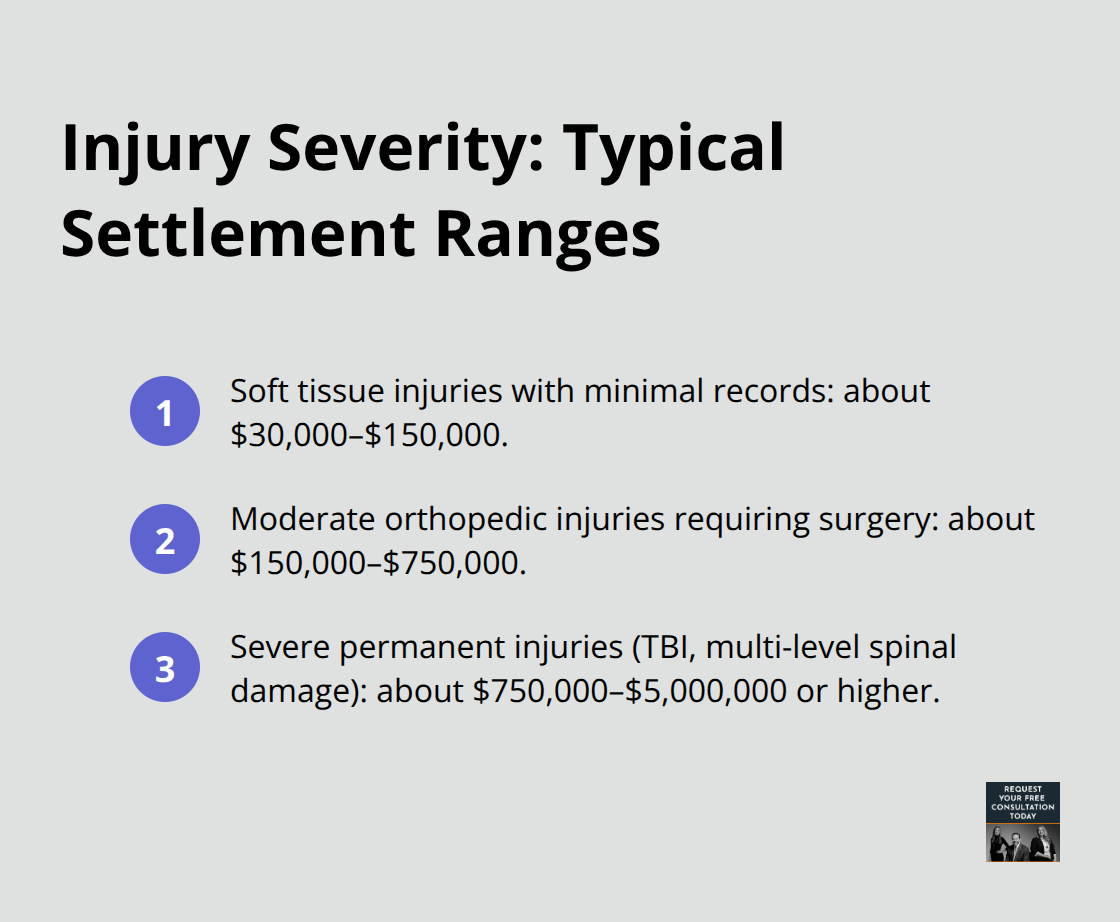
Injury severity sits at the top of the settlement calculation, and insurance companies measure this through documented medical treatment, not sympathy. A soft tissue injury with minimal medical records typically settles in the $30,000–$150,000 range, while moderate orthopedic injuries requiring surgery land in the $150,000–$750,000 range. Severe permanent injuries like multi-level spinal cord damage or traumatic brain injuries with lasting cognitive deficits push settlements toward $750,000–$5,000,000 or higher.
Permanent impairment matters far more than the size of your medical bills. A person with a $50,000 medical bill but permanent nerve damage often receives a higher settlement than someone with a $200,000 bill from temporary treatment. Insurance adjusters focus on permanence because it affects your lifetime earning capacity and quality of life.
Your medical records must show consistent treatment from the injury date forward; gaps in treatment reduce value significantly. If you delayed seeking care or stopped treatment early, insurers will argue your injuries were not serious, regardless of your actual pain level.
How Liability and Fault Reduce Your Payout
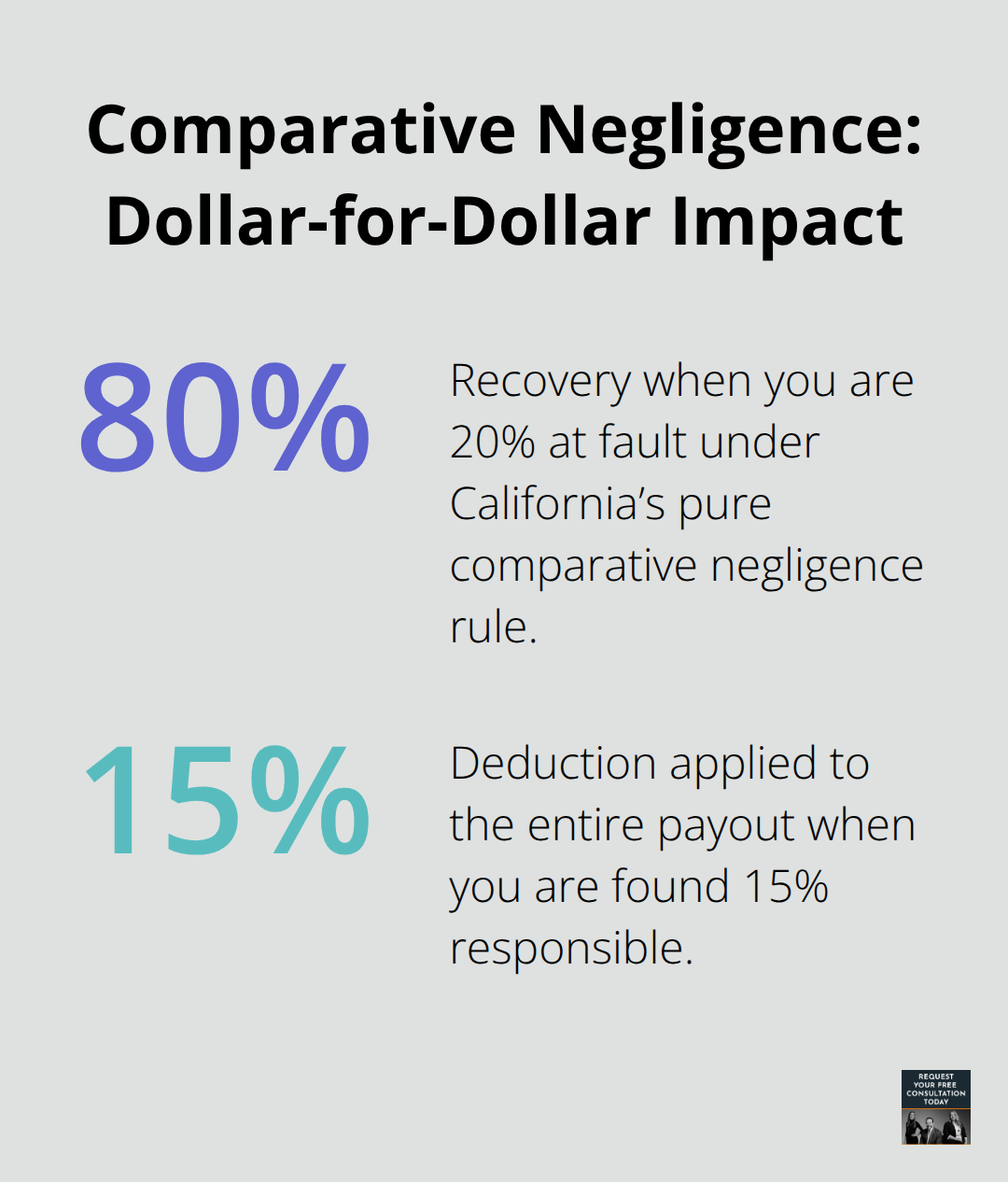
California’s pure comparative negligence rule means even partial fault reduces your payout dollar-for-dollar. If you were 20% at fault, you recover only 80% of the settlement value. This is why liability evidence matters tremendously: electronic logging device data from the truck, dashcam footage, accident reconstruction reports, and witness statements all establish who caused the crash.
Truck carriers must maintain compliance with Federal Motor Carrier Safety Administration regulations, and violations like hours-of-service breaches, inadequate driver training, or poor vehicle maintenance strengthen liability claims against the carrier itself. Multiple defendants often exist in truck crashes-the driver, the motor carrier, the truck owner, the cargo loader, and maintenance contractors-and each layer of liability and insurance coverage increases your total recovery potential.
Lost Wages and Future Earning Capacity
Lost wages and future earning capacity form the economic damages that follow injury severity and liability. If the crash left you unable to return to your previous job, you can claim past lost wages plus future earning capacity reduced to present value. Someone earning $60,000 annually with a permanent 50% work capacity loss over a 30-year working life has substantial future earning damages that push settlement value higher.
Property damage claims cover your vehicle replacement and repair costs; total loss vehicles receive valuation at fair market value, not what you owe on the loan. These economic damages stack on top of your injury-related compensation, and insurance companies calculate each category separately before determining your total settlement offer. Understanding how insurers value lost income and property damage helps you identify when their initial offer falls short of what you actually deserve.
How Insurers Calculate Your Settlement
The Multiplier Method and Per Diem Approach
Insurance companies apply two primary calculation methods to arrive at settlement offers, and understanding which one applies to your case directly affects whether you accept or reject their number. The multiplier method takes your documented economic damages-medical bills, lost wages, property damage-and multiplies that total by a severity factor typically ranging from 1.5 to 5 depending on injury permanence and impact on daily life. A person with $100,000 in economic damages and a permanent spinal injury might see a multiplier of 4, yielding $400,000 in total non-economic damages added to their economic losses.
The per diem approach assigns a daily dollar amount for pain and suffering across your recovery period. If you receive $500 per day for 300 recovery days, that adds $150,000 to your settlement before permanent impairment adjustments apply. Insurance adjusters rarely volunteer which method they use, and many switch between them during negotiations to present whichever number serves their interests.
How Comparative Negligence Reshapes Your Payout
California’s pure comparative negligence rule reshapes whatever number the multiplier or per diem method produces. If accident reconstruction shows you were 15% responsible for the crash, the insurer subtracts 15% from the final settlement amount-not 15% of just the non-economic portion, but 15% of the entire payout. This is where Federal Motor Carrier Safety Administration violations by the truck carrier become your strongest negotiating tool.
Hours-of-service breaches, inadequate driver training records, or maintenance failures documented in carrier logs shift fault heavily toward the defendant, sometimes eliminating your comparative negligence reduction entirely. Represented claimants recover approximately 3.5 times more than unrepresented claimants in California trucking cases, largely because attorneys know how to layer FMCSA compliance violations into liability arguments that reduce comparative fault assignments.
Identifying All Available Insurance Coverage Layers
Insurance companies calculate three elements-economic damages, non-economic damages, and your percentage of fault-then apply available policy limits from the primary carrier, excess coverage, and umbrella policies. Federal minimum liability coverage for commercial trucks ranges from $750,000 to $5,000,000 depending on vehicle type, and many carriers maintain $5 million to $25 million in stacked coverage.
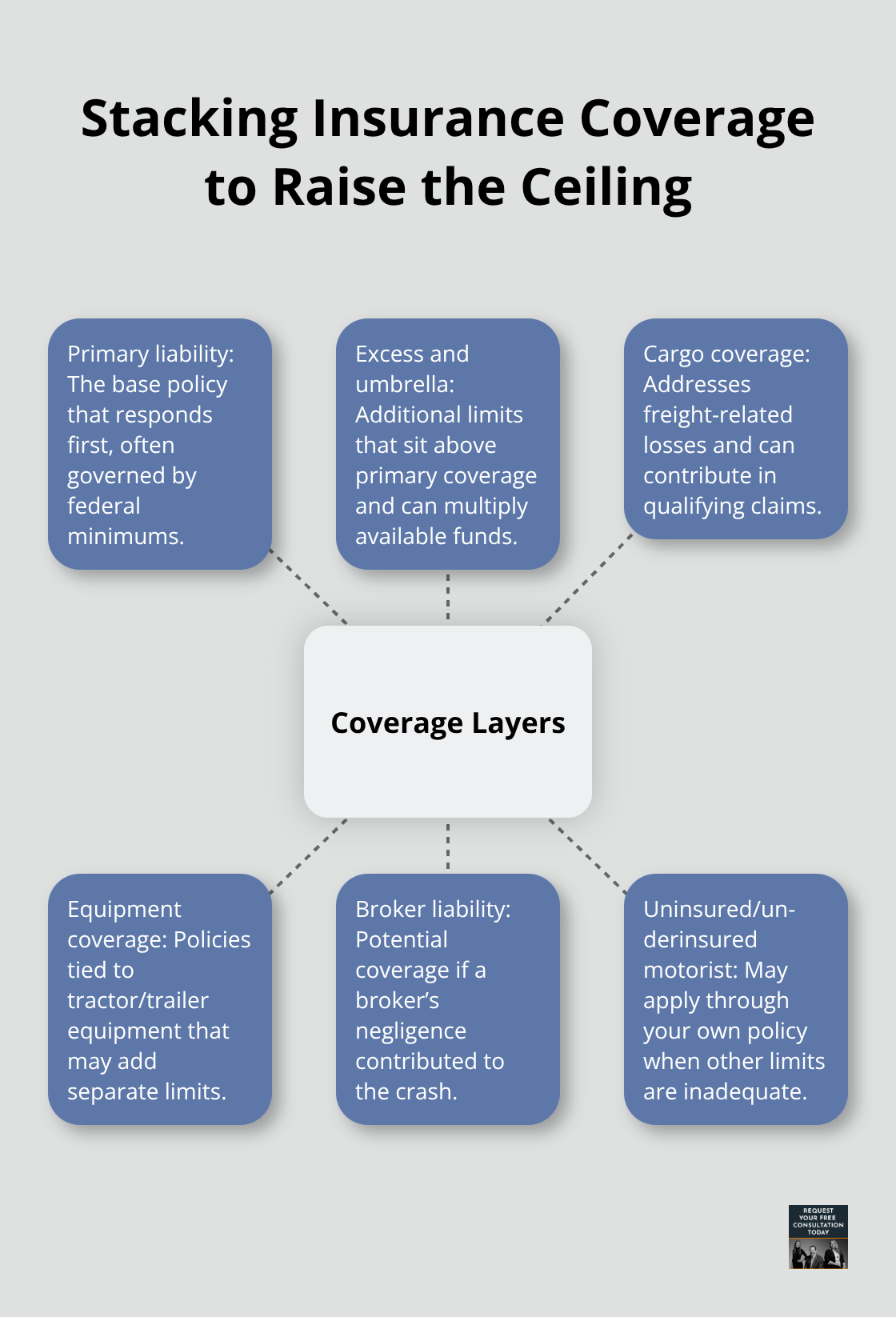
Your settlement ceiling depends on how thoroughly you and your attorney identify all available insurance coverage layers. Cargo coverage, equipment coverage, broker liability, and uninsured motorist protection all stack on top of primary liability limits. Missing even one coverage layer can cost you hundreds of thousands of dollars in potential recovery, which is why the investigation phase of your claim matters as much as proving liability itself.
Decisions That Cost You Thousands
Insurance adjusters exploit mistakes you make in the first weeks after your crash, and the three most common errors directly reduce your final payout. The initial settlement offer from an insurance company is almost never their final number, yet most unrepresented claimants accept it within 30 to 60 days of the accident. Represented claimants recover approximately 3.5 times more than unrepresented ones partly because attorneys reject lowball offers and continue negotiating through depositions, mediation, and trial preparation.
Why You Should Reject the First Offer
When an adjuster presents their first offer, they have incomplete medical records, no independent medical examination results, and no accident reconstruction analysis. They calculate based on minimal information and expect you to accept out of financial pressure or confusion about your rights. Countering that offer requires documentation of your permanent injuries, expert testimony about future earning losses, and evidence of all available insurance coverage layers-elements that take months to develop properly. Accepting early means you forfeit hundreds of thousands of dollars in potential recovery that stronger evidence would have supported.
Social Media Posts Destroy Your Credibility
Social media posts about your accident, your injuries, or your daily activities create evidence that insurance companies use against you during settlement negotiations. A photograph showing you at a friend’s gathering weeks after the crash, even if you were experiencing significant pain, gets presented as proof your injuries are exaggerated. Insurance adjusters screenshot posts, save videos, and build narratives that minimize your credibility. What you post today becomes ammunition in settlement discussions months later.
Admitting Fault Locks You Into Lower Payouts
Admitting fault at the accident scene or during early conversations with insurance representatives locks you into a comparative negligence position that reduces your payout dollar-for-dollar under California law. Many crash victims say things like “I think I didn’t see the truck” or “I might have been going too fast” without realizing these statements become official admissions recorded in claim files and used during settlement calculations. The correct approach after any truck crash is to avoid discussing fault with anyone except your attorney, decline the first settlement offer regardless of the amount presented, and keep your social media accounts private until your case resolves. These three decisions-rejecting premature offers, avoiding public statements, and staying silent about fault-protect your settlement value during the months when insurers gather information and form their negotiating positions.
Final Thoughts
Your truck crash settlement in California depends on injury permanence, liability strength, available insurance coverage, and the decisions you make immediately after your accident. Injury severity establishes your baseline value, but comparative fault under California law reduces that amount if you admit responsibility or fail to document FMCSA violations by the truck carrier. Lost wages, future earning capacity, and property damage stack on top of your injury-related compensation, and insurance companies calculate each category separately before presenting an offer.
Represented claimants recover approximately 3.5 times more than unrepresented claimants because attorneys understand how to layer FMCSA compliance violations into liability arguments, identify all available insurance coverage layers, and reject lowball initial offers. Insurance adjusters count on your financial pressure and confusion about your rights to accept their first number within weeks of your crash. The gap between what you accept alone and what legal representation secures reveals the true cost of handling a truck crash settlement without professional guidance.
We at Schaar & Silva LLP work on contingency, meaning you pay attorney fees only if we recover compensation for you. Contact us today for a free consultation to discuss your specific circumstances and protect your claim. The sooner you reach out, the sooner we begin gathering evidence and building the case that reflects your actual damages.
