

Truck accidents in California often result in settlements that take months or even years to resolve. The truck accident settlement timeline depends on multiple factors, from the severity of your injuries to how many parties share liability.
At Schaar & Silva LLP, we help injured people navigate this process and understand what happens at each stage. This guide breaks down the realistic timeframes you can expect and the key milestones along the way.
Why Truck Accidents Create Longer Settlement Timelines Than Car Crashes
Truck accidents settle differently than car accidents because the financial and legal stakes are dramatically higher. Federal minimum insurance for trucking companies ranges from $750,000 for intrastate operations to $5,000,000 for interstate carriers, compared to California’s $30,000 auto minimum. This difference alone means insurers conduct more thorough investigations and move slower. When an 80,000-pound tractor-trailer collides with a passenger vehicle, the occupants of the smaller vehicle suffer the overwhelming majority of serious and fatal injuries, according to the FMCSA Large Truck Crash Causation Study. This severity drives settlements into ranges of $250,000 to $500,000 for median cases, with many catastrophic injuries exceeding $3,000,000. The timeline stretches because insurers know the exposure is substantial and cannot afford quick decisions.
Multiple parties multiply the complexity
Truck accidents rarely involve just two parties. The truck driver, trucking company, cargo loader, trailer owner, maintenance provider, and component manufacturers can all share liability. Each party carries separate insurance policies, and your settlement must account for all available coverage layers. A cargo loader who failed to secure the load properly, a maintenance company that missed brake defects, or a manufacturer whose tire failed all become part of the claim. Identifying every liable party and their coverage takes time-often 30 to 60 days just for the investigation phase. California’s pure comparative negligence rule means that even if you are partially at fault, you can still recover, but your award is reduced by your percentage of fault. This creates disputes over liability percentages that extend negotiations significantly. Clear evidence from dashcam footage, electronic logging device data, and police reports accelerates this process, but without it, liability questions can stall a case for months.
Regulatory violations and injury severity compound delays
Federal trucking regulations create additional investigation layers. Hours-of-service violations, inadequate driver training, failed drug and alcohol testing, or maintenance record gaps can establish per-se negligence and support punitive damages under California law. Insurers must investigate compliance with FMCSA standards, which takes longer than standard car accident claims. Simultaneously, the nature of your injuries determines how long medical treatment continues before settlement discussions can meaningfully begin. Soft tissue injuries typically stabilize in three to six months, but brain injuries, spinal cord damage, or multiple surgeries can extend treatment beyond one year. You should not settle before reaching Maximum Medical Improvement-the point where your treating physician determines your condition has stabilized as much as possible. Settling too early risks underestimating future medical costs and can cost you tens of thousands of dollars. This medical reality, combined with regulatory complexity, means truck accident settlements inherently take longer than car crashes, which is why understanding the three distinct phases of the settlement process helps you prepare for what comes next.
The Three Phases of Your Truck Accident Settlement
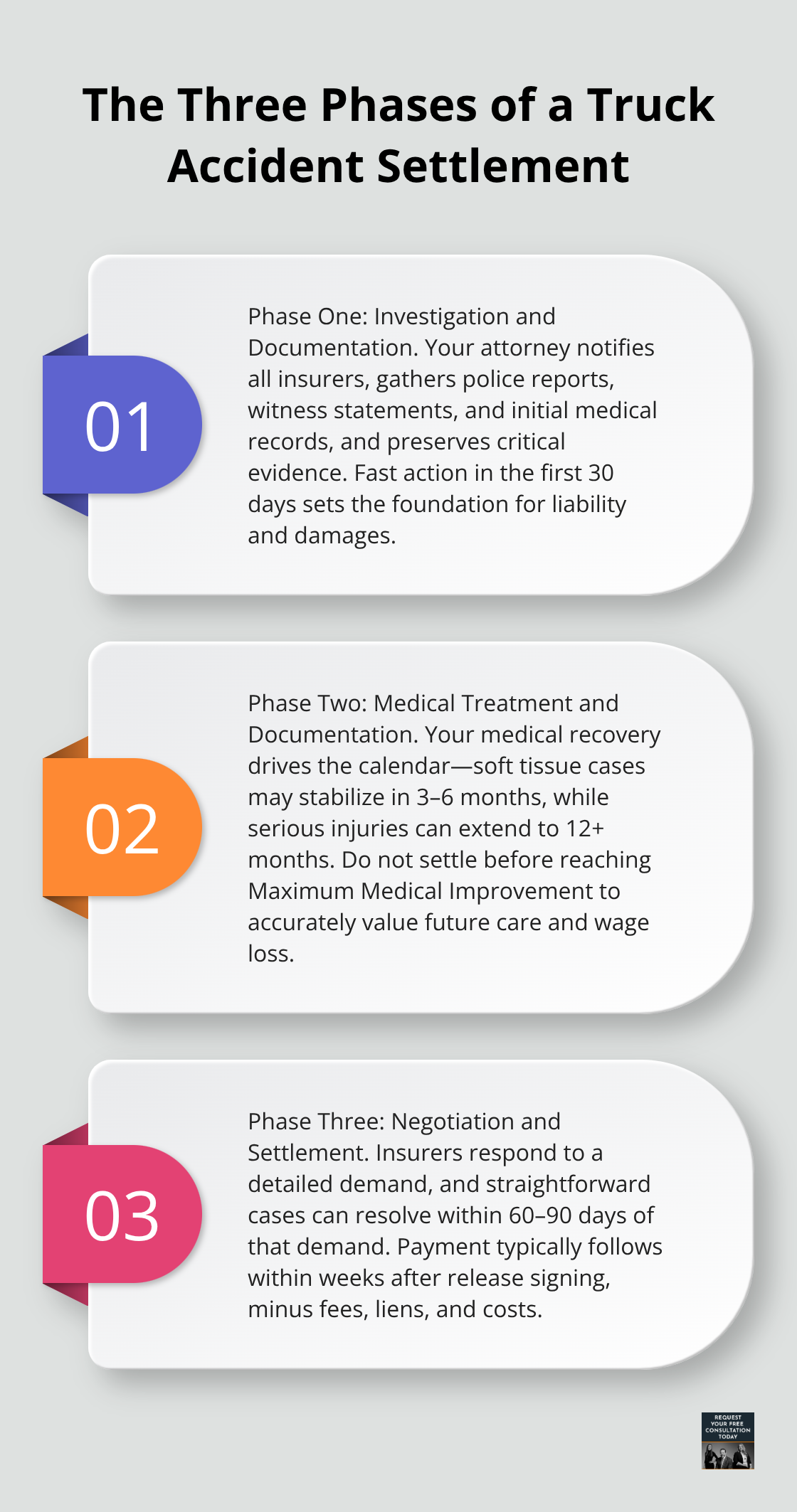
Your truck accident settlement follows a predictable three-phase timeline that typically spans 12 to 36 months from the moment you hire an attorney, though straightforward cases with clear liability can resolve in as little as 6 to 9 months.
Phase One: Investigation and Documentation (First 30 Days)
Your attorney sends representation letters to all insurers, collects the police report, and obtains witness statements and initial medical records within the first month. Insurers will contact you directly, but your attorney screens these communications to protect your claim.
Do not provide recorded statements to adjusters without your lawyer present, and avoid discussing the accident on social media. Preserve all physical evidence immediately: dashcam footage, photos of the crash scene, vehicle damage images, and witness contact information. Electronic logging device data from the truck and the driver’s logbooks establish timeline violations or fatigue factors that strengthen your case. This first month moves quickly when you act immediately after the accident.
Phase Two: Medical Treatment and Documentation (Months 2–6)
Your medical condition determines the calendar more than anything else during this phase. Soft tissue injuries stabilize in three to six months, allowing settlement discussions to begin sooner, while brain injuries, spinal cord damage, or multiple surgeries extend this phase to 12 months or longer. Do not settle before reaching Maximum Medical Improvement, because early settlement locks in damages that may not cover future surgery, therapy, or long-term care. Keep meticulous records of every medical bill, wage loss statement from your employer, and receipt for out-of-pocket expenses. The Insurance Research Council reports that represented claimants recover on average 3.5 times more than unrepresented claimants, partly because organized documentation strengthens your demand package. After your treating physician confirms your condition has stabilized, your attorney assembles a detailed demand package that includes medical records, bills totaling your past damages, calculations of future medical costs via life-care plans, wage loss documentation, and non-economic damages for pain and suffering.
Phase Three: Negotiation and Settlement (Final 3–6 Months)
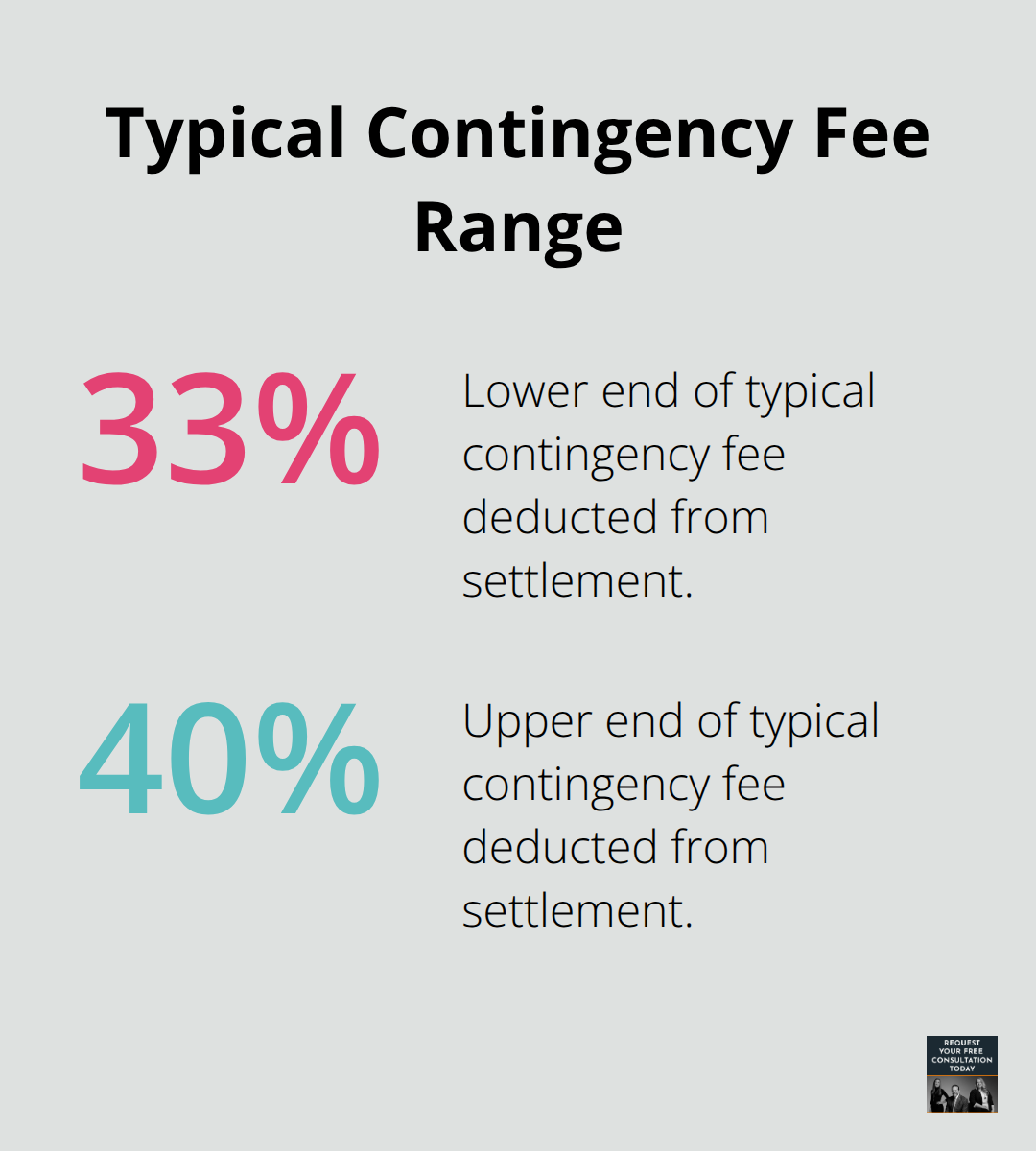
Insurers typically respond to your demand within 30 days. Straightforward cases with clear liability may settle within 60 to 90 days of the demand, while disputed-fault scenarios or catastrophic injuries extend negotiations significantly. Payment arrives 10 to 21 business days after you sign the settlement release, though some carriers take up to 30 days. Your attorney deposits the check into trust, deducts the contingency fee (roughly 33 to 40%), pays medical liens and case costs, and provides you with final accounting before you receive your net settlement.
Understanding these three phases helps you anticipate what happens next and prepare the documentation that accelerates your path toward resolution, which is why the specific details of your injuries and liability situation determine whether your case moves quickly or requires extended negotiation.
What Really Controls Your Settlement Timeline
Injury Severity Sets the Medical Calendar
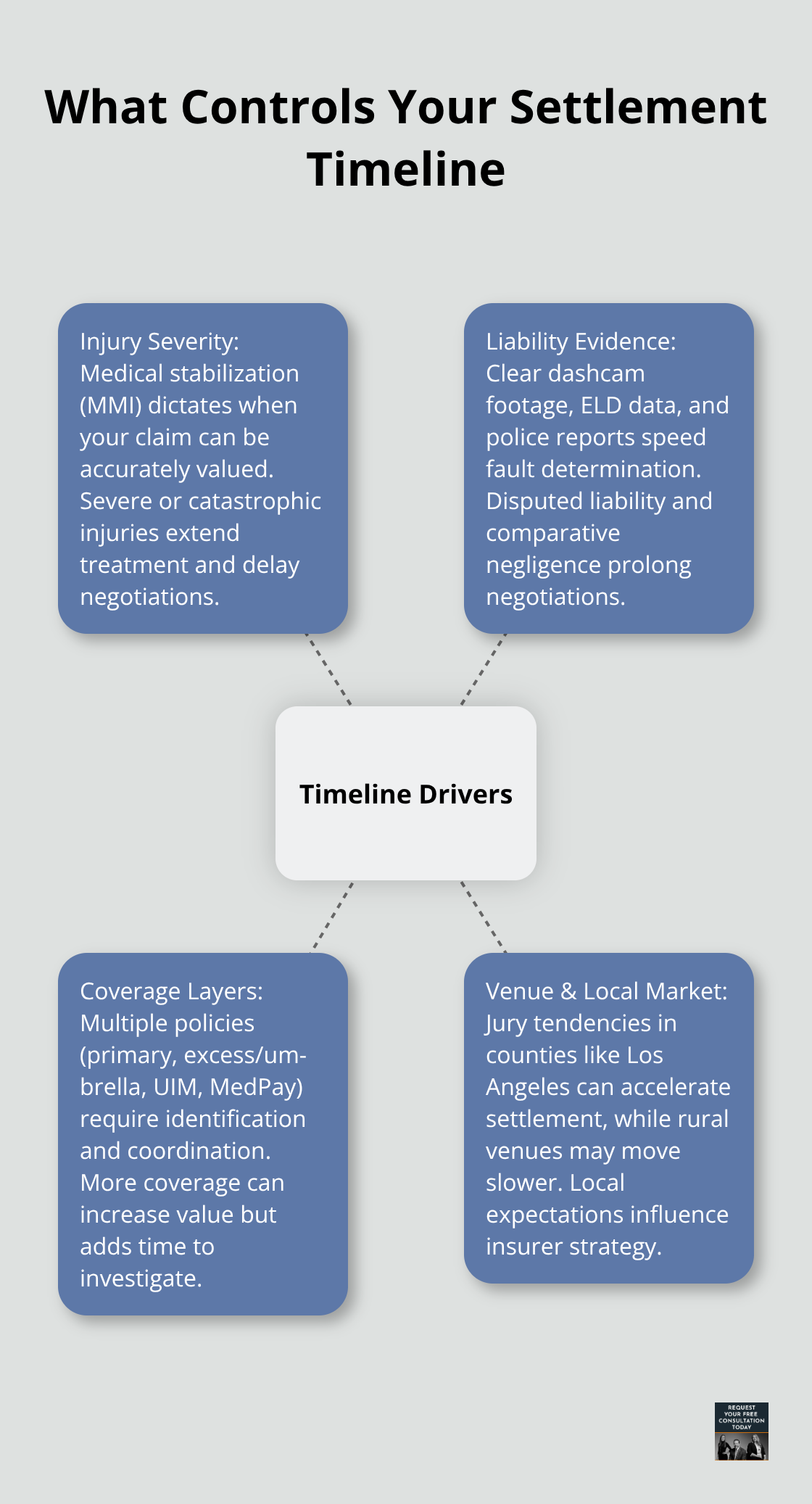
Injury severity is the single most powerful factor controlling how long your settlement takes, and it operates on a predictable medical schedule that has nothing to do with insurance company speed. Soft tissue injuries stabilize in three to six months, moderate orthopedic injuries with surgery extend to six to twelve months, severe permanent injuries stretch beyond one year, and catastrophic brain or spinal cord injuries can take two to four years or longer. The reason is straightforward: you cannot accurately value your claim until your treating physician confirms you have reached Maximum Medical Improvement, the point where your medical condition has stabilized as much as possible.
Settling before MMI is a serious mistake because you lock in damages that may not cover future surgeries, ongoing therapy, or long-term care costs. A person with a herniated disc might need revision surgery two years after the initial injury, but if you settled at six months, that future cost is no longer your insurer’s responsibility. The Insurance Research Council found that represented claimants recover on average 3.5 times more than unrepresented claimants; attorneys delay settlement until medical reality is clear.
Liability Disputes and Evidence Quality
Liability disputes are the second major timeline factor, and they vary dramatically based on evidence quality. A rear-end truck collision with dashcam footage showing clear fault settles faster than a multi-vehicle crash where comparative negligence applies. California’s pure comparative negligence rule means that even a 30 percent fault finding on your part reduces a five million dollar case to three million five hundred thousand dollars, so insurers fight hard over liability percentages.
Electronic logging device data from the truck, driver logbooks, and police reports accelerate liability resolution, but without them, disputes can stall a case for months. Federal trucking regulation violations also influence liability timelines; hours-of-service breaches, inadequate driver training, or maintenance record gaps establish per-se negligence that strengthens your position but require additional investigation time.
Insurance Coverage Layers and Available Funds
Insurance policy limits and coverage availability are the third critical factor, and this is where many injured people fail to maximize their recovery. Federal minimum coverage for intrastate trucking is seven hundred fifty thousand dollars, while interstate carriers must carry seven hundred fifty thousand to five million dollars depending on cargo type. Your own underinsured motorist coverage, medical payment coverage, and any excess or umbrella policies from the trucking company create stacked coverage layers that most people never identify without legal help.
When the at-fault truck driver’s primary policy is exhausted, you need access to the trucking company’s excess coverage, the cargo loader’s coverage, and potentially the manufacturer’s product liability coverage if equipment failure contributed to the crash. Identifying all available coverage sources takes thirty to sixty days and requires sending formal demands to each carrier, which extends timelines but dramatically increases settlement value. A case with five hundred thousand dollars in available coverage settles differently than a case with three million dollars in coverage because insurers know their exposure limits.
Venue and Local Market Factors
The venue also influences settlement speed; Los Angeles County juries tend to award higher values, which makes insurers more willing to settle quickly in that market, while rural counties may see slower movement because damage awards are historically more moderate. In Santa Cruz County, Sacramento, and Oakland, understanding local jury expectations helps your attorney position your case for faster resolution. The practical reality is that you should not rush settlement regardless of these factors. A case that takes eighteen months to resolve because you waited for MMI and gathered complete evidence is far superior to a case that settled in six months at half the value because you pushed for quick resolution. The timeline is determined by your medical recovery, not by insurance company convenience, and accepting that reality positions you for maximum recovery.
Final Thoughts
Your truck accident settlement timeline in California typically spans 12 to 36 months from the moment you hire an attorney, though straightforward cases with clear liability can resolve in 6 to 9 months. The three phases-investigation within 30 days, medical treatment and documentation over 2 to 6 months, and negotiation lasting 3 to 6 months-create a predictable framework for what to expect. Payment arrives 10 to 21 business days after you sign the settlement release, though some carriers take up to 30 days.
Realistic timeframes depend entirely on your specific situation. Soft tissue injuries settle faster than brain or spinal cord injuries because medical stability determines when settlement discussions can meaningfully begin. Liability disputes extend timelines when evidence is unclear, while straightforward rear-end collisions with dashcam footage move quickly, and insurance coverage availability also matters since cases with multiple policy layers and higher limits take longer to investigate but often yield substantially higher settlements.
Working with legal representation maximizes your recovery in ways that self-representation cannot match. An attorney identifies all liable parties, locates every available insurance policy, gathers evidence that proves liability, and delays settlement until your medical condition stabilizes-the Insurance Research Council reports that represented claimants recover on average 3.5 times more than unrepresented claimants. We at Schaar & Silva LLP help injured people in Santa Cruz County, Sacramento, and Oakland navigate this process with dedicated client service and in-depth legal knowledge, and we invite you to contact us for a free case review to understand your specific truck accident settlement timeline and settlement value.
