

Soft tissue injuries from car accidents are among the most common yet most undervalued claims in California. Insurance companies routinely offer settlements far below what these injuries actually cost you in medical bills, lost wages, and pain.
At Schaar & Silva LLP, we’ve seen firsthand how settlements for soft tissue damage can range from a few thousand dollars to six figures, depending on how well your claim is presented. The difference often comes down to documentation and knowing how to counter the tactics insurers use to minimize payouts.
What Soft Tissue Injuries Really Cost You
Soft tissue injuries are damage to muscles, tendons, ligaments, and connective tissues that don’t show up on X-rays or standard imaging. Whiplash is the most common type after car crashes, caused by rapid neck movement that strains the soft tissues in your neck and shoulders. Muscle strains, ligament sprains, tendon injuries, and contusions round out the typical injuries we see in Santa Cruz County, Sacramento, and Oakland accident cases. What makes these injuries frustrating is that they often have delayed onset-pain and symptoms can appear days or even weeks after the crash. Insurance companies exploit this delay relentlessly, arguing that if you didn’t seek medical care immediately, the injury wasn’t serious.
Get Medical Documentation Before It’s Too Late
The single biggest mistake accident victims make is waiting to see a doctor. You need medical records that directly connect your injury to the crash, and those records must be detailed and contemporaneous. A medical report from the day of or within 48 hours of your accident carries far more weight than one from two weeks later. Your doctor should document the mechanism of injury, your symptoms, imaging results if applicable, and a clear clinical assessment linking the crash to your condition. Keep invoices, receipts for all treatments, physical therapy notes, and any prescription records. Insurance adjusters review medical documentation first, and gaps or delays in your records give them ammunition to downvalue your claim. Consistent medical follow-up throughout your treatment strengthens your settlement position significantly.
Why Insurers Systematically Undervalue Soft Tissue Claims
Insurance carriers use algorithmic valuation systems like Colossus to anchor settlement offers artificially low on soft tissue cases. These systems are designed to minimize payouts on the most common injury type. They treat soft tissue injuries as minor by default unless your medical records paint an undeniably serious picture. The insurer’s adjuster will point to the lack of surgery, normal imaging results, or gaps in your treatment to justify lowball offers in the $5,000 to $15,000 range, even when your actual damages (medical bills, lost wages, and pain) far exceed that amount. California soft tissue settlements actually range from $5,000 to $50,000 or more depending on severity, yet most unrepresented victims accept offers well below the realistic range for their injury level. The carriers count on you not knowing this range exists.
How Settlement Amounts Actually Break Down
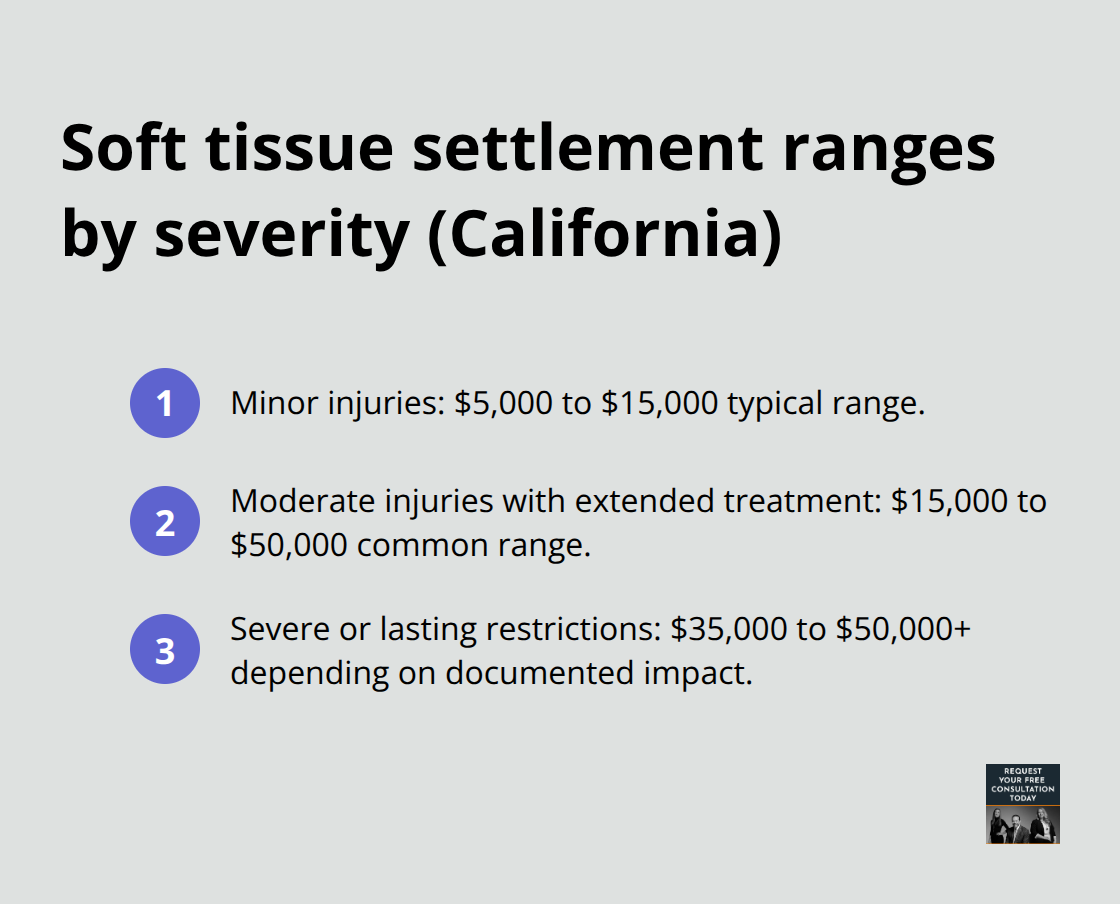
Severity determines where your case lands within that $5,000 to $50,000 range. Minor injuries typically settle in the $5,000 to $15,000 range, while moderate injuries with extended treatment (physical therapy, chiropractic care, weeks of ongoing medical attention) commonly settle in the $15,000 to $50,000 range. Your medical bills, lost wages, and documented impact on daily life all factor into the calculation.
Insurance companies will try to minimize each of these components, which is why detailed records matter. The difference between accepting a $10,000 offer and securing a $35,000 settlement often comes down to how thoroughly you document your losses and how effectively you counter the insurer’s downvaluation tactics.
Factors That Influence Soft Tissue Settlement Amounts
Injury Severity and Treatment Duration
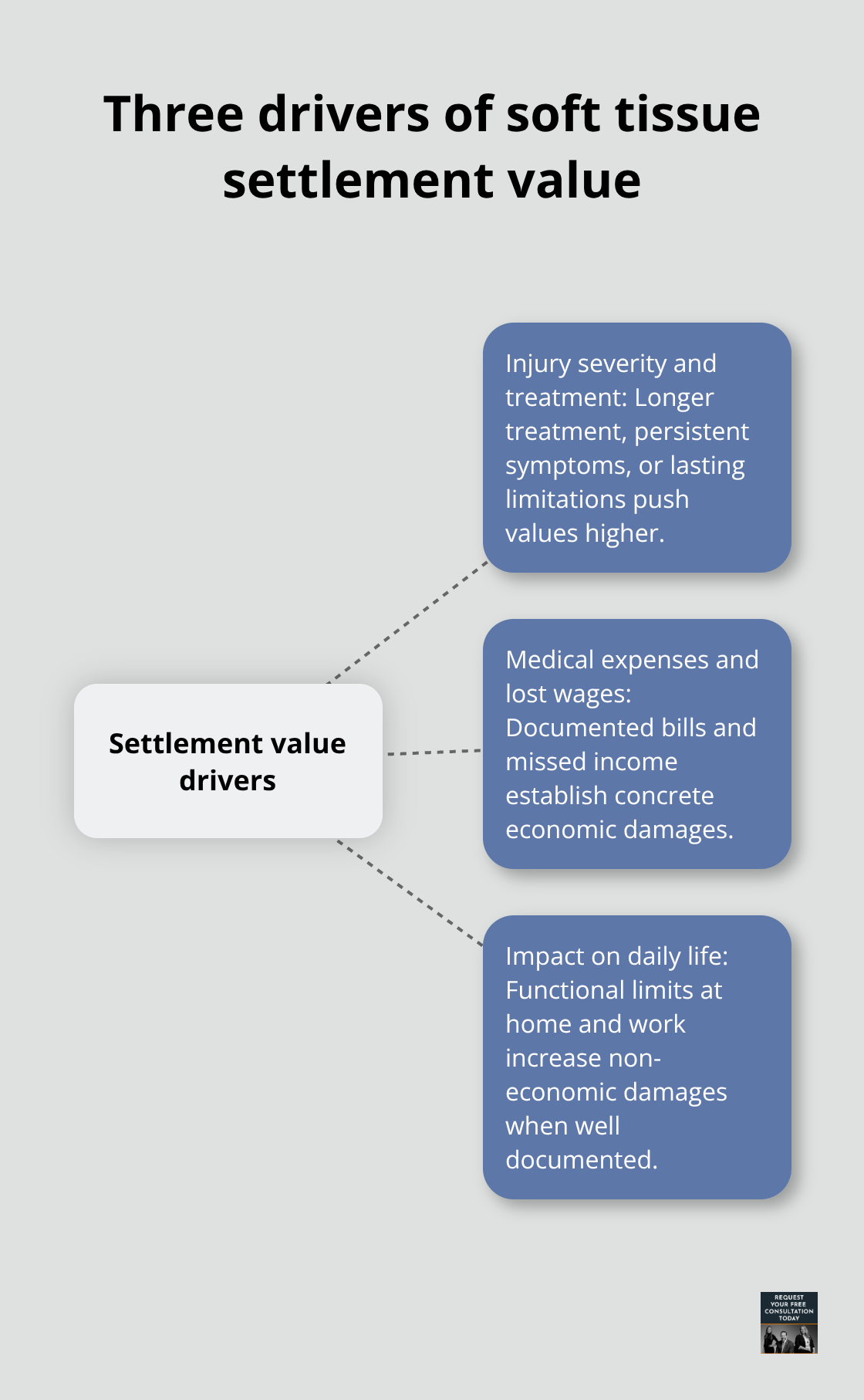
The injury severity you sustained in the crash is the primary driver of settlement value, and California courts and insurers measure this through specific clinical markers rather than vague descriptions. A soft tissue injury that resolves in four weeks with conservative treatment sits at the bottom of the settlement range, typically $5,000 to $10,000. An injury that requires twelve weeks of physical therapy, chiropractic care, or ongoing medical management moves into the $15,000 to $30,000 range. If your injury creates lasting restrictions-chronic pain that limits your ability to work, permanent loss of range of motion, or documented nerve involvement-settlements climb to $35,000 to $50,000 or higher.
The timeline between your accident and your first medical visit matters enormously. Insurance companies scrutinize this gap; a gap of more than 48 hours gives adjusters justification to discount your claim by 20 to 40 percent, regardless of how severe your injury actually is. Your medical records must show consistent treatment throughout your recovery period without unexplained gaps. If you stop seeing your doctor for three weeks, then resume treatment, insurers argue the injury resolved and you’re exaggerating current symptoms.
Medical Expenses and Lost Wages
Your actual economic losses form the foundation of any realistic settlement demand. Total medical expenses, including emergency room visits, imaging, specialist consultations, physical therapy at $150 to $250 per session, and prescription medications, typically range from $3,000 to $15,000 for moderate soft tissue cases. You must document every expense with receipts and invoices.
Lost wages carry equal weight in settlement calculations. If your injury forced you to miss work for four weeks at $1,500 per week, that’s $6,000 in documented economic damages before you even address pain and suffering. Collect pay stubs, employer statements confirming missed days, and records of lost bonuses or overtime. These documents transform vague claims into concrete numbers that insurers cannot easily dismiss.
Impact on Daily Life and Work Capacity
The impact on your daily life translates directly into non-economic damages, which California allows without caps for auto injury claims. If your soft tissue injury prevents you from lifting your children, playing sports, or performing your job duties for months, that functional loss has measurable value. Insurance companies will ask you to quantify this impact, so maintain a detailed pain journal that documents your symptoms, limitations, and how the injury affects work capacity and personal activities.
Represented claimants in California recover approximately 3.5 times more than unrepresented claimants after accounting for attorney fees, primarily because legal representation ensures thorough documentation of these three components and counters insurer downvaluation tactics systematically. This disparity underscores why how you present your case-not just what happened to you-determines whether you land at $10,000 or $40,000 within your injury range.
Understanding these three factors positions you to counter the low offers that insurers typically make first. The next section examines the specific negotiation tactics insurers deploy and how to respond effectively.
Negotiating Your Soft Tissue Settlement in California
Understanding California’s Comparative Negligence Rules
California’s pure comparative negligence rule allows you to recover damages even if you share partial fault, but insurers weaponize this principle aggressively in settlement negotiations. If you were 20 percent responsible for the accident, the insurer will anchor their initial offer as if you were 40 or 50 percent responsible, banking on you accepting the lowball number rather than fighting back. The law permits you to recover your full proportional share of damages, but only if you present evidence that directly contradicts the insurer’s inflated fault assessment.
Collect police reports, witness statements, photographs of vehicle damage patterns, and any traffic camera footage immediately after your accident. These materials establish liability clearly and prevent insurers from manufacturing shared fault where none exists. When you counter their initial offer with documented evidence of their liability, you shift negotiating power substantially in your direction.
Recognizing Lowball Tactics and Responding Effectively
Insurers deploy three consistent tactics to suppress settlement value on soft tissue claims. First, they delay their response to your demand letter, betting that financial pressure will force you to accept less. Settlement negotiations typically begin within 30 to 90 days after you report your claim, but many carriers stretch this timeline while your medical bills accumulate and you face mounting pressure. Second, they request unnecessary medical records or authorizations to create the appearance of thorough investigation while actually seeking ammunition to challenge your treatment decisions. Third, they offer a settlement that falls 40 to 60 percent below the realistic range for your injury, expecting you to counter-offer and eventually meet somewhere in the middle.
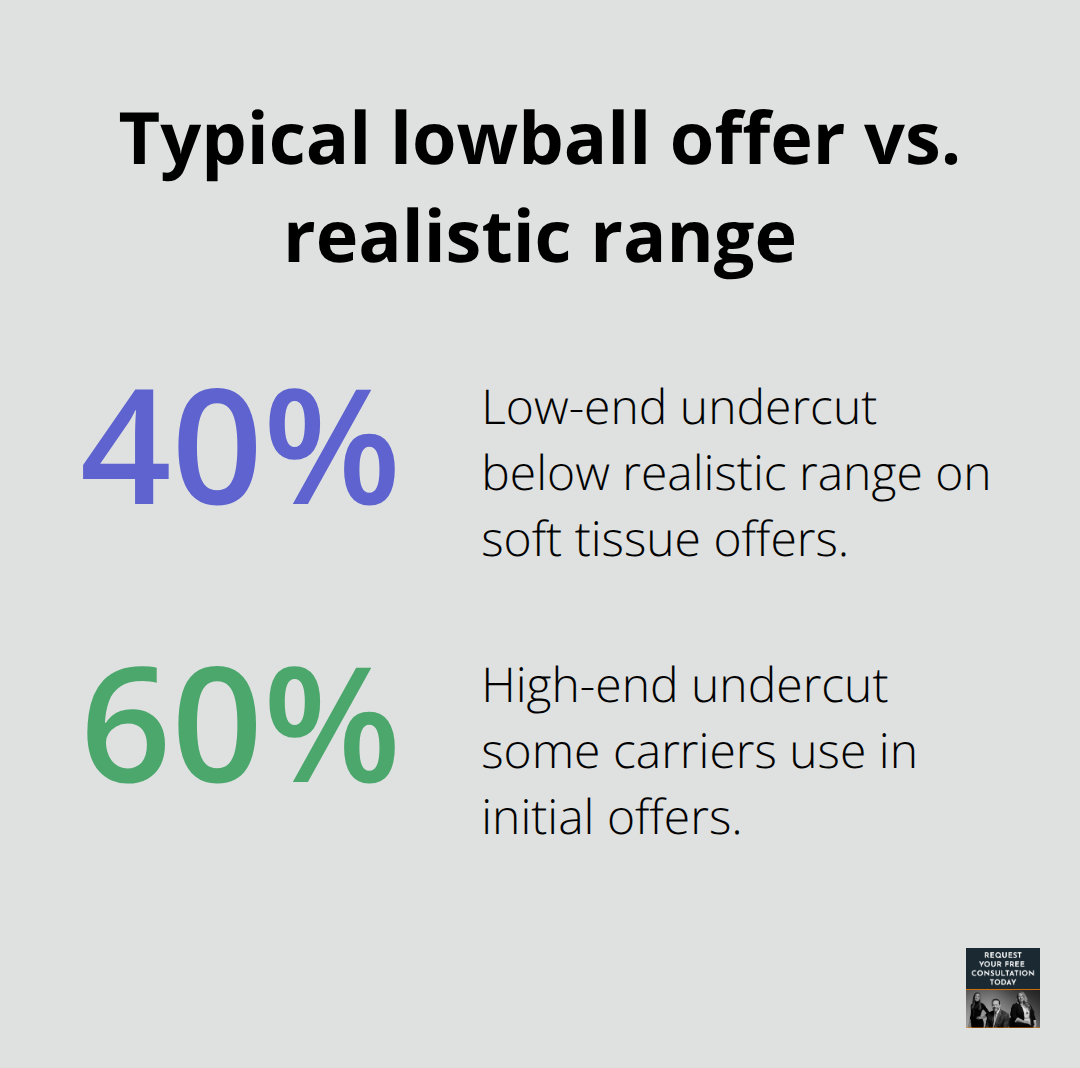
This anchoring tactic works because most unrepresented claimants lack knowledge of the actual settlement ranges for soft tissue injuries in their county and accept offers that fall far short of what comparable cases resolve for in Sacramento, Oakland, and Santa Cruz County. Do not respond to a lowball offer with a counter-offer in the middle ground. Instead, submit a detailed written response that itemizes your economic damages, references settlement ranges for comparable soft tissue injuries in your county, and explains why their liability assessment contradicts the evidence. Request a follow-up call within seven days to discuss your position. This forces the insurer to engage substantively rather than play delay games.
Building an Undeniable Evidence Package
Your settlement outcome depends entirely on the strength of evidence you present during negotiation. Medical records form the core, but you must organize and present them strategically. Create a timeline document that shows your accident date, first medical visit within 48 hours, consistent treatment throughout your recovery, and the current status of your injury. Attach all medical bills, receipts, and invoices in chronological order with subtotals for each provider type. Calculate lost wages precisely using pay stubs and employer statements rather than estimates.
Document your pain and symptoms with specific entries from your pain journal that describe functional limitations. If your injury prevents you from performing job duties, request a written statement from your employer confirming the restrictions and any lost work capacity. Photographs of visible injuries at the time of the accident strengthen soft tissue claims considerably. These materials, presented together in a single demand package, create a compelling narrative that makes denying or minimizing your damages much harder for the insurer. Represented claimants in California recover approximately 3.5 times more than unrepresented claimants because legal representation ensures this evidence is compiled, organized, and presented in a format that insurers cannot easily dismiss or downvalue.
Final Thoughts
Soft tissue settlements in California require thorough documentation, knowledge of realistic settlement ranges for your injury level, and the ability to counter insurer downvaluation tactics. You now understand that minor injuries typically settle between $5,000 and $15,000, moderate injuries between $15,000 and $50,000, and that the difference between accepting a lowball offer and securing fair compensation often comes down to how well you present your case. Medical records that connect your injury directly to the crash, detailed records of lost wages, and documentation of how the injury affects your daily life form the foundation of any credible settlement demand.
The data shows that represented claimants in California recover approximately 3.5 times more than unrepresented claimants after accounting for attorney fees. This disparity exists because legal representation ensures your evidence is compiled strategically, your demand is anchored in realistic county-specific ranges, and you have someone who understands insurer tactics well enough to counter them effectively. You should not negotiate alone against carriers that deploy algorithmic valuation systems and trained adjusters whose job is to minimize what you receive.
Contact Schaar & Silva LLP for a free case evaluation and bring your accident report, medical records, and any correspondence from the insurance company. We assess your claim against realistic settlement ranges for your injury type and county, identify gaps in your documentation, and explain exactly what your case is worth. The consultation costs nothing, and we work on a no-fee-unless-we-win basis, which means your interests and ours align completely.
