
A Sacramento rear-end accident can happen anywhere traffic stops and starts: at a red light on a busy boulevard, in stop-and-go congestion on Interstate 5 or Highway 50, or at the end of an off-ramp where cars back up without warning. These collisions are often described as fender benders, yet the force of being struck from behind can cause neck, back, and head injuries that affect your work and daily life for months. Knowing how fault is decided gives you real control over your claim and helps you avoid the mistakes that quietly weaken it.
At Schaar & Silva LLP, we help people in Sacramento who have been hurt in car and truck accidents so you can move forward with confidence. This guide explains how rear-end crashes actually happen, how California law decides who is responsible, and the missteps that most often derail an otherwise strong case.
How Sacramento Rear-End Accidents Actually Happen
Sacramento’s mix of freeways, wide arterial streets, and dense downtown blocks creates constant changes in speed. Commuters move from free-flowing traffic into sudden slowdowns near interchanges, and drivers on surface streets face frequent signals, turning vehicles, and pedestrians. A moment of inattention in any of these settings is enough to close the gap between two cars.
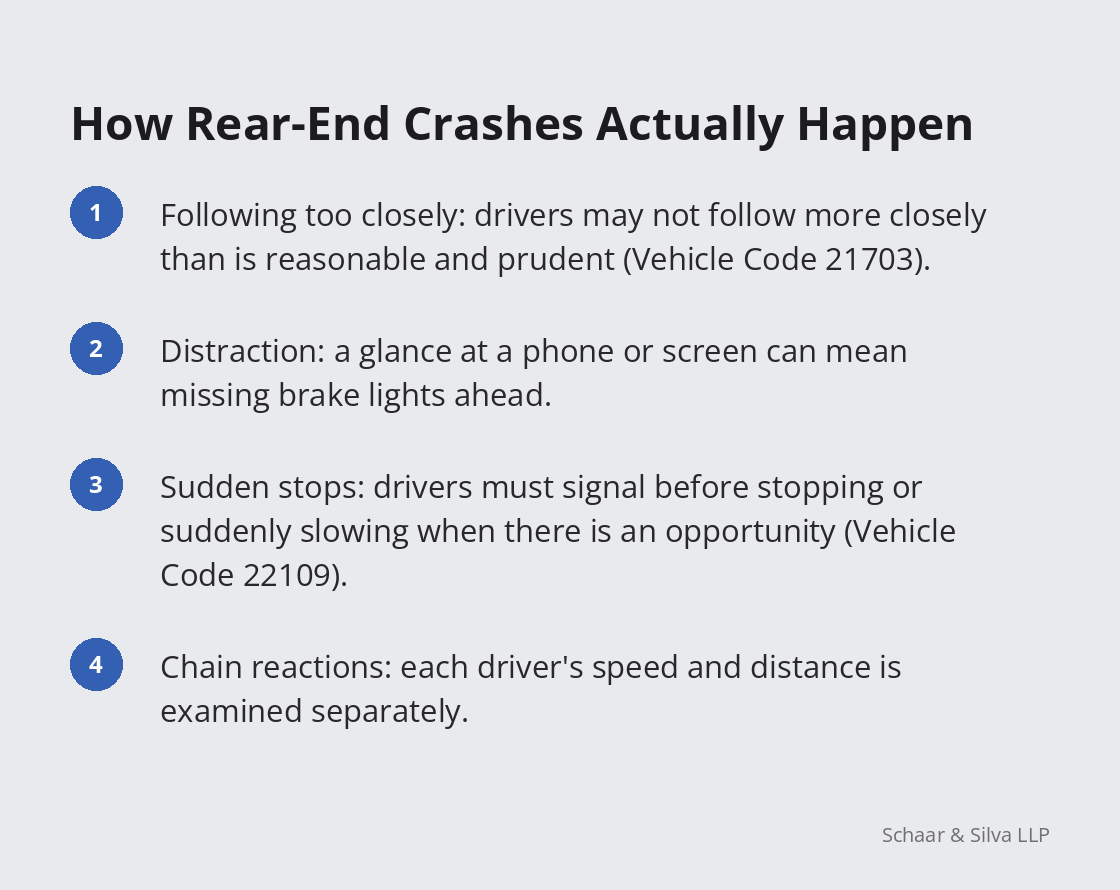
Most rear-end crashes fall into a handful of patterns. Identifying the pattern in your collision points to the driving rule that was likely broken and the evidence that will matter most.
Following Too Closely in Stop-and-Go Traffic
Tailgating is the most common cause of rear-end collisions. California Vehicle Code Section 21703 provides that the driver of a motor vehicle shall not follow another vehicle more closely than is reasonable and prudent, having due regard for the speed of that vehicle and the traffic upon, and the condition of, the roadway. The rule does not set a fixed number of car lengths. Instead, it asks whether the following distance was reasonable for the speed and conditions at that moment.
On a congested freeway where traffic can drop from highway speed to a crawl within seconds, a driver who stays close to the bumper ahead leaves no time to react. When the lead car brakes, the following driver often cannot stop in time.
Distracted and Inattentive Drivers
Many rear-end crashes happen because the following driver simply was not looking. A glance at a phone, a navigation screen, or a passenger can be long enough to miss brake lights ahead. Signalized intersections along major Sacramento corridors are common locations for these crashes, especially when one car stops for a yellow light and the driver behind expects it to keep going.
Distraction is rarely admitted at the scene, which is why phone records, vehicle data, and witness accounts can become important in proving what really happened.
Sudden Stops, Lane Changes, and Chain Reactions
Not every rear-end collision is entirely the rear driver’s fault. Vehicle Code Section 22109 prohibits a driver from stopping or suddenly decreasing speed on a highway without first giving an appropriate signal to the driver of any vehicle immediately to the rear when there is an opportunity to give that signal. A driver who cuts into a lane and then brakes hard, or who stops abruptly for no traffic reason, may share responsibility.
Multi-vehicle chain reactions add complexity. When one car strikes another and pushes it into a third, each driver’s speed, following distance, and timing must be examined separately to sort out who caused which impact.
How Fault Is Determined After a Sacramento Rear-End Accident
Insurance companies often start from the assumption that the driver in the back is responsible. That assumption is frequently correct, but it is not automatic. Fault depends on the facts, and the outcome of your claim depends on how well those facts are documented.
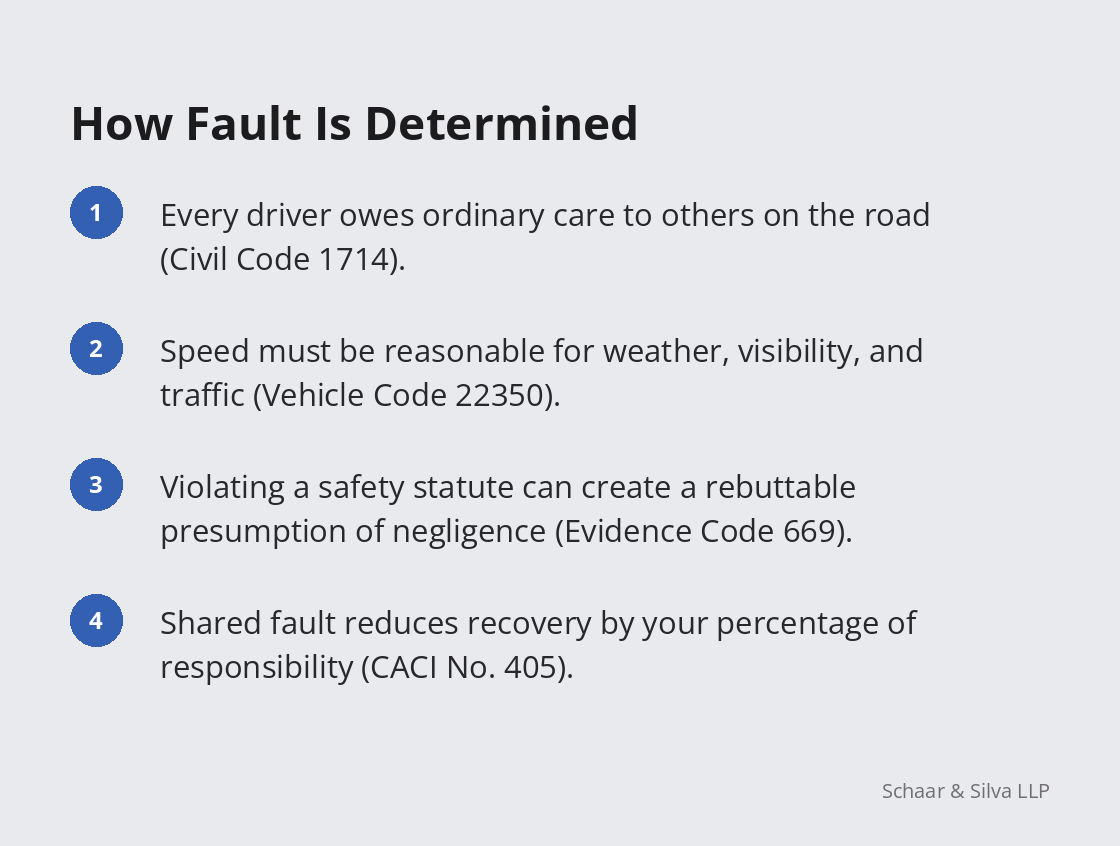
California law gives adjusters and courts a framework for measuring each driver’s conduct and dividing responsibility when more than one person contributed to the crash.
The Duty of Ordinary Care and the Basic Speed Law
California Civil Code Section 1714 provides that everyone is responsible for an injury caused to another by a want of ordinary care or skill in the management of his or her property or person. For drivers, ordinary care includes watching the road ahead, keeping a safe distance, and adjusting speed to traffic.
Vehicle Code Section 22350, the basic speed law, prohibits driving at a speed greater than is reasonable or prudent having due regard for weather, visibility, traffic, and the surface and width of the highway, and in no event at a speed that endangers the safety of persons or property. A driver can follow the posted limit and still be driving too fast for the heavy traffic or rain in front of them.
Traffic Violations and the Presumption of Negligence
Under California Evidence Code Section 669, a person’s failure to exercise due care is presumed if that person violated a statute, the violation caused the injury, the injury resulted from the kind of occurrence the statute was designed to prevent, and the injured person was among those the statute was meant to protect. Following-distance and speed rules are written to prevent exactly this kind of collision, so proof of tailgating can be persuasive.
The presumption can be rebutted. The rear driver may argue that the lead car stopped without reason or cut in without warning. That is why independent evidence, rather than one driver’s word against another’s, so often decides these disputes.
Shared Fault Under California Law
California uses comparative fault. Under the Judicial Council’s civil jury instructions, CACI No. 405, if the defendant proves that the injured person was partly responsible for the harm, the injured person’s damages are reduced by the percentage of their own responsibility. A lead driver with broken brake lights, for example, could be assigned part of the blame even though the other driver struck from behind.
Being partly responsible does not erase your claim. Careful documentation helps keep any share of fault assigned to you accurate rather than inflated.
Mistakes That Can Derail Your Sacramento Rear-End Accident Claim
Rear-end claims often look straightforward, which can make people less careful about protecting them. Insurers know that small gaps in evidence or treatment can be used to argue that a crash was minor or that injuries came from somewhere else.
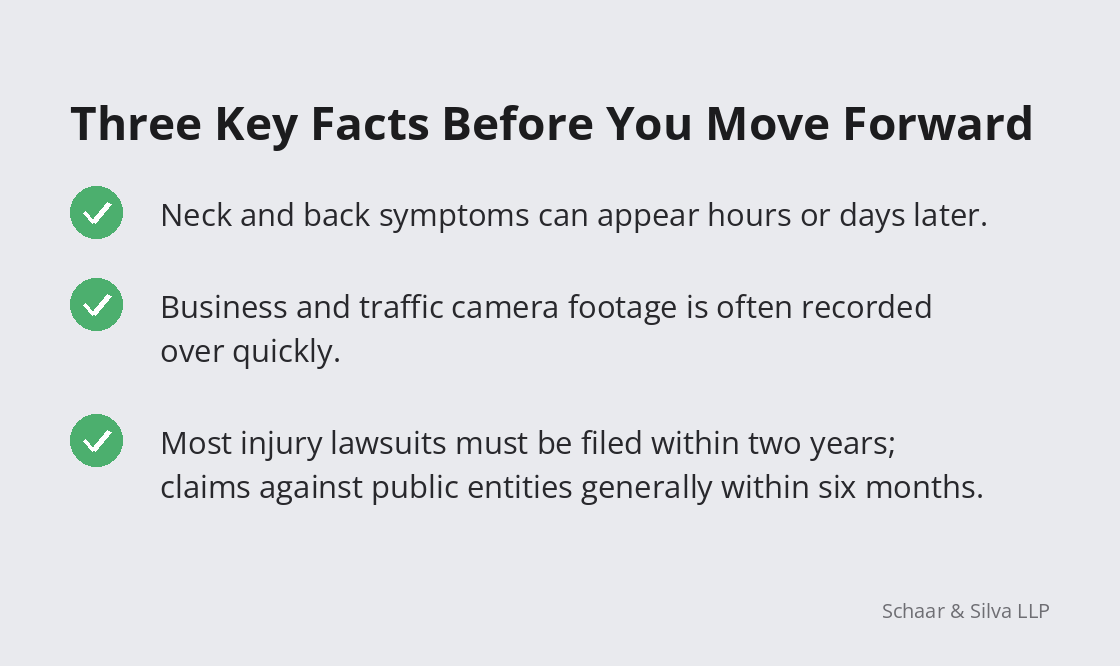
Avoiding the problems below helps protect both your health and the strength of your claim.
Downplaying Neck and Back Pain
The sudden back-and-forth motion of a rear impact commonly causes soft-tissue injuries to the neck and back, and symptoms may not appear until hours or days later. People who feel only stiffness at the scene sometimes decline care and later discover they are seriously hurt. Getting evaluated promptly protects your health and creates a medical record that ties your symptoms to the collision.
Keeping your follow-up appointments matters just as much. Long gaps between visits give insurers an opening to argue that you recovered quickly or that something else caused your pain.
Failing to Preserve Evidence
Photographs of both vehicles, the roadway, skid marks, and traffic signals can help show speed and following distance. Many Sacramento intersections and businesses have cameras whose footage is recorded over quickly, so identifying them early is important. Witness names and phone contacts, along with any dashcam video, can confirm whether the lead car stopped normally or braked without warning.
Freeway crashes are often handled by the California Highway Patrol, while collisions on city streets are typically handled by local police or the sheriff’s office. Knowing which agency responded helps you request the right report. If your crash involved a merge or lane change on the freeway, our guide to a Sacramento freeway accident explains how those claims are evaluated.
Overlooking Reporting Duties and Deadlines
California law imposes duties at the scene and afterward. Vehicle Code Section 20001 requires a driver involved in an accident resulting in injury to another person or death to immediately stop at the scene and fulfill the duties the law requires. Vehicle Code Section 16000 requires a driver involved in an accident that results in bodily injury or death, among other situations, to report it to the DMV within 10 days on an approved form, separate from any police report.
For most injury lawsuits, Code of Civil Procedure Section 335.1 generally allows two years to file. If a public entity may be responsible, such as when a city bus or government vehicle caused the crash, Government Code Section 911.2 generally requires a claim for personal injury to be presented no later than six months after the cause of action accrues. Missing that deadline can seriously limit your options.
Final Thoughts
A Sacramento rear-end accident can leave you with injuries that are more serious than the vehicle damage suggests, along with an insurer eager to minimize what happened. California’s following-distance rule, the basic speed law, the duty of ordinary care, and comparative fault principles all shape how responsibility is decided.
The steps you take early, from getting medical care to preserving video and witness information, often have the greatest effect on how your claim unfolds. You do not have to navigate these questions on your own.
If you were hurt in a rear-end crash anywhere in Sacramento, contact Schaar & Silva LLP to talk with our team about what happened. We will review the evidence, explain your options, and help you take the next step with confidence.