
A Sacramento freeway accident can happen in a split second. One driver drifts across a lane line on Interstate 80, another cuts over to catch an exit on Highway 50, or traffic on Interstate 5 slows suddenly and the car behind you does not. Afterward, the questions come quickly: who caused the crash, how fault gets proven when several cars were involved, and what you need to do now to protect your health and your claim. Understanding how freeway crash claims actually work gives you real control over what happens next.
At Schaar & Silva LLP, we help people in Sacramento who have been hurt in car accidents, truck accidents, and other serious crashes on the region’s busy freeways. This guide explains the rules of the road that decide fault in a freeway collision, the steps that protect your claim, and the mistakes that most often weaken a case, so you can move forward with confidence.
How Fault Actually Works in a Sacramento Freeway Accident
Freeway crashes feel chaotic, but the law that decides responsibility is fairly orderly. California’s Vehicle Code sets clear expectations for how drivers must change lanes, keep their distance, and choose a safe speed. When a driver breaks one of those rules and someone is hurt, that rule often becomes the center of the injury claim.
The Basic Duty Every Driver Owes
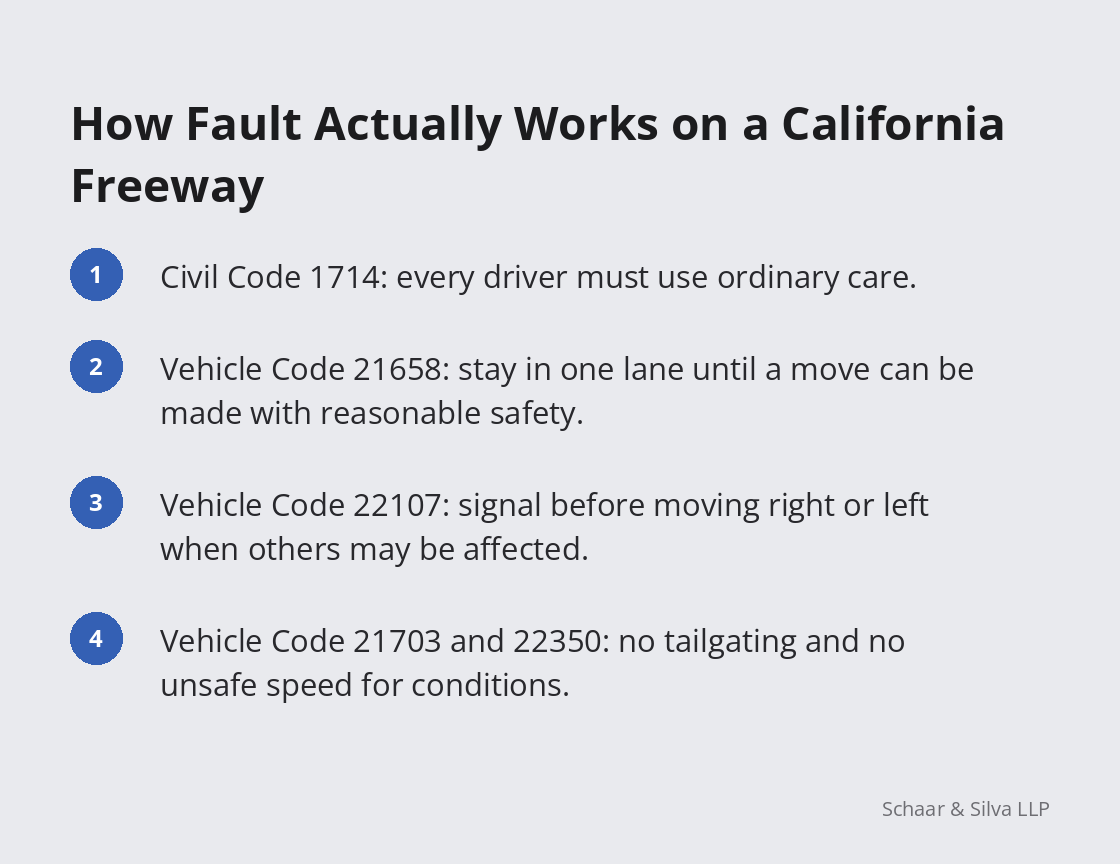
Every injury claim after a crash starts with the idea of ordinary care. California Civil Code 1714 states that everyone is responsible for an injury occasioned to another by his or her want of ordinary care or skill in the management of his or her property or person. On a freeway, ordinary care means paying attention at high speed, watching mirrors and blind spots, and adjusting to traffic that can change in an instant. A driver who is texting, drowsy, or weaving through traffic near the Interstate 5 and Interstate 80 interchange is not meeting that standard, and the people they injure may hold them responsible.
Lane Change Rules That Decide Many Freeway Claims
Unsafe lane changes are among the most common causes of multi-lane freeway collisions. Vehicle Code 21658 provides that when a roadway has been divided into two or more clearly marked lanes for traffic in one direction, a vehicle shall be driven as nearly as practical entirely within a single lane and shall not be moved from the lane until such movement can be made with reasonable safety. Vehicle Code 22107 adds that no person shall move right or left upon a roadway until the movement can be made with reasonable safety, and then only after giving an appropriate signal when another vehicle may be affected. Under Vehicle Code 22108, a signal of intention to turn right or left must be given continuously during the last 100 feet traveled before turning. When a driver merges into your lane without looking or signaling, these sections help show that the driver failed to follow the rules every motorist is expected to know.
Following Distance and Speed on Crowded Freeways
Many freeway crashes are chain reactions that begin when traffic slows and a driver is following too closely. Vehicle Code 21703 states that a driver shall not follow another vehicle more closely than is reasonable and prudent, having due regard for the speed of such vehicle and the traffic upon, and the condition of, the roadway. California’s basic speed law, Vehicle Code 22350, says no person shall drive at a speed greater than is reasonable or prudent having due regard for weather, visibility, the traffic on, and the surface and width of, the highway. That means a driver can be careless even while staying under the posted limit, for example by keeping freeway speed in dense Tule fog, heavy rain, or stop-and-go commute traffic on Business 80.
Steps to Protect Your Claim After a Freeway Crash
The hours and days after a freeway collision are when the most important evidence is easiest to capture. Vehicles get towed, skid marks fade, and witnesses drive away. A few organized steps help you keep the facts you need and avoid giving the other side easy arguments.
Who Investigates Crashes on Sacramento Freeways
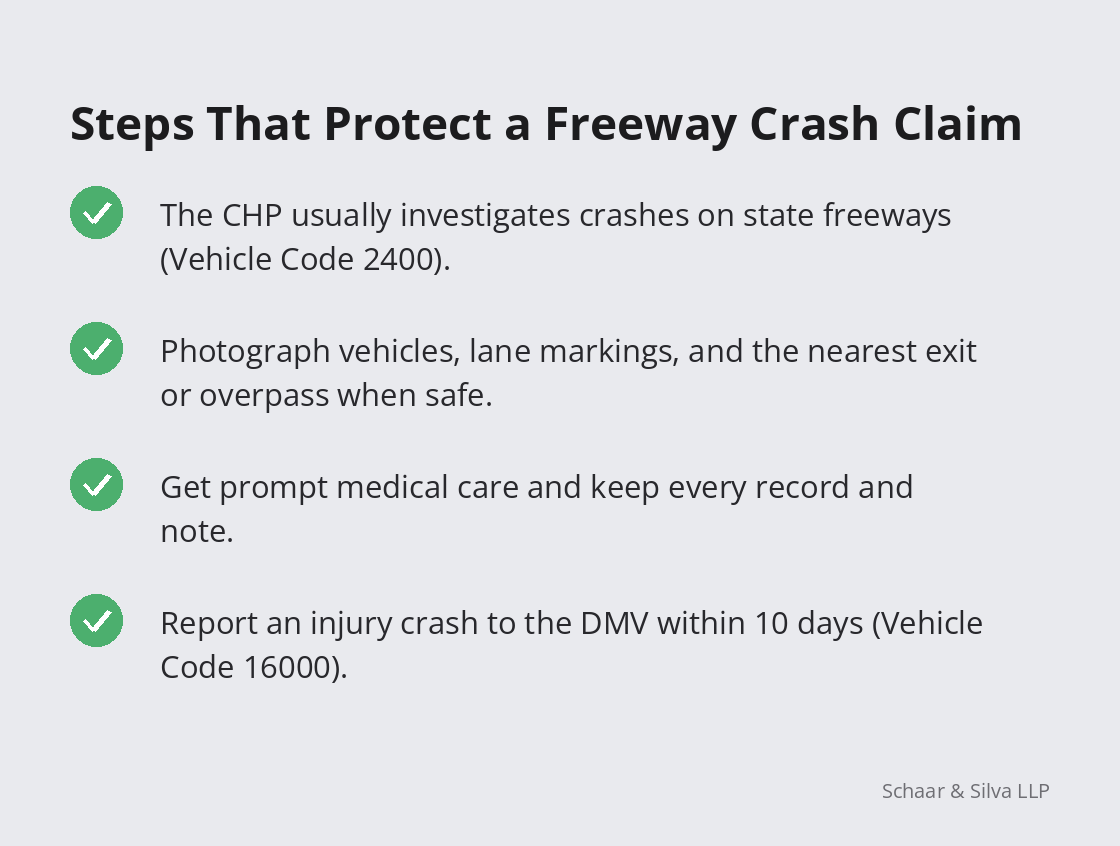
On state freeways, the California Highway Patrol usually leads the investigation. Vehicle Code 2400 gives the CHP commissioner full responsibility and primary jurisdiction for the administration and enforcement of the laws, and for the investigation of traffic accidents, on state highways constructed as freeways. That means the collision report for a crash on Interstate 5, Interstate 80, Highway 50, or Highway 99 will often come from the CHP rather than a city police department. Before you leave the scene, write down the officer’s name and the report number if one is given, and ask how you can request a copy of the report later. Our guide on how to get and use a Sacramento police report explains how a collision report fits into a claim.
Documenting a Fast-Moving Scene Safely
Your safety comes first on a freeway shoulder, so only gather evidence when it is safe to do so. If you can, photograph the position of each vehicle, the damage, the lane markings, any debris, and the road and weather conditions. Note the nearest exit, mile marker, or overpass so the location can be identified later. Ask witnesses for their names and phone numbers, because freeway witnesses rarely stay long. If you are hurt, let emergency responders treat you and ask a passenger or family member to help collect information afterward.
Getting Medical Care and Keeping Records
Freeway crashes involve high forces, and injuries such as whiplash, concussions, and back injuries are not always obvious at the scene. Getting checked promptly protects your health and creates a medical record that connects your symptoms to the collision. Keep copies of visit summaries, imaging results, therapy notes, and work restrictions. A short daily journal describing pain, sleep, and the activities you can no longer do also helps show how the injury has affected your life in ways medical charts alone cannot capture.
Reporting Requirements You Should Know
California has its own reporting rule in addition to the police report. Under Vehicle Code 16000, the driver of a vehicle involved in an accident on a street or highway that results in bodily injury or the death of any person must report the accident to the Department of Motor Vehicles within 10 days after the accident, either personally or through an insurance agent, broker, or legal representative. This report is separate from anything the CHP prepares, and missing it can create problems with your driving privilege. You should also notify your own insurance company promptly, but be careful about giving recorded statements to the other driver’s insurer before you understand your rights.
Mistakes That Weaken a Sacramento Freeway Accident Claim
Strong freeway claims are often weakened by avoidable missteps rather than by the facts of the crash. Knowing the most common problems helps you avoid them and keep the focus on the driver who caused the collision.
Assuming Shared Fault Ends Your Claim
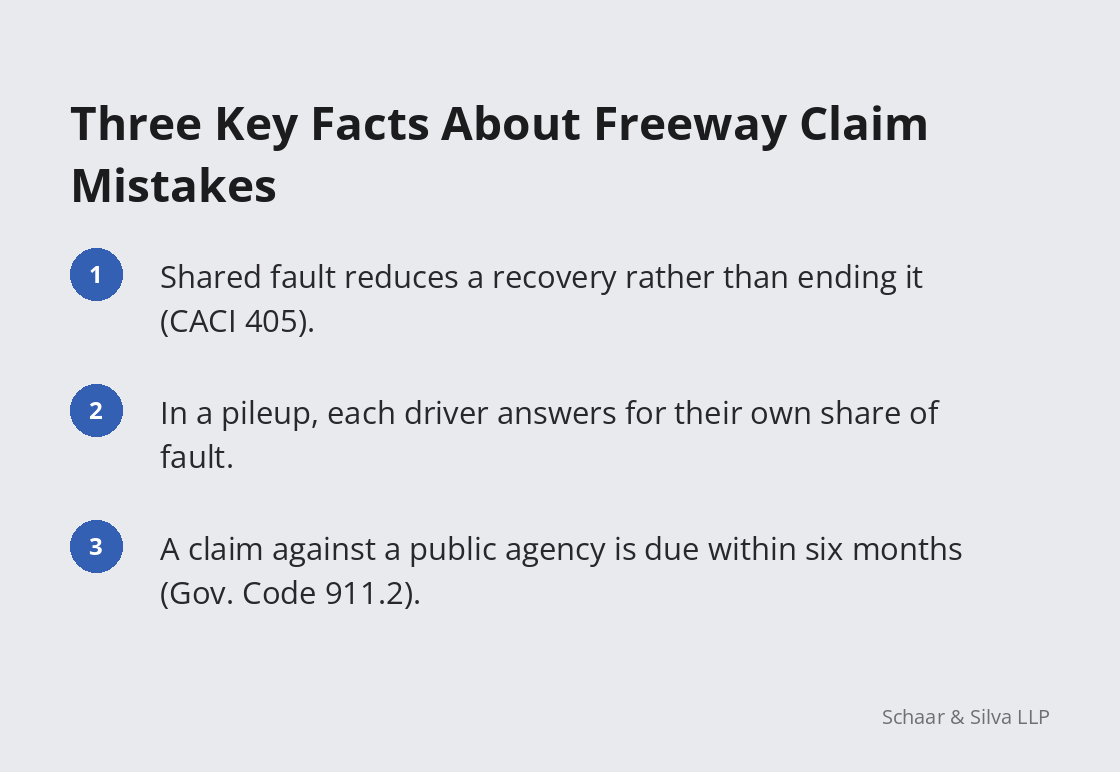
Many people assume that if they were partly at fault, for example by braking hard or changing lanes themselves, they cannot recover anything. California does not follow that all-or-nothing approach. Under the comparative fault rule reflected in California Civil Jury Instruction 405, a jury that finds an injured person partly responsible reduces that person’s damages by their percentage of responsibility rather than eliminating the claim. Insurers sometimes overstate a driver’s share of fault to reduce a claim, so it is worth having the evidence reviewed carefully before accepting their version of events.
Overlooking Other Drivers in a Multi-Car Crash
Freeway pileups can involve several drivers who each contributed to the harm. Civil Code 1431.2 provides that in an action based on comparative fault, each defendant’s liability for non-economic damages, such as pain, suffering, and emotional distress, is several only and is allocated in direct proportion to that defendant’s percentage of fault. In practical terms, if you focus only on the driver who struck you last, you may miss another driver whose lane change or sudden stop started the chain reaction. Identifying every responsible party early helps make sure each one answers for their share.
Missing a Road Condition or Public Agency Claim
Some freeway crashes involve more than driver error. A worn lane marking, a poorly placed work zone, or another hazard on the roadway may play a role. Under Streets and Highways Code 90, the California Department of Transportation has full possession and control of all state highways. Government Code 835 allows a claim against a public entity for injury caused by a dangerous condition of its property when specific requirements are met, including that the condition created a reasonably foreseeable risk of the kind of injury that occurred. These claims have a much shorter timeline: Government Code 911.2 requires a claim for personal injury to be presented not later than six months after the cause of action accrues.
Waiting Too Long to Act
Even when no public agency is involved, time limits still apply. Code of Civil Procedure 335.1 sets a two-year period for an action for injury to, or for the death of, an individual caused by the wrongful act or neglect of another. Waiting also makes evidence harder to find, since vehicle data, nearby business video, and witness memories fade over time. Acting early gives you the best chance of preserving the facts that show what really happened on the freeway.
Final Thoughts
A Sacramento freeway accident can turn an ordinary commute into months of medical visits, missed work, and difficult conversations with insurance companies. The rules that decide fault, from safe lane changes to following distance and the basic speed law, give injured people a clear way to show what went wrong. Careful documentation, prompt medical care, and attention to deadlines keep those rules working in your favor.
You do not have to sort through a multi-lane crash, a CHP report, and competing insurance stories on your own. Our team can review the evidence, identify every driver or agency that may share responsibility, and explain your options in plain language. If you are still working through the first steps, our guide on what to do immediately after a Sacramento car accident is a helpful place to start.
If you were hurt in a freeway crash on Interstate 5, Interstate 80, Highway 50, or anywhere in the Sacramento area, contact Schaar & Silva LLP to speak with our team. We will listen to your story, answer your questions, and help you move forward with confidence.