
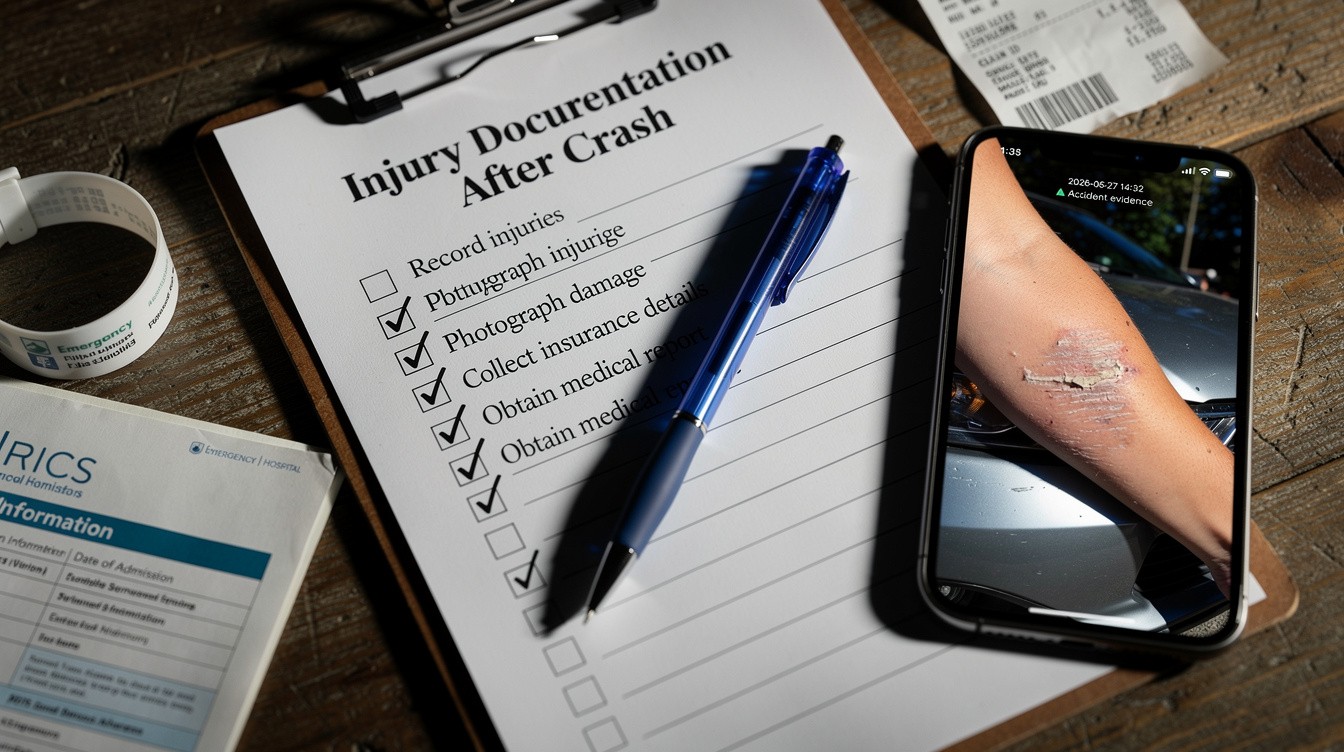
After a crash in California, most people focus on getting medical help and dealing with insurance. What they often miss is that injury documentation after a crash becomes the foundation of any claim you might file later.
We at Schaar & Silva LLP have seen countless cases where weak documentation cost people thousands in compensation. The difference between a strong claim and a weak one often comes down to what you recorded in those first hours and days after the accident.
What to Document at the Crash Scene
The first few hours after a crash determine whether your injury claim will be strong or weak. Most people wait until they get home to think about documentation, but that delay costs them money. Visual evidence captured immediately at the scene carries far more weight than anything recorded days later.
Photograph visible injuries at the accident location
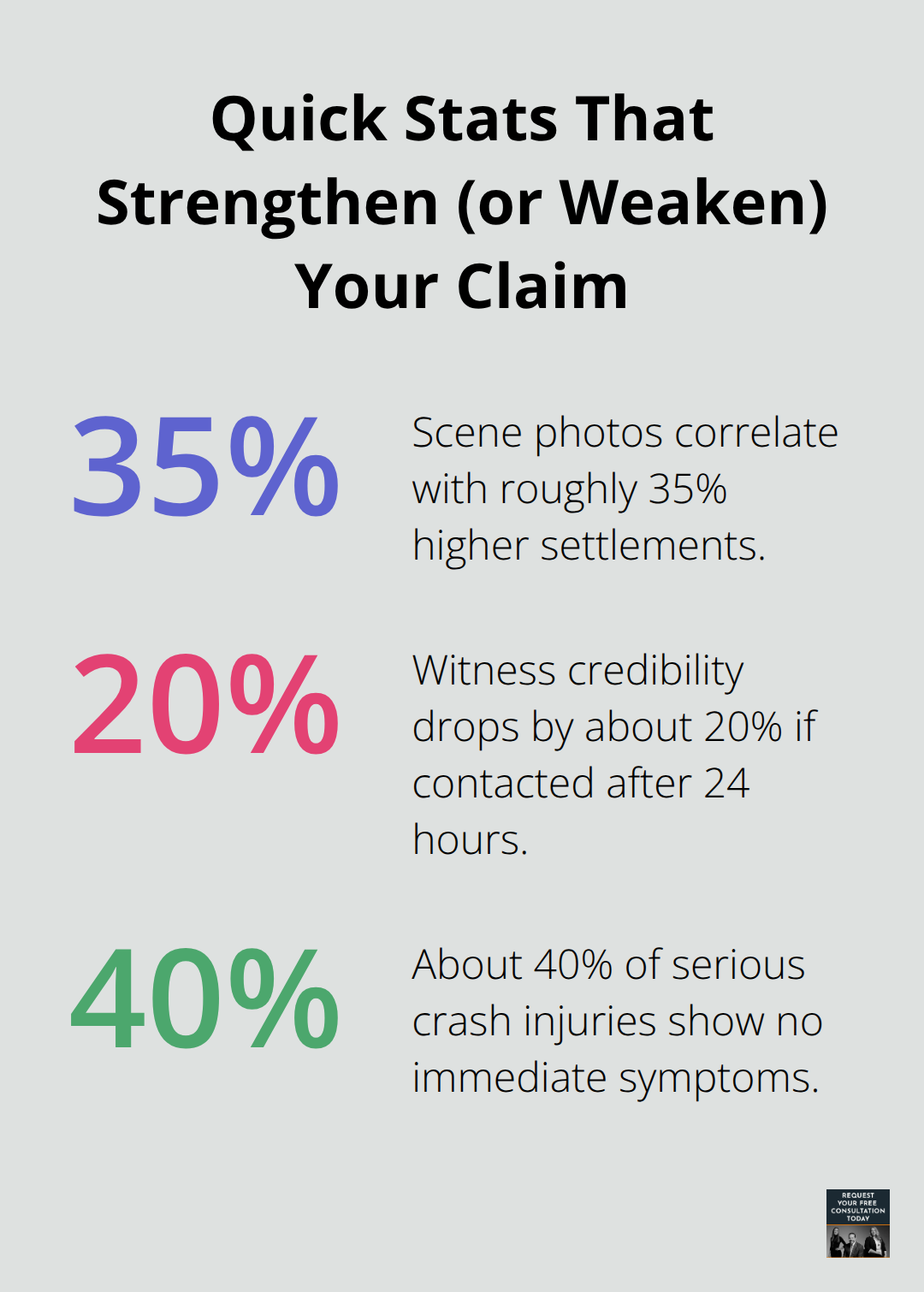
Take photos of any visible injuries while you remain at the accident location-swelling, cuts, bruising, or any visible wound. Use your phone camera and capture multiple shots from different angles. If a witness sees your injuries at the scene, that observation becomes far more credible than a medical photo taken a week later. Research shows that cases with visual evidence of injuries at the scene settle for roughly 35 percent higher amounts than cases without scene documentation.
Do not wait for perfect lighting or a better angle; photograph what you see immediately, even if the images are blurry or poorly framed. Those raw, unpolished photos often carry more credibility than professional-looking ones because they appear unmanipulated.
Record video statements while witnesses remain present
Video statements made at the scene hold enormous power in your claim. Use your phone to record a short video where you describe your pain, visible injuries, and symptoms while standing at the accident location. Speak clearly and mention specific areas of pain-your neck, back, shoulder, or anywhere you feel injury. This video should last 30 seconds to two minutes; longer recordings do not improve your claim.
The critical element is that this recording happens at the scene while witnesses can corroborate what they observe about your condition. Insurance companies and juries find scene videos far more persuasive than written descriptions recorded weeks later because they capture your actual state immediately after impact.
If you cannot record yourself due to shock or pain, ask a witness to record a statement where they describe what they observed about your injuries and your condition at that moment. Witness observations made on video at the scene create a timestamped record that protects against claims that your injuries developed later or were exaggerated.
Collect witness contact information immediately
Collect the phone numbers and names of anyone who saw your injuries or heard you describe your pain at the accident location. Contact these witnesses within 24 hours to confirm their availability and willingness to provide a statement; witness credibility drops by roughly 20 percent when contacted more than 24 hours after an accident.
Write down the full names, phone numbers, and email addresses of everyone at the scene who observed your physical condition. Do not rely on memory; write this information down immediately while you remain at the location. If a witness has a business card, photograph it with your phone.
Ask each witness specifically what they observed about your injuries or symptoms-did they see you limping, hear you say you were in pain, or notice visible wounds. Document their answers in writing. This specificity matters far more than a generic statement that someone was present. When you later contact an attorney about your claim, you will have concrete witness information ready to provide, which accelerates the investigation process and prevents evidence loss.
The documentation you gather at the scene forms only the first layer of your injury record. What happens next-in the hours and days following the crash-determines whether your medical evidence will support a strong claim or leave gaps that insurance companies will exploit.
Medical Records That Prove Your Injury Claim
Emergency room records and hospital documentation create the strongest foundation for any injury claim because they establish a direct link between the crash and your medical treatment. Visit the emergency room immediately after the accident, even if you feel only minor pain or think your injuries are not serious. About 40 percent of serious injuries from vehicle crashes do not produce immediate symptoms; many develop over hours or days as swelling and inflammation increase.
Document your emergency room visit
When you arrive at the emergency room, tell the medical staff exactly how the crash happened and describe every area where you feel pain, pressure, or discomfort. The medical record will document your arrival time, your reported symptoms, and the physician’s clinical findings. This timestamped record proves you sought treatment on the day of the accident, which insurance companies view as credible evidence that your injuries stem directly from the crash rather than from something that happened later.
Collect and organize all medical records
Request copies of all medical records from every healthcare provider you visit after the accident. This includes emergency room reports, imaging reports like X-rays and MRI results, follow-up appointment notes from your primary care physician, and records from any specialists you see for orthopedic care, neurology, or physical therapy. California law gives you the right to obtain these records within 15 business days of your request. Do not wait until you file a claim to gather these documents; collect them continuously as you receive treatment.
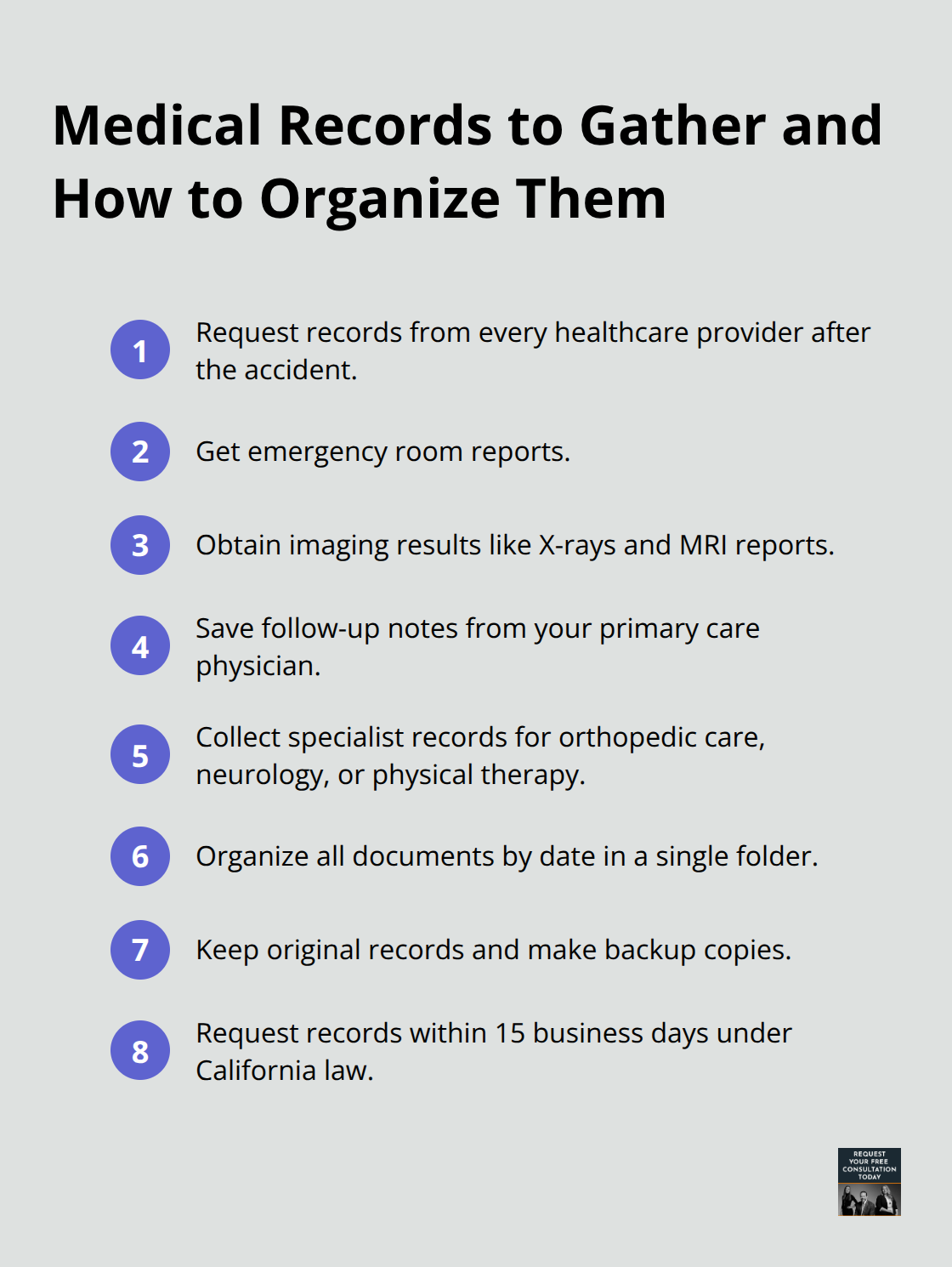
Organize them by date in a single folder, either physical or digital, so you can quickly provide them to an attorney if your case moves forward. Medical documentation accounts for roughly 40 to 45 percent of total injury compensation in California claims, meaning incomplete records directly reduce the money you receive. Keep original records and make backup copies because medical offices sometimes lose documents or take months to respond to record requests.
Request detailed functional impact notes from your physician
When you visit a doctor for follow-up care, ask the physician to document not just your physical examination findings but also how your injuries affect your ability to work, sleep, exercise, and perform daily activities. A physician’s note stating that your neck pain prevents you from lifting more than ten pounds or that your back injury makes sitting at a desk for eight hours impossible carries substantial weight in settlement negotiations. Imaging reports matter enormously; an MRI showing a disc herniation or a fracture provides objective evidence that your injury is real and not imaginary.
Insurance adjusters scrutinize cases where medical imaging shows no abnormality, so if your symptoms persist without imaging confirmation, your physician should document why imaging was not performed or why it did not reveal the underlying injury. These detailed notes transform your medical file from a simple record of treatment into a powerful narrative that connects your crash directly to your ongoing limitations.
Your Personal Injury Journal
Start documenting immediately after the crash
A personal injury journal is not optional documentation; it is the single most powerful tool you control after a crash. Insurance companies and juries weight your own daily observations far more heavily than medical records alone because your journal captures what medical records cannot: how your injuries actually disrupted your life. Start your journal the day of the accident and maintain it continuously until your case resolves. Write entries every evening, even if you only spend five minutes on each one. The consistency matters far more than lengthy entries.
Each entry should note the date, time, and specific areas where you experienced pain or discomfort during that day. Write exactly what you felt, not what you think sounds serious. If your headache was mild in the morning but severe by afternoon, write that progression. If you could not sleep because of back pain, document the specific hours you were awake.
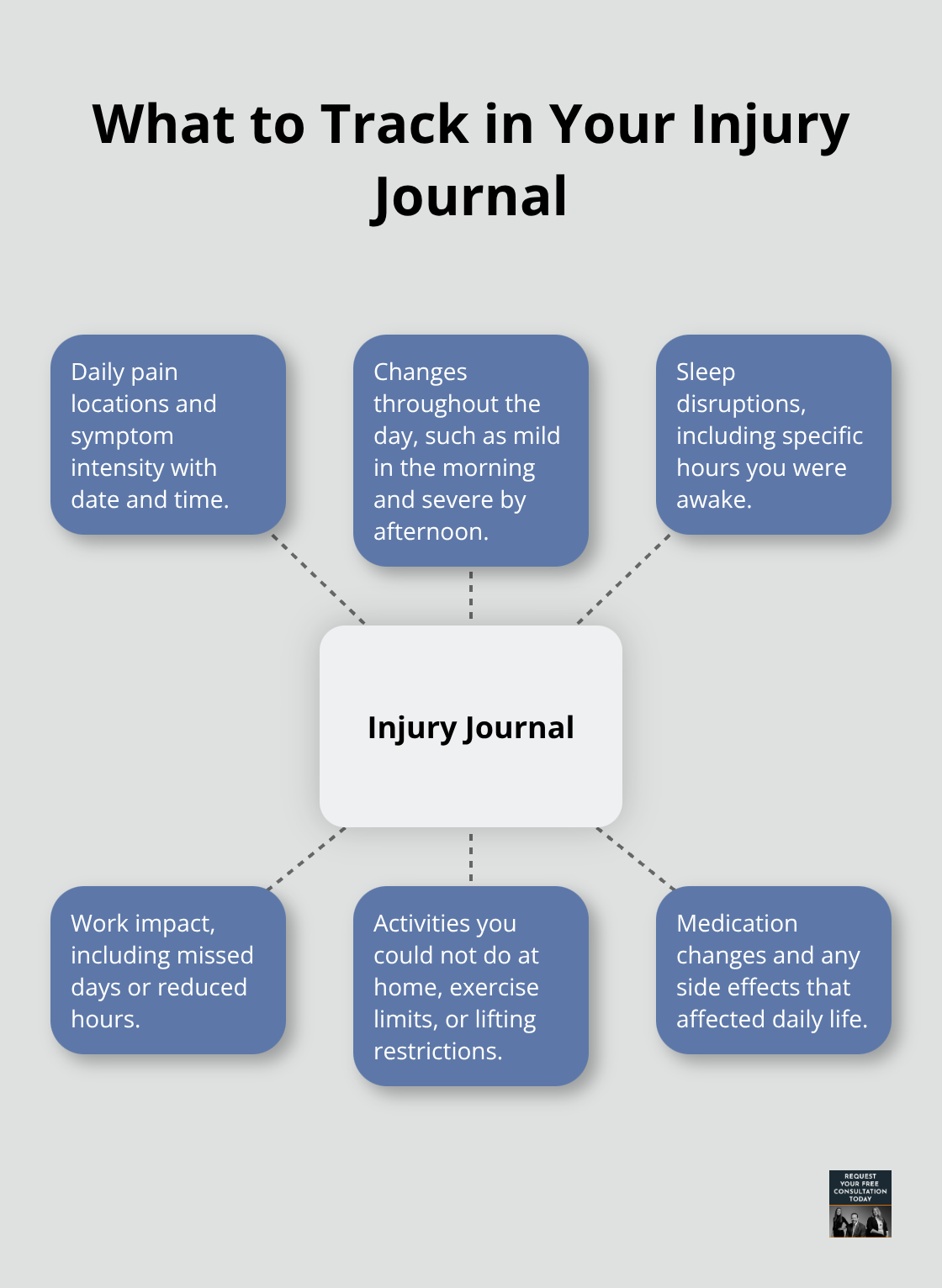
Insurance adjusters will scrutinize your journal for exaggeration, so accuracy strengthens your credibility enormously.
Track how injuries affect your daily life
Document how your injuries prevented you from working, exercising, sleeping, or managing household responsibilities. If your neck injury made it impossible to look down at your computer, write that. If your injured shoulder prevented you from lifting your child or carrying groceries, record it. If you missed work days or had to reduce your hours, note the dates and reason. This functional impact documentation directly supports claims for lost wages and reduced earning capacity, which often represent the largest portion of your total damages.
When your journal entries match your medical records and physician notes, that alignment becomes nearly unbeatable evidence in negotiations. Insurance adjusters know that most accident victims do not maintain detailed journals, which means your disciplined documentation immediately sets your claim apart from the weak claims they handle routinely.
Record medication changes and side effects
Track every medication change, including new prescriptions, dosage increases, and over-the-counter pain relievers you purchased. If a medication caused side effects that affected your work or daily life, document that impact. Medication changes signal to insurers that your condition evolved or worsened, which validates the need for ongoing treatment (and often justifies higher settlement amounts).
When you later meet with an attorney about your claim, your injury journal transforms the abstract concept of pain into a concrete, day-by-day narrative that demonstrates exactly how your accident changed your life. Your detailed entries provide the evidence that supports every damage claim you make.
Final Thoughts
The documentation you gather after a crash determines whether your injury claim succeeds or fails. Insurance companies pay higher settlements when they see organized, detailed evidence that connects your crash directly to your medical treatment and ongoing limitations. Weak injury documentation after a crash costs people thousands in lost compensation because adjusters exploit gaps and inconsistencies.
Organizing your records means creating a single, chronological file that contains your scene photos and witness statements, all medical records from every provider, imaging reports, and your personal injury journal. When you have this organized file ready, you can provide it immediately to an attorney, which accelerates the investigation and strengthens your negotiating position. Insurance companies move faster when they see you have already compiled comprehensive evidence.
The statute of limitations in California gives you two years to file a personal injury claim after a crash, but waiting costs you money. Evidence degrades over time, witnesses become harder to locate, and medical records get lost or archived. We at Schaar & Silva LLP help accident victims in Santa Cruz County, Sacramento, and Oakland organize their injury documentation and build strong claims-contact us to discuss how your documentation supports your claim.
