

Insurance adjusters have a financial incentive to pay you less than your claim is worth. At Schaar & Silva LLP, we’ve seen firsthand how insurance adjuster tactics can leave accident victims with inadequate compensation.
Understanding these tactics is your first line of defense. This guide shows you exactly what adjusters do and how to fight back with evidence and preparation.
What Tactics Do Insurance Adjusters Use to Lower Your Payout
The Speed Trap: Why Adjusters Contact You Immediately
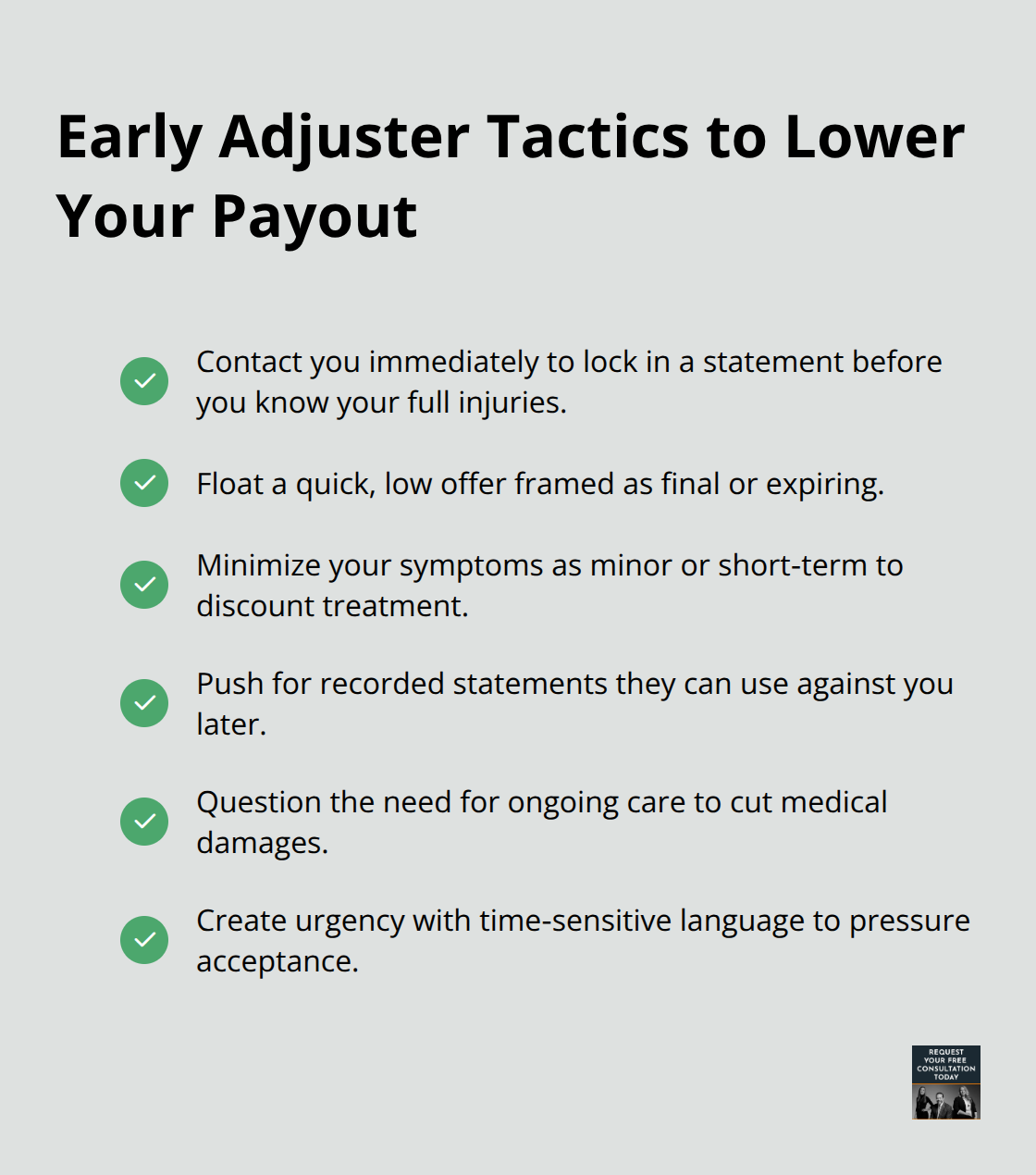
Insurance adjusters contact accident victims within hours, and that timing is deliberate. They want to lock you into a statement before you’ve had time to understand your injuries or gather documentation. A quick settlement offer sounds appealing when you’re in pain and facing medical bills, but accepting one costs thousands. Unrepresented claimants receive significantly lower settlements than those with legal guidance, yet many victims accept initial offers without understanding their true value. Adjusters know this dynamic and exploit it.
Adjusters present offers as final or time-sensitive, creating artificial pressure. They’ll also minimize your injuries by questioning whether you truly need ongoing treatment or by suggesting your pain will resolve quickly. When you mention a headache or lingering discomfort, they document it as minor and use that language to justify lower compensation.
The Fault-Finding Questions: How Adjusters Build a Comparative Negligence Argument
Adjusters ask whether you were distracted, whether you could have avoided the crash, or whether you had a pre-existing condition-not because they need answers, but because any admission strengthens their argument that you bear partial fault. This is pure strategy. Under California’s comparative negligence law, even 1% of shared fault reduces your recovery proportionally, so adjusters fish for admissions that create doubt.
Don’t answer these questions without legal guidance. Statements about phone use, fatigue, or prior medical conditions can fuel a comparative fault argument and reduce your recovery. The at-fault driver’s insurer has no right to a recorded statement from you, and you have no obligation to provide one.
Disputing Liability and Using Medical Gaps Against You
Adjusters claim liability is unclear, that witnesses contradict each other, or that the police report doesn’t definitively prove the other driver caused the crash. They use this uncertainty to justify lower offers, betting you’ll accept rather than fight. They’ll also request medical records without explaining why, then use gaps in treatment against you-if you skipped a week of physical therapy, they argue your injuries weren’t serious.
Don’t sign blanket medical authorizations that grant access to your entire health history. Provide only basic information: names, date, time, location, and policy details. Once you hire an attorney, all communication goes through them. This shift is critical because adjusters lose leverage when they can’t control the narrative.
Why Legal Representation Changes the Dynamic
An attorney identifies what the adjuster is missing-complete medical records, wage documentation, repair estimates-and uses that gap to demand higher offers. If you’re in Santa Cruz County, Sacramento, or Oakland and facing settlement pressure, contact a personal injury attorney within 24 to 72 hours after your accident to preserve evidence and guide your response to early adjuster contact. The legal team at Schaar & Silva LLP can help you navigate these early interactions and protect your claim from the start.
What Evidence Turns the Tables on Insurance Adjusters
Build a Complete Evidentiary Package
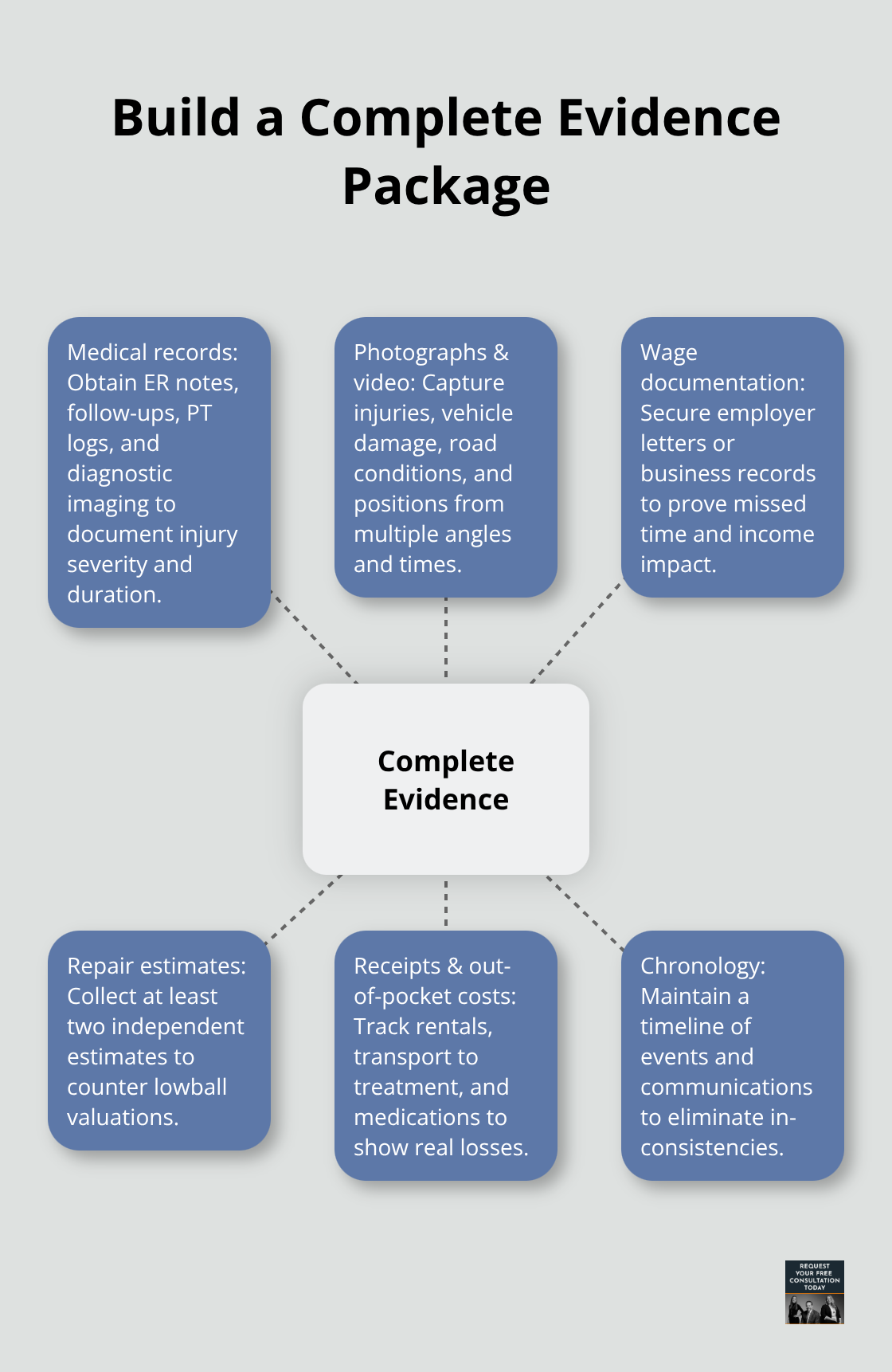
Adjusters rely on incomplete information to justify low offers. The moment you provide a complete evidentiary package, their negotiating position weakens. Medical records, photographs, wage documentation, and repair estimates force adjusters to acknowledge the full scope of your damages and eliminate the gaps they exploit.
Start gathering this evidence immediately after your accident because delays create problems. If you wait weeks to obtain medical records or photographs, adjusters claim the delay suggests your injuries weren’t serious or that property damage was less severe than initially reported. The first 48 to 72 hours after an accident are critical for collecting evidence before memories fade and conditions change.
Document Your Medical Treatment Thoroughly
Medical documentation is your strongest tool against injury minimization. Obtain records from every provider you see, including emergency room visits, follow-up appointments, physical therapy sessions, and any diagnostic imaging like MRI or X-ray results. Insurance companies scrutinize treatment gaps, so consistent care strengthens your claim. If you miss appointments or skip treatment weeks, adjusters use those gaps to argue your injuries resolved faster than you claim. Photograph your injuries if visible, including bruises, cuts, or swelling on the day of the accident and during recovery. This visual record prevents adjusters from questioning whether injuries actually occurred.
Capture Property Damage and Repair Evidence
For property damage, take photos and videos from multiple angles showing vehicle damage, road conditions, and vehicle positioning at the scene. Collect repair estimates from at least two independent shops because adjusters often use low estimates to reduce settlement offers. Keep every receipt related to your accident, including rental car costs, transportation to medical appointments, and medication expenses. These receipts add up quickly and represent real out-of-pocket losses that adjusters frequently overlook or minimize.
Document Lost Wages and Create a Timeline
Document lost wages by obtaining written confirmation from your employer showing the dates you missed work and your hourly rate or salary. If you’re self-employed, provide tax returns or business income records covering the period affected by your injuries. Adjusters frequently underestimate lost wages because victims fail to document them comprehensively. Create a timeline of all events, communications, and expenses in a single document that you can reference during settlement discussions. This organization prevents you from forgetting important details when an adjuster pressures you into quick decisions. Store all documents in one secure location, either digital or physical, and back up digital files. Never rely on memory alone during negotiations because adjusters exploit inconsistencies between your statements and your documented evidence.
Organize Your Evidence for Negotiation Power
A well-organized evidence file transforms your negotiating position. Adjusters expect most victims to arrive unprepared, armed only with vague recollections and scattered receipts. When you present a complete medical file, repair documentation, wage records, and a detailed timeline, adjusters recognize that you’ve invested time in your claim and that you understand its value. This preparation signals that you won’t accept a lowball offer and that litigation becomes a real possibility if they don’t improve their position. With your evidence organized and your claim documented, you’re ready to respond strategically when adjusters make their next move.
How to Negotiate Without Getting Exploited
Calculate Your Claim’s True Value Before Negotiating
Calculating your claim’s true value before any negotiation begins separates victims who accept fair settlements from those who take lowball offers. Start with economic damages: add your total medical bills, lost wages, vehicle repair or replacement costs, and out-of-pocket expenses like rental cars and medication. If you earned $50,000 annually and missed 6 weeks of work, that’s roughly $5,769 in lost income alone. For non-economic damages like pain and suffering, California courts typically award 1.5 to 5 times your economic damages, depending on injury severity and treatment duration. A victim with $15,000 in medical bills and lost wages might reasonably expect $22,500 to $75,000 total, not the $8,000 opening offer adjusters often make. Research comparable settlements in your county through public court records or consult an attorney to understand what similar injuries have settled for in Santa Cruz County, Sacramento, or Oakland. Without this baseline, you’ll negotiate blind and accept whatever the adjuster suggests.
Request Written Offers and Force Itemization
When an adjuster presents a low offer, your response determines whether negotiations improve or stall. Never accept or reject the offer in that moment. Instead, request the offer in writing and ask the adjuster to itemize how they calculated each component: medical expenses, lost wages, and pain and suffering.
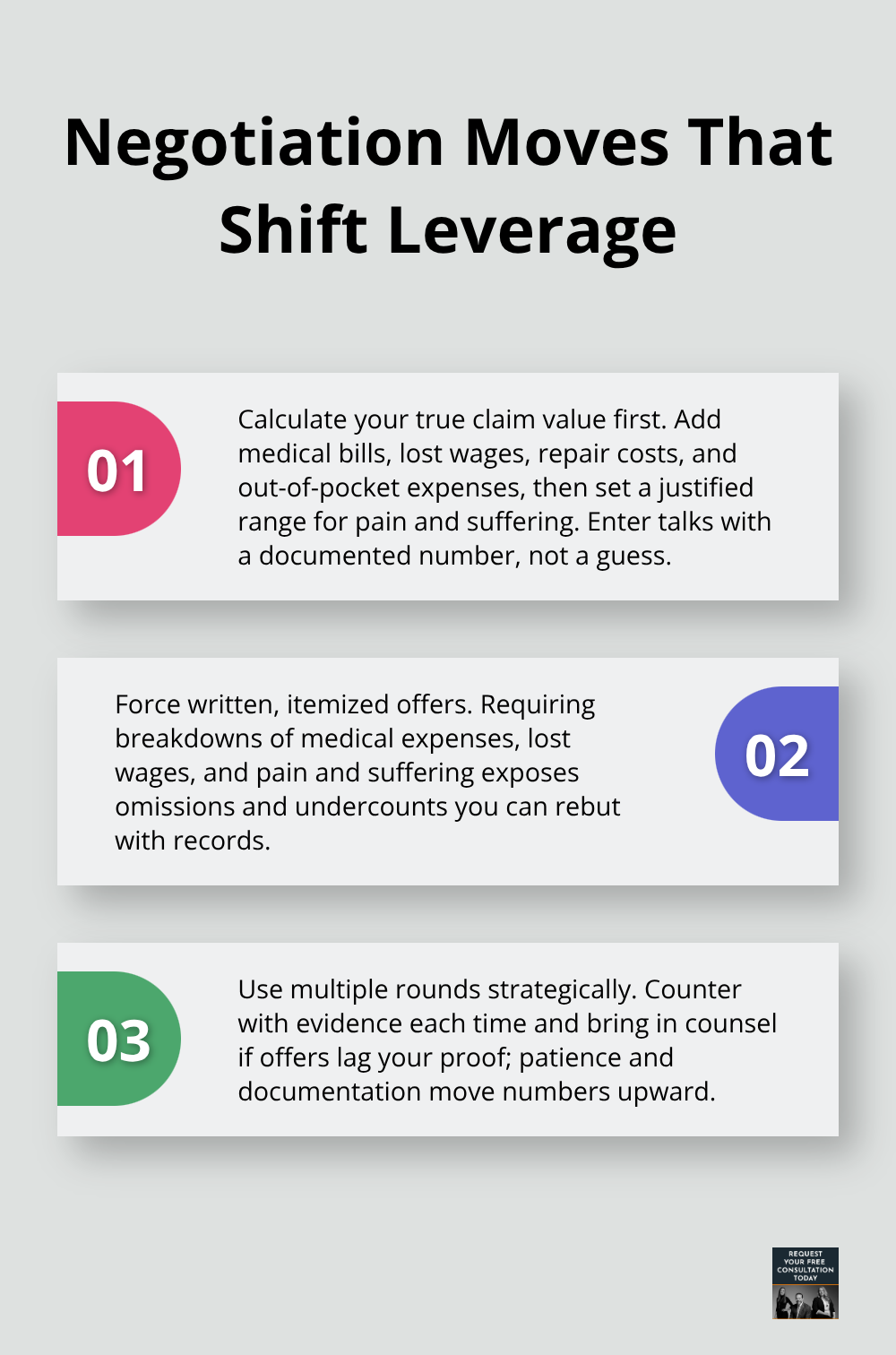
This forces them to justify their numbers and often reveals gaps where they undercounted bills or ignored wage documentation. Respond with a detailed counter that lists every medical bill, repair estimate, and wage record with supporting documentation attached. If the adjuster valued your case at $8,000 but you’ve documented $15,000 in medical treatment and 8 weeks of lost work, your counter backed by evidence makes their position indefensible.
Use Multiple Rounds of Negotiation to Your Advantage
Most adjusters expect victims to accept first offers without pushback, so a professional counter with complete documentation shifts the dynamic immediately. Negotiations typically continue through multiple rounds until just before trial, so patience matters more than speed. Each round gives you the opportunity to present additional evidence, challenge their calculations, and demonstrate that you understand your claim’s value. If the adjuster’s second or third offer still falls short of what your evidence supports, legal representation becomes essential. An attorney knows exactly which documents carry weight in negotiations and how to structure counteroffers that force higher settlements. We at Schaar & Silva LLP handle all communication with the adjuster, preventing you from making statements that weaken your position while we build leverage through evidence and credibility. When medical liens are involved, proper negotiation becomes even more critical to protecting your final recovery.
Final Thoughts
Insurance adjuster tactics exploit your uncertainty and pressure you into accepting less than your claim deserves. Adjusters contact you quickly, question your injuries, dispute liability, and use documentation gaps to justify low offers. Understanding these strategies protects you, but preparation protects you far more effectively. Gathering complete medical records, photographing property damage, and documenting lost wages transforms your negotiating position from vulnerable to credible.
Calculating your claim’s true value before negotiating prevents you from accepting inadequate offers. Economic damages like medical bills and lost wages are straightforward to calculate, while non-economic damages for pain and suffering typically range from 1.5 to 5 times your economic losses depending on injury severity. Without this baseline, you negotiate blind and accept whatever the adjuster suggests. An attorney identifies what the adjuster is missing and uses that gap to demand higher offers that reflect your actual damages.
If adjuster offers consistently fall short of what your evidence supports, or if liability is genuinely disputed, legal representation becomes essential. We at Schaar & Silva LLP handle all communication with adjusters, preventing you from making statements that weaken your position while we build leverage through evidence and credibility. If you’re in Santa Cruz County, Sacramento, or Oakland and facing settlement pressure, contact us within 24 to 72 hours after your accident to protect your claim from the start.
