
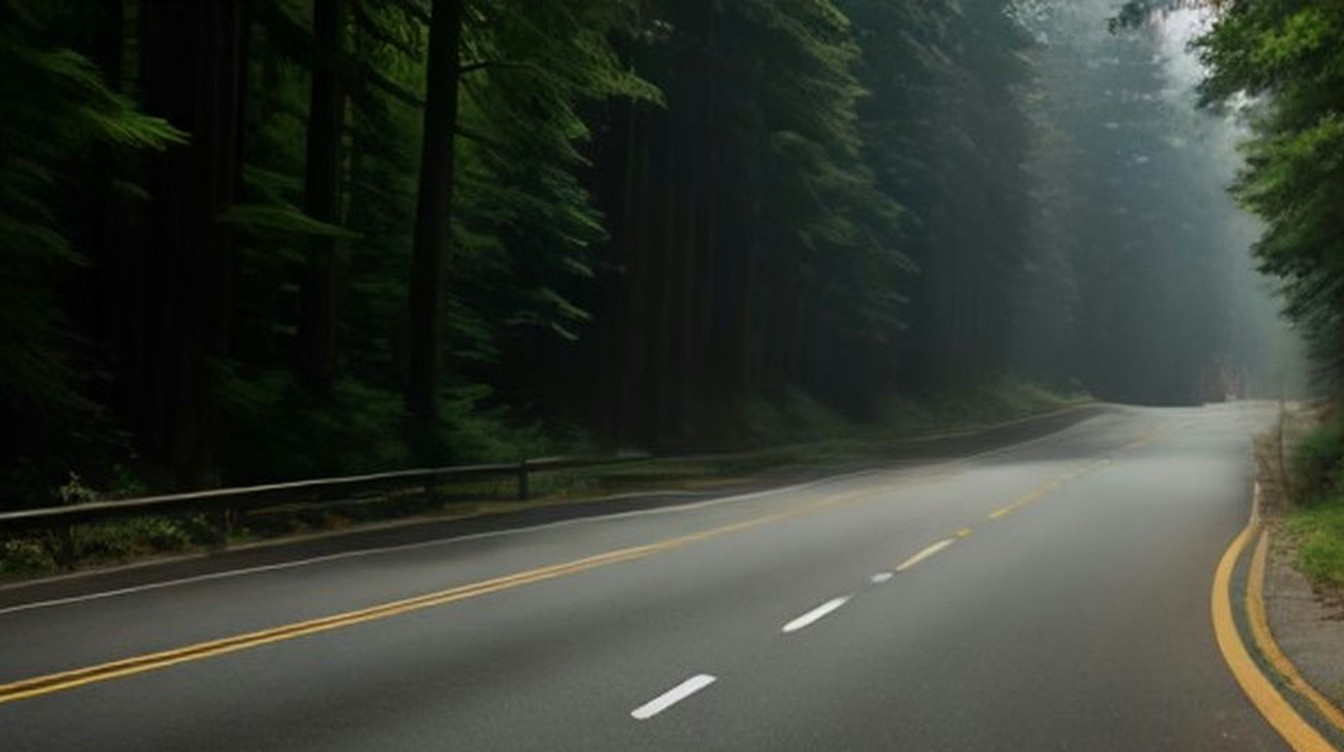
A Highway 9 car accident in Santa Cruz County can turn a scenic drive through the redwoods into a long and confusing recovery. The road winds from Santa Cruz through Felton, Ben Lomond, and Boulder Creek, with tight curves, narrow shoulders, shaded pavement, and limited places to pass. When a crash happens on a mountain road like this, figuring out who was at fault often comes down to specific California driving rules that many people have never heard of. Knowing how those rules work gives you real control over your claim and helps you avoid mistakes that can quietly weaken it.
At Schaar & Silva LLP, we help people across Santa Cruz County who have been hurt in car and truck accidents so you can move forward with confidence. This guide explains how Highway 9 crashes actually happen in the San Lorenzo Valley, how fault is proven after a mountain road collision, and the missteps that most often derail an otherwise strong case.
How Highway 9 Car Accidents Actually Happen in the San Lorenzo Valley
Highway 9 is a two-lane state route for most of its length through the San Lorenzo Valley. It carries commuters, school traffic, delivery vehicles, cyclists, and visitors headed to parks such as Henry Cowell Redwoods State Park. Because the road is narrow and curving, small driving errors can quickly become serious collisions, especially head-on and sideswipe crashes where there is little room to recover.
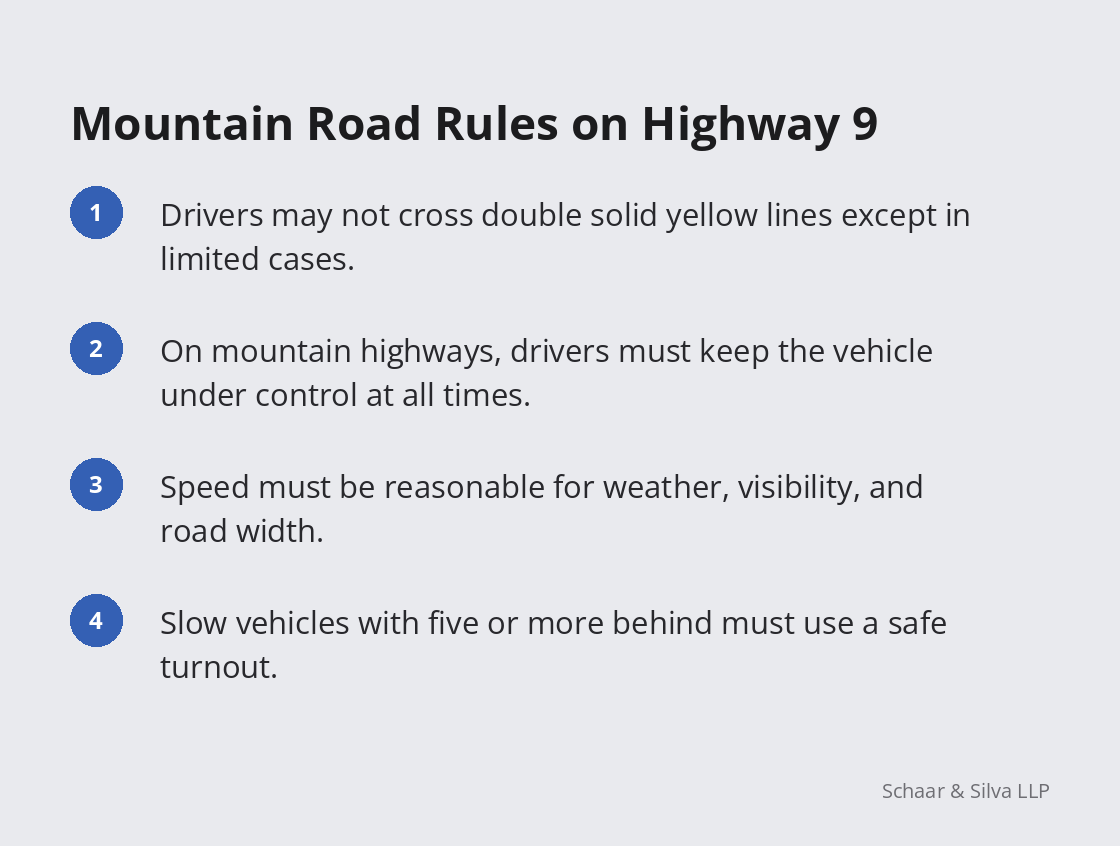
California’s Vehicle Code includes rules written with roads like this in mind. Understanding them is the first step in understanding how your crash happened and who should be held responsible.
Blind Curves and Centerline Crossings
Many Highway 9 crashes begin when a driver drifts over the center of the road on a curve. Under California Vehicle Code Section 21460, when double parallel solid yellow lines are in place, a driver shall not drive to the left of the lines, except in limited situations such as turning left into or out of a driveway or private road. A driver who cuts a curve and crosses those lines puts oncoming traffic directly in harm’s way.
Mountain roads also come with their own specific duty. Vehicle Code Section 21662 says the driver of a motor vehicle traveling through canyons or upon mountain highways shall hold the vehicle under control at all times. If the roadway has no marked centerline, the driver must stay as near the right-hand edge as reasonably possible. On stretches too narrow for a vehicle to stay entirely to the right of center, the driver must sound the horn when approaching a curve where the view is obstructed within 200 feet. These rules matter because they describe exactly what a careful driver should have done in the moments before a crash.
Speed That Is Too Fast for the Conditions
Speed on Highway 9 is not only about the posted limit. California’s basic speed law, Vehicle Code Section 22350, provides that no person shall drive at a speed greater than is reasonable or prudent having due regard for weather, visibility, traffic, and the surface and width of the highway, and never at a speed that endangers the safety of persons or property. A driver can be within the posted limit and still violate this law on a wet, shaded curve or in heavy fog.
The San Lorenzo Valley sees damp pavement, falling leaves, and low light under the redwood canopy for much of the year. Drivers who carry too much speed into a turn may lose traction, cross into the opposite lane, or rear-end a vehicle that has slowed for a curve. When speed for the conditions is the issue, the basic speed law often becomes central to proving fault.
Slow Traffic, Turnouts, and Unsafe Passing
Frustration builds quickly on a road where passing is difficult. California addresses this directly. Vehicle Code Section 21656 says that on a two-lane highway where passing is unsafe, a vehicle traveling slower than the normal speed of traffic with five or more vehicles lined up behind it shall turn off at the nearest designated turnout, or wherever sufficient area for a safe turnout exists, to let the vehicles behind it proceed.
That rule cuts both ways. A slow driver who ignores turnouts can contribute to a dangerous situation, but a driver who loses patience and passes across a double yellow line on a blind curve is still responsible for the head-on crash that follows. Sorting out these competing choices is often the heart of a Highway 9 car accident claim.
How Fault Is Proven After a Mountain Road Crash
California injury claims are built on negligence, which means showing that another driver failed to act with reasonable care and that this failure caused your injuries. On a rural road with few cameras and fewer witnesses, the way that proof comes together looks different than it does at a busy city intersection.
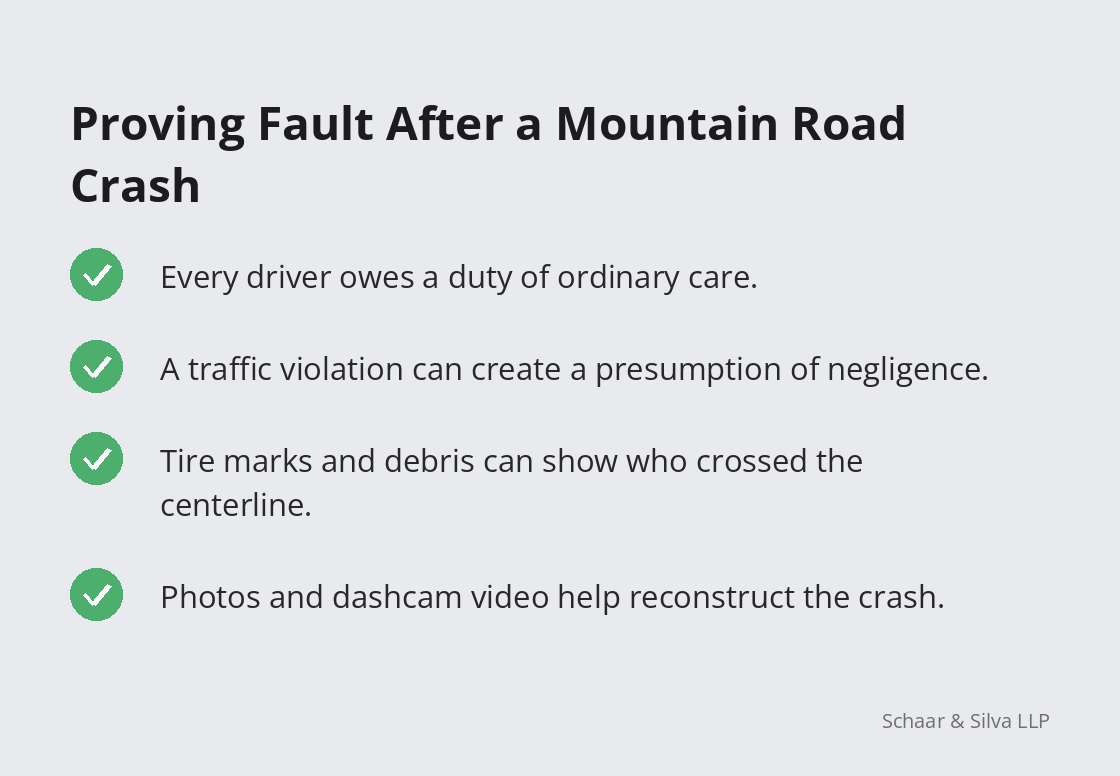
The good news is that California law provides clear standards for judging driver conduct, and the physical evidence on a mountain road can tell a detailed story when it is collected early.
The Duty of Ordinary Care
California Civil Code Section 1714 makes everyone responsible for an injury caused to another by a want of ordinary care or skill in the management of their property or person. For drivers, this means paying attention, keeping a safe speed, staying in their own lane, and reacting reasonably to the road ahead. A driver who is distracted while rounding a blind curve, or who follows too closely on a winding downhill stretch, may be breaching that duty.
Ordinary care also applies to the companies that put vehicles on the road. If a commercial driver caused the crash while working, the employer may share responsibility for the harm, which can affect how a claim is pursued.
When a Traffic Violation Creates a Presumption
California Evidence Code Section 669 can make proving fault more straightforward. Under that section, a failure to exercise due care is presumed when a person violated a statute, the violation proximately caused the injury, the injury resulted from the kind of occurrence the statute was designed to prevent, and the injured person was among those the statute was meant to protect. The presumption can be rebutted, but it shifts the conversation in an important way.
If a driver crossed a double yellow line in violation of Section 21460, or failed to keep right on a mountain road as Section 21662 requires, and that conduct caused a head-on collision, this presumption may apply. Linking the other driver’s conduct to a specific Vehicle Code section is often one of the most effective ways to establish fault.
Evidence That Matters on a Rural Road
Highway 9 crashes often happen far from security cameras, so physical evidence carries extra weight. Tire marks, debris fields, gouges in the pavement, and the final resting positions of the vehicles can show which car crossed the centerline and how fast each was traveling. Photographs taken before vehicles are moved can be especially valuable.
Other sources include dashcam footage, photos of the curve and signage, statements from residents or other drivers who stopped, and the official collision report. Damage patterns on the vehicles also help reconstruct the angle of impact. Because rain, traffic, and road crews can erase evidence quickly on a mountain route, early documentation is one of the strongest things you can do for your claim.
What Actually Weakens a Highway 9 Car Accident Claim
Even when another driver was clearly careless, certain mistakes can reduce the value of a claim or stop it altogether. Many of these problems are avoidable when you know about them in advance.
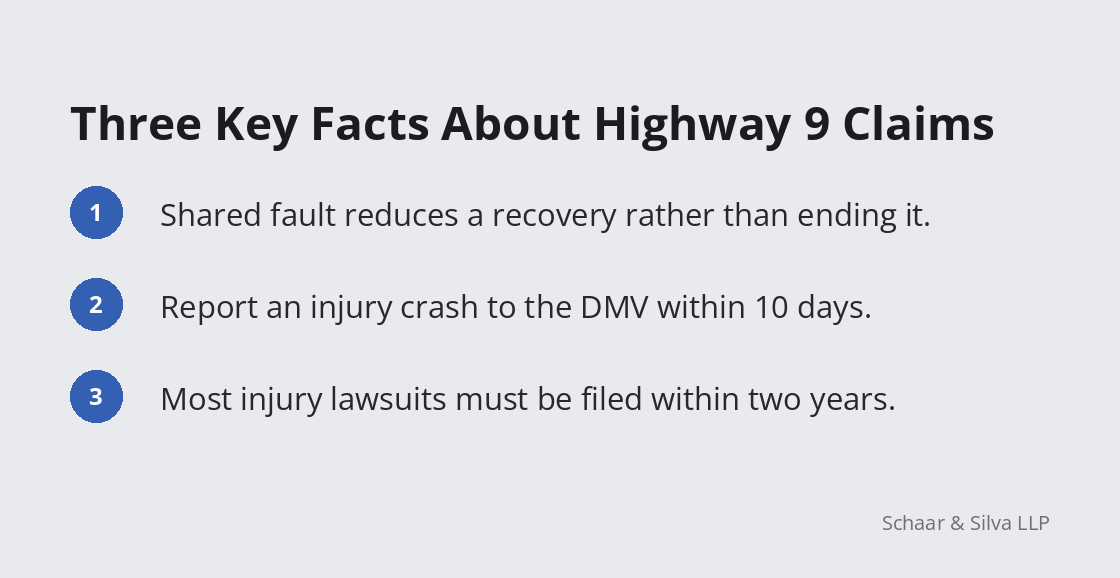
The issues below come up again and again after crashes on winding Santa Cruz County roads.
Assuming Shared Fault Ends Your Case
Some people never pursue a claim because they think they were partly at fault, perhaps because they were driving slowly without using a turnout or took a curve a little wide. California uses a comparative fault system. Under the state’s civil jury instructions, if the other side proves you were partly responsible, your damages are reduced by your percentage of responsibility rather than eliminated.
Insurers sometimes use the possibility of shared fault to push injured people into accepting less than their claim is worth. An honest look at the evidence often shows that the other driver bears most of the responsibility, especially when that driver crossed the centerline or passed unsafely.
Waiting Too Long to Document the Scene
The days after a crash are often consumed by medical appointments and vehicle repairs. During that time, skid marks fade, debris is swept away, and witnesses become harder to locate. Vehicles may also be repaired or salvaged before anyone has examined them closely.
It is also important to get medical care promptly and to follow through with treatment. Some injuries, such as concussions and soft-tissue damage, do not show their full effects right away. Gaps in treatment can give an insurance company an opening to argue that your injuries were not caused by the crash.
Missing Reporting and Filing Deadlines
California has firm deadlines that apply after a crash. Vehicle Code Section 16000 requires a driver involved in an accident that results in bodily injury or death, among other situations, to report the accident to the Department of Motor Vehicles within 10 days on an approved form. This report is separate from any police or California Highway Patrol report.
For a lawsuit, Code of Civil Procedure Section 335.1 generally allows two years to file an action for injury or death caused by the wrongful act or neglect of another. If a public entity may share responsibility, for example because of a road condition, a claim generally must be presented within six months under Government Code Section 911.2. Missing either deadline can end a claim no matter how strong it is. You can read more about related mountain driving issues in our guide to a Highway 17 car accident in Santa Cruz County.
Final Thoughts
A Highway 9 car accident can leave you facing injuries, missed work, and questions about who is responsible. California’s rules on staying right of the centerline, driving at a safe speed for the conditions, using turnouts, and controlling a vehicle on mountain roads give a clear framework for judging what went wrong. Combined with early evidence and attention to deadlines, those rules can help you build a strong claim.
You do not have to sort through these issues alone. If you or a loved one was hurt in a crash in the San Lorenzo Valley or elsewhere in Santa Cruz County, contact Schaar & Silva LLP to talk with our team about your situation and your next steps.