

A Highway 17 car accident can turn an ordinary commute into a life-changing event in seconds. Many people in Santa Cruz County rely on this mountain route to reach jobs, schools, and family over the hill, and when traffic slows suddenly around a curve or a driver drifts out of a lane, the results can be serious. If you were hurt on Highway 17, you probably have questions about who is responsible, which agency handles the report, and what you should be doing right now to protect your health and your claim.
At Schaar & Silva LLP, we help people throughout Santa Cruz County, including Scotts Valley and the communities along the Highway 17 corridor, after auto accidents and other serious crashes. This guide explains the California rules that usually decide fault in a Highway 17 collision, the steps that protect your claim, and the mistakes that most often weaken a case, so you can move forward with a clear plan.
Why Highway 17 Car Accidents in Santa Cruz County Happen
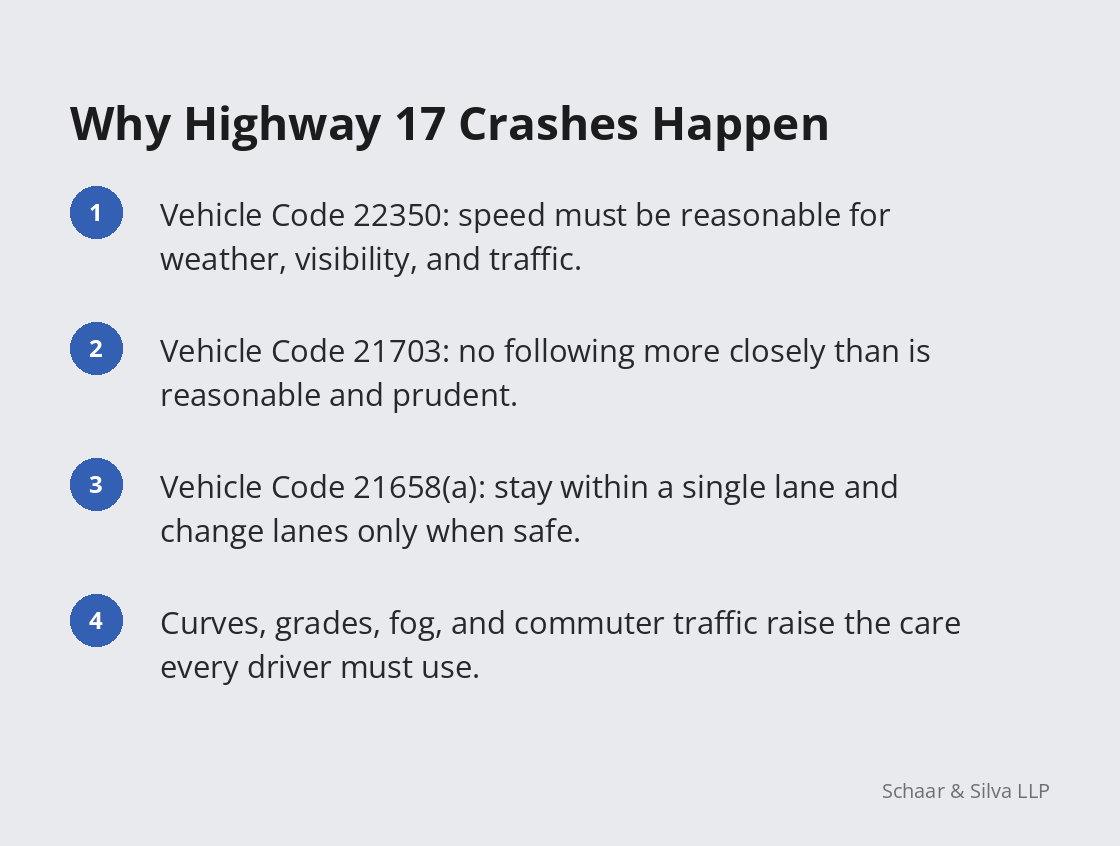
Every crash has its own facts, but many Highway 17 collisions involve the same handful of driving errors. The California Vehicle Code sets the rules that insurance adjusters and courts use as a starting point when they decide who was careless.
A Mountain Route Between Santa Cruz and San Jose
Under California Streets and Highways Code Section 317, Route 17 runs from Route 1 near Santa Cruz to Route 280 in San Jose. For people who live in Santa Cruz, Scotts Valley, and the surrounding mountain communities, it is a primary connection to Los Gatos and the South Bay. The road climbs through the Santa Cruz Mountains, and drivers deal with curves, changing grades, fog or rain, and heavy commuter traffic at the start and end of the workday. Those conditions do not excuse careless driving. Instead, they raise the level of care every driver must use.
Speed That Is Too Fast for Conditions
California’s basic speed law, Vehicle Code Section 22350, says no one may drive at a speed greater than is reasonable or prudent having due regard for weather, visibility, traffic, and the surface and width of the highway, and never at a speed that endangers people or property. This matters on Highway 17 because a driver can be under the posted limit and still be driving too fast for a wet curve, a patch of fog, or traffic that has stopped just out of sight. When a driver loses control or cannot stop in time, the basic speed law is often central to proving fault.
Following Too Closely
Rear-end collisions can happen wherever traffic speeds up and slows down without warning. Vehicle Code Section 21703 prohibits following another vehicle more closely than is reasonable and prudent, having due regard for the speed of the vehicles, the traffic, and the condition of the roadway. On a route where traffic can bunch up quickly behind a slower vehicle or a stalled car, a driver who tailgates leaves no room to react. If you were struck from behind while slowing for traffic ahead, this rule is usually a key part of your claim.
Unsafe Lane Changes and Drifting
Where a roadway is divided into two or more clearly marked lanes for traffic in one direction, Vehicle Code Section 21658(a) requires a vehicle to be driven as nearly as practical entirely within a single lane, and it may not be moved from that lane until the movement can be made with reasonable safety. Drivers who cut across lanes to pass, drift while distracted, or misjudge a curve can sideswipe another car or force it toward the shoulder or barrier. Witness statements, vehicle damage patterns, and dashcam footage often show which driver left its lane.
Steps to Take After a Highway 17 Car Accident
What you do in the hours and days after a crash can make a real difference in how your claim unfolds. These steps help protect both your health and the evidence that supports your case.
Stop, Get Medical Care, and Call for Help
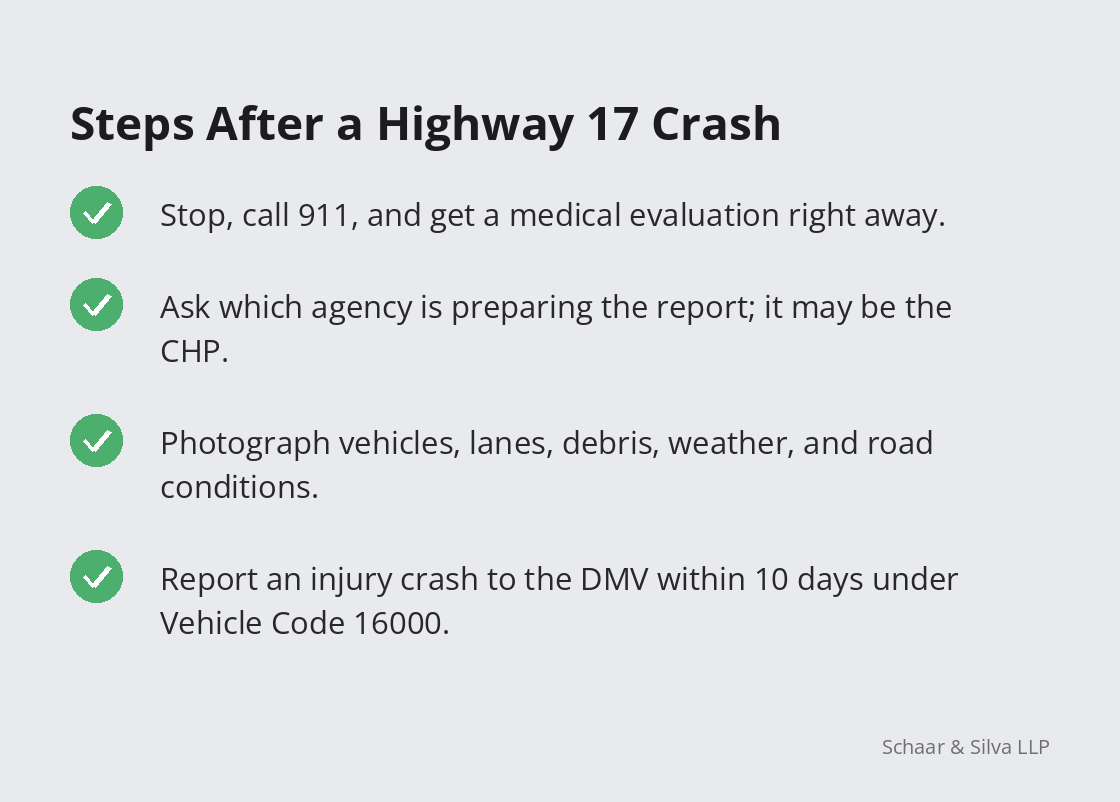
California Vehicle Code Section 20001(a) requires the driver of a vehicle involved in an accident resulting in injury to another person to stop immediately at the scene and fulfill the duties set out in the related code sections. If you are able, move to a safe place, call 911, and accept medical evaluation even if you feel you can walk away. Some injuries, such as concussions and soft tissue damage, do not show their full effect right away. Prompt medical records also connect your injuries to the crash, which insurance companies will look for.
Know Who Investigates the Crash
Under Vehicle Code Section 2400, the commissioner of the California Highway Patrol enforces the laws regulating the operation of vehicles and the use of the highways, and the CHP has primary jurisdiction for investigating traffic accidents on state highways constructed as freeways. Because Highway 17 is a state highway, the report for your collision may come from the CHP rather than a city police department. Ask the responding officer which agency is preparing the report and how to request a copy, since that report often becomes an important piece of evidence.
Document the Scene and Road Conditions
If it is safe, take photos of every vehicle involved, the lanes, skid marks, debris, and any signs or warnings nearby. Capture the weather, lighting, and pavement conditions, because those details often matter when fault is disputed under the basic speed law. Get names and contact information for witnesses, and write down your own memory of what happened as soon as you can. If a nearby driver had a dashcam, ask whether they will share the footage before it is recorded over.
Report the Crash to the DMV
California Vehicle Code Section 16000(a) requires a driver involved in a crash on a street or highway that results in bodily injury or death, or property damage above the threshold set in the statute, to report it to the Department of Motor Vehicles within 10 days. The report can be made personally or through an insurance agent, broker, or legal representative. This report is separate from any law enforcement report, so do not assume the officer’s report satisfies it.
Mistakes That Can Weaken a Highway 17 Claim
Many injured people hurt their own cases without realizing it. Avoiding these common mistakes keeps your options open while you focus on recovery.
Assuming You Cannot Recover If You Share Some Blame
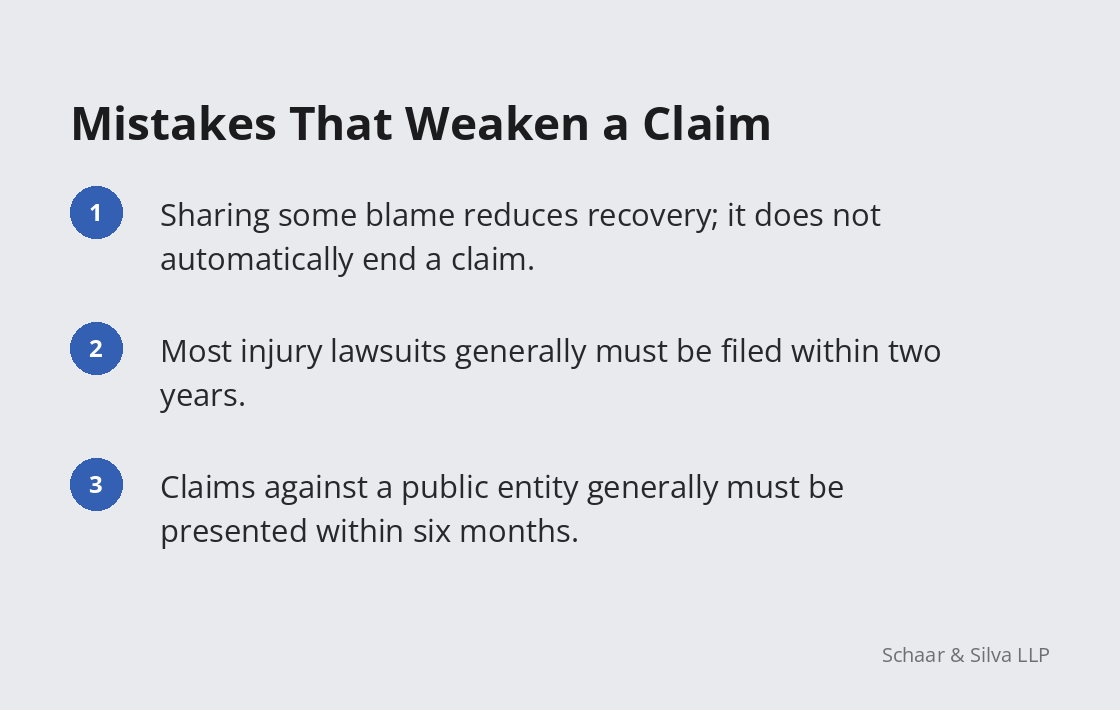
California follows a comparative fault approach. Under CACI No. 405, the standard jury instruction on comparative fault, if the defendant proves the injured person was partly responsible, that person’s damages are reduced by the percentage of their own responsibility. In other words, sharing some blame does not automatically end your claim. California Civil Code Section 1714(a) makes everyone responsible for injuries caused by a lack of ordinary care in managing their property or person, and that duty applies to every driver on the road. An insurance adjuster may try to push more blame onto you than the facts support, so be careful about what you say.
Waiting Too Long to Act
Under California Code of Civil Procedure Section 335.1, an action for injury to, or for the death of, an individual caused by the wrongful act or neglect of another generally must be brought within two years. That may sound like plenty of time, but evidence fades quickly. Vehicles are repaired, video is overwritten, and witnesses forget details. Starting early gives you the best chance to preserve the proof your claim depends on.
Overlooking a Possible Public Entity Claim
Some crashes involve more than driver error. Under California Government Code Section 835, a public entity can be liable for injury caused by a dangerous condition of its property when the plaintiff proves the property was in a dangerous condition, the condition caused the injury, the risk was reasonably foreseeable, and either a public employee created the condition or the entity had notice of it in time to protect against it. Claims like these come with a much shorter deadline. Government Code Section 911.2 requires a claim for injury to a person to be presented no later than six months after the cause of action accrues. If a road defect, missing guardrail, or similar problem may have played a part, it is important to act quickly.
Final Thoughts
A Highway 17 car accident can leave you dealing with injuries, missed work, and an insurance company that may not have your interests in mind. California law gives you clear tools to work with. The basic speed law, the rule against following too closely, and the lane rules often decide fault, comparative fault reduces rather than eliminates recovery, and the deadlines for court actions and public entity claims are strict. Knowing these rules helps you protect yourself from the start.
If you or someone you love was hurt in a crash on Highway 17 or anywhere in Santa Cruz County, you can learn more about our approach to immediate steps after a Santa Cruz car accident or contact Schaar & Silva LLP to talk about your situation. We are here to help you understand your options and take the next step with confidence.