
A car crash changes everything in an instant. Beyond the physical injuries, many people experience emotional distress that lingers long after the accident-anxiety, nightmares, and fear that affects daily life.
At Schaar & Silva LLP, we understand that your emotional pain is real and deserves recognition in your recovery claim. California law allows you to seek compensation for this suffering, and we’ll walk you through your rights and the steps to heal both emotionally and financially.
How Emotional Distress Shows Up After a Crash
Emotional distress after a car crash operates on a different timeline than physical healing, and most people don’t realize how serious it can become. About 32.3% of car accident survivors develop PTSD, with some studies suggesting rates as high as 45%. This isn’t a minor aftereffect-it’s a documented psychological injury that affects your ability to work, drive, sleep, and maintain relationships. The crash itself lasts seconds, but the emotional fallout can persist for months or years if left untreated.
What Emotional Distress Actually Looks Like
The symptoms vary widely depending on the crash’s severity and your personal circumstances. Intrusive thoughts and flashbacks replay the accident without warning in your mind. You might experience hypervigilance while driving-constant scanning for danger, gripping the steering wheel tightly, or avoiding roads where the crash occurred. Sleep disturbances affect roughly 11% of survivors with moderate disruption and 41.5% with mild symptoms. Anxiety, panic attacks, and depression follow for many survivors, with depression reported by approximately 17.4% of accident survivors. Persistent anxiety affects roughly 5.8% of survivors and erodes quality of life over time.
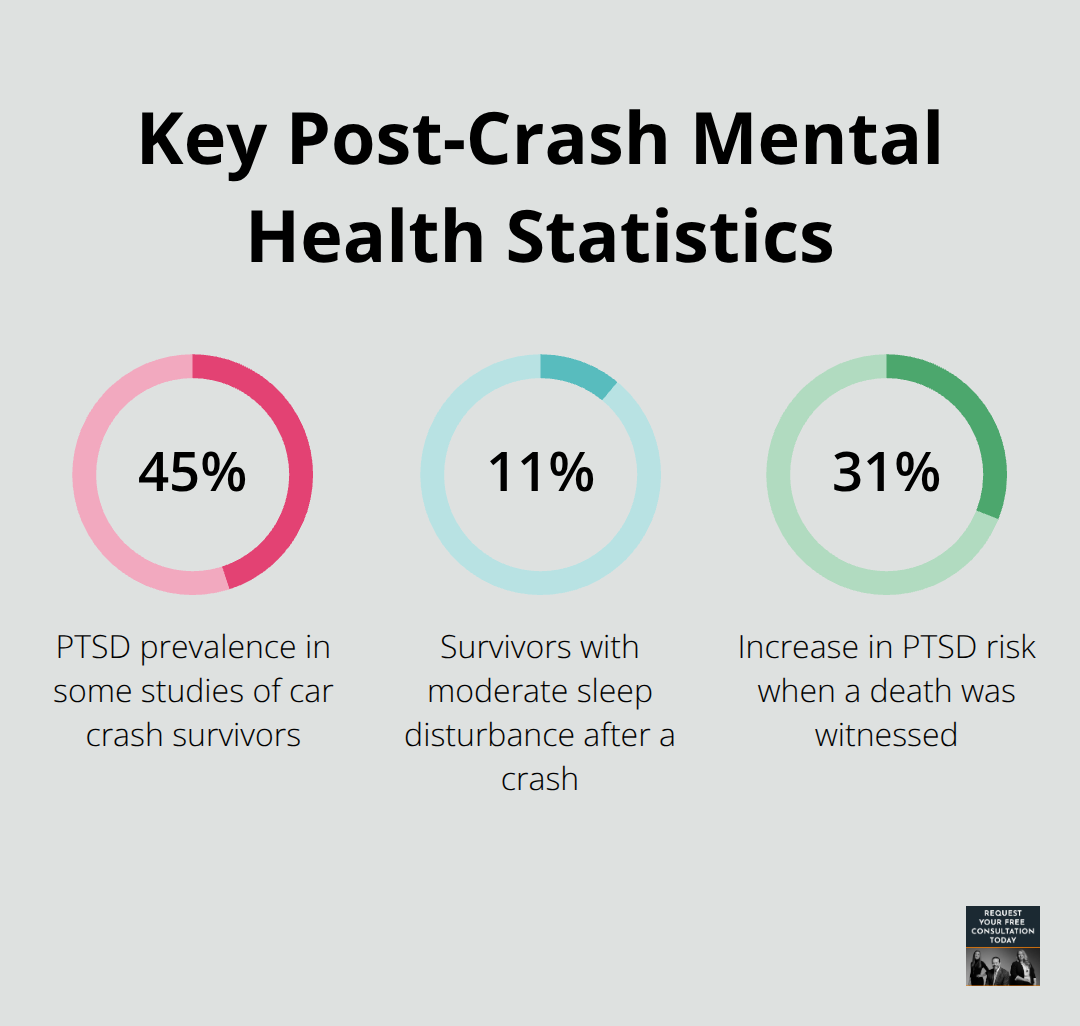
If you witnessed death during the accident, your PTSD risk increases by about 31% compared to those who didn’t witness fatalities. The emotional impact extends beyond the individual-about 48.8% of survivors experience extreme impairment in family life, and 51.9% report severe social dysfunction, meaning your relationships suffer alongside your mental health.
How the Crash Affects Your Daily Functioning
The psychological injury manifests in concrete ways that disrupt your routine. Extreme impairment in work or schooling affects 70.2% of survivors, which means lost income and career setbacks compound your financial stress. You might find yourself unable to concentrate, calling in sick repeatedly, or losing your job entirely. Relationships deteriorate as you withdraw from loved ones or become irritable without understanding why. Some survivors develop amaxophobia (fear of driving) so severe that they cannot return to work or handle basic transportation. Others experience panic attacks triggered by sounds similar to the crash-a car horn, screeching tires, or even a slamming door. These aren’t character flaws or weakness; they’re measurable symptoms of psychological trauma that demand treatment and recognition.
Why This Matters for Your Claim and Recovery
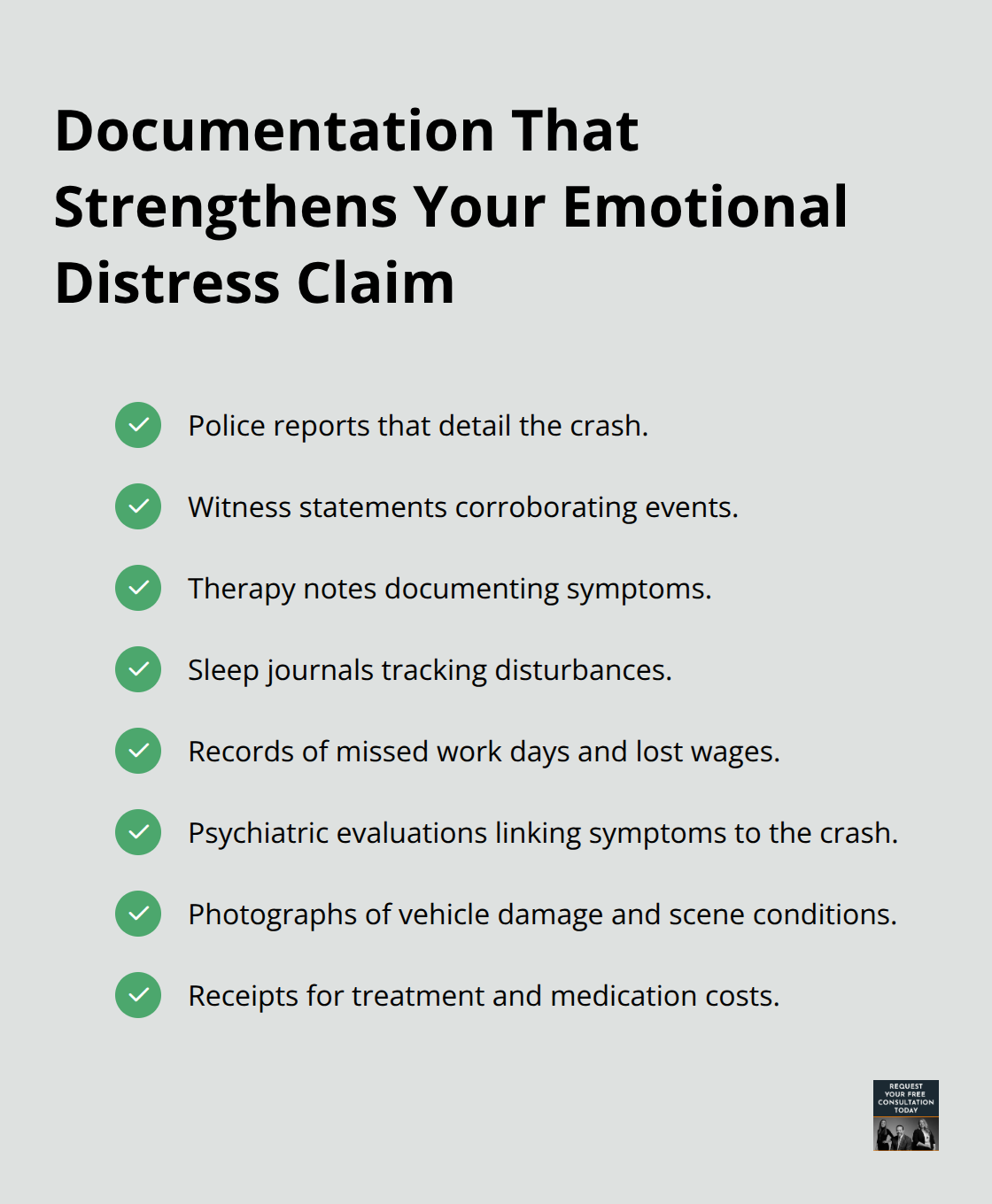
California law recognizes emotional distress as a legitimate form of harm that you can include in your compensation claim. You don’t need a broken bone to have a valid claim; the psychological injury itself counts. The challenge is proving the connection between the crash and your distress through solid documentation. Medical records from therapists or counselors are essential-self-reported feelings alone won’t convince an insurance company or court. Police reports, witness statements, and accident photos establish what happened, while therapy notes, sleep journals, and documentation of missed work days build the evidence that the crash caused measurable harm. The timeline matters too: if symptoms appear within days or weeks of the crash and worsen over time, that strengthens your case.
At Schaar & Silva LLP, we connect you with mental health support and help document the full scope of your emotional injury so your claim reflects the real impact on your life.
Understanding the depth of your emotional distress is the first step toward recovery-and toward building a strong legal case that holds the at-fault driver accountable for all the harm they caused.
What Compensation Can You Actually Recover
Economic Damages: Your Documented Costs
California law treats emotional distress as a real injury, not a secondary complaint you mention in passing. You can recover two distinct categories of damages: economic damages that reimburse your documented out-of-pocket costs, and non-economic damages that compensate for pain, suffering, and lost quality of life. Economic damages include therapy and counseling bills, psychiatric medication costs, lost wages from missing work due to your mental health condition, and any other measurable expenses tied to your emotional recovery. If you attended 20 therapy sessions at $150 each, that amounts to $3,000 in recoverable costs. If you missed eight weeks of work earning $1,500 weekly due to PTSD symptoms, that totals $12,000 in lost income. These figures add up quickly, and the at-fault driver’s insurance company must cover them.
Non-Economic Damages: Pain, Suffering, and Lost Life Quality
Non-economic damages cover the emotional anguish itself-the nightmares, the anxiety that prevents you from driving, the depression that strains your marriage, and the loss of enjoyment in activities you once loved. California imposes no cap on non-economic damages for emotional distress claims, unlike medical malpractice cases which are capped at $250,000. This means your settlement isn’t artificially limited by statute; it reflects the actual severity of your psychological injury. In cases involving extreme recklessness or intentional conduct (such as a drunk driver who causes your crash), you may also pursue punitive damages designed to punish the at-fault driver and deter similar behavior. These are rare but can be substantial when the circumstances warrant them.
Building Your Evidence: Documentation That Proves Your Claim
The critical challenge lies in proving the connection between the crash and your distress through documentation that insurance companies and courts will accept. Police reports and witness statements establish what happened; therapy notes and psychiatric evaluations prove your emotional condition and link it directly to the accident. Start a detailed journal immediately after the crash that documents your sleep quality, anxiety levels, panic attacks, and how symptoms affect your work and relationships-this provides powerful evidence of ongoing harm. Medical records from your therapist or counselor are non-negotiable; insurance adjusters dismiss self-reported suffering but respect professional clinical assessments. If you witnessed death during the accident, that increases your PTSD risk by approximately 31% according to research from road traffic accident survivors, and this documented risk factor strengthens your claim.
Photographs and Scene Evidence
Photographs of accident damage, vehicle impact patterns, and scene conditions help establish the crash’s severity, which correlates with psychological trauma. Documentation of missed work days, reduced productivity, or job loss directly ties your emotional distress to financial consequences. These concrete records transform your emotional distress from a subjective complaint into a measurable, compensable injury that the at-fault driver’s insurance company cannot easily dismiss.
Organizing Your Claim for Maximum Recovery
The at-fault driver’s insurance company will scrutinize every element of your claim, so comprehensive documentation becomes your strongest tool. Organize your evidence chronologically: start with the police report and witness statements, then add medical records, therapy notes, and your personal journal entries. Include receipts for all mental health treatment, medication costs, and any other expenses tied to your emotional recovery. This organized approach demonstrates the full scope of your psychological injury and the financial impact it created. When you present a well-documented claim, you shift the conversation from whether your emotional distress is real to how much compensation you deserve for the harm the at-fault driver caused.
How to Move Forward With Emotional and Financial Recovery
Start Mental Health Treatment and Legal Action Together
Recovery after a car crash requires two parallel tracks: mental health support and legal claim building. These processes reinforce each other rather than compete for your attention. When you start therapy immediately, you create documentation that strengthens your compensation claim. When you work with a legal team that understands emotional distress claims, they guide you toward the right mental health resources. In Santa Cruz County, Santa Cruz County Behavioral Health Services offers counseling and psychiatric services, and many therapists in the area have experience treating PTSD and anxiety disorders following motor vehicle accidents. If you live in Sacramento or Oakland, local mental health centers and private therapists trained in trauma-focused cognitive behavioral therapy or EMDR can address your specific symptoms. The key is starting mental health support within weeks of the crash, not months later.
Research shows that early intervention improves outcomes significantly-delaying treatment allows symptoms to entrench and become harder to treat. When you seek therapy, inform your therapist about the accident and ask them to document the connection between your symptoms and the crash in their clinical notes. This medical documentation becomes essential evidence for your claim.
Document Your Symptoms Systematically
Your therapist or counselor should track your symptoms systematically: sleep quality, anxiety episodes, panic attacks, avoidance behaviors, and how your condition affects work and relationships. Ask for copies of all clinical notes and assessment reports. These records prove the existence and severity of your emotional distress far more convincingly than your own description of your suffering. At Schaar & Silva LLP, we can connect you with mental health providers in your area who understand how to document emotional distress for legal purposes. Your documentation should include specific dates, times, and descriptions of symptoms-not vague statements about feeling anxious or sad.
Understand the Settlement Timeline
The legal process for emotional distress claims moves at its own pace, and understanding the timeline prevents frustration and unrealistic expectations. Most car accident claims settle within six to twelve months, though emotional distress cases sometimes take longer because they require stronger documentation. Insurance adjusters will request your medical records, therapy notes, and documentation of all expenses related to your mental health treatment. Expect this discovery phase to take four to eight weeks.
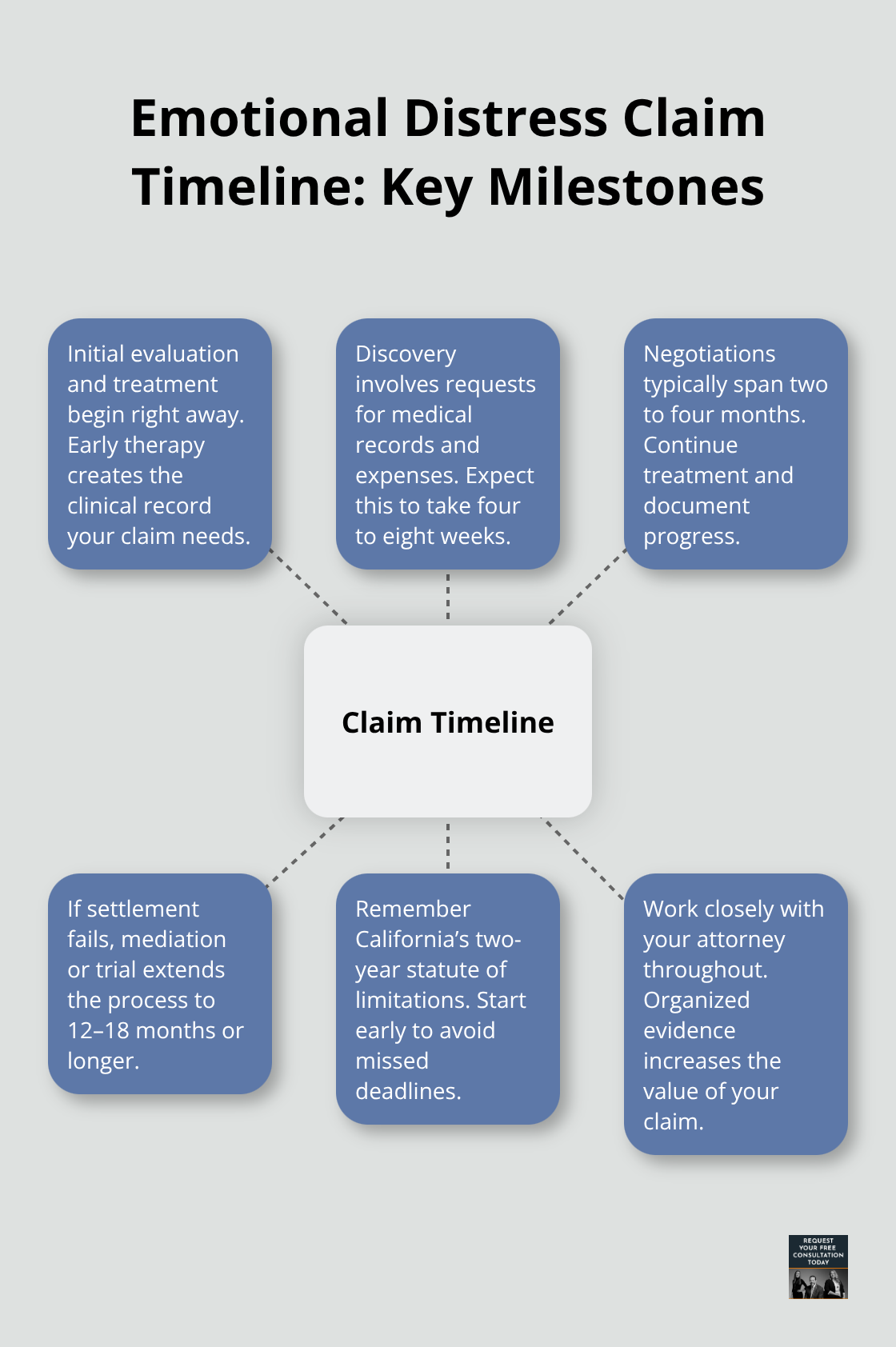
The insurance company will likely make an initial settlement offer that undervalues your emotional distress claim-this is standard practice. Your attorney will counter with a detailed demand letter that includes all economic damages, copies of medical records proving your psychological injury, and a calculation of non-economic damages based on the severity and duration of your suffering. Settlement negotiations typically occur over two to four months. During this time, continue your therapy and maintain detailed records of your symptoms and progress.
Know What Happens If Settlement Fails
If your case doesn’t settle, it may proceed to mediation or trial, which extends the timeline to twelve to eighteen months or longer. The statute of limitations for emotional distress claims in California is two years from the date of the accident, so you have time to build a thorough claim-but don’t waste it. Many people delay seeking legal representation, thinking they’ll handle the claim themselves, then discover they’ve missed critical documentation deadlines or failed to preserve evidence.
Consult an Attorney Early
We recommend consulting with an attorney within the first month after your accident. This early consultation costs nothing and gives you clarity on your rights and timeline. An experienced attorney identifies which mental health providers document symptoms in ways that strengthen your claim and which documentation gaps could weaken your case later. The sooner you act, the sooner you can focus on healing while your legal team handles the claim process.
Final Thoughts
Emotional distress after a car crash is not something you have to accept as permanent damage. The psychological injury you experience is real, measurable, and legally compensable under California law. You have the right to recover for both the documented costs of your mental health treatment and the pain and suffering that emotional distress car crash cases create in your daily life. Start therapy or counseling within weeks of your accident, not months later, because early intervention improves your recovery outcomes and creates the medical documentation that strengthens your compensation claim.
Keep detailed records of your symptoms, treatment costs, and how your emotional distress affects your work and relationships. This documentation transforms your claim from subjective complaints into objective evidence that insurance companies must take seriously. In Santa Cruz County, Sacramento, and Oakland, mental health resources are available through local behavioral health services and trauma-informed therapists who understand motor vehicle accident recovery.
Contact us at Schaar & Silva LLP for a free consultation to discuss your emotional distress car crash case and understand your rights. We serve Santa Cruz County and can guide you through the steps needed to recover the compensation you deserve while you focus on healing.
