
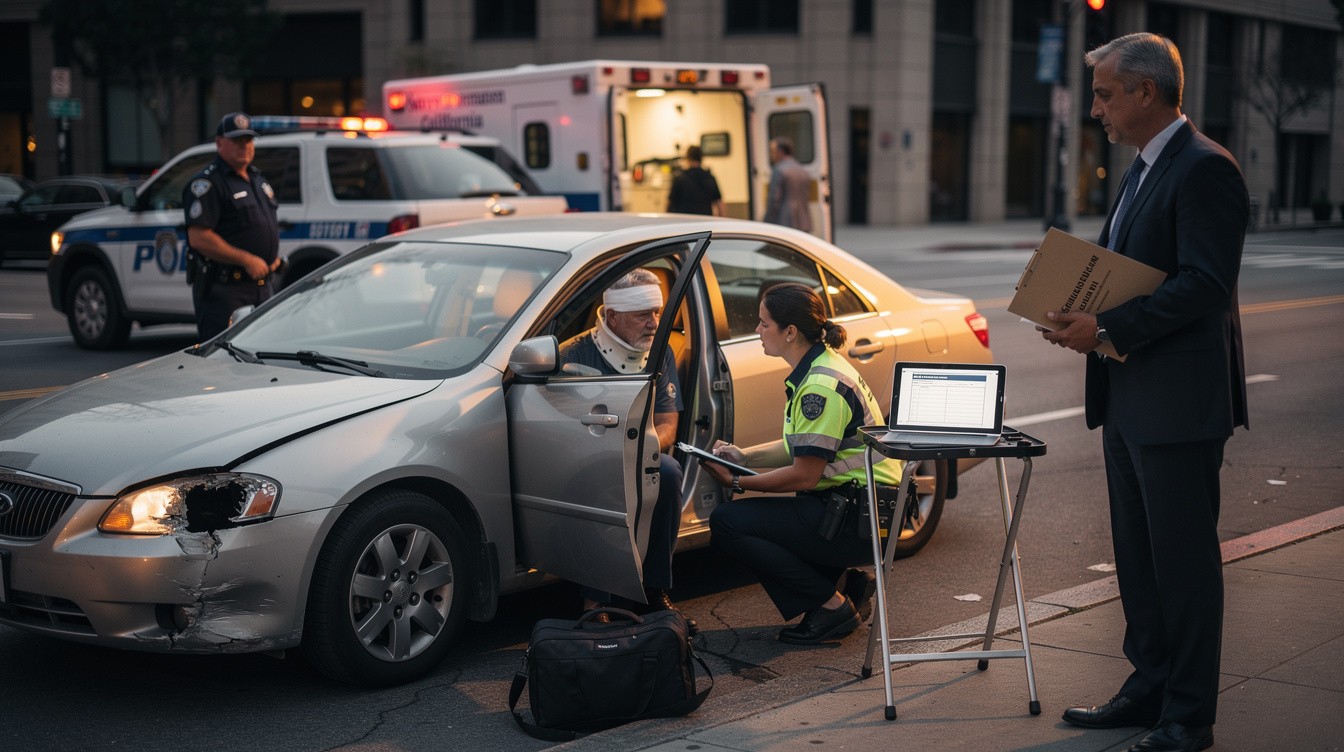
A concussion from a car accident can change your life in seconds, yet many people don’t realize how serious these injuries are. You might feel fine immediately after the crash, only to experience headaches, memory problems, or dizziness days later.
We at Schaar & Silva LLP help accident victims in Santa Cruz County, Sacramento, and Oakland understand their rights to compensation for concussion injuries. This guide walks you through California’s legal process and shows you exactly what you need to win your concussion claim.
What Happens to Your Brain in a Car Crash
The Mechanics of Concussion Injury
A concussion is a type of traumatic brain injury that occurs when the force of a collision causes your brain to move rapidly inside your skull. This movement damages brain cells and creates chemical imbalances that disrupt normal brain function. Unlike a broken bone, a concussion doesn’t always show up on CT or MRI scans, which is why the Mayo Clinic calls it an “invisible injury.” In California car accidents, concussions happen more often than many people realize. When a vehicle hits you at even moderate speed, the sudden acceleration and deceleration forces your brain to shift within your skull, triggering injury.
Why Symptoms Appear Later
You might feel fine at the scene because adrenaline masks symptoms, but hours or days later, headaches, dizziness, memory problems, and concentration issues emerge. Some people experience mood changes, sensitivity to light, or sleep disruption. The problem is that many drivers and passengers dismiss these symptoms as stress or assume they’ll fade on their own. This delayed onset creates a critical window where you must act quickly to protect your claim.
Post-Concussion Syndrome and Settlement Value
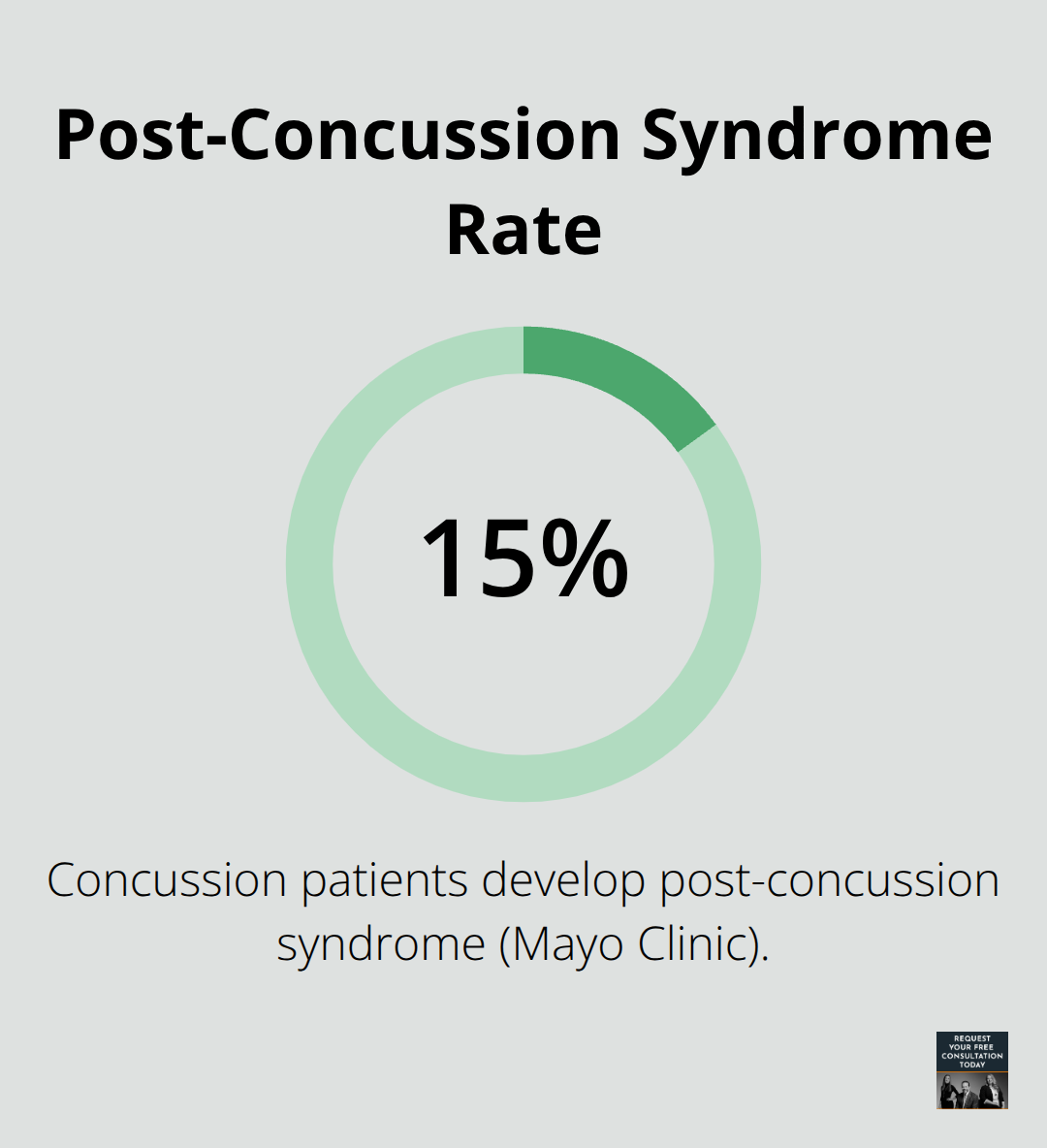
The real danger emerges when symptoms persist beyond the typical recovery window. The Mayo Clinic reports that roughly 15 percent of concussion patients develop post-concussion syndrome, a condition where symptoms last more than three months. This long-term impact is where your claim gains significant value. Someone with mild concussion symptoms might settle for $15,000 to $40,000, but cases involving post-concussion syndrome with ongoing symptoms commonly yield settlements of $150,000 to $300,000 or more.
Building Credible Medical Evidence
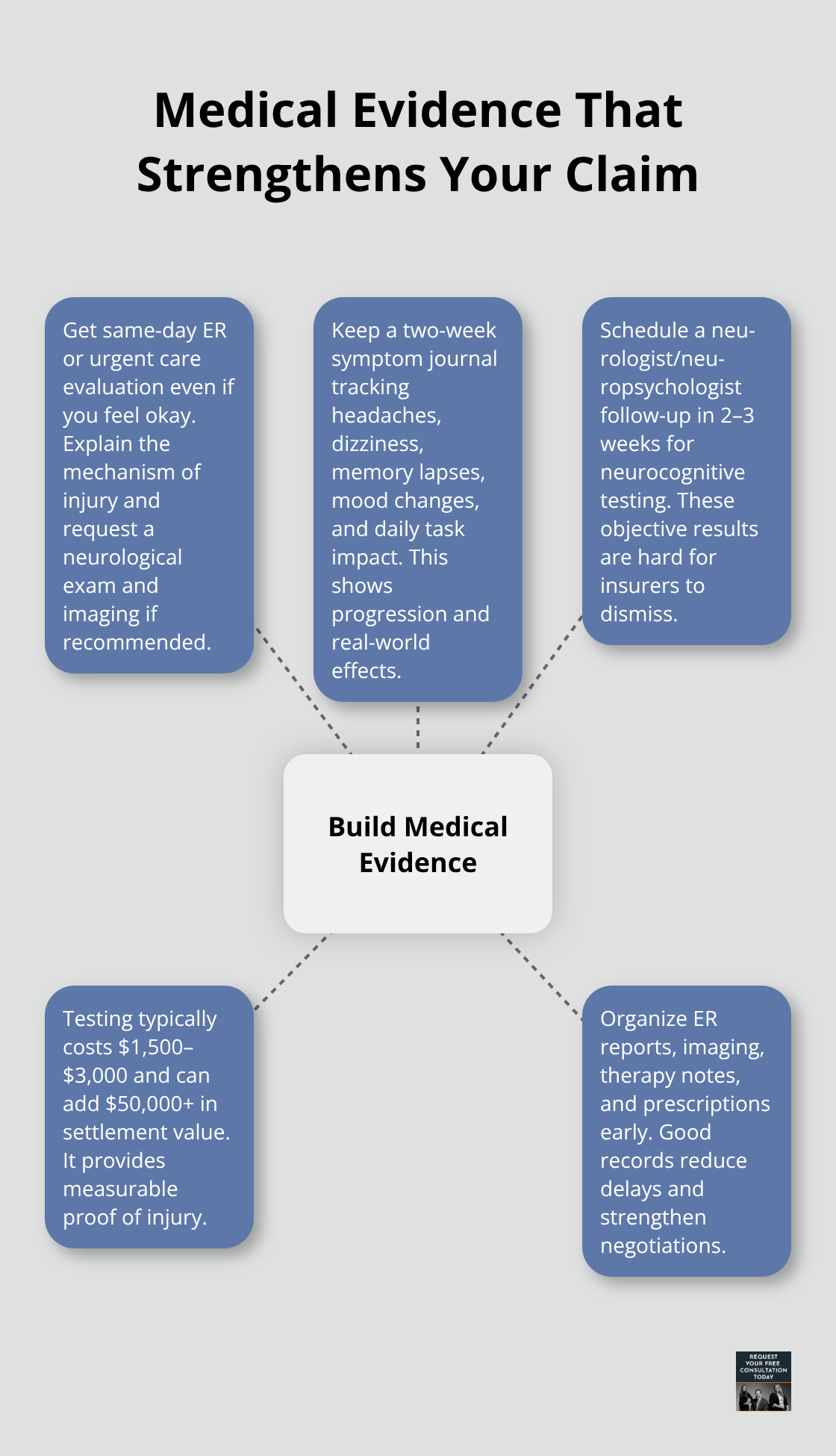
The difference lies in documented evidence of your symptoms and their impact on your daily life. If you ignore medical care after a crash, you lose the opportunity to build this evidence. Seek evaluation from an emergency room or urgent care clinic the same day of your accident, even if you feel okay. Request a neurological exam and imaging if the doctor recommends it.
Keep detailed records of every symptom you experience, when it started, and how it affects your work, sleep, and relationships. Insurance companies scrutinize concussion claims heavily because symptoms are subjective, but consistent medical documentation and evaluations from neurologists or neuropsychologists transform your claim from questionable to credible. This foundation matters when negotiating compensation and sets the stage for determining what evidence you’ll need to present to insurers.
How California Law Protects Your Concussion Claim
Filing Deadlines That Control Your Rights
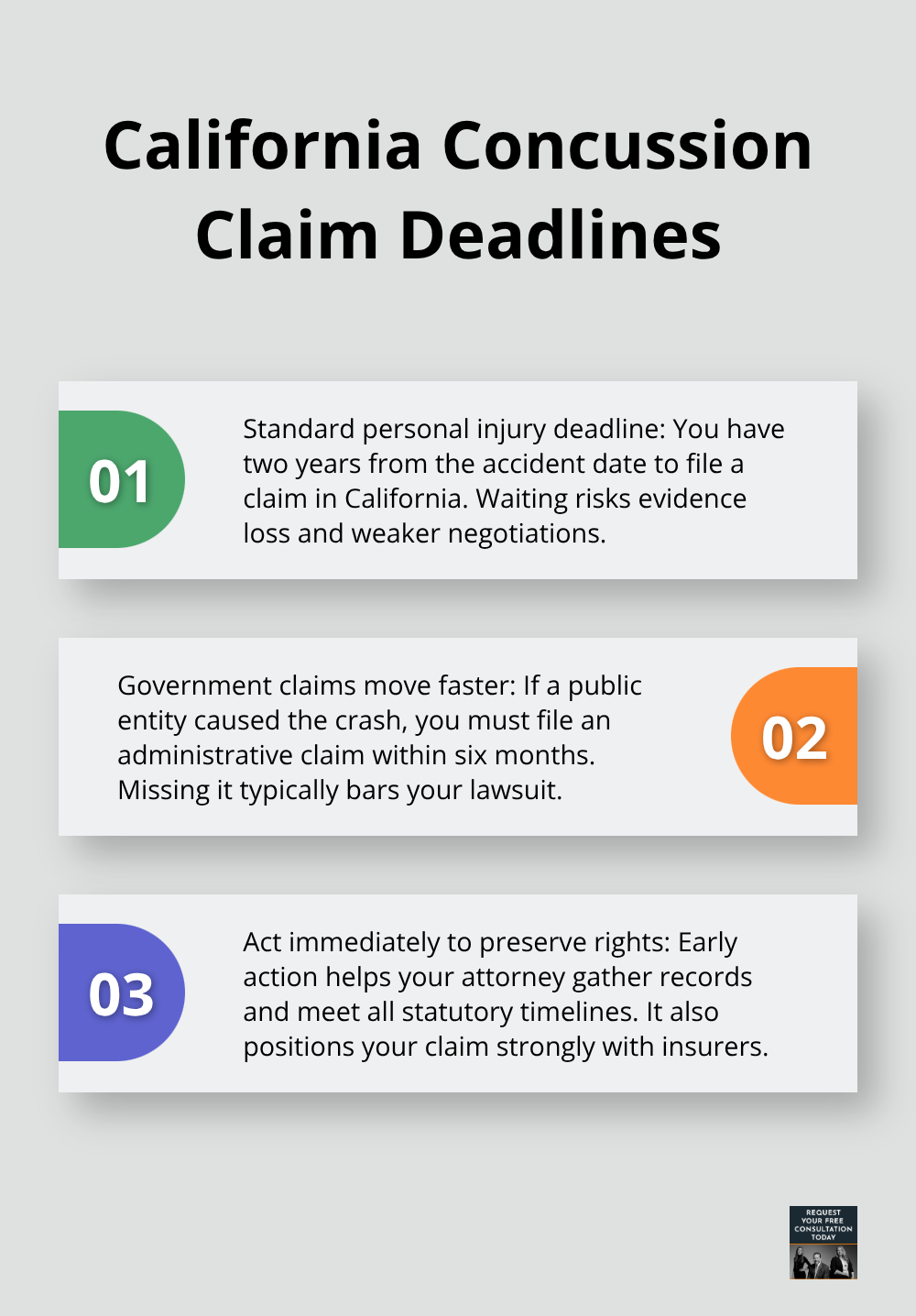
California gives you two years from the accident date to file a personal injury claim for your concussion, but this deadline moves faster if a government vehicle caused your crash. If a public entity like a city bus or county vehicle hit you, you must file an administrative claim within six months, not two years. Missing this shorter window eliminates your right to sue, so acting immediately matters when government involvement exists.
Pure Comparative Negligence Works in Your Favor
California’s pure comparative negligence rule works in your favor in ways that many other states do not allow. Unlike states that bar recovery if you’re partially at fault, California allows you to recover compensation even if you caused 30 percent of the accident. Your settlement simply reduces by your percentage of fault. This rule means that even if the other driver claims you contributed to the crash, you still have a legitimate path to compensation.
Insurance Coverage and the UM/UIM Gap
The minimum auto liability insurance in California is now $15,000 per person and $30,000 per accident under the updated 2025 law, but these minimums often prove insufficient for concussion cases. If the at-fault driver carries only the minimum coverage and your damages exceed that amount, your uninsured or underinsured motorist coverage becomes critical. Reviewing your own UM/UIM coverage immediately after a crash matters because it frequently covers gaps that the other driver’s policy won’t.
Proving Negligence Through Traffic Violations
California courts recognize concussions as legitimate injuries worthy of substantial compensation, but proving your case requires meeting the negligence standard. You must demonstrate that the other driver owed you a duty of care, breached that duty through negligent driving, and caused your concussion as a direct result. Traffic violations strengthen negligence arguments significantly. If the other driver ran a red light, exceeded the speed limit, or violated the Move Over law when stopped, these violations create what California law calls negligence per se (meaning the violation itself suggests negligence without requiring additional proof). Documenting the other driver’s violation through police reports, traffic camera footage, or witness statements transforms your claim from circumstantial to compelling.
The strength of your legal position depends on how well you document these violations and build your medical evidence. The next section shows you exactly what documentation you need to collect at the accident scene and in the weeks following your injury.
Building Your Concussion Claim From Evidence to Resolution
Collect Medical Evidence Immediately After Your Accident
Visit an emergency room or urgent care facility the same day of the crash, even if symptoms haven’t appeared yet. Request a neurological examination and explain the mechanism of injury to the doctor-how your head moved, whether you lost consciousness, and any immediate sensations. Ask for written records of the exam and imaging results. Over the next two weeks, keep a symptom journal that notes headaches, dizziness, memory lapses, mood changes, and how these issues affect your ability to work or perform daily tasks. This journal becomes powerful evidence because it shows the progression and real-world impact of your injury.
Schedule a follow-up appointment with a neurologist or neuropsychologist within two to three weeks. These professionals perform neurocognitive testing that measures memory, concentration, and processing speed-objective data that insurers cannot dismiss as subjective complaint. The cost of these evaluations typically ranges from $1,500 to $3,000, but they often increase settlement value by $50,000 or more because they provide measurable proof of injury. Collect all medical records including ER reports, imaging files, therapy notes, and prescription records. Insurance companies will request these anyway, so organizing them early prevents delays.
Document Your Economic Losses
Obtain written confirmation from your employer showing the dates you missed work and your hourly rate. If your concussion affects your ability to perform your job duties, have your supervisor document any reduced hours or modified responsibilities. This economic damage strengthens your claim significantly because it translates your injury into concrete financial loss.
Gather Accident Scene and Witness Information
At the accident scene, photograph the final positions of all vehicles, damage patterns, and road conditions from multiple angles. Take photos of traffic signals, stop signs, and any visible violations like skid marks. Obtain contact information and written statements from every witness, including their account of how the crash occurred. Request the police report within 48 hours by contacting the local police department with your incident number-this report documents the investigating officer’s observations of fault and violations.
If dashcam footage exists from nearby vehicles or traffic cameras captured the collision, request this immediately through public records requests or your attorney. Vehicle event data, commonly called black box data, records speed, braking, and acceleration in the seconds before impact. This data proves negligence definitively in many cases.
Protect Your Claim Through Strategic Communication
Do not communicate with the at-fault driver’s insurance company before consulting with legal representation. Insurance adjusters are trained to minimize claims and may record your statements for use against you later. Avoid saying you’re fine or speculating about how the accident occurred. When the insurer contacts you, provide only your name, claim number, and a statement that you’ll have your attorney respond. This single step prevents statements that could reduce your settlement by thousands of dollars.
We at Schaar & Silva LLP handle all communications with insurers on your behalf, eliminating the risk of inadvertent statements that damage your claim. Our team coordinates with medical providers, gathers records efficiently, meets all filing deadlines, and negotiates settlements while you focus on recovery.
Final Thoughts
Filing a concussion claim in California requires speed, documentation, and strategic legal guidance. You have two years to file your claim, but government vehicle crashes demand action within six months. Medical evidence from neurologists and neuropsychologists transforms subjective symptoms into measurable proof that insurers cannot dismiss, and traffic violations documented in police reports strengthen your negligence argument significantly.
California’s pure comparative negligence rule protects you even if you bear partial fault, and the gap between minimum insurance coverage and your actual damages makes uninsured motorist coverage essential. Your symptom journal, employment records, and accident scene documentation create the foundation for settlement negotiations that often reach $150,000 to $300,000 or more when post-concussion syndrome develops. These legal protections exist, but only if you act decisively from the moment of impact.
We at Schaar & Silva LLP guide accident victims through every step of this process. Our team handles insurer communications so you avoid statements that reduce settlements, coordinates with medical providers to build credible evidence, and meets all filing deadlines that protect your rights. Contact Schaar & Silva LLP for a free and confidential case evaluation to understand your rights and options under California law.
