

A car crash can turn your life upside down in seconds. Medical bills pile up, your vehicle needs repairs, and you’re left wondering how to recover what you’ve lost.
We at Schaar & Silva LLP have helped countless drivers in Santa Cruz County, Sacramento, and Oakland navigate the settlement process. This guide walks you through practical car crash settlement tips that can help you get the compensation you deserve.
What to Do Right After Your Crash
The first hour after a crash determines how strong your settlement case becomes. Your actions now affect how much compensation you’ll recover later. Start by checking if anyone needs medical attention and call 911 if injuries are present. Once emergency responders arrive, stay calm and avoid admitting fault or apologizing for the crash, as these statements can be used against you later. California law requires you to report accidents involving injuries or property damage exceeding $750 to the DMV within 10 days, according to the California Department of Insurance. Missing this deadline can result in license suspension, so mark your calendar immediately.
Photograph Everything at the Scene
Take photos and video of the entire accident scene before anything moves. Capture the vehicle damage from multiple angles, the road conditions, traffic signs, weather, and the final resting positions of all vehicles involved. Include wide shots showing the accident location and close-ups of specific damage. If your phone dies or you forget, the scene changes within minutes and evidence vanishes. Photos prove the severity of impact and support your claim for damages.
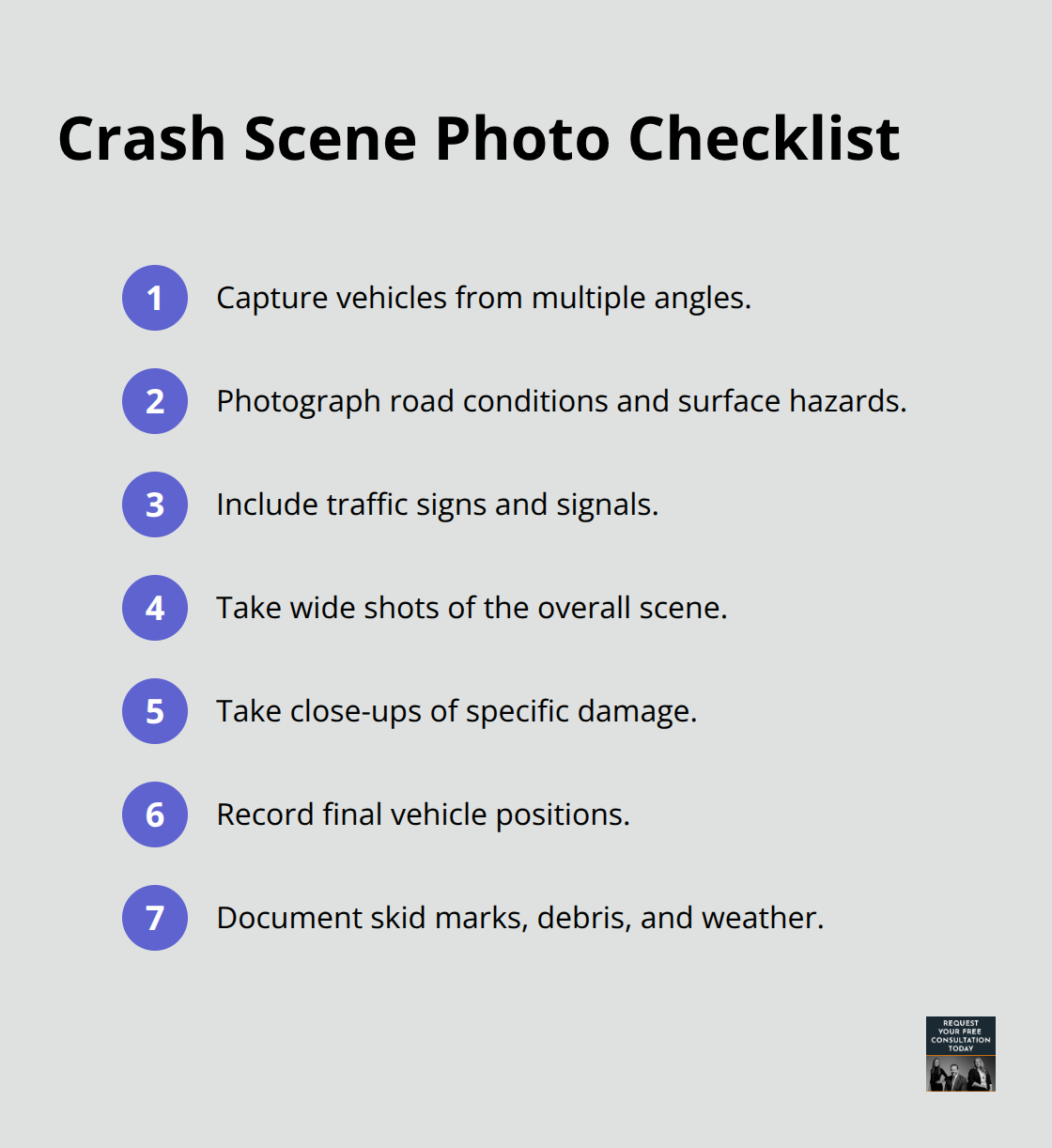
Document any skid marks, debris, or road hazards that contributed to the crash. These images become critical negotiating tools with insurance companies later.
Collect Names, Numbers, and Insurance Details
Get the other driver’s name, phone number, address, driver’s license number, license plate, vehicle identification number (VIN), and insurance policy information. Write down the name and badge number of any police officer at the scene. Speak with witnesses and record their names, phone numbers, and what they saw. Don’t rely on memory-write everything down on paper or your phone immediately. Insurance companies verify witness statements, and credible witnesses strengthen your case significantly. If witnesses leave before you get their information, the California Department of Insurance recommends gathering contact details from nearby businesses that may have security footage.
Report to Police and Your Insurance Company
Contact your insurance company as soon as possible after the crash (ideally within 24 hours). Provide them with the police report number, the other driver’s information, and photos you took at the scene. Your insurer will assign an adjuster to investigate the claim and assess vehicle damage. When speaking with your insurer, stick to the facts and avoid speculation about injuries or fault. File a police report if one wasn’t already filed at the scene, as this official documentation strengthens your case. Keep copies of all communications with your insurance company, including claim numbers, adjuster names, and dates of conversations.
Understanding how insurance claims work in California sets the foundation for negotiating your settlement effectively.
How Insurance Claims Work and What Your Settlement Options Are
After you file a claim with your insurance company, they follow a specific process that directly affects your settlement value. The adjuster assigned to your case will contact you within 15 days to acknowledge your claim, according to California’s Fair Claims Settlement Practices Regulations. Within 40 days after you provide proof of loss (medical records, repair estimates, photos), the insurer must decide whether to accept or deny your claim.
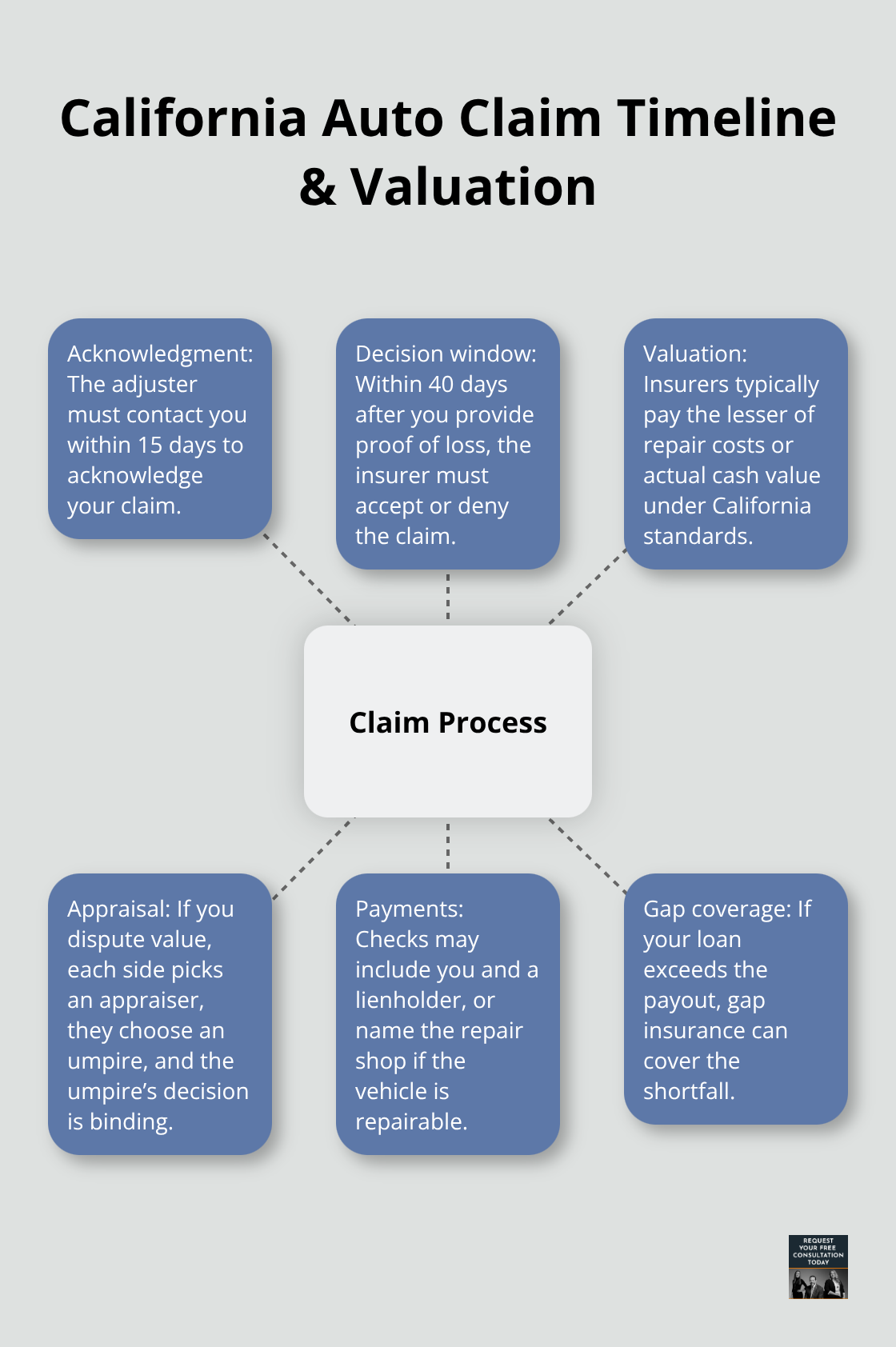
This timeline matters because delays signal potential bad faith, which can strengthen your negotiating position. Your insurer will inspect vehicle damage and may send a second appraiser if additional damage surfaces after the initial inspection. For physical-damage claims, the insurer typically pays the lesser of repair costs or your vehicle’s actual cash value, which in California means the fair market value a willing buyer and seller would agree on under normal conditions. If you disagree with their valuation, many policies include an appraisal provision where each side picks an appraiser, those two select a neutral umpire, and the umpire’s decision becomes binding. Settlement checks may be issued in your name and the lienholder’s name together, or the repair shop can be named as a payee depending on whether your vehicle is repairable. If your loan balance exceeds the payout, you’re responsible for the difference, though gap insurance can cover this shortfall if you have it.
When to Settle vs. When to Pursue Legal Action
Most car crash claims settle without going to court, but rushing to accept an early settlement offer from the insurance company often costs you thousands in lost compensation. Insurers use undervaluation tactics like making quick low-ball offers within 60 to 90 days, disputing whether injuries are real, arguing you received unnecessary medical treatment, and monitoring your social media for posts that contradict your injury claims. Never sign anything or make a recorded statement without consulting an attorney, as these can be used to minimize your claim value. California uses pure comparative negligence, meaning you can recover damages even if you’re partly at fault, but your award gets reduced by your percentage of fault. If the at-fault driver has no insurance, your uninsured motorist coverage pays up to your policy limits. If they’re underinsured, your underinsured motorist coverage fills the remaining gap. You should negotiate with the insurance company directly if your injuries are minor and documented, but you should pursue legal action if your medical bills exceed $10,000, your injuries are permanent, the insurer denies a reasonable settlement offer, or comparative fault is disputed. California Senate Bill 1107, effective January 2025, raised minimum liability coverage to 30/60/15, which affects how much insurance money is available in serious crashes.
Economic Damages You Can Recover
Your settlement includes economic damages, which are straightforward to calculate and prove. Past medical expenses cover emergency room visits, hospital stays, surgery, physical therapy, imaging (MRIs, CT scans), and ongoing treatment. Future medical expenses require a life-care plan prepared by a medical professional, especially for permanent injuries like traumatic brain injury or spinal damage, which can reach hundreds of thousands over your lifetime. Lost wages include income you missed while recovering, plus future earning capacity if the injury prevents you from returning to your previous job. Property damage covers repair costs or the vehicle’s fair market value if it’s totaled.
Non-Economic Damages and Settlement Ranges
Non-economic damages have no cap in California and typically represent the largest portion of your settlement. Pain and suffering, emotional distress, loss of enjoyment of life, and loss of consortium are valued using multipliers (typically 1.5 to 5 times your economic damages) or per-diem methods where a dollar amount is assigned per day of recovery. Injury severity is the strongest predictor of settlement value, with minor soft-tissue injuries typically settling for $5,000 to $25,000, moderate whiplash for $15,000 to $75,000, herniated discs for $50,000 to $250,000, and traumatic brain injury for $250,000 to over $1,000,000. Insurance policy limits cap most settlements, so if damages exceed available coverage, you may need to pursue the at-fault driver’s personal assets or explore additional coverage sources. Understanding these damage categories helps you evaluate whether an insurance company’s offer reflects your actual losses and future needs.
Building Your Settlement Case
Organizing your medical records and expenses is where settlement negotiations actually begin. Insurance companies pay based on documented evidence, not promises or vague descriptions of your injuries. Start by collecting every medical bill, receipt, and statement from the date of your crash forward. This includes emergency room visits, hospital stays, specialist appointments, physical therapy sessions, imaging tests like MRIs and CT scans, medications, and any medical equipment you purchased. Create a spreadsheet with the date, provider name, service description, and amount for each expense. Total your past medical costs separately from projected future costs. For future medical expenses, you’ll need documentation from your treating physician about ongoing care requirements. If your injuries are permanent, a life-care plan prepared by a medical professional becomes essential. These plans project costs over your lifetime and can reach hundreds of thousands of dollars for serious injuries like traumatic brain injury or spinal damage. Insurance adjusters scrutinize medical records for gaps or inconsistencies, so maintain a clear timeline showing continuous treatment from the crash date onward. Any break in treatment gives the insurer ammunition to argue your injuries weren’t serious. Photograph all medical bills and receipts, then store originals in a safe location.
Calculate Your True Losses
Your economic damages extend far beyond medical bills. Lost wages include every paycheck you missed while recovering, which requires pay stubs, tax returns, or a letter from your employer confirming your hourly rate and hours missed. If your injury prevents you from returning to your previous job, you’ll need professional testimony about your diminished earning capacity over your working lifetime. Self-employed individuals should gather tax returns for the past two to three years to establish income. Property damage is straightforward: repair estimates or the vehicle’s fair market value if it’s totaled. Non-economic damages like pain and suffering have no set formula but are typically calculated using a multiplier of 1.5 to 5 times your economic damages or a per-diem method assigning daily dollar amounts. Injury severity drives these multipliers upward. Soft-tissue injuries rarely exceed a 2x multiplier, while permanent injuries like spinal cord damage or traumatic brain injury command 4x to 5x multipliers or higher. Insurance Research Council data shows represented claimants recover roughly 3.5 times more than unrepresented claimants, largely because attorneys know how to properly value non-economic damages.
Build Your Settlement Demand Letter
Create a detailed settlement demand letter that itemizes all economic damages, explains your medical treatment timeline, describes your pain and suffering with specific examples of daily impact, and justifies your requested amount using comparable cases. This document becomes your negotiating foundation with the insurance company. The National Association of Insurance Commissioners reported California’s average bodily injury liability claim around $51,635 in 2021, but your case value depends entirely on your specific injuries, documented treatment, and available insurance coverage.
Protect Your Claim Value
Avoid these mistakes that systematically reduce what insurance companies offer. Don’t give recorded statements to adjusters without an attorney present, as they’ll use your words to minimize injury claims. Don’t post on social media about your recovery, activities, or emotions, because insurers monitor these posts and use them to argue you’re not as injured as claimed.
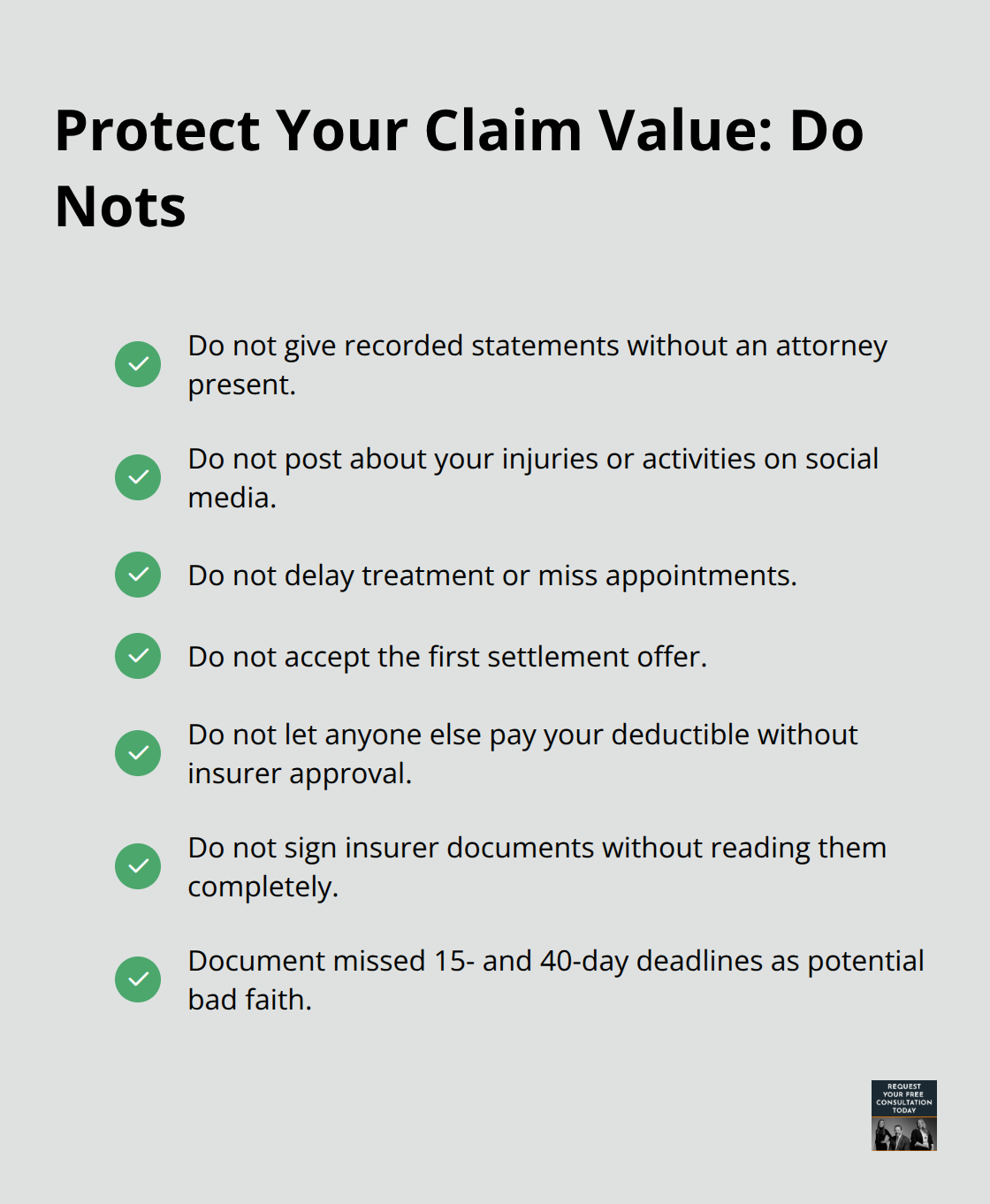
Don’t delay medical treatment or skip appointments, as gaps suggest injuries weren’t serious. Don’t accept the first settlement offer, which is almost always significantly below your claim’s actual value. Insurers deliberately make low early offers knowing most unrepresented claimants will accept them. Don’t let anyone else pay your deductible without checking with your insurer first, as this could complicate your claim. Don’t sign anything the insurance company sends without reading it completely. Settlement releases waive future claims permanently, so rushing this step means you can’t seek additional compensation if your condition worsens. California’s Fair Claims Settlement Practices Regulations require insurers to acknowledge claims within 15 days and decide within 40 days after you provide proof of loss. If they’re missing these deadlines, document it as potential bad faith, which strengthens your negotiating position.
Final Thoughts
Your car crash settlement depends on the actions you take in the days and weeks following your accident. Document everything, organize systematically, and avoid rushing into agreements that undervalue your claim. The strongest settlements come from claimants who gather medical evidence consistently, calculate their true economic losses accurately, and refuse low initial offers from insurers. Represented claimants recover roughly 3.5 times more than those handling claims alone, according to Insurance Research Council data.
Knowing when to negotiate directly with an insurer and when to pursue legal action separates adequate settlements from fair ones. Minor injuries with clear documentation may settle through direct negotiation, while permanent injuries, disputed liability, denied settlement offers, or medical bills exceeding $10,000 signal that legal representation becomes necessary. These car crash settlement tips work best when you apply them consistently from the moment the crash occurs. Your medical records form the foundation of your case value, your lost wages matter significantly, and your pain and suffering often represents the largest portion of your recovery.
We at Schaar & Silva LLP help drivers throughout Santa Cruz County, Sacramento, and Oakland navigate the settlement process with confidence. Contact us for a free case evaluation to understand your claim’s true value and explore your options. Protecting your rights today means you won’t settle for less than you deserve.
