

A car accident in Santa Cruz County can leave you facing medical bills, lost income, and vehicle repairs. You deserve to know what California auto accident compensation you’re entitled to receive.
We at Schaar & Silva LLP help accident victims understand their rights and calculate what they may be owed. This guide walks you through the types of damages available, the factors that affect your settlement amount, and how to build your claim.
What Compensation Can You Actually Recover
Medical Expenses and Treatment Costs
California law allows you to recover three main categories of damages after a car accident. Medical expenses cover everything from emergency room visits to ongoing physical therapy, surgery, specialist consultations, and medications directly tied to your injuries. If you required hospitalization, imaging like MRIs or CT scans, or surgical intervention, these costs add up quickly.
Many accident victims stop documenting their medical damages too early. Treatment often extends months or years after the initial crash, especially for spinal injuries, traumatic brain injuries, or fractures. You should keep detailed records of every medical bill, prescription receipt, and healthcare provider visit.
In 2026 California, minor soft tissue injuries typically settle between $5,000 and $25,000, reflecting shorter treatment periods and full recovery expectations. Moderate injuries like herniated discs or broken bones commonly settle in the $25,000 to $150,000 range due to higher medical costs and extended recovery timelines. Severe injuries, including traumatic brain injuries and permanent impairment, can command $150,000 to well over $1,000,000, supported by objective medical evidence like imaging reports and long-term care plans.
Lost Wages and Income
Lost wages represent income you missed while recovering or attending medical appointments. This includes time away from work immediately after the crash and ongoing losses during your recovery period. If your injury causes permanent impairment affecting your earning capacity, you can recover future lost income as well.
High earners, self-employed individuals, and skilled tradespeople often see substantially larger settlements due to higher lost-wage claims. Economists or vocational experts can calculate future earning capacity losses, which can add hundreds of thousands to serious injury cases.
Property Damage and Comparative Fault
Property damage covers vehicle repair costs or the vehicle’s fair market value if it’s totaled. You should obtain written repair estimates from reputable shops and keep documentation of your vehicle’s pre-accident condition.
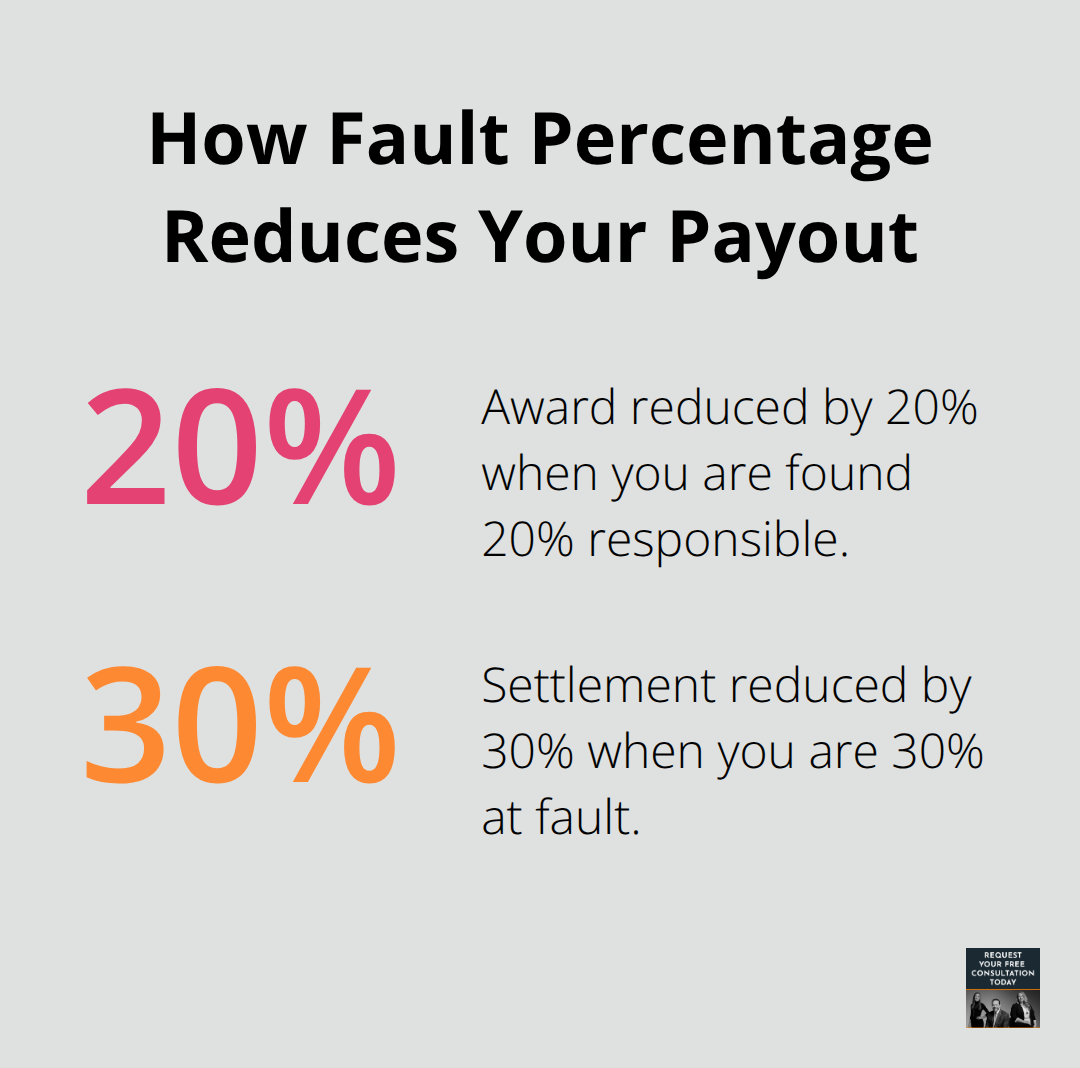
California’s pure comparative negligence system means you can recover damages even if you share some fault, though your compensation is reduced by your percentage of responsibility. For example, if you’re found 20% responsible, your award is reduced by 20%. The strength of your claim depends heavily on how thoroughly you document everything from the accident scene forward. Understanding which factors influence your settlement amount helps you build a stronger case.
What Actually Drives Your Settlement Amount
How Injury Severity Shapes Your Compensation
Injury severity stands as the single most influential factor in determining your compensation. The difference between a minor soft tissue injury and a traumatic brain injury can mean the gap between a $15,000 settlement and $500,000 or more. Insurance companies and courts assign higher values to injuries with objective medical documentation-MRI scans, surgical reports, specialist opinions, and imaging evidence carry far more weight than subjective pain complaints alone. A broken bone with clear X-ray evidence will command significantly more compensation than whiplash without imaging confirmation.
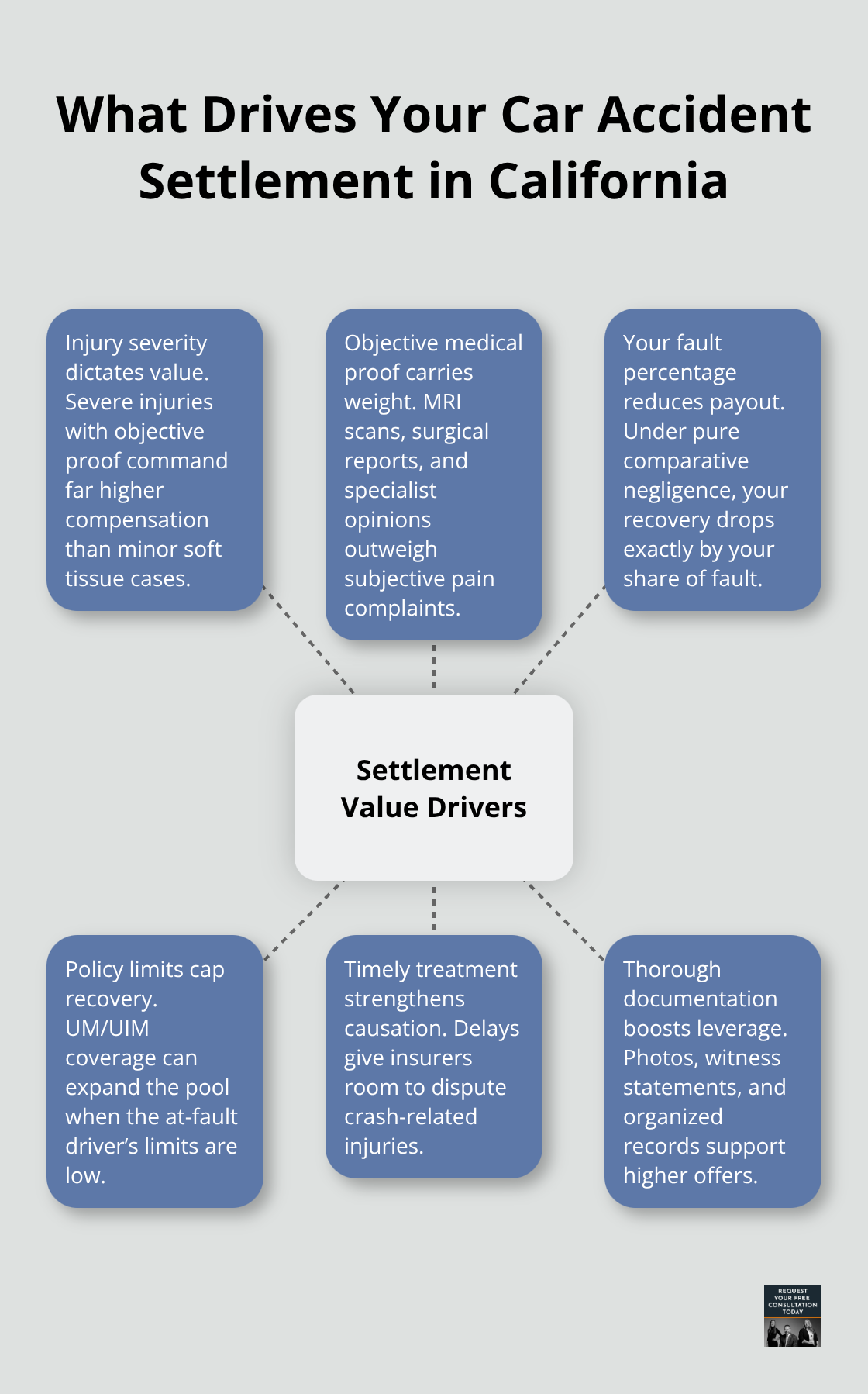
The more concrete medical proof you have, the stronger your negotiating position becomes. Seeking immediate medical attention after your accident matters profoundly; delayed treatment weakens the connection between the crash and your injuries, giving insurers ammunition to reduce your claim value.
Fault Percentage and Its Direct Impact
Your percentage of fault directly reduces what you ultimately receive, but California’s pure comparative negligence system means you’re not shut out entirely even if you’re partially responsible. If you’re found 30% at fault, your settlement is reduced by exactly 30 percent. Insurance companies routinely overstate your fault percentage during negotiations, so solid evidence from police reports, witness statements, and accident scene photos becomes your defense against inflated fault assignments.
Insurance Policy Limits as a Hard Ceiling
Insurance policy limits create a hard ceiling on recovery-if the at-fault driver carries only the state minimum of $30,000 per person liability coverage and your damages total $150,000, you’re capped at that $30,000 unless you can pursue additional coverage through your own uninsured or underinsured motorist protection. Roughly 16 to 20 percent of California drivers are uninsured, making this protection essential. Identifying all potential insurance sources and liable parties in your case maximizes the available recovery pool rather than accepting the first inadequate offer from the at-fault driver’s insurer. This is where understanding your own policy options becomes critical before moving forward with settlement negotiations.
Building Your Settlement Calculation
Organize Your Economic Damages
Start with the hardest numbers first: your economic damages. Pull together every medical bill, prescription receipt, physical therapy invoice, and healthcare provider statement from the day of the crash forward. Don’t stop at past expenses-include estimates for ongoing treatment your doctor has recommended. If you required surgery, ask your surgeon’s office for a written prognosis that outlines expected follow-up appointments and rehabilitation costs over the next year or two.
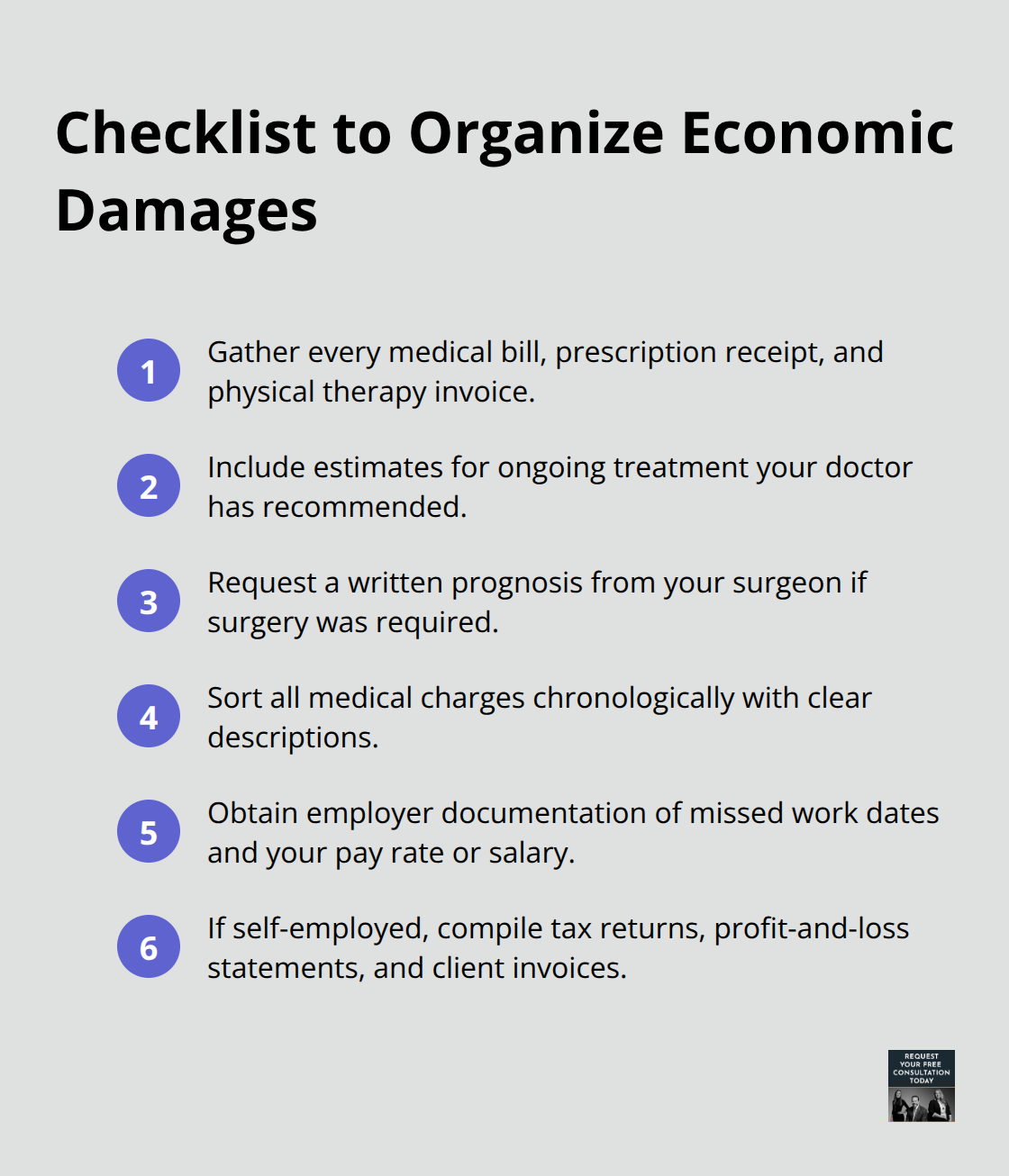
Insurance companies scrutinize medical bills aggressively, so organize them chronologically with clear descriptions of what each charge covers. Lost wages demand equal precision. Request written documentation from your employer showing the exact dates you missed work and your hourly rate or salary. If you’re self-employed, gather tax returns, profit-and-loss statements, and client invoices to establish your average monthly income.
Calculate Future Income Losses
For future lost wages, you need a vocational expert or economist to calculate earning capacity losses if your injury causes permanent impairment. This is where settlements jump from five figures to six figures or higher. Property damage requires repair estimates from at least two reputable Santa Cruz County shops. Obtain written quotes, not verbal estimates, and include photos of the damage from multiple angles. If your vehicle is totaled, obtain the fair market value using Kelley Blue Book or NADA Guides adjusted for your vehicle’s specific condition before the crash.
Apply the Settlement Formula
Once you’ve assembled these numbers, apply California’s settlement formula. Add your total economic damages, then multiply by a pain-and-suffering multiplier ranging from 1.5 to 5 times that amount depending on injury severity. A minor soft tissue injury typically uses a 1.5 to 2 multiplier, while severe injuries with permanent effects justify 4 to 5 times the economic damages.
Objective medical evidence becomes your leverage here-MRI scans, surgical reports, and specialist diagnoses support higher multipliers because they remove guesswork from pain claims. After calculating that subtotal, subtract your percentage of fault and check it against the at-fault driver’s policy limits.
Identify Additional Coverage Sources
If your calculated value exceeds their coverage, that’s when your own uninsured or underinsured motorist coverage becomes critical, potentially adding up to $1,000,000 in additional protection depending on your policy. Insurance adjusters will lowball this calculation immediately, so knowing your actual value prevents you from accepting inadequate early offers that many victims mistakenly accept within weeks of their crash. Identifying all potential insurance sources and liable parties maximizes the available recovery pool rather than accepting the first insufficient offer from the at-fault driver’s insurer.
Final Thoughts
You now understand the three main categories of California auto accident compensation available to you: medical expenses, lost wages, and property damage. You’ve learned how injury severity, fault percentage, and insurance policy limits directly shape what you ultimately receive. You know how to calculate your potential settlement by organizing economic damages, applying the pain-and-suffering multiplier, and identifying all available insurance sources. The next step is taking action within California’s two-year statute of limitations-file a police report if you haven’t already, gather all medical records and bills, document your lost wages with employer statements, and collect repair estimates for your vehicle.
Insurance adjusters use predictable tactics to undervalue claims, including lowball initial offers, questioning whether injuries are pre-existing, and pressuring you to settle before you’ve reached maximum medical improvement. Many accident victims make costly mistakes by accepting inadequate offers within weeks of their crash or by posting about their injuries on social media, which insurers use against them. Photograph your injuries as they heal and keep a written record of how the accident affected your daily life. Avoid giving recorded statements without legal guidance when the at-fault driver’s insurance company contacts you.
We at Schaar & Silva LLP help Santa Cruz County accident victims navigate this process and recover what they’re actually owed. Our team handles the legal complexities while you focus on healing, and we work on a contingency-fee basis so you pay attorney fees only if a recovery is obtained. Contact us for a free consultation to discuss your case and learn how we can protect your claim’s full value.
