

If you’ve been in a car accident in Santa Cruz County, you’re probably wondering what your claim is worth. Auto injury settlement examples show that payouts vary dramatically depending on the type of injury and how severe it is.
We at Schaar & Silva LLP have handled hundreds of accident cases, and we’ve seen settlements range from a few thousand dollars to well over a million. This post breaks down real numbers from actual cases so you understand what to expect.
What Different Injuries Actually Settle For
Whiplash and Neck Injuries
Whiplash gets undersold more often than not. Most people think a neck strain is minor, but settlements for whiplash range from $12,000 to $30,000 according to data from Miller & Zois. The range widens based on one factor: how thoroughly you document your pain. If you attend physical therapy twice a week for six months and maintain detailed notes about your headaches and neck stiffness, your case commands far more value than if you see a doctor once and stop treatment.

Cervical disc injuries, especially herniated discs in your neck, push settlements much higher into the six-figure range depending on your jurisdiction. The key difference between a $15,000 settlement and a $100,000 settlement for neck injuries rests on future medical costs. When imaging shows a disc problem that will require ongoing care or surgery down the road, that fact transforms your case value.
Back and Spinal Cord Injuries
Back and spinal cord injuries produce significantly higher settlement values. Auto accident back injuries typically settle between $20,000 and $50,000 for moderate cases, but herniated discs with documented nerve damage can exceed six figures. Most people make a critical mistake: they stop treatment too early. Insurance companies monitor this closely. If you have a herniated disc and halt physical therapy after three months, the settlement offer drops. If you continue treatment for a year and show progression toward recovery or reach a plateau at a certain pain level, you build a stronger case for future medical expenses. The longer your treatment timeline and the more detailed your medical records, the higher your settlement potential.
Traumatic Brain Injuries and Documentation
Traumatic brain injuries from car accidents present unique valuation challenges because symptoms like headaches, memory problems, and concentration issues often fail to appear on scans. Documentation matters more than the injury type itself in these cases. Keep a journal of your symptoms, missed work days, and how the injury affects your daily life. One Los Angeles rear-end collision resulted in a $32.8 million verdict, with future medical costs alone reaching $9 million, because the plaintiff had permanent neurological damage. Your brain injury case may not reach that level, but the principle remains identical: prove the long-term impact, and the settlement reflects it.
Understanding how different injuries settle prepares you for what comes next in the claims process.
What Actually Determines Your Settlement Amount
Medical Treatment Creates Your Settlement Foundation
Medical treatment intensity and duration form the foundation of settlement valuation, not injury type alone. Insurance companies calculate settlement offers by multiplying your documented medical costs by a factor typically ranging from 1.5 to 5, depending on injury severity and jurisdiction. If you undergo surgery and attend physical therapy three times weekly for eight months, your multiplier sits closer to 4 or 5. If you see a doctor twice and declare yourself healed, your multiplier drops to 1.5 or 2. This means the difference between consistent treatment and sporadic care can easily double or triple your settlement.
Documentation proves everything here. You must keep receipts for every therapy session, prescription, imaging study, and specialist visit. Track your out-of-pocket costs separately from insurance-covered expenses because both count toward your claim value. One rear-end collision case in Los Angeles generated a $32.8 million verdict partly because past medical costs totaled $700,000 and future medical projections reached $9 million, demonstrating how thorough treatment records transform settlement potential.

Insurance Policy Limits Set Your Maximum Recovery
Insurance policy limits act as a hard ceiling on what you can recover, regardless of your actual damages. California law permits you to pursue claims beyond policy limits through the defendant’s personal assets, but collectability becomes difficult and expensive. Most drivers carry minimum coverage of $15,000 per person in California, which disappears instantly in moderate-to-severe injury cases. If your documented medical expenses, lost wages, and pain and suffering calculations total $150,000 but the defendant’s policy maxes at $15,000, you face a collectability problem that requires additional legal strategy.
Permanency and Long-Term Impact Drive Future Costs
The permanency and long-term impact of your injury determine whether future medical expenses justify your settlement demand. A herniated disc that requires ongoing pain management, potential surgery within five years, and lifetime physical therapy commands substantially higher value than the same disc injury in someone whose symptoms resolve within six months. You should establish your recovery timeline early through medical providers’ assessments and imaging reports. Request written statements from your doctors about expected duration of treatment and long-term prognosis. These documents become your settlement negotiation leverage because they quantify future costs that insurance companies must account for in their offers.
Understanding these three factors-treatment documentation, policy limits, and long-term medical needs-positions you to evaluate any settlement offer critically. The next section examines how Santa Cruz County cases illustrate these principles in action.
Santa Cruz County Settlement Outcomes
Low-Impact Collisions and Treatment Documentation
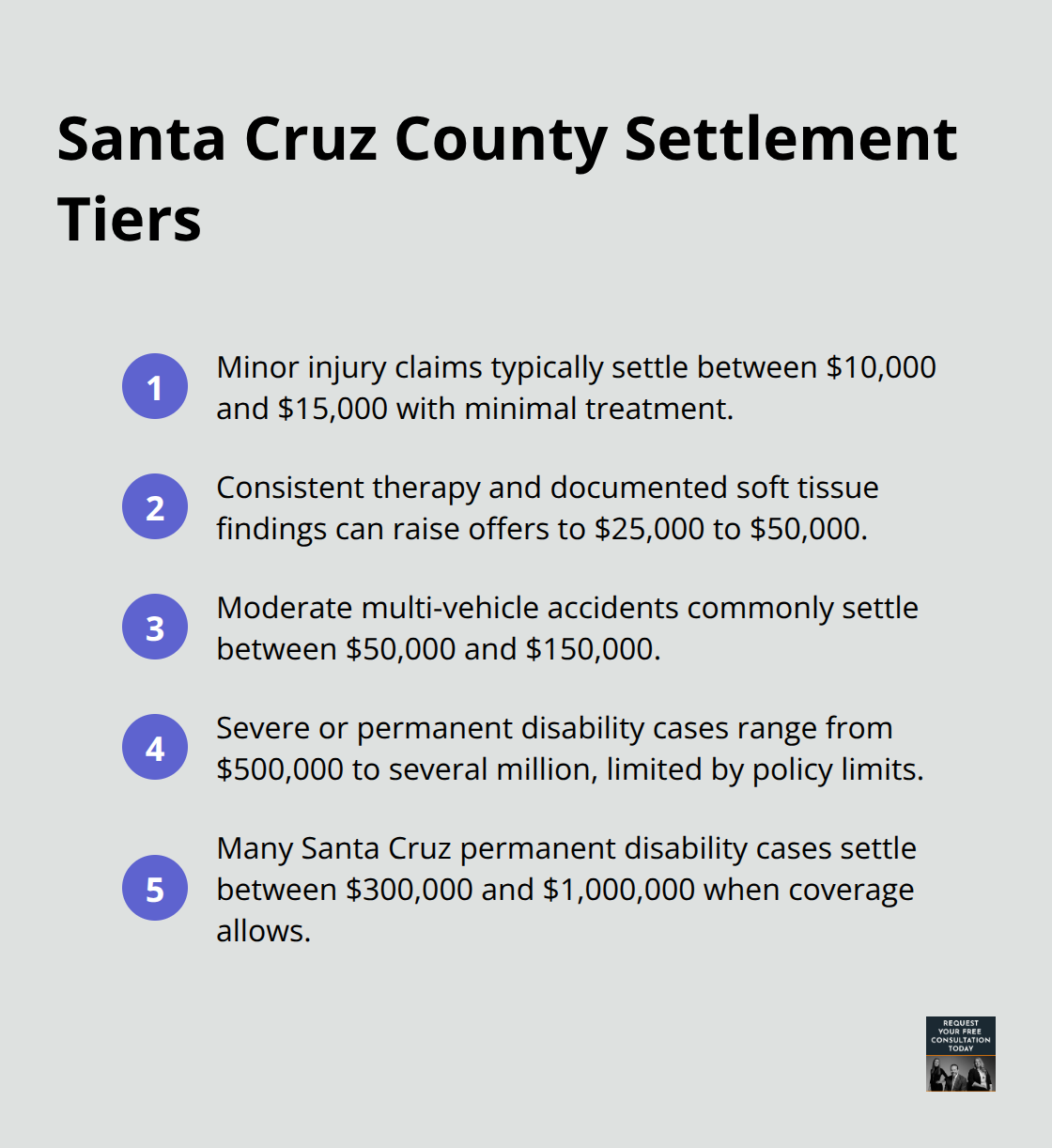
Minor injury claims in Santa Cruz County typically settle between $10,000 and $15,000 when the injured person receives minimal medical attention and recovers within weeks. The same collision type produces settlements in the $25,000 to $50,000 range when the victim pursues consistent physical therapy, obtains imaging studies confirming soft tissue damage, and maintains detailed records of pain and functional limitations for three to six months. The difference isn’t the accident itself-it’s the medical documentation trail. Insurance adjusters in Santa Cruz County evaluate these cases using the multiplier method, applying factors between 1.5 and 3 to your documented medical expenses. If you spend $8,000 on treatment and maintain thorough records, expect a settlement offer around $12,000 to $24,000. Your treatment choices directly control your settlement range within the low-impact category.
Moderate-Injury Multi-Vehicle Accidents
Moderate-injury multi-vehicle accidents involving two or more vehicles shift settlement expectations substantially higher, typically landing between $50,000 and $150,000 depending on injury severity and available insurance coverage. These cases usually involve herniated discs, significant soft tissue injuries, or moderate traumatic brain injuries requiring extended treatment. Santa Cruz County cases in this range typically feature medical expenses between $15,000 and $40,000, with treatment extending six to twelve months. The multiplier applied to these cases ranges from 2.5 to 4, meaning a $20,000 medical bill generates a $50,000 to $80,000 settlement. Insurance companies account for longer recovery periods and more substantial medical interventions when they calculate offers in this category.
Severe Injury and Permanent Disability Cases
Severe injury and permanent disability cases command substantially higher values. Catastrophic injuries producing permanent neurological damage, spinal cord injuries, or permanent loss of function settle or award between $500,000 and several million dollars, limited primarily by available insurance policy limits. A Los Angeles rear-end collision verdict reached $32.8 million, with future medical costs alone totaling $9 million, demonstrating how permanent disability transforms case value. Most Santa Cruz County cases with permanent disability settle between $300,000 and $1,000,000 when policy limits permit, though cases exceeding policy limits require pursuing the defendant’s personal assets through judgment enforcement.
What Controls Your Settlement Within These Ranges
Three factors determine your settlement outcome within these ranges: how thoroughly you document medical treatment, how clearly your medical providers establish long-term prognosis, and whether the defendant carries sufficient insurance coverage to compensate your actual damages. Medical records that span months and show consistent treatment patterns carry far more weight than sporadic visits. Written statements from your doctors about expected duration of treatment and long-term prognosis become your negotiation leverage because they quantify future costs that insurance companies must account for in their offers. Policy limits act as a hard ceiling on what you can recover, regardless of your actual damages. California law permits you to pursue claims beyond policy limits through the defendant’s personal assets, but collectability becomes difficult and expensive.
Final Thoughts
Settlement amounts for auto injuries in Santa Cruz County vary dramatically based on injury type, treatment documentation, and insurance coverage. Whiplash cases settle between $12,000 and $30,000, while back injuries range from $20,000 to $50,000 for moderate cases. Severe injuries with permanent disability command $500,000 to several million dollars, limited primarily by available policy limits.
After an accident, photograph the scene, vehicle damage, and visible injuries before leaving. Obtain the police report number and contact information from all witnesses, then seek medical attention even if you feel fine (some injuries like whiplash appear hours or days later). Keep detailed records of every medical visit, prescription, therapy session, and out-of-pocket expense, and maintain a journal documenting your pain levels and how the injury affects your daily activities.
Legal representation fundamentally changes settlement outcomes because insurance adjusters offer lower amounts to unrepresented claimants who lack knowledge about multiplier calculations and policy limits. Attorneys who handle auto injury settlement examples regularly understand how Santa Cruz County adjusters evaluate cases and what documentation strengthens your position. Contact our team at Schaar & Silva LLP to discuss your case and understand what your claim is actually worth based on your specific injuries and treatment needs.
