
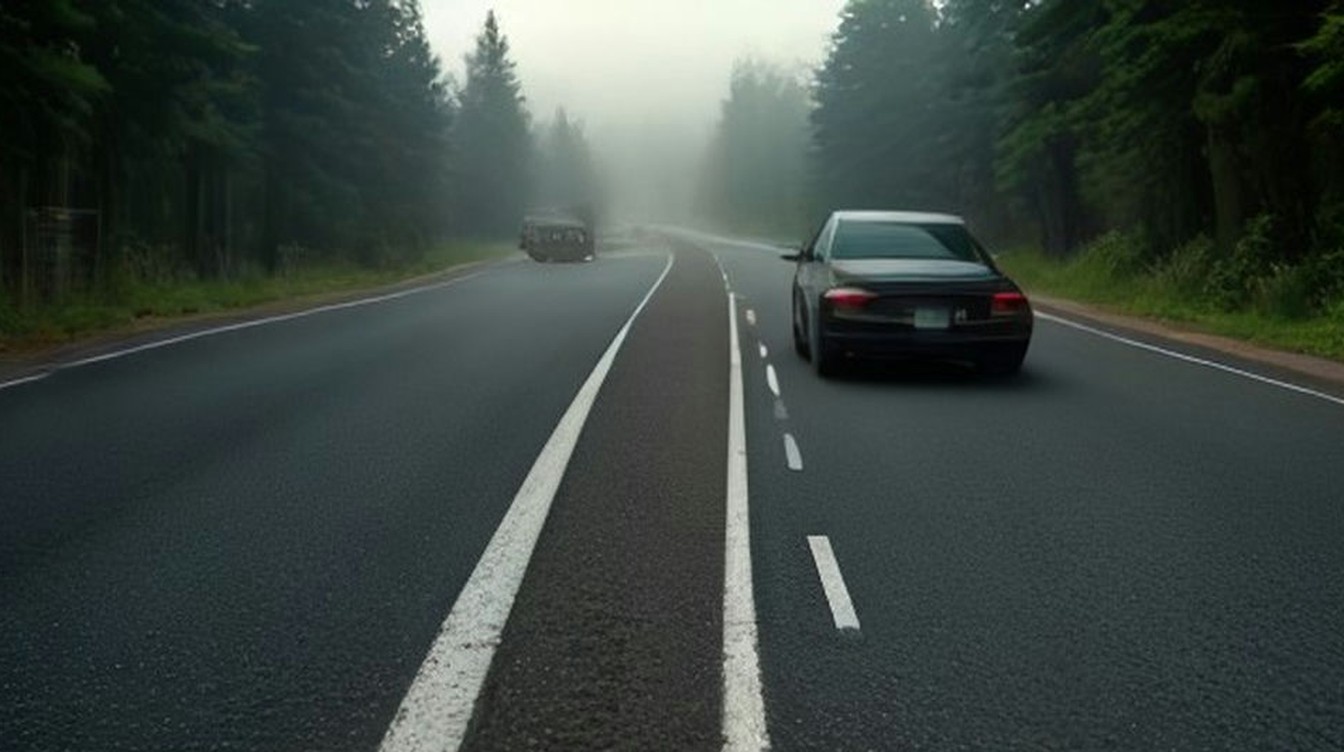
A sideswipe accident in Santa Cruz County can happen in a split second: a driver drifts over the line on a winding mountain road, merges into your lane on Highway 1 without looking, or squeezes past you on a narrow street near the beach. Because the vehicles are moving in roughly the same direction, many people assume a sideswipe is a minor scrape. In reality, these crashes can push a car off the road, into oncoming traffic, or into a guardrail, and they often leave drivers with neck, shoulder, and back injuries along with a frustrating argument about who crossed into whose lane.
At Schaar & Silva LLP, we help people across Santa Cruz County who have been hurt in car and truck accidents so you can move forward with confidence. This guide explains how sideswipe crashes actually happen on local roads, how California law decides who was at fault, and the mistakes that most often weaken an otherwise strong claim.
How Sideswipe Accidents Actually Happen in Santa Cruz County
Santa Cruz County packs a wide variety of driving conditions into a small area. Multi-lane stretches of Highway 1 carry commuters between Watsonville, Aptos, and Santa Cruz, while two-lane routes through the mountains and farmland wind through curves with little or no shoulder. Each setting creates its own version of the sideswipe crash.
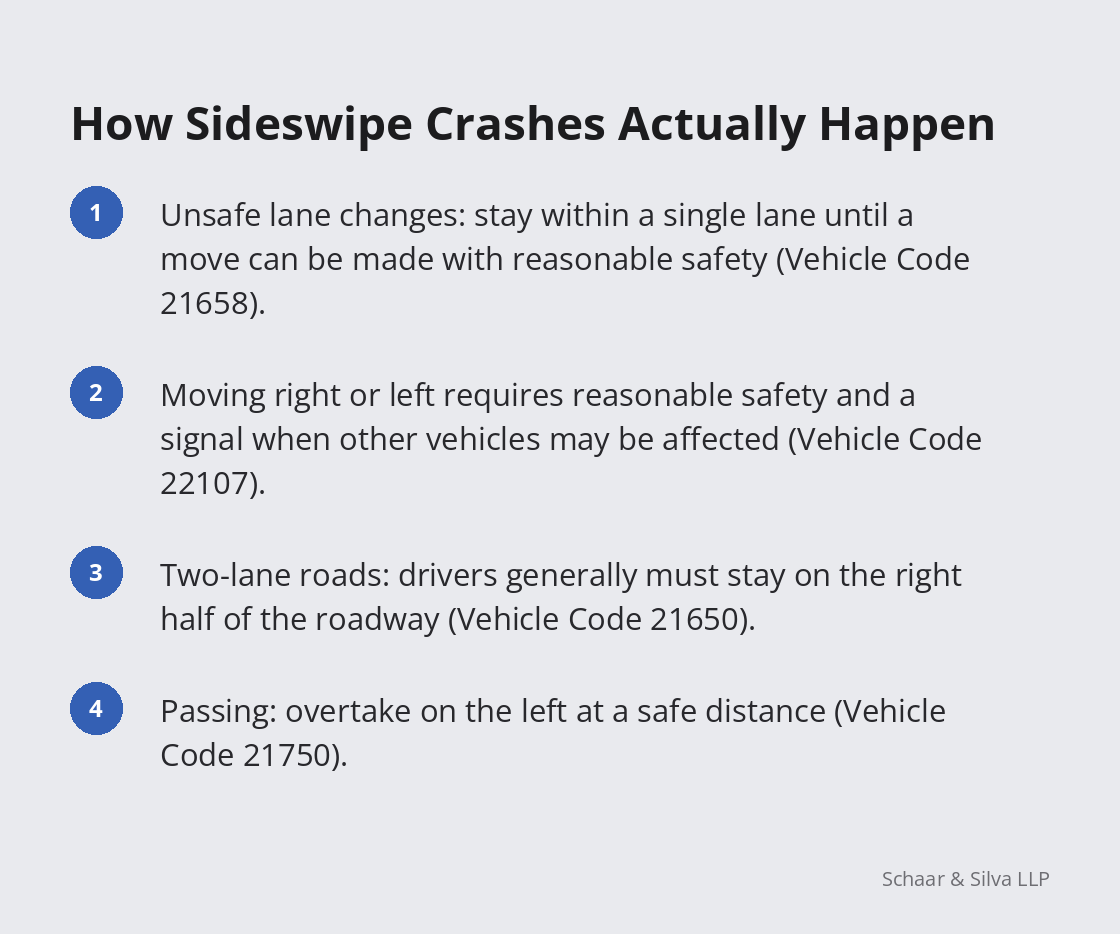
Understanding which pattern fits your collision helps identify the specific driving rule that was broken. That rule often becomes the foundation of the liability argument in your claim.
Unsafe Lane Changes on Multi-Lane Highways
The most common sideswipe happens when a driver changes lanes without making sure the lane is clear. California Vehicle Code Section 21658 says that when a roadway has been divided into two or more clearly marked lanes for traffic in one direction, a vehicle must be driven as nearly as practical entirely within a single lane and must not be moved from that lane until the movement can be made with reasonable safety.
Vehicle Code Section 22107 adds a second layer. It prohibits a driver from turning from a direct course or moving right or left on a roadway until the movement can be made with reasonable safety, and then only after giving an appropriate signal when another vehicle may be affected. A driver who darts into the next lane to reach an exit often violates both rules at once.
Drifting Over the Center Line on Two-Lane Roads
On two-lane county roads, a sideswipe often involves a vehicle traveling in the opposite direction. Vehicle Code Section 21650 generally requires vehicles on a highway to be driven on the right half of the roadway, with limited exceptions such as lawfully passing, preparing for a left turn, or a roadway that is closed or not wide enough. Vehicle Code Section 21460 also provides that where double parallel solid yellow lines are in place, a driver must not drive to the left of those lines except as the statute permits.
Tight curves and fog tempt drivers to cut corners, and the damage pattern on both vehicles often shows where the impact happened.
Passing Too Closely and Squeezing Into Tight Spaces
Sideswipes also happen when one driver tries to pass another without leaving enough room. Under Vehicle Code Section 21750, a driver overtaking another vehicle traveling in the same direction must pass to the left at a safe distance without interfering with the safe operation of the overtaken vehicle, subject to the limits and exceptions in the passing rules.
In beach areas and older neighborhoods, narrow streets lined with parked cars create similar problems. A driver who tries to squeeze through a gap that is too small, or who swings wide around a parked delivery van without checking oncoming traffic, may be responsible for the collision that follows.
How Fault Is Determined After a Sideswipe Accident
Sideswipe claims frequently turn into a dispute over a single question: which car left its lane? Both drivers may honestly believe the other one moved over, which makes careful analysis of the evidence especially important.
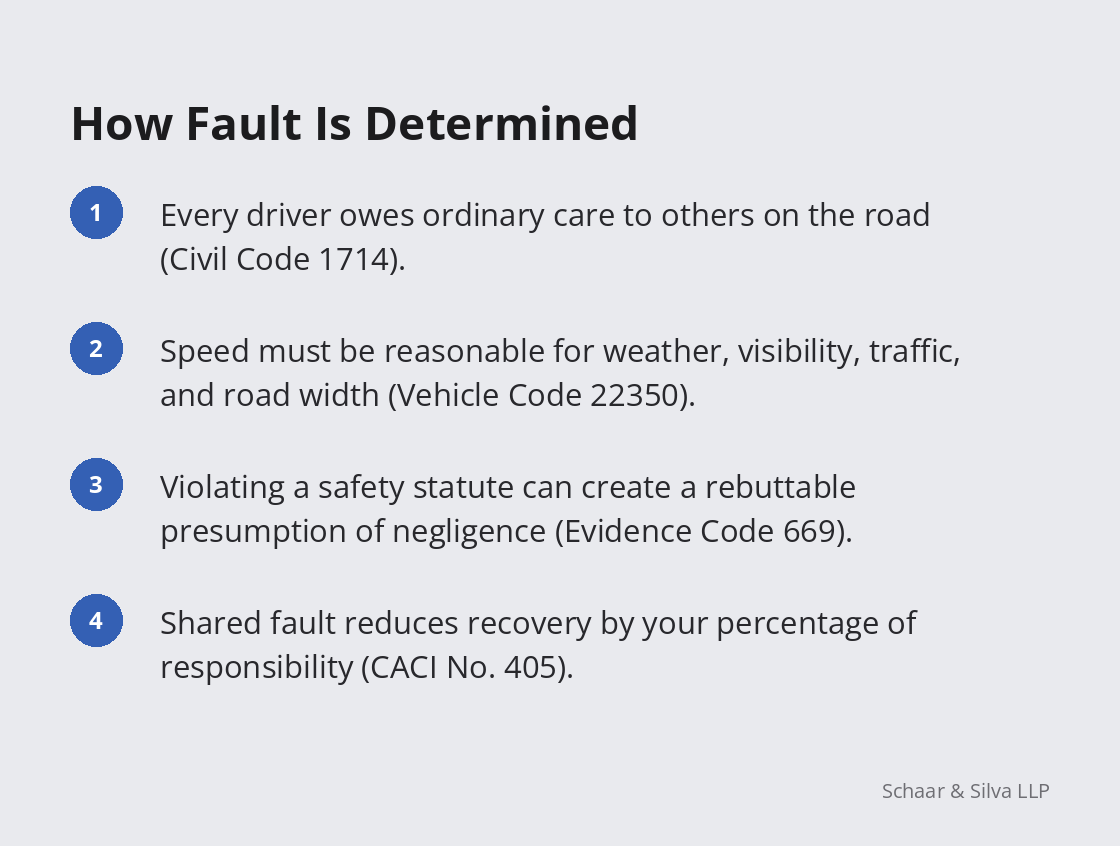
Adjusters, attorneys, and courts look at the driving rules involved, the physical evidence, and the conduct of both drivers to decide how responsibility should be shared.
The Duty of Ordinary Care on the Road
California Civil Code Section 1714 provides that everyone is responsible for an injury caused to another by a want of ordinary care or skill in the management of his or her property or person. For drivers, that means checking mirrors and blind spots before changing lanes, staying within the lane, and adjusting to traffic and road conditions.
Vehicle Code Section 22350, the basic speed law, reinforces this duty. It prohibits driving at a speed greater than is reasonable or prudent given the weather, visibility, traffic, and the surface and width of the highway, and in no event at a speed that endangers the safety of persons or property. A driver taking a narrow mountain curve too fast is far more likely to drift across the line, even if the posted limit was never exceeded.
Using Traffic Violations to Prove Negligence
California Evidence Code Section 669 allows a presumption that a person failed to exercise due care if that person violated a statute, the violation caused the injury, the injury resulted from the kind of occurrence the statute was designed to prevent, and the injured person was among the people the statute was meant to protect. Lane rules exist precisely to prevent vehicles from colliding side to side, so proof that the other driver made an unsafe lane change can carry real weight.
The presumption can be rebutted, however. The other driver may claim an emergency, such as swerving to avoid debris or a deer, or argue that you were the one who moved over. Independent evidence such as witness statements, dashcam footage, and paint transfer patterns is often what settles the question.
When Both Drivers Share Responsibility
California follows comparative fault. Under the Judicial Council’s civil jury instructions, CACI No. 405, if the defendant proves that the injured person was partly responsible for the harm, the injured person’s damages are reduced by the percentage of their own responsibility. A sideswipe in which both drivers were drifting, or in which one driver was speeding while the other changed lanes, may be divided between them.
Being partly at fault does not end your claim, but insurers frequently try to inflate the share assigned to the injured driver. Clear documentation of lane positions, vehicle damage, and the moments before impact helps keep that percentage accurate.
Mistakes That Can Weaken Your Sideswipe Accident Claim
Many sideswipe claims lose strength not because of what happened on the road, but because of what happened afterward. The hours and days after a crash are when the most important evidence is either preserved or lost.
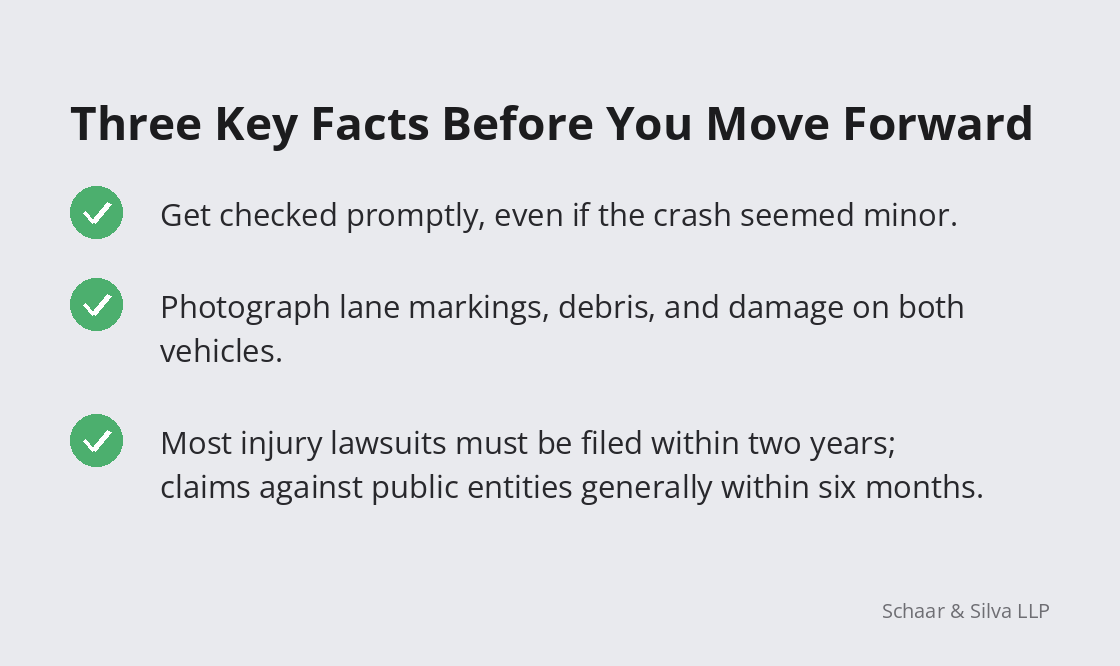
Avoiding the following missteps protects both your recovery and your ability to show what really happened.
Assuming a Side Impact Is Too Minor to Matter
Because sideswipes often leave scrapes rather than crushed bumpers, people sometimes skip medical care or exchange information and drive away without a second thought. Yet the sudden sideways jolt can strain the neck, shoulders, and lower back, and symptoms may build over the following days. Getting evaluated promptly protects your health and creates a record linking your symptoms to the collision.
Following your treatment plan matters too, because gaps in care give an insurer room to argue your injuries were not serious.
Leaving the Scene Without Photographs and Witnesses
In a sideswipe case, the location of debris, the final resting positions of the vehicles, and the damage along each side can show which car crossed the line. Photographs of the lane markings, nearby signs, and road conditions are equally useful, especially on rural roads where fog, curves, or a missing shoulder played a role. Contact information for witnesses can make the difference when the other driver’s story changes later.
Crashes on state highways such as Highway 1 and Highway 17 are often handled by the California Highway Patrol, while incidents on city streets are typically handled by local police. Knowing which agency responded helps you request the correct report. If your crash happened on the mountain route over the hill, our guide to a Highway 17 car accident explains the evidence that matters on that road.
Missing Reporting Duties and Filing Deadlines
California law imposes duties that start at the scene. Vehicle Code Section 20001 requires a driver involved in an accident resulting in injury to another person or death to immediately stop at the scene and fulfill the duties the law requires. Vehicle Code Section 16000 separately requires a driver involved in an accident that results in bodily injury or death, among other situations, to report the accident to the DMV within 10 days on an approved form, which is a separate obligation from any police report.
For most personal injury lawsuits, Code of Civil Procedure Section 335.1 generally allows two years to file. If a public entity may be responsible, such as a county vehicle or a dangerous road condition, Government Code Section 911.2 generally requires a claim for personal injury to be presented no later than six months after the cause of action accrues. Missing that shorter window can seriously limit your options.
Final Thoughts
A sideswipe accident in Santa Cruz County may look like a simple scrape, but it can cause real injuries and a stubborn dispute over who left their lane. California’s lane-use rules, the duty of ordinary care, and comparative fault principles all shape how responsibility is decided and how your recovery is measured.
The choices you make early, including getting medical care, preserving photographs and witness information, and keeping track of reporting and filing deadlines, often have the greatest influence on how your claim unfolds. You do not have to work through these questions alone.
If you were hurt in a sideswipe crash on Highway 1, a mountain road, or a city street anywhere in Santa Cruz County, contact Schaar & Silva LLP to talk with our team about what happened. We will review the evidence, explain your options, and help you take the next step with confidence. We serve Santa Cruz County and surrounding communities.