
An Oakland 18-wheeler accident is rarely a simple fender bender. Tractor-trailers move through the city every day on their way to and from the Port of Oakland, warehouses near Interstate 880, and businesses across the East Bay, and they share narrow downtown streets and busy freeway lanes with cars, cyclists, and pedestrians. When a truck that size swings wide on a turn or changes lanes into a vehicle it cannot see, the results can be devastating. Knowing how California law assigns fault in these crashes gives you real control over your claim.
At Schaar & Silva LLP, we help people in Oakland who have been hurt in auto and truck accidents so you can move forward with confidence. This guide explains how 18-wheeler crashes actually happen on Oakland streets and freeways, how fault is proven when a big rig is involved, and the mistakes that can weaken a strong case.
How Oakland 18-Wheeler Accidents Actually Happen
An 18-wheeler is a combination vehicle, usually a truck tractor pulling a long semitrailer. That length, weight, and height change everything about how the truck turns, stops, and sees other traffic. Many collisions in Oakland involve trucks doing ordinary things, such as turning onto a surface street from a port access road or merging onto the freeway, in a way that fails to account for the vehicles around them.
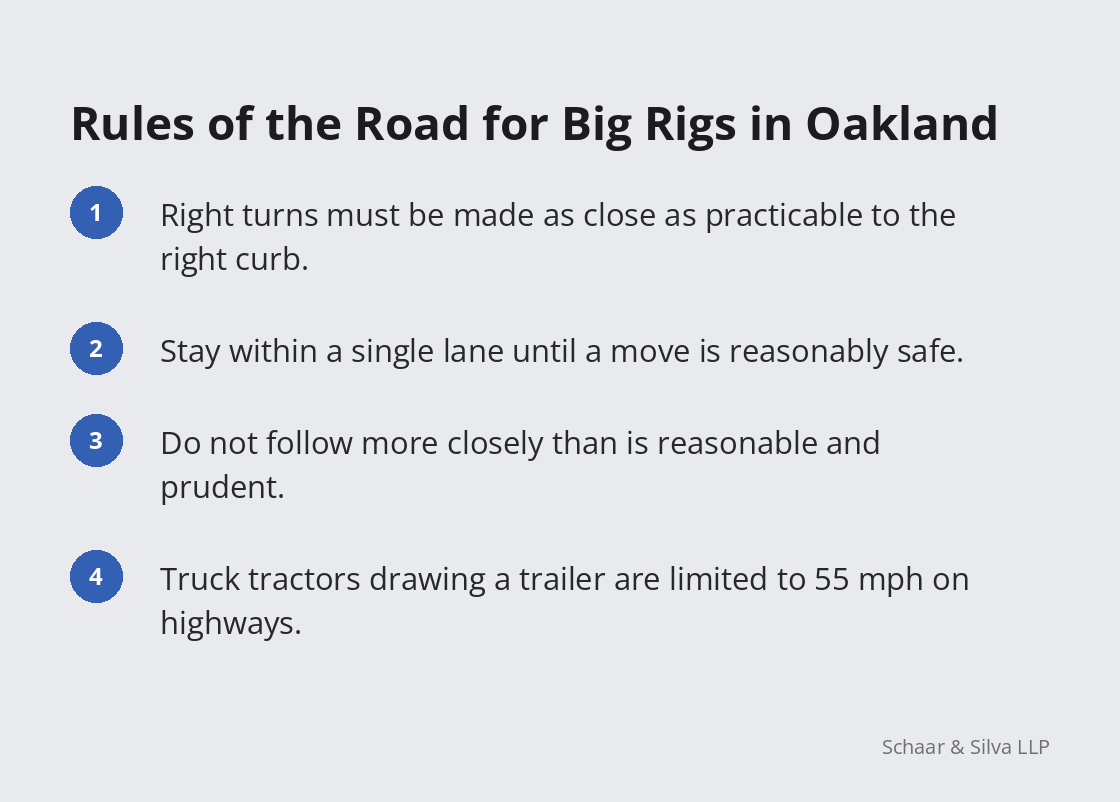
Most big rig collisions follow a handful of recognizable patterns. Identifying the pattern in your crash helps pinpoint which rule of the road the truck driver may have broken.
Wide Right Turns and the Squeeze Play
Because a trailer tracks inside the path of the tractor, truck drivers sometimes swing left before turning right. A car or cyclist moving up on the right can be caught in the gap as the trailer closes in, which is often called a squeeze play. California Vehicle Code Section 22100 says that both the approach for a right-hand turn and the right-hand turn itself shall be made as close as practicable to the right-hand curb or edge of the roadway, subject to limited exceptions for designated turn lanes and certain multi-lane roads.
The word practicable matters. A long trailer cannot always hug the curb, but the driver still has to plan the turn carefully, watch the mirrors, and avoid sweeping into an occupied lane. When a truck driver makes a wide turn without checking that the space beside the trailer is clear, that choice can be strong evidence of fault.
Blind Spot Lane Changes on Interstate 880 and Interstate 580
Large trucks have significant blind spots along both sides, directly behind the trailer, and immediately in front of the cab. A passenger car can disappear from the driver’s view for several seconds, especially on crowded freeway stretches through Oakland. California Vehicle Code Section 21658 requires a vehicle on a roadway divided into clearly marked lanes to be driven as nearly as practical entirely within a single lane and not moved from that lane until the movement can be made with reasonable safety.
Vehicle Code Section 22107 adds that no person shall turn or move right or left upon a roadway until the movement can be made with reasonable safety, and then only after giving an appropriate signal when another vehicle may be affected. A blind spot is not an excuse. Truck drivers are expected to know where their blind spots are and to check them before moving over.
Speed, Following Distance, and Lane Rules for Big Rigs
A fully loaded tractor-trailer needs far more distance to stop than a passenger car. California Vehicle Code Section 21703 provides that a driver shall not follow another vehicle more closely than is reasonable and prudent, having due regard for the speed of the vehicles and the traffic upon, and the condition of, the roadway. Rear-end crashes caused by trucks often come down to this rule.
California also sets specific limits for heavy trucks. Under Vehicle Code Section 22406, a truck tractor drawing another vehicle may not be driven on a highway at a speed in excess of 55 miles per hour. Vehicle Code Section 21655 generally requires these vehicles to use a designated truck lane where signs are posted, or, when no lane is designated, the right-hand lane, with the lane immediately to its left also allowed on divided highways with four or more marked lanes in one direction, with exceptions for turning, entering, or exiting. A truck that was speeding or traveling in the wrong lane at the time of a crash may face a presumption of negligence.
Proving Who Is at Fault After an Oakland Big Rig Crash
Truck accident claims often involve more parties, more insurance, and more evidence than a typical car crash. The truck driver, the motor carrier, a company that loaded the trailer, and others may each play a role. Understanding how California measures responsibility helps you see why an early, thorough investigation matters.
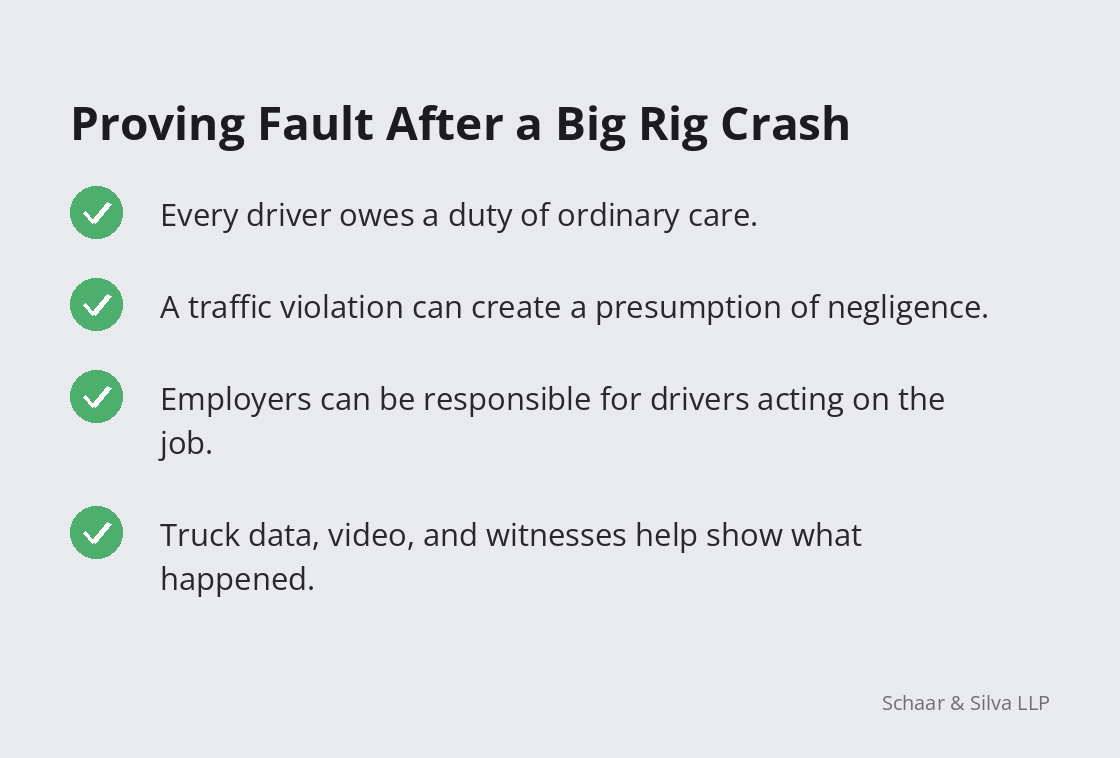
The rules below shape how fault is decided, whether the case resolves through negotiation or goes to trial.
Driver Negligence and the Duty of Ordinary Care
California Civil Code Section 1714 provides that everyone is responsible for an injury caused to another by a want of ordinary care or skill in the management of his or her property or person. For a professional truck driver, ordinary care includes checking mirrors before turning or changing lanes, leaving enough room to stop, and driving at a speed suited to traffic and road conditions.
California Evidence Code Section 669 allows a presumption that a person failed to use due care when that person violated a statute, the violation caused the injury, the injury was the kind the statute was meant to prevent, and the injured person was among those it was meant to protect. Turning, lane-change, and following-distance laws exist precisely to prevent collisions, so proof of a violation can be a powerful tool. The presumption can be rebutted, which is why independent evidence is so important.
When the Trucking Company Shares Responsibility
Many 18-wheeler drivers work for a motor carrier or another business. Under the Judicial Council’s civil jury instructions, CACI No. 3700, an employer is responsible for harm caused by the wrongful conduct of its employees while acting within the scope of their employment. This means the company behind the truck may be responsible in addition to the driver.
Trucking companies can also bear responsibility for their own decisions, such as how they train, supervise, and schedule drivers. If driver fatigue may have played a role in your crash, our guide to how driver fatigue and hours-of-service rules affect an Oakland truck accident claim explains what to look for.
Evidence That Shows What the Truck Was Doing
Modern trucks often carry electronic systems that can record information such as speed and braking, and many carriers use dashcams or telematics. Companies also keep records about the driver, the trip, and the truck itself. This information can be critical in a wide-turn or lane-change case, but it is not always kept forever, so sending a prompt request to preserve evidence is an important early step.
Scene evidence still matters. Photographs of vehicle positions, scrape marks along the side of a car, damage height, and the location of turn lanes can help reconstruct how the trailer moved. Witnesses and video from nearby businesses can confirm whether the truck signaled and whether it swung into an occupied lane.
Mistakes That Can Derail an Oakland 18-Wheeler Accident Claim
Truck companies and their insurers often begin building their defense almost immediately after a crash. Injured people, meanwhile, are focused on recovery and may not realize how quickly important evidence and deadlines can slip away.
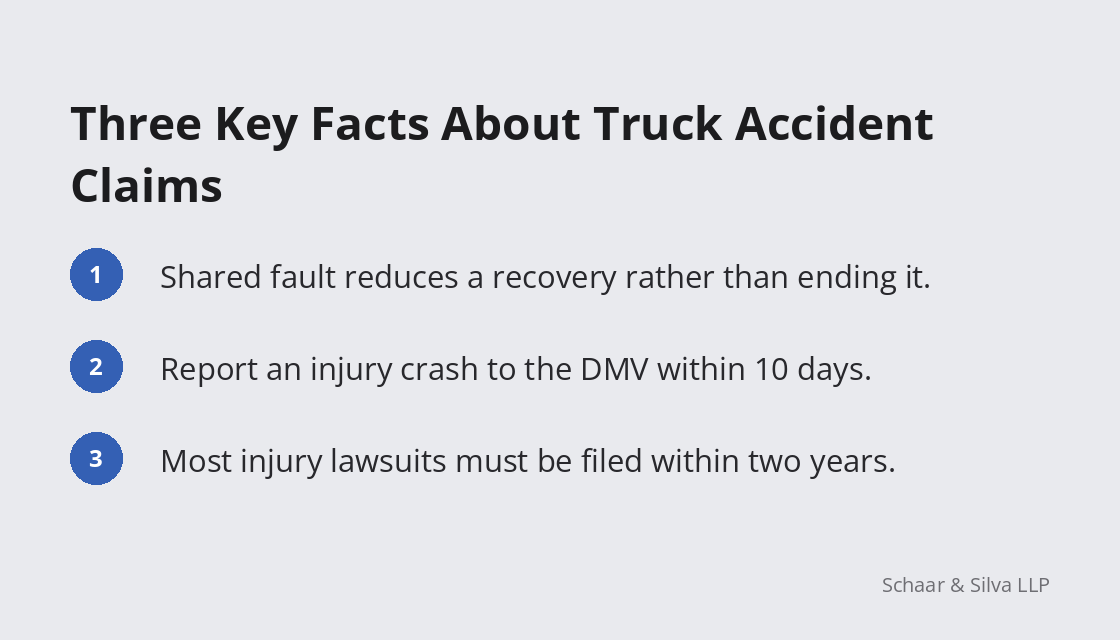
Avoiding the mistakes below can help protect both your health and your claim.
Accepting the Blame Too Quickly
After a squeeze-play or blind spot crash, the truck driver or company representative may suggest that you should not have been beside the truck. Do not agree to that version of events at the scene or in a recorded statement to an insurer. California follows comparative fault, and under CACI No. 405, if the defendant proves the injured person was partly at fault, that person’s damages are reduced by their percentage of responsibility rather than eliminated.
That rule protects you even if you made a small error, but it also gives insurers a reason to exaggerate your share of the blame. Let the evidence, not a hurried conversation, decide how responsibility is divided.
Delaying Medical Treatment
Crashes involving heavy trucks frequently cause serious injuries, including fractures, spinal injuries, and head trauma, but some symptoms appear only after the adrenaline fades. Getting evaluated promptly protects your health and creates a clear record linking your injuries to the collision. Gaps in treatment are among the first things an insurer will point to when arguing that an injury is less serious than it is.
Keep copies of your medical records, follow your treatment plan, and write down how your injuries affect your work, sleep, and daily life. That record helps show the full impact of the crash.
Missing Reporting and Filing Deadlines
California Vehicle Code Section 16000 requires a driver involved in an accident that results in bodily injury or death, among other situations, to report it to the DMV within 10 days on an approved form, which is separate from any police report. For most injury lawsuits, Code of Civil Procedure Section 335.1 generally allows two years to file.
If a public entity may share responsibility, such as when a government vehicle or a dangerous road condition was involved, a much shorter deadline applies. Government Code Section 911.2 generally requires a personal injury claim against a public entity to be presented no later than six months after the cause of action accrues.
Final Thoughts
An Oakland 18-wheeler accident can change your life in an instant, and the size of the truck is often matched by the size of the company and insurer on the other side. California’s turning, lane-change, and following-distance rules, together with the duty of ordinary care and employer responsibility, provide a framework for holding the right parties accountable.
The steps you take early, including getting medical care, preserving evidence, and protecting your deadlines, can have a lasting effect on your claim. You do not have to face a trucking company on your own.
If you were hurt in a crash with a big rig in Oakland, contact Schaar & Silva LLP to speak with our team about what happened. We will review the evidence, explain your options, and help you take the next step with confidence.