

An Oakland truck accident caused by driver fatigue can change your life in an instant. Commercial trucks move through Oakland every day on the freeways, surface streets, and routes serving the Port of Oakland, and many of those drivers work long shifts under tight delivery schedules. When a tired driver loses focus behind the wheel of a vehicle that weighs many times more than a passenger car, the injuries are often severe. Federal safety rules limit how long commercial drivers can stay on the road, and those rules can become powerful evidence when a fatigued driver causes a crash. Understanding how they work gives you real control over your claim.
At Schaar & Silva LLP, we help people injured in truck crashes in Oakland and throughout Northern California pursue the accountability they deserve so you can move forward with confidence. This guide explains how hours-of-service rules actually work, how fatigue is proven after a crash, and the mistakes that can weaken a truck accident claim.
How Hours-of-Service Rules Actually Work
The Federal Motor Carrier Safety Regulations, found in Title 49 of the Code of Federal Regulations, set safety standards for commercial trucking. Under 49 CFR Section 390.3, the rules in that part of the regulations apply to employers, employees, and commercial motor vehicles that transport property or passengers in interstate commerce. The hours-of-service rules in Part 395 are designed to prevent exactly the kind of fatigue that leads to devastating crashes. They limit how long a driver can drive, how long a workday can last, and how much rest a driver must take before getting back behind the wheel.
Daily Driving and Duty Limits
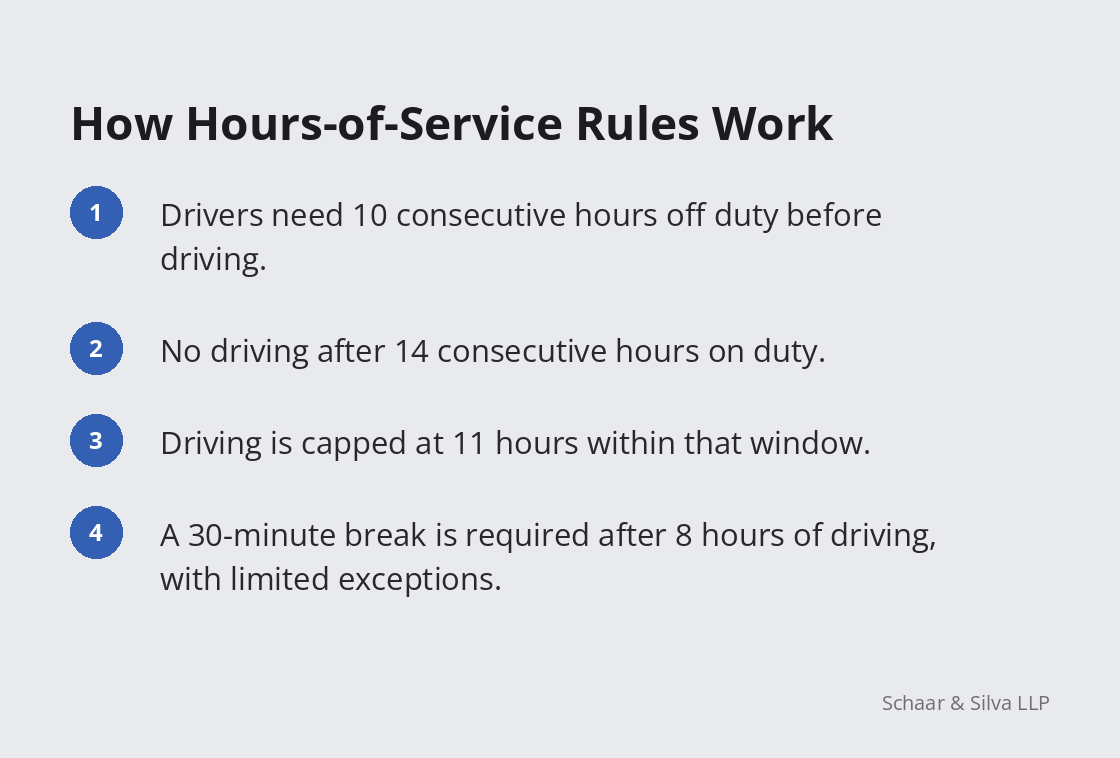
For drivers of property-carrying commercial vehicles, 49 CFR Section 395.3 sets several core limits. A driver may not drive without first taking 10 consecutive hours off duty. A driver may not drive after a period of 14 consecutive hours after coming on duty following those 10 hours off, and within that 14-hour window, a driver may drive a total of 11 hours. The regulation also provides that, except for drivers who qualify for certain short-haul exceptions, driving is not permitted if more than 8 hours of driving time have passed without at least a consecutive 30-minute interruption in driving status.
Weekly On-Duty Limits
The rules also limit work over multiple days. Section 395.3(b) provides that a driver may not drive after having been on duty 60 hours in any period of 7 consecutive days if the employing motor carrier does not operate every day of the week, or 70 hours in any period of 8 consecutive days if the carrier operates every day of the week. Under Section 395.3(c), those periods may end with the beginning of an off-duty period of 34 or more consecutive hours. These weekly limits matter because fatigue builds over time, and a driver who is technically within daily limits may still be exhausted from a long week.
The Rule Against Driving While Fatigued
Beyond the specific hour limits, 49 CFR Section 392.3 contains a broader safety rule. It provides that no driver shall operate a commercial motor vehicle, and a motor carrier shall not require or permit a driver to operate one, while the driver’s ability or alertness is so impaired, or so likely to become impaired, through fatigue, illness, or any other cause, as to make it unsafe to begin or continue driving. This rule places responsibility on both the driver and the trucking company. A company that pressures drivers to keep going when they are exhausted may share responsibility for the harm that follows.
Proving Fatigue After an Oakland Truck Accident
Fatigue rarely leaves obvious physical marks at a crash scene, so proving it depends on records and careful investigation. Trucking companies are required to keep records that can show whether a driver was within legal limits, and California law provides ways to connect a safety violation to the harm it caused.
Electronic Logging Device Records
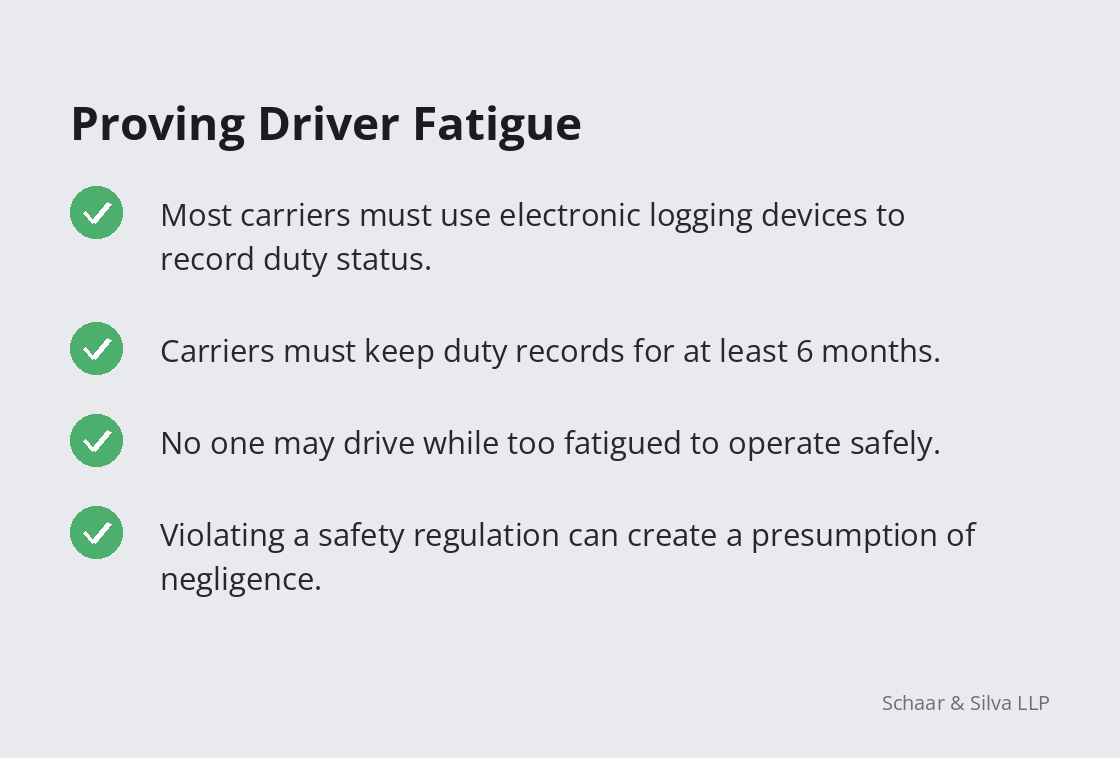
Under 49 CFR Section 395.8, a motor carrier subject to the hours-of-service rules must generally require each driver to record duty status for each 24-hour period, and most carriers must install and require drivers to use an electronic logging device, commonly called an ELD. These records show when a driver was driving, on duty, off duty, or in a sleeper berth. Comparing ELD data with delivery records, fuel receipts, and dispatch communications can reveal whether a driver exceeded the limits or whether the logs fail to match what actually happened.
Why Record Retention Deadlines Matter
Records do not last forever. Section 395.8(k) requires a motor carrier to retain records of duty status and supporting documents for each driver for a period of not less than 6 months from the date of receipt. Because the minimum retention period is relatively short, it is important to act quickly after a crash so that a formal request to preserve evidence reaches the trucking company before key records can be discarded in the ordinary course of business.
Connecting a Violation to Negligence
California law gives safety regulations real weight in an injury case. Civil Code Section 1714 provides that everyone is responsible for an injury caused to another by a lack of ordinary care in managing their property or person. Evidence Code Section 669 goes further, providing that a failure to exercise due care is presumed when a person violated a statute, ordinance, or regulation of a public entity, the violation proximately caused the injury, the injury resulted from an occurrence of the kind the regulation was designed to prevent, and the injured person was among those the regulation was adopted to protect. Hours-of-service rules exist to prevent fatigue-related crashes, which makes them a natural fit for this presumption, although the presumption can be rebutted under the statute.
Mistakes That Weaken a Truck Accident Claim
Truck accident claims often involve multiple companies, insurers, and investigators working quickly to protect their own interests. The mistakes below are the ones that most often hurt injured people in Oakland truck accident cases.
Focusing Only on the Driver
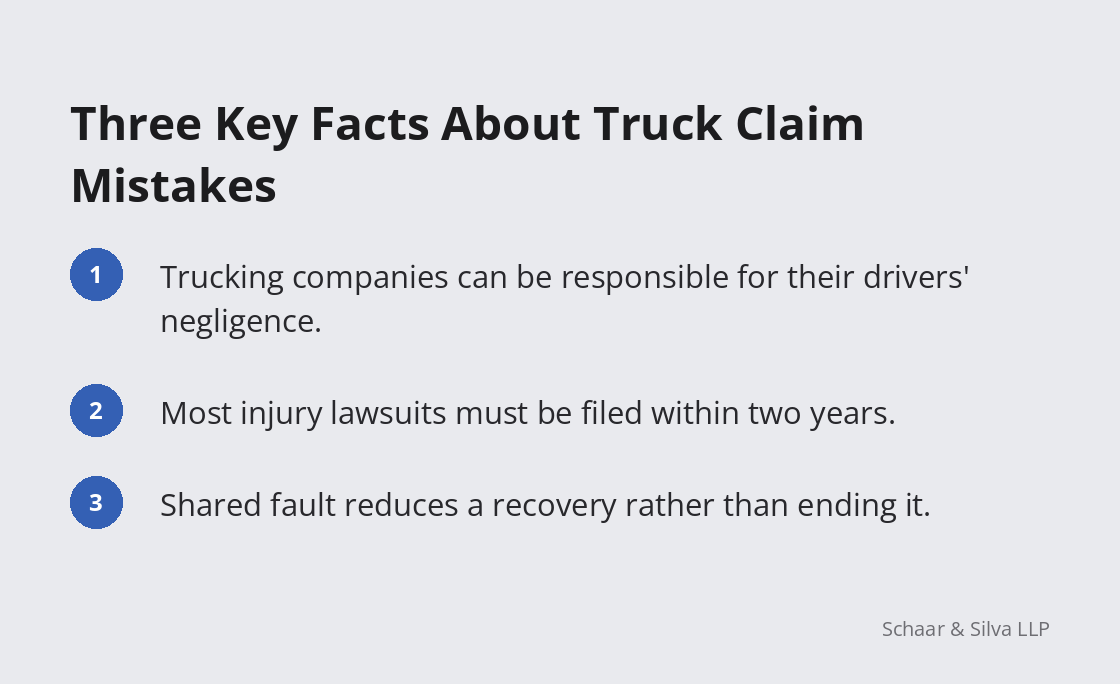
The driver is often not the only responsible party. Civil Code Section 2338 provides that a principal is responsible to third persons for the negligence of its agent in the transaction of the business of the agency. In practice, this means a trucking company may be responsible for a driver’s negligence while the driver is working. Section 392.3 also makes clear that a motor carrier must not require or permit a fatigued driver to operate. Looking into dispatch practices, delivery schedules, and company policies can reveal whether the company contributed to the conditions that led to the crash.
Waiting Too Long to Act
Under Code of Civil Procedure Section 335.1, an action for injury to or death of an individual caused by the wrongful act or neglect of another must generally be filed within two years. That may sound like plenty of time, but in a truck case the more pressing deadline is often practical rather than legal. Logbook data, dashcam footage, and maintenance records can be lost long before the statute of limitations runs. If a public agency vehicle was involved, a much shorter claim deadline may also apply under the Government Claims Act. Speaking with a lawyer early protects both the evidence and your rights.
Assuming Shared Fault Ends the Claim
Trucking companies and their insurers often argue that the injured driver was partly to blame. California follows a comparative fault approach. Under the Judicial Council’s civil jury instruction on comparative fault, CACI No. 405, if a defendant proves that the injured person was negligent and that this negligence was a substantial factor in causing the harm, the injured person’s damages are reduced by the percentage of that person’s responsibility. Shared fault reduces a recovery rather than eliminating it, so you should not assume your claim is over just because the other side points to something you did.
Final Thoughts
An Oakland truck accident caused by fatigue is often preventable. Federal rules limit driving to 11 hours within a 14-hour window after 10 hours off duty, require breaks and weekly limits, and prohibit anyone from driving while too tired to operate safely. When those rules are broken and someone is hurt, electronic logs and company records can prove what happened, and California law allows those violations to support a finding of negligence. Moving quickly to preserve evidence is one of the most important steps you can take. To learn more about how we approach these cases, visit our page on Oakland truck accident claims.
Recovering from a serious truck crash takes time, and you should be able to focus on your health while someone else focuses on the investigation. Keeping your medical records, photos, and any information about the truck and its company organized will help your case from the start.
If you or a loved one was hurt in a truck accident in Oakland, contact Schaar & Silva LLP for a case evaluation. We will review what happened, explain your rights under California law, and help you take the next step with confidence.