
A Scotts Valley car accident in Santa Cruz County often happens in the places locals drive every day: the Mount Hermon Road corridor, the Scotts Valley Drive shopping areas, and the ramps that connect town traffic to Highway 17. These crashes can feel minor in the moment, yet they frequently leave people with neck and back injuries, damaged vehicles, and a confusing argument about who had the right-of-way. Understanding the rules that decide fault gives you real control over your claim and helps you avoid the mistakes that quietly weaken it.
At Schaar & Silva LLP, we help people across Santa Cruz County who have been hurt in car and truck accidents so you can move forward with confidence. This guide explains how Scotts Valley crashes actually happen, how California law decides who was at fault at an intersection, and the missteps that most often derail an otherwise strong case.
How Scotts Valley Car Accidents Actually Happen
Scotts Valley sits along Highway 17 between Santa Cruz and the Santa Cruz Mountains, so a large share of local traffic is a mix of residents running errands and commuters getting on or off the highway. That combination puts drivers who are in a hurry next to drivers who are looking for a parking lot entrance, a school drop-off, or a turn into a shopping center. Many collisions in town happen at signals and driveways rather than at high speed, but even a low-speed impact can cause lasting injuries.
Most of these crashes fall into a few familiar patterns. Knowing which pattern fits your collision is the first step toward identifying which California driving rule was broken and who should be held responsible.
Intersection Crashes on Mount Hermon Road and Scotts Valley Drive
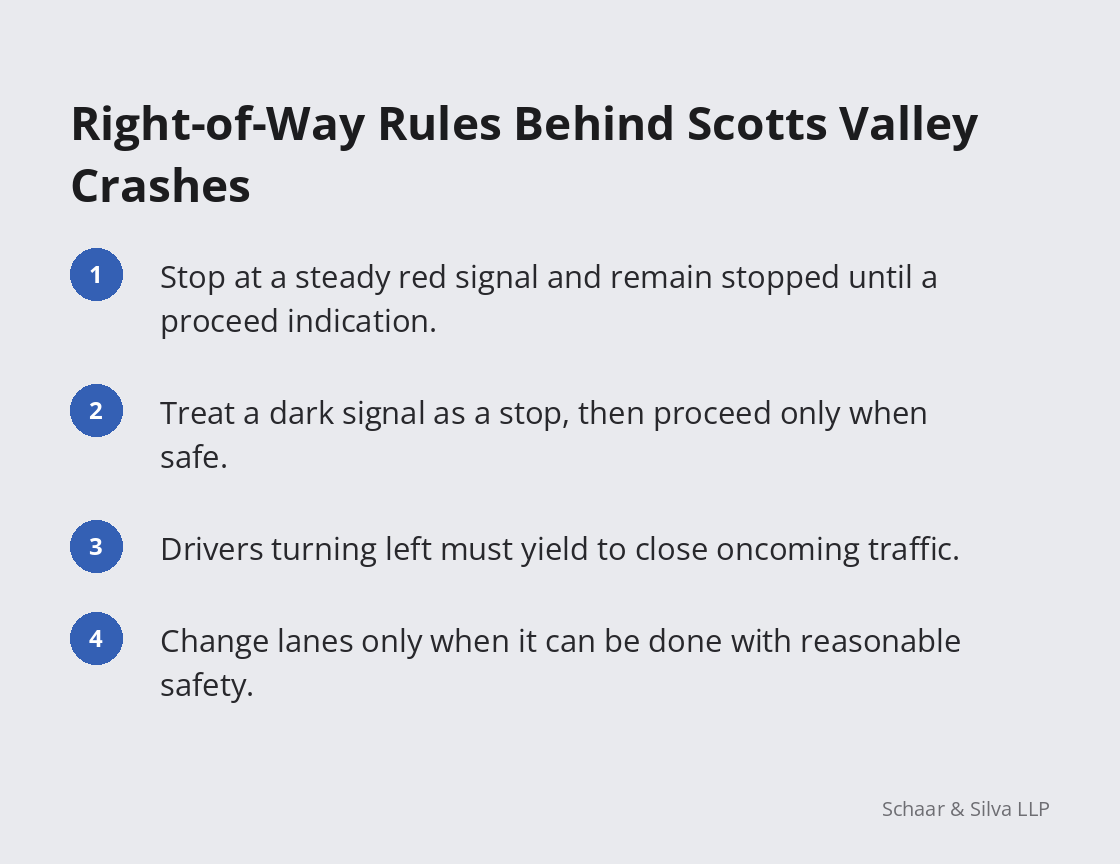
Signalized intersections carry heavy traffic through the middle of town, and a driver who runs a light can cause a violent side-impact crash. Under California Vehicle Code Section 21453, a driver facing a steady circular red signal must stop at the marked limit line, or before the crosswalk or intersection if there is no line, and remain stopped until an indication to proceed is shown. A driver who may turn right on red after stopping must still yield to pedestrians in an adjacent crosswalk and to any vehicle approaching so closely that it is an immediate hazard.
When a signal is dark because of a power outage or storm, the rules change. Vehicle Code Section 21800 says a driver approaching an intersection with inoperative traffic signals must stop and may proceed with caution only when it is safe to do so. These details matter because the person who ignored the signal, or treated a dark signal like a green light, is often the person who caused the crash.
Left Turns Into Shopping Centers and Side Streets
Left turns are a frequent source of serious collisions in commercial corridors. California Vehicle Code Section 21801 requires a driver turning left, making a U-turn, or turning left into public or private property to yield the right-of-way to all vehicles approaching from the opposite direction that are close enough to constitute a hazard at any time during the turn. The turning driver must continue to yield until the turn can be made with reasonable safety.
In practice, this means a driver who cuts across oncoming traffic to reach a parking lot entrance usually carries significant responsibility if a collision follows. That said, an oncoming driver who was speeding or not paying attention can share responsibility, which is why the details of timing, speed, and visibility deserve careful review.
Stop Signs, Side Streets, and Highway 17 Ramps
Residential streets in and around Scotts Valley connect to busier roads through stop-controlled intersections. Under Vehicle Code Section 21802, a driver approaching a stop sign at the entrance to an intersection must stop and then yield to vehicles that have approached from another highway or are approaching so closely as to constitute an immediate hazard, continuing to yield until it is reasonably safe to proceed.
Ramp traffic adds another layer. Drivers merging toward Highway 17 or slowing to exit often change lanes quickly. Vehicle Code Section 22107 prohibits turning or moving right or left upon a roadway until the movement can be made with reasonable safety, and requires an appropriate signal when another vehicle may be affected. A sudden, unsignaled lane change near a ramp is a common way a routine drive turns into an injury claim.
How Fault Is Determined After a Scotts Valley Car Accident
Insurance adjusters and courts in California look at more than who hit whom. They examine whether each driver used reasonable care, whether anyone broke a traffic law, and how much each person’s conduct contributed to the crash. The answers shape whether you can recover compensation and how much of your loss is covered.
The rules below explain how responsibility is measured, and why the evidence gathered in the first days after a crash carries so much weight.
The Duty of Ordinary Care
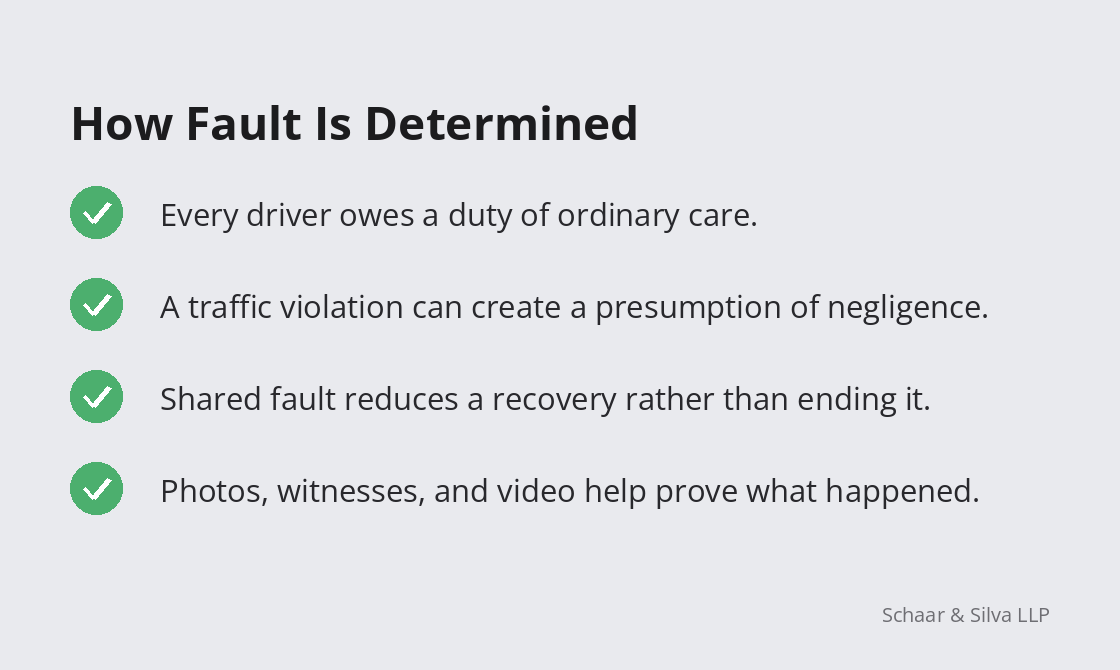
California Civil Code Section 1714 provides that everyone is responsible for an injury caused to another by a want of ordinary care or skill in the management of his or her property or person. For drivers, ordinary care means paying attention, driving at a safe speed for the conditions, and following the rules of the road. A driver who looks down at a phone while approaching a signal, or who rolls through a stop sign without checking cross traffic, falls short of that standard.
If the driver was working at the time, such as a delivery or service driver, the employer may also share responsibility for harm caused by an employee acting within the scope of employment. Identifying every responsible party early helps protect your options.
When a Traffic Violation Creates a Presumption of Negligence
California Evidence Code Section 669 allows a presumption that a person failed to use due care if that person violated a statute, the violation caused the injury, the injury was the kind of harm the statute was designed to prevent, and the injured person was among those the statute was meant to protect. Right-of-way and signal laws are written precisely to prevent intersection collisions, so proof that the other driver ran a red light or failed to yield can be powerful.
The presumption can be rebutted, however. The other side may argue that the driver had a valid excuse or acted as a reasonably careful person would have. That is why independent evidence, rather than one driver’s word against another, so often decides these cases.
Shared Fault and How It Affects Your Claim
California uses comparative fault. Under the Judicial Council’s civil jury instructions, CACI No. 405, if the defendant proves the injured person was partly at fault, the injured person’s damages are reduced by the percentage of their own responsibility. Being partly to blame does not automatically end your claim.
Insurers know this rule well and often try to shift a larger share of the blame onto the injured driver. Clear photographs, witness statements, signal timing information, and video from nearby businesses can keep that percentage where it belongs.
Mistakes That Can Derail Your Scotts Valley Car Accident Claim
Many strong claims lose ground because of avoidable missteps in the hours, days, and weeks after a crash. Most of them have nothing to do with the collision itself and everything to do with documentation, timing, and communication.
Avoiding the problems below helps protect both your health and the value of your claim.
Waiting to Get Medical Care
Soft-tissue injuries, concussions, and back injuries do not always cause obvious symptoms right away. People often go home from a fender bender in a shopping center lot feeling sore but functional, only to wake up days later with significant pain. Getting checked promptly protects your health and creates a medical record that connects your symptoms to the crash.
Gaps in treatment give insurers an opening to argue that something else caused your injury or that you were not seriously hurt. Following your provider’s recommendations and keeping appointments helps close that gap.
Losing Evidence From the Scene
Many Scotts Valley intersections are surrounded by businesses with security cameras, and that footage is often recorded over quickly. Photographs of vehicle positions, damage, skid marks, signal positions, and nearby cameras can make the difference between a clear liability picture and a dispute. Names and contact information for witnesses are just as valuable.
Collisions on city streets are generally handled by local police, while crashes on state highways such as Highway 17 are often handled by the California Highway Patrol. Knowing which agency responded helps you request the right report. If you were hurt on the highway portion of your trip, our guide to a Highway 17 car accident explains the evidence that matters on that route.
Missing Reporting and Filing Deadlines
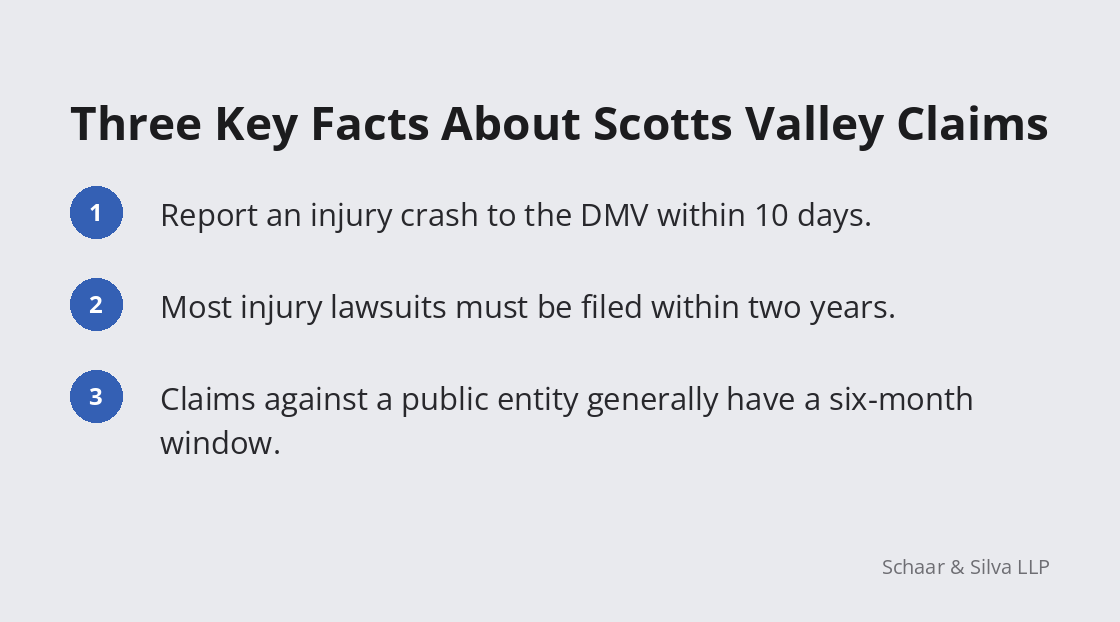
California law sets firm time limits. Vehicle Code Section 16000 requires a driver involved in an accident that results in bodily injury or death, among other situations, to report the accident to the DMV within 10 days on an approved form, which is separate from any police report. For most injury lawsuits, Code of Civil Procedure Section 335.1 generally allows two years to file.
A much shorter deadline applies if a public entity may be responsible, such as when a city vehicle was involved or a dangerous road condition contributed to the crash. Government Code Section 911.2 generally requires a claim for personal injury against a public entity to be presented no later than six months after the cause of action accrues. Missing that window can seriously limit your options.
Final Thoughts
A Scotts Valley car accident in Santa Cruz County can leave you dealing with injuries, vehicle repairs, and an insurance company that seems more interested in assigning blame than resolving your claim. California’s right-of-way rules, the duty of ordinary care, and comparative fault principles all play a role in deciding who is responsible and how your recovery is measured.
The steps you take early, including getting medical care, preserving evidence, and keeping track of deadlines, often have the biggest impact on how your case unfolds. You do not have to sort through these questions on your own.
If you were hurt in a crash in Scotts Valley or anywhere in Santa Cruz County, contact Schaar & Silva LLP to speak with our team about what happened. We will review the evidence, explain your options, and help you take the next step with confidence. We serve Santa Cruz County and surrounding communities.