

A shoulder injury from a car accident can sideline you for months or even years. The path to a fair shoulder injury settlement requires understanding what your case is actually worth.
At Schaar & Silva LLP, we help people in Santa Cruz County recover the compensation they deserve after shoulder injuries. This guide walks you through how settlements work and what factors determine your payout.
What Shoulder Injuries Look Like After a Car Crash
Rotator Cuff Tears: The Most Common Shoulder Injury
Rotator cuff tears represent the most common shoulder injuries we see from car accidents in Santa Cruz County. These tears occur when the muscles and tendons that stabilize your shoulder get stretched or ripped during impact. A complete rotator cuff tear typically requires arthroscopic surgery, which costs between $15,000 and $25,000 before physical therapy. Partial tears sometimes heal without surgery, but full-thickness tears almost always need surgical repair.
The supraspinatus muscle, which sits on top of your shoulder blade, tears most frequently because of how your arm gets pinned or twisted during a collision. If an MRI confirms a rotator cuff tear, your settlement value jumps significantly compared to soft tissue injuries. Rotator cuff cases with clear liability settle between $100,000 and $175,000 when surgery is required, while non-surgical rotator cuff injuries typically settle between $40,000 and $75,000.
Dislocations, Labral Tears, and Bursitis
Shoulder dislocations and labral tears create different injury patterns. A dislocation happens when the shoulder joint pops out of its socket during the crash, and it’s extremely painful-you’ll need immediate emergency care. Labral tears affect the cartilage ring that cups the shoulder joint, and these injuries often don’t show up on standard X-rays, requiring MRI confirmation instead.
Both injuries can cause long-term instability and chronic pain that affects your ability to lift, reach overhead, or sleep comfortably. Bursitis develops when the fluid-filled sacs around your shoulder become inflamed from the trauma, causing swelling and restricted movement. The key difference between these injuries and rotator cuff tears is that shoulder dislocations and labral tears sometimes heal without surgery, but when surgery becomes necessary, your claim value increases substantially.
Building Your Settlement Foundation with Medical Evidence
Medical bills anchor settlement value, and shoulder surgery cases generate higher bills because of hospital costs, anesthesia, orthopedic surgeon fees, and months of physical therapy. You should document every medical expense and follow your physical therapy plan completely-this creates the evidence trail that supports your settlement demand. The at-fault driver’s insurance company will examine your medical records closely, so consistent treatment and detailed documentation matter significantly when we negotiate your case.
What Drives Your Settlement Value
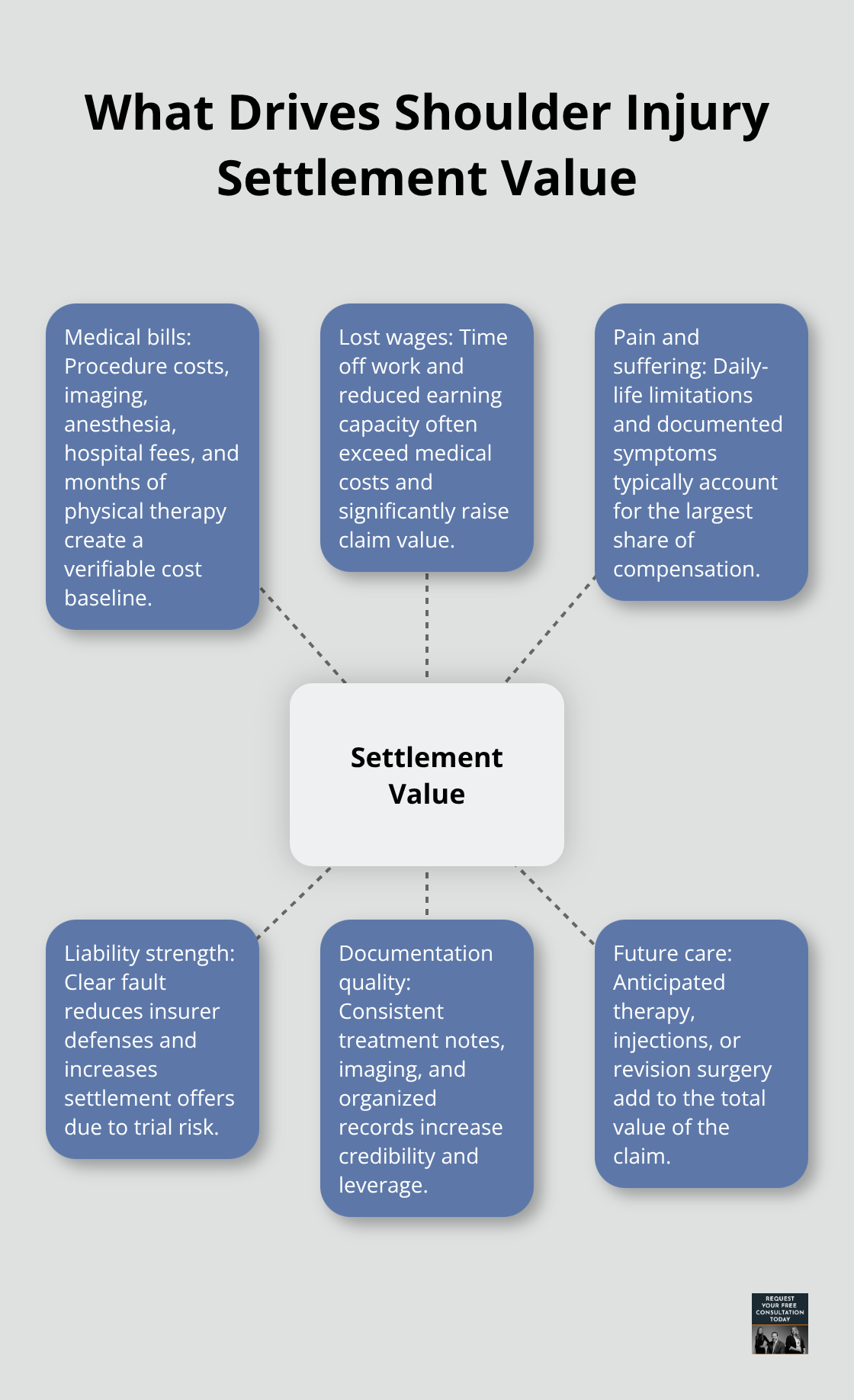
Medical Bills Form Your Settlement Foundation
Medical bills anchor every shoulder injury settlement, and they run higher than most people anticipate. A rotator cuff surgery costs $15,000 to $25,000 for the procedure alone, but emergency room visits, MRI imaging, orthopedic consultations, anesthesia, hospital facility fees, and months of physical therapy push your total medical expenses well above $40,000. Insurance adjusters use these documented costs as an anchor point-they know exactly what you spent because the bills are verifiable and objective. The more substantial your medical documentation, the stronger your negotiating position when we work toward your settlement.
Future care matters significantly. If your doctor recommends ongoing physical therapy, injections, or potential revision surgery down the road, these anticipated costs get factored into the settlement amount. A shoulder that requires long-term management is worth considerably more than one that heals cleanly in six months.
Lost Wages and Earning Capacity Often Exceed Medical Costs
Lost wages and earning capacity frequently dwarf medical bills in settlement value, especially if your job involves physical demands. Construction workers, nurses, and anyone in fields requiring overhead lifting or repetitive arm movement face substantial lost income during recovery. A person earning $60,000 annually who loses four months of work due to shoulder surgery loses $20,000 in wages before we even consider reduced earning capacity.
Many people return to work with permanent restrictions-they cannot lift over ten pounds, cannot work overhead, or cannot perform their previous job duties. This restriction gap between your pre-injury earning capacity and your post-injury capacity gets calculated into the settlement. The larger this gap, the higher your claim value becomes.
Pain and Suffering Dominates Most Shoulder Settlements
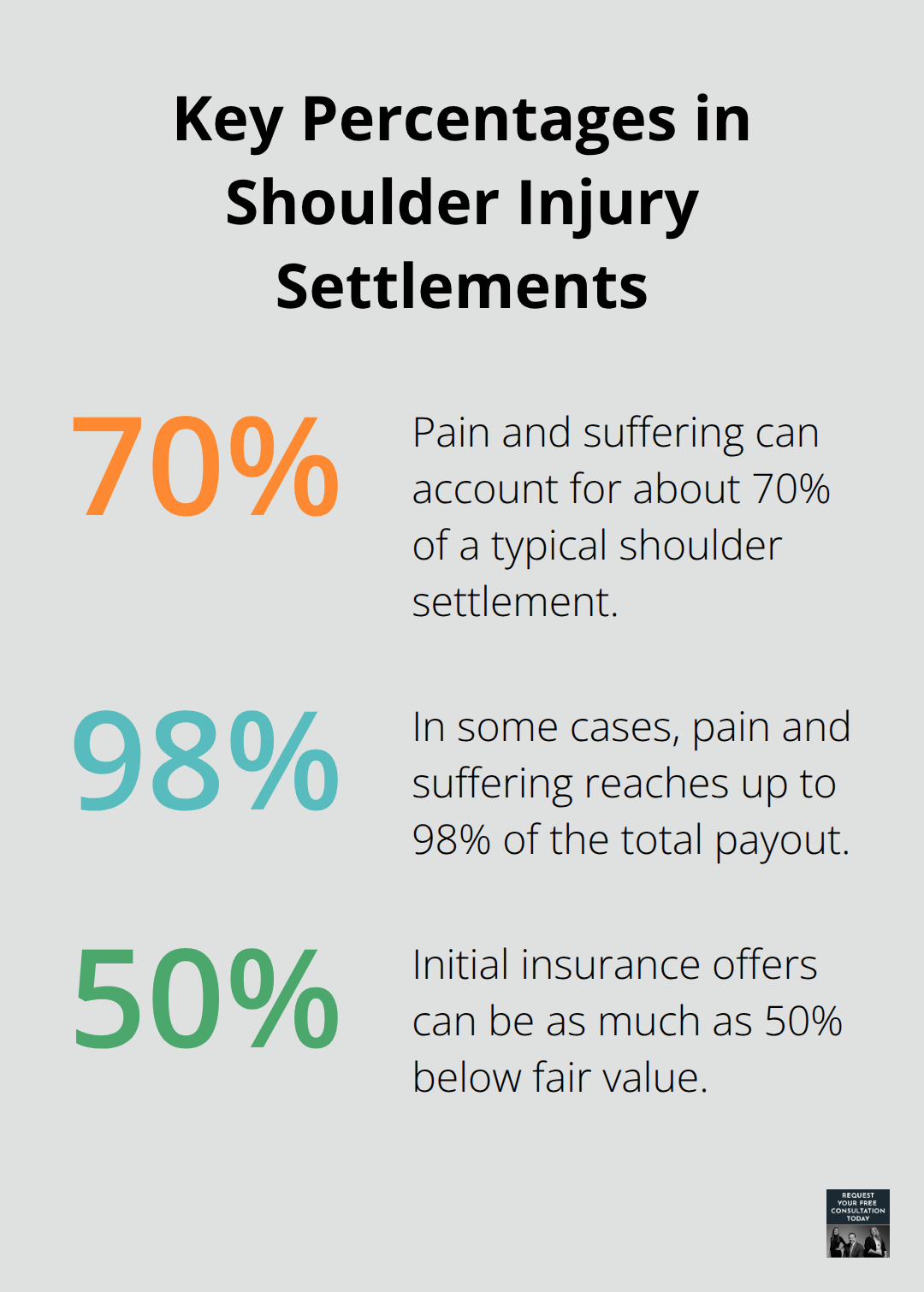
Pain and suffering represents the largest piece of most shoulder injury settlements, typically accounting for 70 to 98 percent of the total payout. Your shoulder injury affects your ability to sleep, drive, dress yourself, and participate in activities you enjoyed before the crash.
An MRI-confirmed rotator cuff tear requiring surgery generates pain and suffering damages between $100,000 and $175,000 in clear liability cases, while non-surgical rotator cuff injuries settle between $40,000 and $75,000.
Insurance companies review your medical records, treatment frequency, and activity limitations documented in your doctor’s notes. They look for evidence that your pain genuinely restricts your daily life, not theoretical suffering. Photograph and document what you cannot do-the activities you stopped doing, the hobbies you put on hold, the nights you cannot sleep comfortably. This concrete evidence of lifestyle changes directly increases your pain and suffering value.
How Insurance Adjusters Calculate Your Claim
Insurance adjusters examine your medical records to understand the severity of your injury and your recovery timeline. They cross-reference your documented treatment with similar cases in your area to establish a baseline settlement range. The presence of an MRI-confirmed tear (rather than soft tissue injury alone) significantly increases your claim value because it provides objective, measurable evidence of structural damage.
Your age, occupation, and pre-injury health status all factor into the calculation. Younger workers with physically demanding jobs typically receive higher settlements because their earning capacity loss extends further into the future. Pre-existing shoulder conditions complicate claims, but a car accident that aggravates a degenerative tear still generates substantial value if you can demonstrate new or worsened symptoms through consistent medical treatment.
Building Your Evidence for Maximum Settlement Value
Insurance adjusters cannot award what you cannot prove. Medical bills, imaging reports, surgical records, and physical therapy documentation create the foundation of your claim. Your doctor’s notes about functional limitations-what movements cause pain, what activities you cannot perform-carry significant weight in settlement negotiations. When you document lost wages through pay stubs and employer statements, you provide objective proof of income loss.
The strength of liability evidence also affects settlement value. Clear liability cases (where the at-fault driver’s fault is obvious) settle for substantially more than disputed liability cases. Crash reports, photos of vehicle damage, witness statements, and traffic camera footage all strengthen your position. As you prepare your claim, understanding how these pieces work together helps you recognize what evidence matters most when we move forward with your case.
Building Your Claim: What Actually Happens Behind the Scenes
Medical Records Create Your Foundation
Medical records form the skeleton of your shoulder injury claim, and specific documentation proves structural damage and recovery costs. Your MRI report showing a rotator cuff tear carries far more weight than general pain complaints because it provides objective evidence the insurance adjuster cannot dispute. Request copies directly from your healthcare providers rather than relying on memory or partial records, since missing pages create delays and give adjusters reasons to question your claim’s legitimacy.
Gather your surgical reports, anesthesia records, hospital bills, physical therapy notes, and imaging studies in one organized file. Insurance companies receive thousands of claims annually and move faster when your documentation is complete and chronological. Your orthopedic surgeon’s notes about tear size, surgical approach, and post-operative restrictions matter enormously-these clinical details establish the injury’s severity and justify higher settlement demands.
Document Functional Limitations in Your Medical Records
When you document functional limitations in your medical records (what you cannot lift, which movements cause sharp pain, how your sleep was disrupted), you create a paper trail that supports pain and suffering damages. Insurance adjusters scrutinize treatment gaps, so consistent appointments and follow-through on physical therapy recommendations strengthen your position significantly. If your doctor recommends future treatment like injections or revision surgery, get that in writing because anticipated care costs get included in settlement calculations.
Track Every Financial Loss
Your recovery timeline and expenses must tell a complete financial story that extends beyond just medical bills. Track every dollar you lose: lost work hours, unpaid time off during surgery and recovery, reduced income from work restrictions, and out-of-pocket expenses for medications, transportation to appointments, or home care assistance. Pay stubs and employer statements documenting your lost wages provide objective proof that adjusters cannot challenge.
Insurance companies know that shoulder surgery typically requires four to six months of recovery before returning to full duty, and longer recovery periods justify higher settlements because the income loss compounds. This extended timeline directly increases your claim value when we present it to the insurance company.
Leverage Documentation in Negotiations
When negotiating with insurance companies, we leverage this documentation strategically-we present medical evidence first to establish injury severity, then layer in financial losses to demonstrate total impact. Initial settlement offers from insurers are intentionally low, sometimes 30 to 50 percent below fair value, because many people accept without representation. Insurance adjusters count on claimants not understanding their case’s true worth or lacking patience for negotiation.
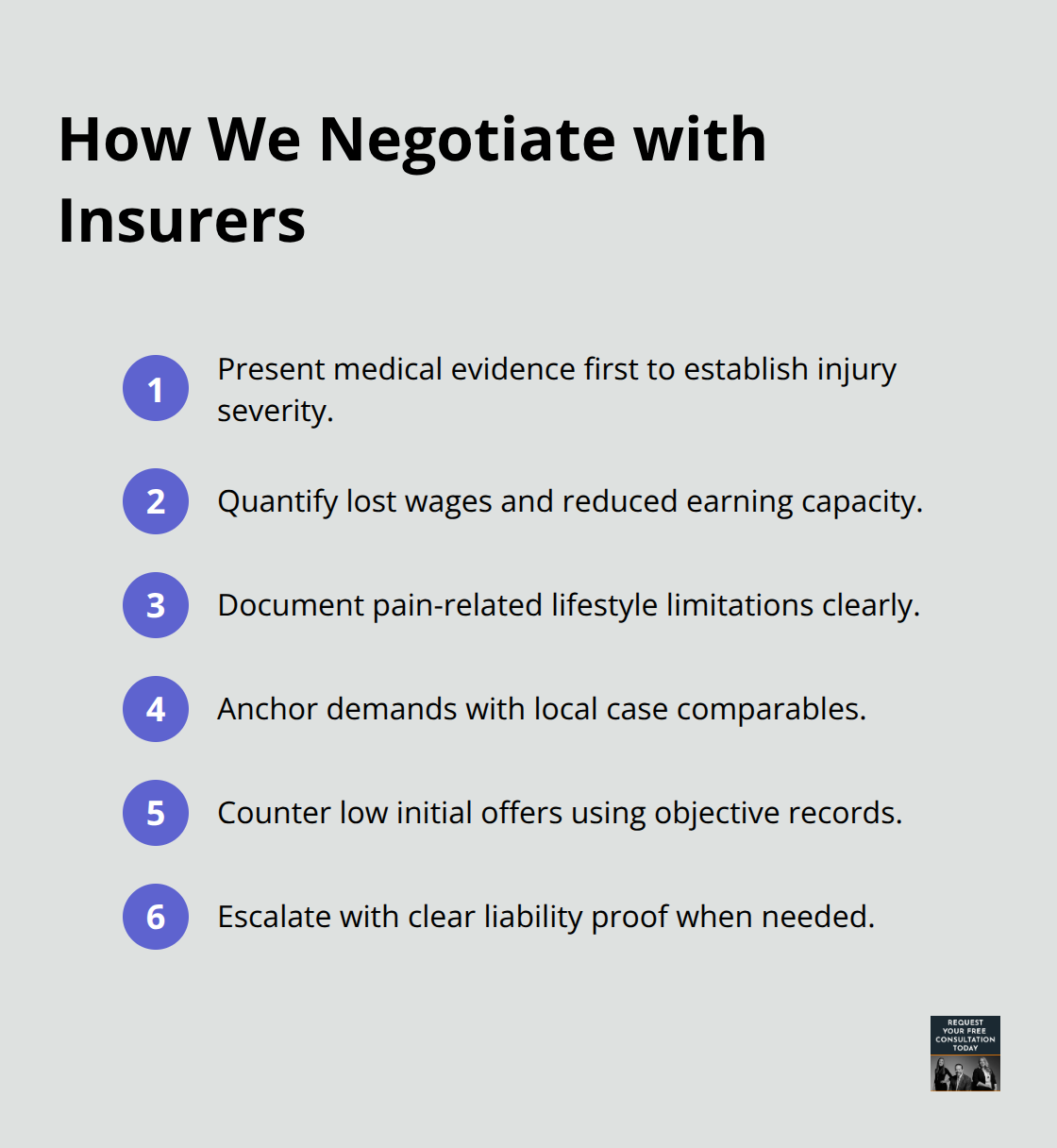
Strong documentation gives us leverage to push back against lowball offers and demand figures that reflect your actual damages. The presence of clear liability (established through police reports, photos of vehicle damage, and witness statements) multiplies your settlement value because the insurance company faces higher trial risk if negotiations fail. We use settlement comparables from similar Santa Cruz County cases to anchor our demands in local market reality rather than national averages, since jury verdicts and settlement patterns vary significantly by region.
Final Thoughts
Shoulder injury settlements in car accidents hinge on three core factors: medical documentation proving structural damage, financial losses from missed work and reduced earning capacity, and pain and suffering damages that reflect how the injury changed your daily life. An MRI-confirmed rotator cuff tear requiring surgery typically settles between $100,000 and $175,000 when liability is clear, while non-surgical cases range from $40,000 to $75,000. These figures assume complete medical records, documented lost wages, and strong evidence of the at-fault driver’s responsibility.
Contact Schaar & Silva LLP to discuss your shoulder injury settlement and understand what your specific situation is worth. We serve Santa Cruz County and handle the legal complexities while you focus on recovery. Insurance companies count on injured people accepting lowball offers without representation, but skilled negotiation backed by solid documentation typically yields settlements 30 to 50 percent higher than initial offers.
You need legal representation because shoulder injury claims involve technical medical evidence, complex damage calculations, and insurance company tactics designed to minimize payouts. The difference between handling your claim alone and working with experienced legal counsel often exceeds $50,000 in net recovery. We understand Santa Cruz County’s local settlement patterns and jury tendencies, giving us leverage that national settlement calculators cannot provide.
