

After a car accident, the insurance company’s first offer rarely reflects what your claim is actually worth. We at Schaar & Silva LLP know that settlement negotiation strategies can mean the difference between accepting far less than you deserve and getting fair compensation for your injuries and losses.
This guide walks you through how insurers calculate settlements, what documentation strengthens your position, and how to respond when they lowball you.
Understanding Your Settlement Range
Insurance companies use a formula-based approach to value your claim, and understanding their math gives you leverage during negotiations. They start with your economic damages-medical bills, lost wages, and property damage-then apply a multiplier ranging from 1.5 to 5 times that figure to account for pain and suffering. The multiplier depends on injury severity, clarity of liability, and how sympathetic your case appears. A soft tissue injury with clear liability might receive a 1.5 multiplier, while a surgery case with permanent limitations could reach 3 to 5.

The adjuster assigned to your file uses internal guidelines and settlement software that pulls data from thousands of past claims, but these systems often undervalue non-economic damages and ignore your specific circumstances.
How Medical Records Shape Their Calculations
Your medical records directly feed into their calculation. Adjusters measure treatment duration, type of care, and whether surgery occurred. If you received physical therapy for four months after a knee injury, they factor that in; if you stopped treatment early, they argue your injuries weren’t serious. Insurance companies demand itemized bills for every provider-emergency room visits, specialist consultations, imaging, surgery, anesthesia, physical therapy, and follow-up appointments. A single knee surgery can cost $15,000 to $50,000 depending on complexity and facility, and that bill anchors the entire negotiation.
Don’t settle before reaching Maximum Medical Improvement, which means your condition has stabilized and further treatment won’t meaningfully improve your function. Settling early costs you the most because you cannot reopen a claim after signing a release, and hidden complications can emerge months later requiring expensive care you won’t recover. Document every medical expense meticulously: copays, deductibles, prescription costs, and transportation to appointments all count. Insurance companies scrutinize bills for overcharges, so they push back on provider fees, especially if a hospital charged $500 for a CT scan that other facilities do for $300. You can negotiate medical liens with providers to reduce their charges before settlement, which increases your net recovery without lowering the gross settlement value.
Wage Loss Demands Concrete Documentation
Wage loss settlements require concrete documentation, not estimates. Provide recent pay stubs, W-2s, and a letter from your employer confirming the dates you missed work and your hourly rate or salary. If you’re self-employed, tax returns and business records establish your average income. Insurance adjusters reimburse only actual days missed, so if you worked part-time while recovering, they deduct that income.
Future earning capacity is harder to prove but far more valuable if you establish it. A construction worker who suffered a back injury preventing heavy lifting has lost earning potential for decades-a forensic economist quantifies this by projecting lifetime income reduction compared to your pre-injury trajectory. Without documented analysis, insurers ignore future losses entirely, costing you tens of thousands. Permanent restrictions matter: if your doctor states you cannot lift more than 10 pounds, that eliminates many jobs and justifies a higher settlement. Self-employed claimants face extra scrutiny because adjusters question whether income loss is real or temporary, so maintain detailed business records and tax documentation to defend your claim.
What Adjusters Miss About Your Actual Damages
The adjuster’s software calculates numbers, but it cannot capture how your injuries changed your life. Your medical records show treatment dates and costs, yet they don’t reflect the pain you endured during recovery or the job opportunities you lost. This gap between what their formula produces and what your claim is truly worth becomes your negotiating advantage. When you prepare your demand letter, you’ll present evidence that pushes back against their undervaluation-and that preparation starts with organizing every document that proves both your economic and non-economic losses.
Building Your Documentation Arsenal
Organized documentation accelerates settlements more than anything else. Insurance adjusters handle hundreds of claims simultaneously, and they move fastest when you present everything they need in one place rather than forcing them to chase records across multiple providers. Start collecting documents immediately after the accident, before memories fade and before records get lost or archived.
Request Medical Records from Every Provider
Request medical records from every provider you’ve seen-emergency room, primary care physician, specialists, imaging centers, physical therapy clinics, and mental health providers if you sought counseling for accident-related trauma. Submit requests in parallel rather than sequentially; each provider typically responds within 10 to 15 business days. Include a written request stating you need itemized bills alongside the records, since some providers separate clinical notes from billing statements and you need both.
Medical facilities charge vastly different rates for identical services. An MRI costs $400 at an independent imaging center but $2,000 at a hospital, and adjusters know this variance exists. Itemized bills let you identify overcharges and negotiate reductions with providers before settlement, which increases your net recovery without reducing the gross settlement amount.
Gather Police Reports and Accident Scene Evidence
Police reports and accident scene documentation carry enormous weight in negotiations because they establish liability objectively. Obtain the police report directly from the California Highway Patrol or local police department that responded to your crash; the report includes officer observations about fault, weather conditions, road hazards, and citations issued. If the at-fault driver received a citation for speeding, unsafe lane change, or traffic violations, that citation appears in the report and eliminates disputes over who caused the accident.
Dashcam footage from your vehicle or nearby businesses provides visual evidence that no amount of insurance company argument can refute. Photographs taken at the scene matter tremendously-capture vehicle damage from multiple angles, road conditions, traffic signals, skid marks, and any visible injuries. Take photos within hours of the accident while details are fresh; waiting weeks means the scene changes and your evidence weakens.
Collect Witness Statements and Documentation
Witness statements signed and dated shortly after the accident carry far more credibility than recollections months later when memories blur. Collect names, phone numbers, and written accounts from anyone who saw the crash, and ask them to describe what they observed about vehicle speeds, traffic signals, and the sequence of events. Insurance adjusters scrutinize witness credibility, so statements that include specific details about traffic conditions and vehicle positioning strengthen your claim more than vague recollections.
Document Your Wage Loss and Income
Wage loss documentation requires pay stubs from at least three months before the accident to establish your baseline income, employer letters confirming dates missed and your hourly rate or salary, and records of any partial work you performed during recovery. Self-employed individuals should compile tax returns from the prior two years and business bank statements showing income patterns; adjusters question self-employment income claims aggressively, so concrete financial records are non-negotiable.
Once you’ve organized this documentation, you hold the leverage adjusters fear most: a complete, undeniable record of your losses. The next step involves translating that evidence into a demand letter that forces them to justify any lowball offer.
How to Demand What Your Claim Actually Costs
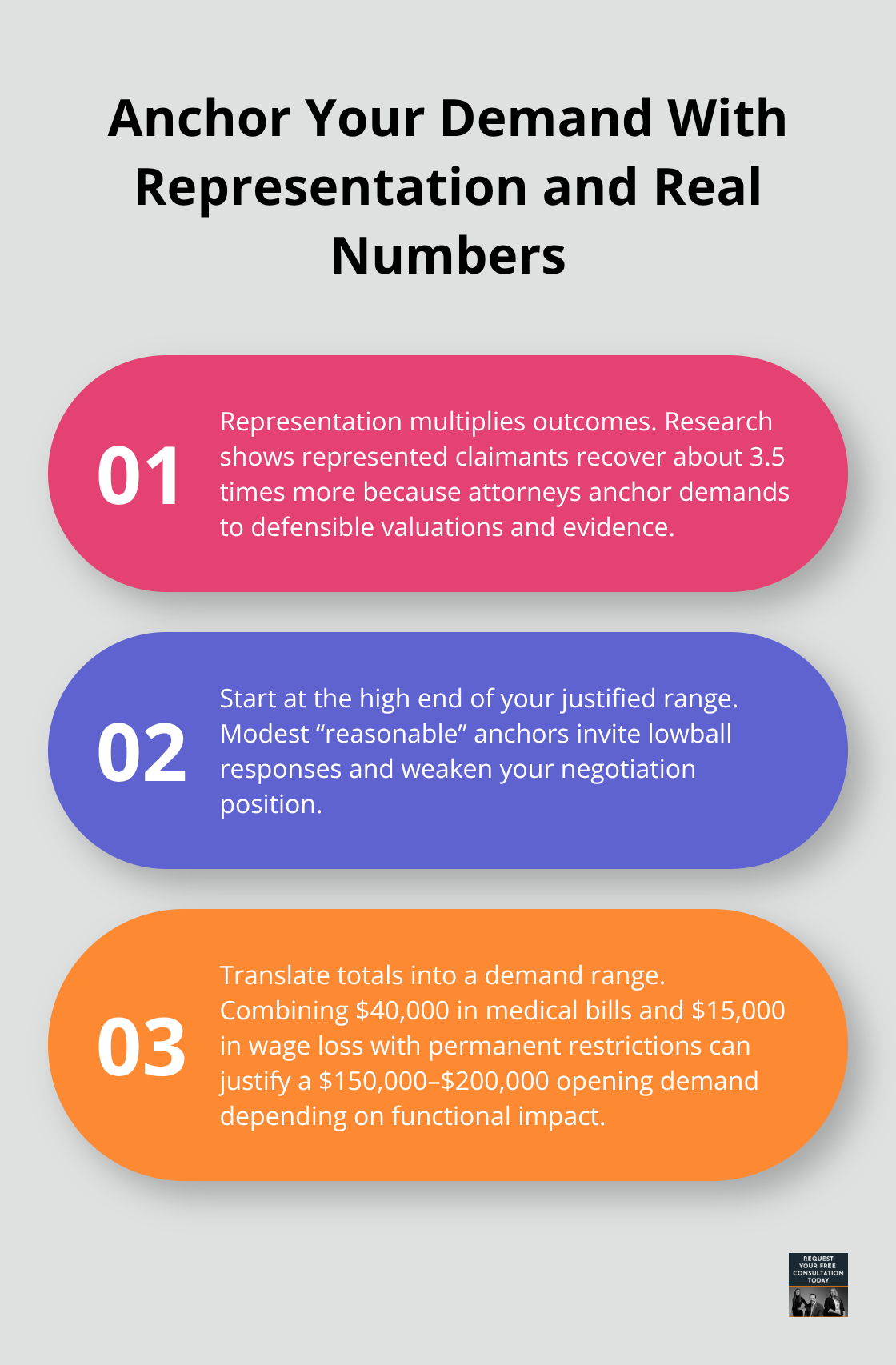
Your opening demand letter sets the negotiation battlefield. Most claimants anchor their demand too low, believing a modest figure will seem reasonable to the adjuster. This backfires systematically. Insurance Research Council data shows represented claimants recover approximately 3.5 times more than unrepresented claimants, even after paying attorney fees, because legal representation anchors demands at realistic valuations rather than guesses. Start at the high end of your legitimate damage range, not the middle. If your medical bills total $40,000, lost wages are $15,000, and you have permanent restrictions limiting future employment, your demand should land between $150,000 and $200,000 depending on your injury’s permanence and impact on daily function.
Reject Lowball Offers with Evidence
Adjusters expect counteroffers; they budget for negotiation and deliberately respond with lowball figures that insult your documented losses. When they offer $35,000 on a $150,000 demand, they test whether you’ll panic and accept. Reject it firmly and present a revised demand backed by specific evidence. Point to your four-month physical therapy timeline, your surgeon’s statement about permanent limitations, and your employer’s letter confirming six weeks of missed work. Reference comparable settlements from your county or region through resources like TopVerdict.com or VerdictSearch, which catalog actual verdicts and settlements. Tell the adjuster your case mirrors a similar 2024 Santa Cruz County settlement where a comparable knee surgery and three-month recovery yielded $125,000. This shifts the conversation from their software calculation to market reality in your geographic area.
Reach Maximum Medical Improvement Before Settlement
Your second tactical advantage emerges when you refuse to settle before reaching Maximum Medical Improvement. Adjusters pressure claimants to close claims quickly because their internal metrics reward fast closures and because delayed settlements tie up reserve capital. Resist this pressure absolutely. If your doctor hasn’t cleared you for full duty or hasn’t provided a prognosis statement, you cannot credibly demand full damages. Conversely, once you reach MMI and have that documented, your demand strengthens immeasurably because you now possess proof of total medical costs and permanent restrictions. Some injuries like back injuries, traumatic brain injuries, and nerve damage require six to twelve months to fully manifest their impact, so settling at three months costs you tens of thousands in undiscovered complications.
Control Communication Through Your Attorney
Maintain organized communication through your attorney rather than speaking directly to adjusters. Every statement you make to an insurance company can be twisted against you later; adjusters record conversations and document your words in claim files. Your attorney filters communication, prevents you from accidentally admitting partial fault, and ensures demands remain strategically positioned. When the adjuster requests additional medical records for the fifth time, your attorney recognizes this as a delay tactic and escalates with a demand letter referencing California Insurance Code Section 790.03, which requires insurers to respond to claims within forty days. Repeated documentation requests beyond reasonable investigation cross into bad faith territory, and your attorney can file a complaint with the California Department of Insurance to pressure faster responses.
Navigate the Settlement Timeline
The settlement typically closes within sixty to ninety days after your final demand if both parties negotiate in good faith, but complex cases with disputed liability or multiple injuries stretch to six months or longer. Patience combined with strategic pressure forces fair offers; rushing to settle for whatever the adjuster offers guarantees you’ll regret it. If negotiations stall or offers remain unfair, your attorney can file a lawsuit to signal seriousness and push toward better pre-trial settlements.
Final Thoughts
Settlement negotiation strategies succeed when you combine organized documentation with realistic expectations about timing and value. Never settle before reaching Maximum Medical Improvement, never communicate directly with adjusters without your attorney present, and never accept the first offer as final. Your medical records, wage loss documentation, and accident scene evidence form the foundation of every counteroffer you present to force them to justify their position rather than relying on software calculations that systematically undervalue your claim.
Knowing when to accept an offer requires honest assessment of your case strength and risk tolerance. If your liability is clear, your injuries are well-documented, and your damages are substantial, holding firm for higher offers makes sense; if liability is disputed or your medical treatment was brief, accepting a reasonable offer avoids the uncertainty of litigation. Most settlements in California resolve within three to six months for straightforward cases, though complex injuries or disputed fault extend timelines to twelve months or beyond, and patience combined with strategic pressure forces fair offers.
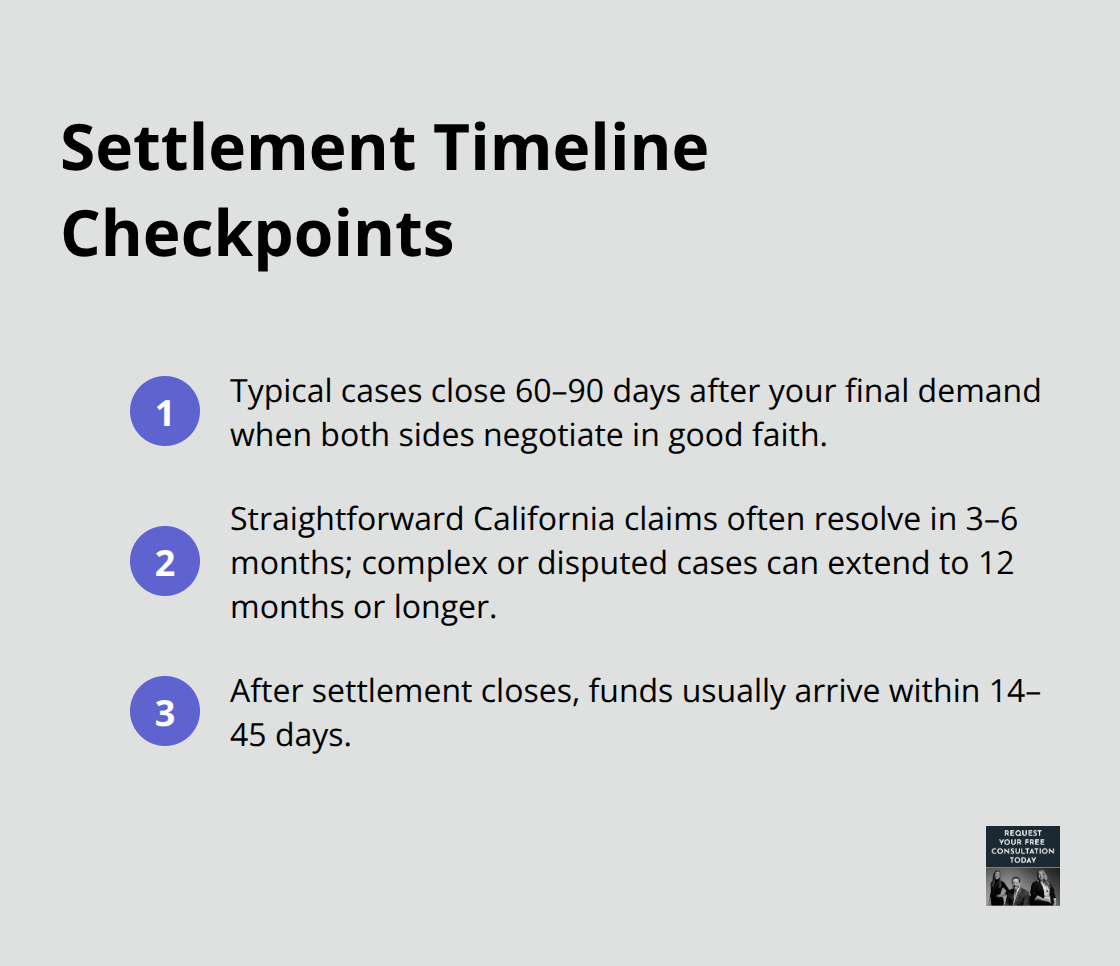
After settlement closes, expect fourteen to forty-five days before funds reach your account, and the release you sign closes the claim permanently, so verify the settlement amount covers all your documented losses before signing. Medical liens, health insurance reimbursements, and attorney fees reduce your net proceeds, so understand these deductions upfront. If you’re navigating settlement negotiations after an accident in Santa Cruz County, Sacramento, or Oakland, contact Schaar & Silva LLP for guidance on your specific claim and realistic settlement expectations.
