

A concussion from a car crash can upend your life in ways that aren’t always visible. Many people don’t realize they have a brain injury until days or weeks after the accident, which makes building a strong claim challenging.
At Schaar & Silva LLP, we’ve helped countless people in California navigate concussion claims and recover the compensation they deserve. This guide walks you through what you need to know about proving your injury and fighting back against insurance companies that try to minimize brain damage.
What Happens to Your Brain in a Car Crash
A concussion occurs when the force of a car crash causes your brain to move rapidly inside your skull, damaging nerve fibers and creating chemical imbalances. The impact doesn’t need to be severe-even a crash at 10 miles per hour can produce enough force to injure your brain. When a vehicle suddenly stops or changes direction, your head and neck experience acceleration-deceleration forces that your brain cannot withstand. The CDC reports that motor vehicle accidents are a leading cause of traumatic brain injuries, accounting for a significant portion of TBI emergency department visits.
You might feel dazed immediately after the crash, or you might feel completely fine for hours or days before symptoms appear. This delayed response happens because adrenaline and endorphins mask pain and cognitive changes. Many people miss the connection between their crash and symptoms that surface later-a headache on day two, memory problems on day four, or mood changes a week later. This is why immediate medical evaluation matters, even when you feel unharmed at the scene.
Physical Symptoms That Appear After Impact
Concussion symptoms fall into two categories: what you feel and what others observe. Physical symptoms include persistent headaches, dizziness, balance problems, sensitivity to light and noise, nausea, and fatigue that doesn’t improve with rest. These signs often intensify over the first 24 to 48 hours as swelling and inflammation develop in brain tissue.
Cognitive and Emotional Changes
Cognitive symptoms are harder to notice because they’re invisible-memory gaps, difficulty concentrating, confusion, slower thinking speed, and trouble following conversations. Emotional and behavioral changes also occur: irritability, mood swings, anxiety, depression, and sleep disturbances. The problem is that many people attribute these changes to stress from the accident rather than brain injury itself.
Why Documentation Protects Your Claim
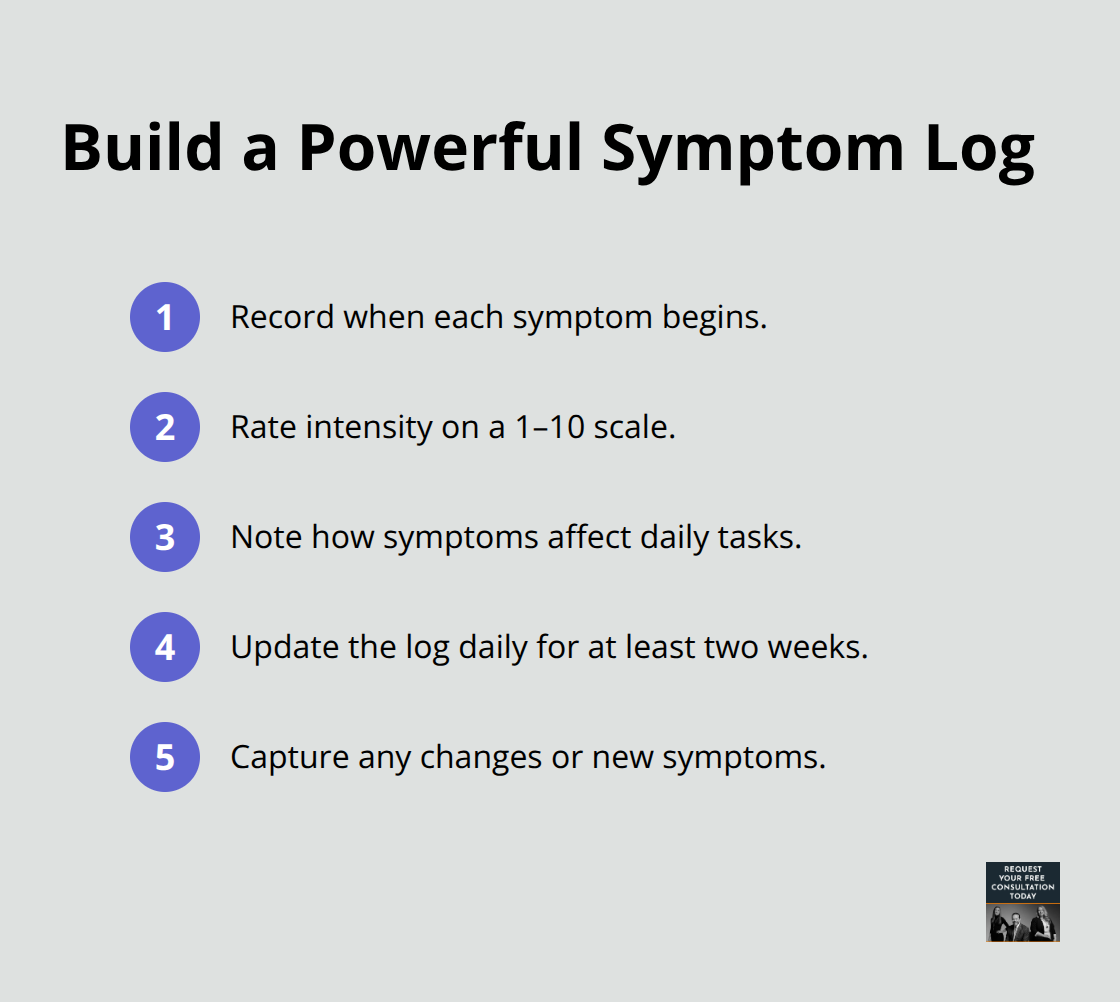
Insurance adjusters exploit confusion about concussion symptoms by claiming your symptoms are exaggerated or unrelated to the crash. Documentation is your defense. Write down when symptoms started, their intensity on a scale of one to ten, and how they affect your daily functioning. Keep a symptom log for at least two weeks after the accident, noting any changes. This creates a documented timeline that connects your symptoms directly to the crash date, making it harder for insurers to dismiss your claim.
The medical evidence you collect now becomes the foundation for your concussion claim. Without proper documentation, insurance companies will argue that your injuries lack credibility or that pre-existing conditions caused your symptoms. Your next step involves obtaining a proper diagnosis from medical professionals who understand brain injuries and can document your condition in ways that hold up against insurer pushback.
Building Medical Evidence for Your Concussion Claim
Start with Immediate Medical Documentation
A doctor who takes your symptoms seriously makes or breaks your concussion claim. You need medical professionals who will document objective findings, not dismiss your symptoms as stress-related or minor. Visit your primary care physician or an emergency room after the accident, even if symptoms haven’t fully emerged yet. This establishes a medical record linked to the crash date. Many people wait days or weeks before seeking care, and insurers will use that gap to argue your injury wasn’t serious. If you can’t reach your regular doctor, urgent care facilities can document initial symptoms. The paper trail you create shows medical professionals took your condition seriously from day one.
Request Specialized Testing That Reveals Hidden Injury
Once you have initial care documented, ask for referrals to a neurologist or neuropsychologist who treats brain injuries. These professionals conduct tests that reveal cognitive deficits invisible on standard MRI scans. Neuropsychological testing measures memory, concentration, processing speed, and executive function with standardized assessments that hold up in settlement negotiations and trials. A neurologist may order functional imaging like SPECT or fMRI scans that show blood flow patterns in your brain, providing visual evidence of injury when conventional imaging appears normal. The invisible injury problem means a clean MRI doesn’t rule out concussion-insurance companies count on this confusion to undervalue claims. Objective testing from qualified medical professionals becomes your strongest defense. Keep all test results, imaging reports, and written assessments in one organized folder.
Track Every Medical Expense and Treatment Visit
You must account for every dollar you spend on medical care related to your concussion. This includes emergency room visits, doctor appointments, neuropsychological testing, physical therapy, occupational therapy, medication costs, and travel expenses to reach specialists. Insurance companies will scrutinize your medical expenses, so organize receipts and bills chronologically. Create a spreadsheet with the date, provider name, service type, and cost for each visit. Many concussion claims settle in the $300,000 to $2,000,000 range in California when medical records are thorough and show intensive treatment. The difference between cases settling at the lower and upper end of that range often comes down to the completeness and organization of your medical records. When you receive a bill months after treatment, add it to your file immediately. Insurance adjusters look for gaps in care or inconsistent records, so completeness protects your claim value.
Connect Your Symptoms Directly to the Accident
Insurance companies will claim your cognitive symptoms stem from anxiety, depression, or pre-existing conditions rather than the crash. Combat this by having your doctor document the specific connection between your symptoms and the impact forces. During appointments, tell your doctor explicitly when symptoms started relative to the accident date and how they’ve progressed. Ask your doctor to note in the medical record that your symptoms are consistent with traumatic brain injury from motor vehicle accident trauma. Request written statements explaining why your symptoms couldn’t reasonably have existed before the crash. If you had previous medical records showing no cognitive issues, provide those to your neuropsychologist so they can document the contrast. Witness statements also strengthen this connection-ask family members or coworkers who noticed changes in your behavior or cognitive function to write brief descriptions of what they observed and when. These statements go into your claim file alongside medical evidence, creating multiple corroborating sources that insurance companies cannot easily dismiss.
The medical foundation you build now determines how insurance companies and juries will view your injury later. With solid documentation in place, you’re ready to confront the tactics insurers use to downplay brain injuries and fight back against their attempts to minimize what you’ve experienced.
Common Challenges in Concussion Claims and How to Overcome Them
Insurance adjusters are trained to undervalue brain injuries because they cannot see them on a balance sheet. The Insurance Research Council reports that represented claimants recover roughly 3.5 times more than unrepresented claimants after accounting for attorney fees, which tells you exactly how aggressively insurers fight these cases. Adjusters use several predictable tactics: they claim your symptoms are psychological rather than neurological, they argue that a normal MRI proves you have no injury, they suggest your cognitive problems stem from depression or anxiety triggered by the accident rather than the impact itself, and they exploit gaps between your crash date and when you sought medical care.
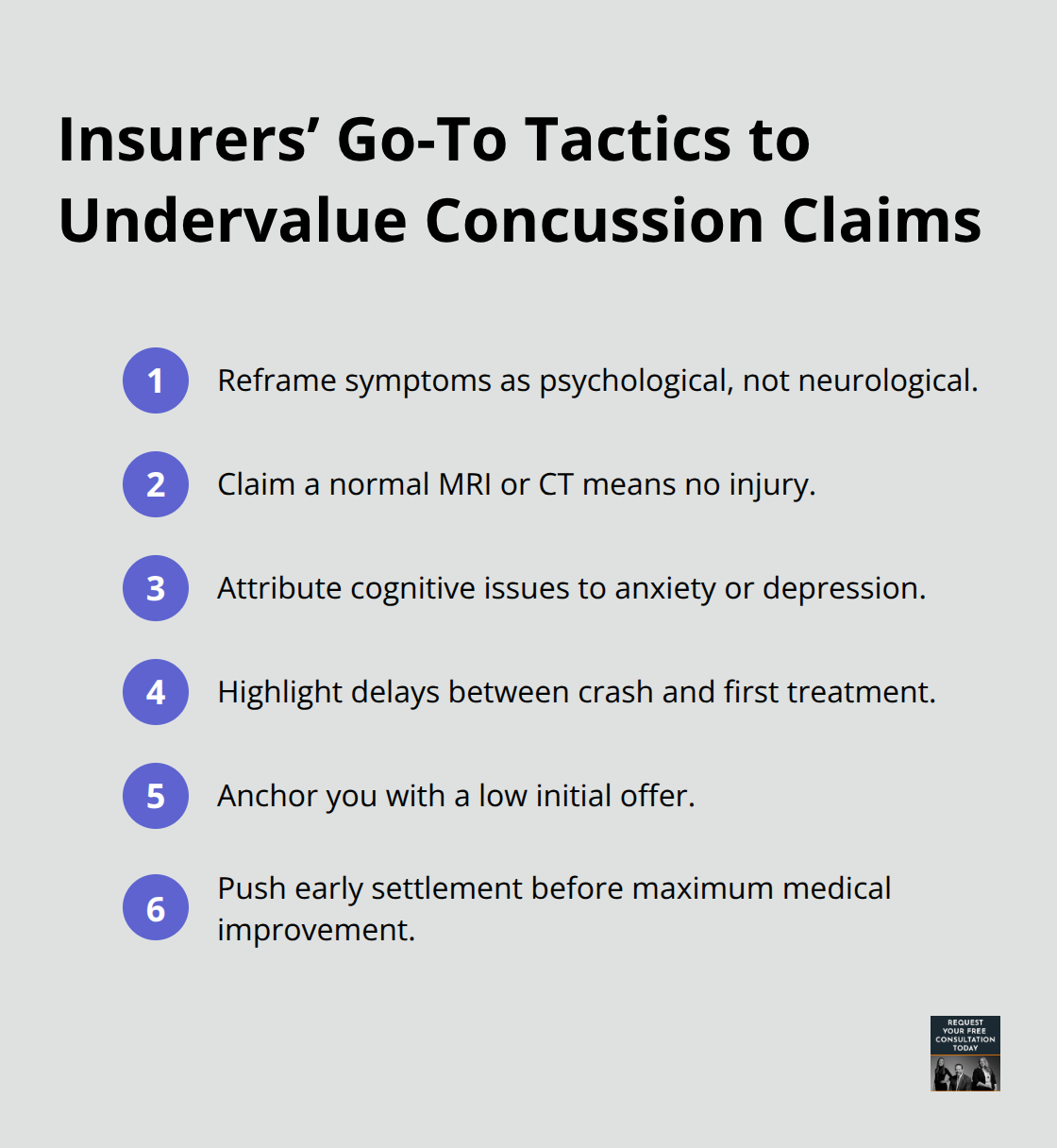
One common tactic involves anchoring your claim low with an initial offer that sounds reasonable until you understand what your injury actually costs over a lifetime. If you accept an early settlement before reaching maximum medical improvement, you forfeit your right to additional compensation when symptoms worsen or persist.
Insurance Companies Downplaying Brain Injuries
Insurance companies count on you not understanding that concussions can have lifelong effects. They also rely on the fact that most people don’t know neuropsychological testing exists or that functional imaging like SPECT scans can reveal brain injury when standard MRI scans appear normal. This knowledge gap is intentional on their part. The biggest challenge in concussion claims is that nothing shows up on a standard MRI or CT scan. Insurance adjusters weaponize this fact to tell you that clean imaging means no real injury. This is medically false. The CDC and NIH both confirm that traumatic brain injury can occur without structural damage visible on conventional imaging.
Proving Non-Visible Injuries
Functional imaging like SPECT or fMRI scans show blood flow patterns and metabolic activity in your brain, revealing injury that structural imaging misses. Neuropsychological testing measures your actual cognitive performance against standardized benchmarks, documenting deficits in memory, processing speed, concentration, and executive function. When you have both functional imaging and neuropsych testing results in your file, you eliminate the insurer’s ability to claim your injury is invisible and therefore unproven. The problem arises when you skip specialized testing and rely only on your doctor’s clinical notes. An adjuster will dismiss clinical observations as subjective opinion, but objective test scores backed by scientific literature are harder to ignore.
Medical records alone are insufficient for serious concussion claims. You need quantifiable evidence. Many people make the mistake of thinking their regular doctor’s documentation is enough. It is not. Your primary care physician can document that you have symptoms consistent with concussion, but they typically lack the specialized training and testing equipment to prove cognitive deficits. This is why referrals to neurologists and neuropsychologists matter so much. The difference between settling your claim at $300,000 versus $800,000 often depends on whether you pursued specialized testing.
Addressing Gaps in Medical Records
Insurance companies scrutinize your medical records for any break in treatment. A two-week gap between appointments gives an adjuster ammunition to argue your injury wasn’t serious enough to require ongoing care. A month without therapy visits becomes evidence that you recovered, regardless of whether you actually did. This is why you need to maintain consistent medical treatment from the accident date forward, even when you feel slightly better. Concussion recovery is not linear. You might feel decent one day and completely impaired the next. Consistent treatment documentation shows the true pattern of your injury rather than isolated snapshots.
If you must pause treatment for financial reasons, have your doctor document in writing that the break in care is temporary and that you plan to resume treatment. If insurance coverage changes or you switch providers, ensure your new provider receives all prior medical records and that there is overlap in documentation. Never allow a gap where no provider is actively treating or monitoring your condition. The moment you stop documenting your injury, insurance companies assume you’ve recovered. California courts have upheld settlements and verdicts in the $1.5 million to $3.2 million range for concussion cases involving rear-end collisions and slip-and-fall incidents where medical documentation was thorough and consistent. The VerdictSearch database shows that cases with treatment gaps or incomplete medical records settled for substantially less, often in the $100,000 to $300,000 range for similar injury patterns. Consistency in treatment is not just good medical practice; it is essential to maximizing your claim value. If financial barriers prevent you from accessing ongoing care, medical lien services can facilitate payment of your bills until your case resolves, ensuring you never face the choice between treatment and financial survival.
Final Thoughts
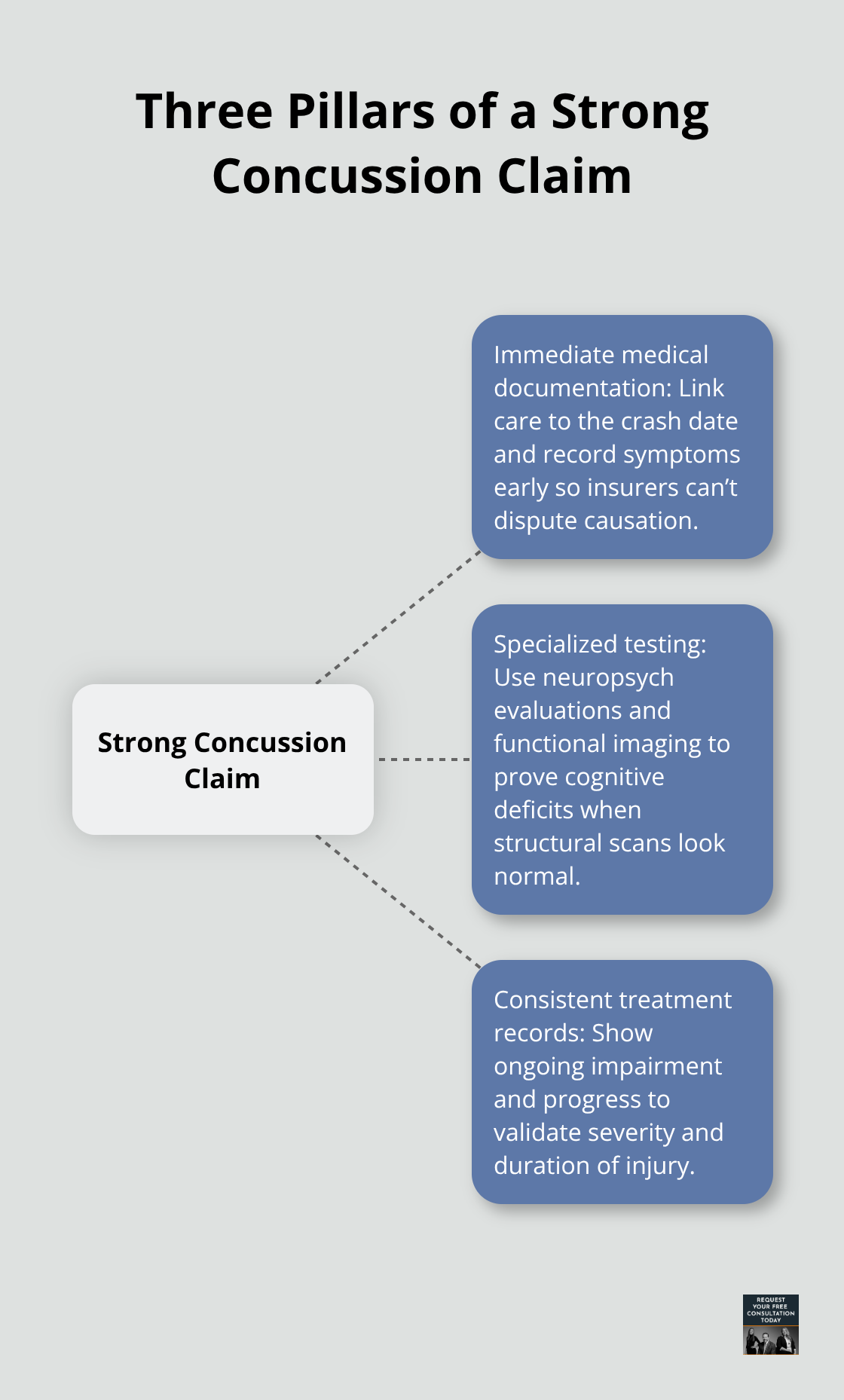
A strong concussion claim rests on three pillars: immediate medical documentation that links your symptoms to the crash date, specialized testing that proves cognitive deficits, and consistent treatment records that show the true scope of your injury. Insurance companies will challenge every element, which is why completeness matters more than perfection. The difference between settling your concussion claims California case at $300,000 versus $1.5 million often comes down to whether you pursued neuropsychological testing, maintained consistent medical care, and organized your evidence in ways that withstand insurer scrutiny.
Legal representation fundamentally changes how insurance companies treat your claim. When you handle negotiations alone, adjusters know you lack leverage and understanding of settlement ranges, but the moment you hire an attorney, the dynamic shifts entirely. Represented claimants recover roughly 3.5 times more than unrepresented claimants after accounting for attorney fees, which reflects the real power imbalance that exists when you face insurers alone.
We at Schaar & Silva LLP help people in Santa Cruz County navigate concussion claims from start to finish, connecting you with medical lien services so financial barriers never prevent you from accessing the specialized care your brain injury requires. Contact Schaar & Silva LLP for a free consultation and bring your accident report, medical records, and any documentation you’ve already gathered. The statute of limitations in California gives you two years from your accident date to file a claim, but waiting costs you money-the sooner you take action, the stronger your position becomes.
