

A car accident shakes more than your body-it affects your mind. Many people in Santa Cruz County experience anxiety, depression, or PTSD after a crash, yet they don’t realize these reactions are treatable.
At Schaar & Silva LLP, we know that accident trauma therapy is just as important as physical recovery. This guide shows you how to find the right therapist and start healing.
Why Your Mind Needs Care After a Crash
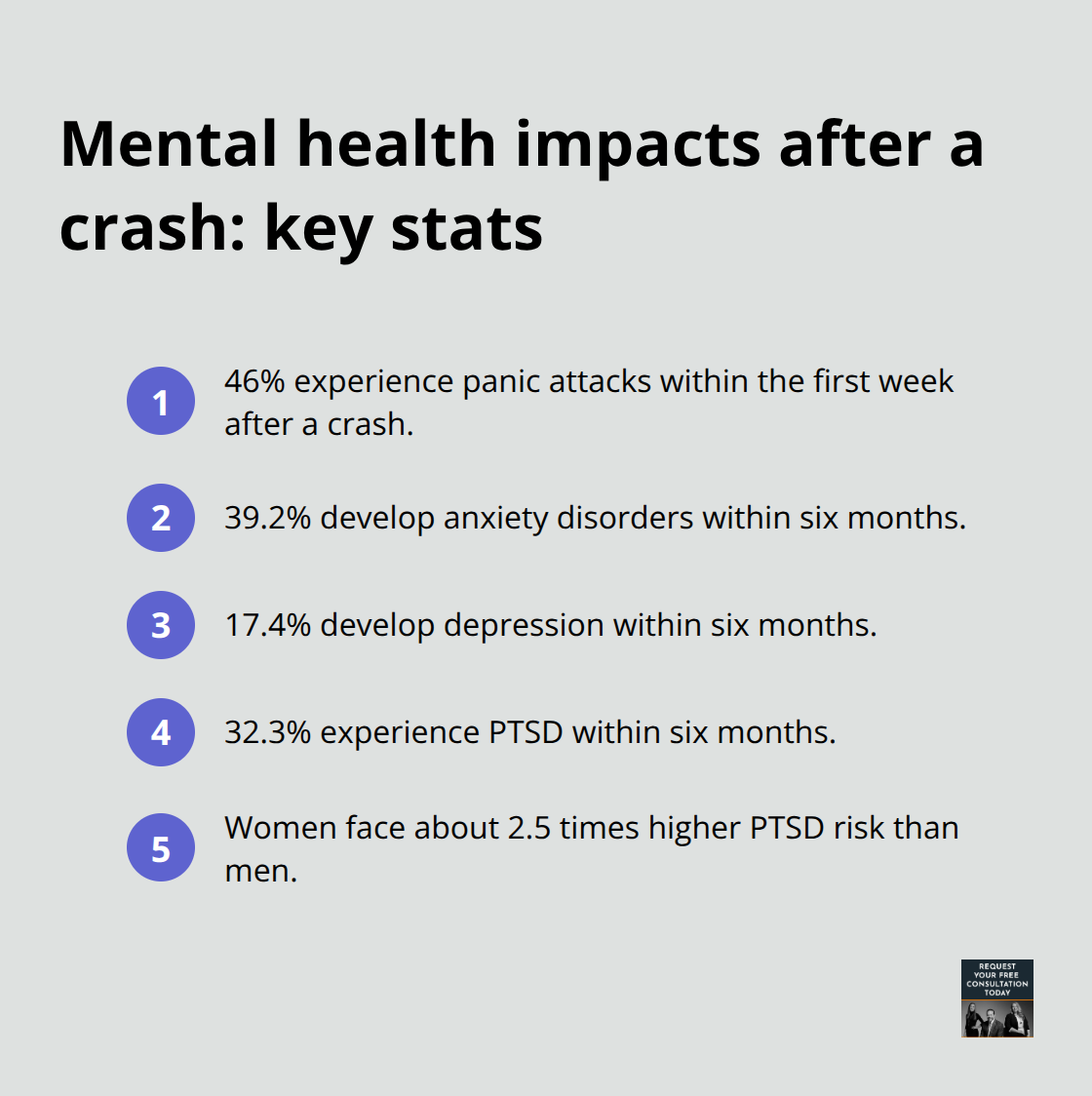
Your body shows injuries from a car accident, but your mind carries invisible wounds that demand attention. About 46% of crash survivors experience panic attacks within the first week after their accident, according to the American Psychological Association and National Institute of Mental Health. Within six months, roughly 39.2% develop anxiety disorders, 17.4% develop depression, and around 32.3% experience PTSD, with women facing about 2.5 times higher risk for PTSD than men. These aren’t signs of weakness-they’re normal responses to trauma that respond well to treatment. Many people ignore these symptoms, hoping they’ll fade on their own. They won’t.
Untreated trauma compounds over time, creating patterns of avoidance and hyperarousal that make daily life harder.
Physical Pain and Emotional Decline Connect
One critical connection most accident survivors miss: persistent physical pain six to eight weeks after a crash strongly predicts greater depression severity about two months later, according to the Journal of Clinical Medicine. Your body and mind are linked in recovery. If you manage pain without addressing the emotional aftermath, you solve only half the problem. About 39.2% of survivors develop avoidance behaviors within six months-avoiding driving certain routes, highways, or even leaving home-which deepens isolation and anxiety.
Evidence-Based Therapy Works Fast
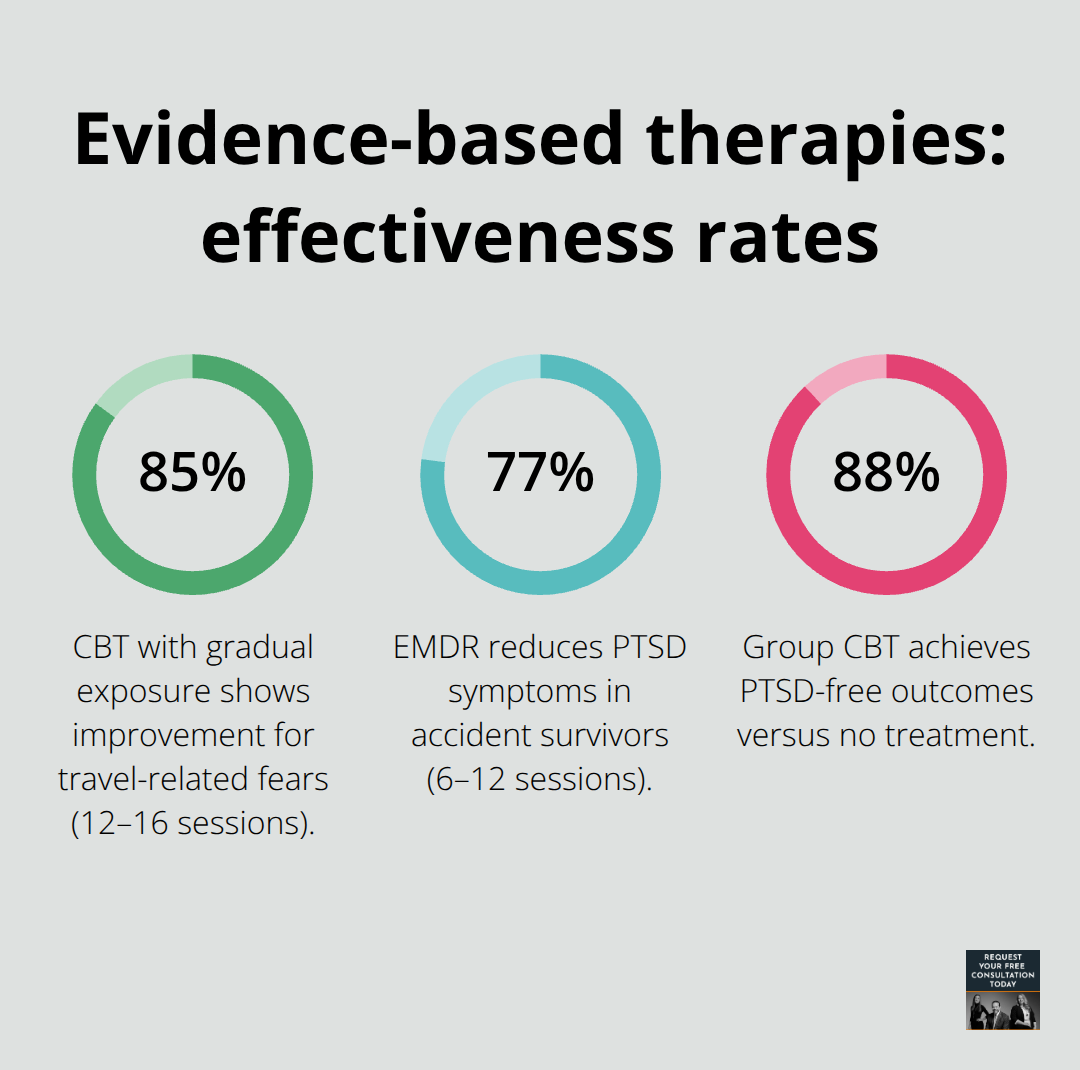
The good news arrives with solid numbers. Cognitive Behavioral Therapy with gradual exposure shows approximately 85% improvement for travel-related fears over 12 to 16 sessions. EMDR therapy reduces PTSD symptoms in about 77% of accident survivors after 6 to 12 sessions. Group CBT tailored to accident-related PTSD achieves around 88% PTSD-free outcomes compared to about 31% with no treatment.
Early intervention works. Waiting makes recovery harder.
Why Timing Matters for Your Recovery
Starting therapy within weeks after your accident, not months later, is associated with better outcomes and reduced risk of chronic symptoms. The window for preventing long-term damage is real. When you coordinate mental health support with legal recovery, both paths strengthen. Your therapist documents your symptoms and progress; this documentation supports your case if you pursue compensation. At Schaar & Silva LLP, we connect you with medical lien services to cover therapy costs during your case. These two paths-healing your mind and protecting your rights-work together, not separately. Now that you understand why therapy matters, the next step is finding the right therapist for your situation.
Finding a Therapist in Santa Cruz County
Start With What Santa Cruz Offers
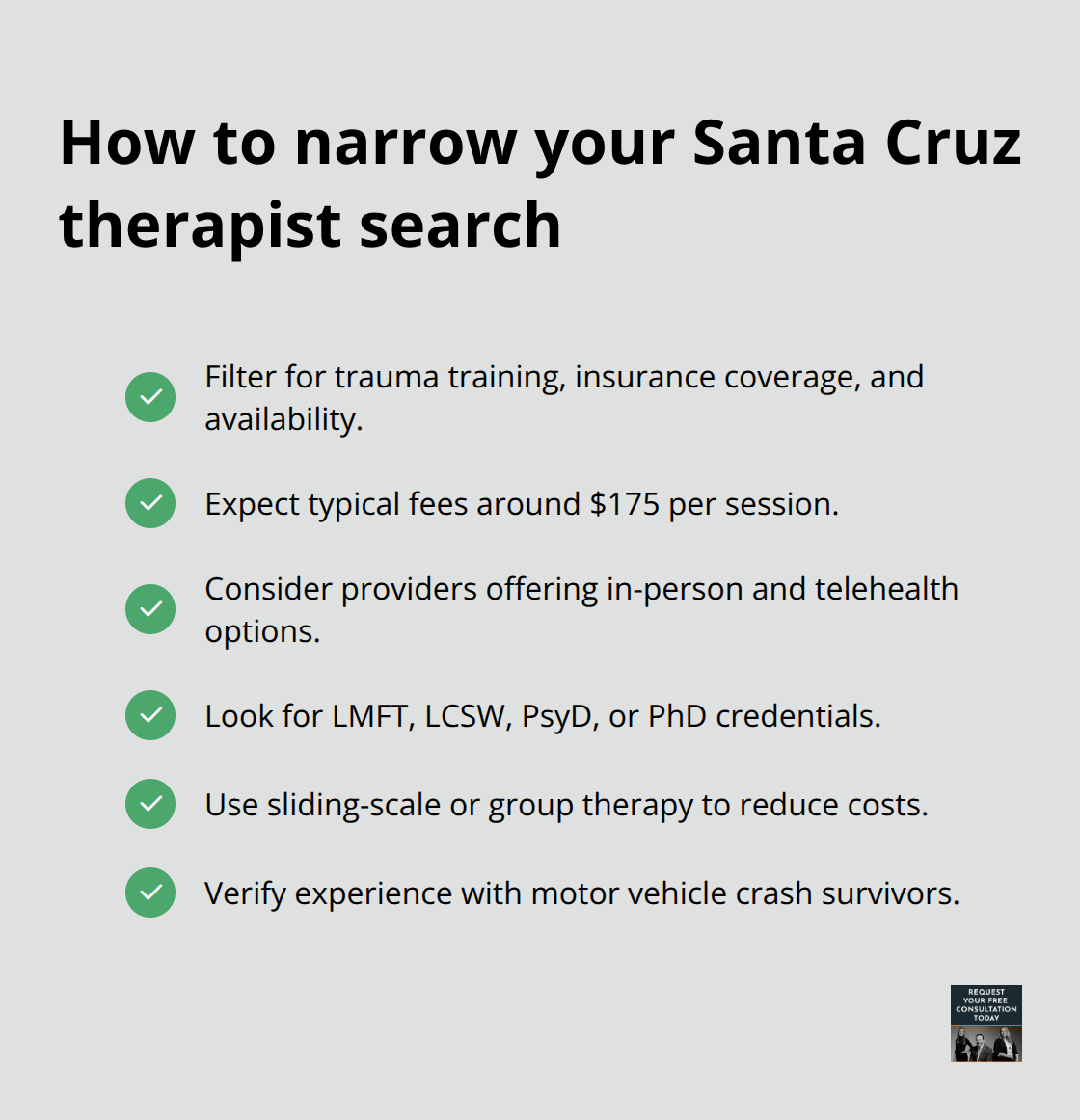
Santa Cruz County has over 500 trauma and PTSD therapists listed on Psychology Today, which makes the search feel overwhelming at first. Filter for three core elements: trauma training, insurance coverage, and availability. Therapists in Santa Cruz typically charge around $175 per session, within the national range of $100 to $200 and up. About two-thirds of local therapists offer both in-person and online sessions, so you have flexibility if travel feels difficult after your accident. Look specifically for credentials like LMFT, LCSW, PsyD, or PhD-these indicate formal training in trauma treatment.
Verify Credentials and Insurance Coverage
Avoid therapists who haven’t worked with accident survivors; they won’t understand the specific symptoms you’re facing or how medical and legal stressors complicate recovery. When you search Psychology Today’s Santa Cruz directory, filter by the issues you’re facing-anxiety, PTSD, depression-and verify the therapist’s license status through the California Board of Behavioral Sciences. Check which major insurers they accept: Aetna, Cigna, Anthem, UnitedHealthcare, Blue Shield, and Medi-Cal all operate in Santa Cruz County and cover trauma-focused therapy. If cost concerns you, ask about sliding-scale rates or group therapy options, which are more affordable than individual sessions.
Choose Between EMDR and Trauma-Focused CBT
Two trauma-focused approaches dominate Santa Cruz practices: EMDR and trauma-focused CBT. EMDR reduces PTSD symptoms in about 77% of accident survivors after 6 to 12 sessions according to the American Psychological Association, while CBT with gradual exposure shows approximately 85% improvement for travel-related fears over 12 to 16 sessions. During your initial consultation (which should last 15 to 20 minutes), ask directly about their experience treating motor vehicle crash survivors and whether they use EMDR or exposure-based CBT. Ask how they track progress and what success looks like in your specific situation.
Confirm Understanding of Your Full Recovery
Confirm they understand the connection between your physical injuries and emotional symptoms, since persistent pain predicts depression severity. Verify they follow HIPAA confidentiality rules and explain how records are stored. Santa Cruz County Behavioral Health operates a 24-hour access line at 800-952-2335 and offers age-specific teams: Transition Age Youth for ages 18 to 25, Adult Recovery Team for 25 to 60, and Older Adult Mental Health Services for those 60 and up. If suicidal thoughts arise, call 988 for the Suicide and Crisis Lifeline.
Act Within the Critical Window
Start therapy within weeks of your accident, not months later, since early intervention significantly reduces chronic symptoms. The right therapist understands both your accident-related trauma and the legal process ahead. When you coordinate mental health support with legal recovery, both paths strengthen-your therapist documents your symptoms and progress, which supports your case if you pursue compensation. At Schaar & Silva LLP, we connect you with medical lien services to cover therapy costs during your case, so healing and legal protection work together. Once you’ve selected a therapist and begun sessions, understanding what happens in the therapy room itself helps you prepare for the work ahead.
What Happens in Your Therapy Sessions
Your First Session Sets the Foundation
Your first session won’t feel like sitting on a therapist’s couch discussing your childhood. Instead, a trauma-informed therapist will assess your symptoms, discuss your accident experience, and explain which therapy type suits your situation. They’ll assess your current anxiety levels, sleep patterns, and avoidance behaviors using concrete tools like the PCL-5 symptom checklist from the VA National PTSD Center, which lets you both track measurable progress over time.
How Trauma-Focused CBT Rewires Your Fear Response
Trauma-focused CBT shows approximately 85% improvement for travel-related fears over 12 to 16 sessions according to the Journal of Clinical Medicine. Your therapist helps you build a timeline of your accident, identifies specific triggers that spike your anxiety, and gradually exposes you to those triggers in a controlled way so your brain rewires its fear response. This structured approach works because it breaks the cycle of avoidance that keeps trauma locked in place.
EMDR Processes Trauma Differently but Effectively
EMDR operates through a different mechanism yet achieves equally strong results, reducing PTSD symptoms in about 77% of accident survivors after 6 to 12 sessions. Your therapist guides your eye movements or uses bilateral stimulation while you process traumatic memories, which appears to help your brain metabolize the trauma rather than store it as frozen fear. The process feels unusual at first, but the data supports its effectiveness for motor vehicle crash survivors.
Homework Assignments Accelerate Your Progress
Between sessions, you’ll complete homework assignments that reinforce what happens in the therapy room. Your therapist might ask you to drive a specific route that triggered avoidance, practice grounding exercises like the 5-4-3-2-1 sensory technique when panic hits, or maintain a symptom journal documenting when nightmares occur and what situations intensify hyperarousal. Progress isn’t linear-some weeks your anxiety drops noticeably; other weeks setbacks happen. A competent therapist expects this and adjusts treatment accordingly.
Building Trust and Adjusting Course When Needed
Your therapist needs to demonstrate they understand the specific connection between your physical injuries and emotional symptoms, since persistent pain six to eight weeks after a crash strongly predicts depression severity two months later according to the Journal of Clinical Medicine. Trust doesn’t arrive instantly in the therapy room, and it shouldn’t. If after 8 to 12 sessions you feel no meaningful progress, discuss switching approaches or finding a different therapist rather than enduring a poor fit. Teletherapy works as effectively as in-person sessions with a strong therapeutic relationship, so if transportation feels overwhelming post-accident, online therapy through a secure platform meets your needs. Santa Cruz County Behavioral Health’s Mobile Crisis Response Team provides on-scene intervention if panic spirals beyond your coping capacity, and the 24-hour access line at 800-952-2335 connects you to immediate support. Coordinate your mental health treatment with your medical team-your primary care doctor, pain specialists, or chiropractors-since integrated care improves outcomes.
Final Thoughts
Your recovery after a Santa Cruz auto accident involves two parallel paths that strengthen each other. Accident trauma therapy addresses the invisible wounds your mind carries, while legal support protects your financial future and removes barriers to healing. Neither path works fully alone, and coordinating both accelerates your progress toward stability.
Starting therapy within weeks of your accident gives you the best chance of preventing chronic symptoms, and the therapists in Santa Cruz County understand motor vehicle crash trauma well enough to guide you through evidence-based treatment like EMDR or trauma-focused CBT. Your therapist documents your symptoms and progress with clinical precision, creating a record that matters if you pursue compensation for your injuries. At Schaar & Silva LLP, we connect you with medical lien services that cover your therapy costs during your case, so financial stress doesn’t force you to choose between healing and paying bills.
When you coordinate mental health care with legal recovery, your therapist’s documentation strengthens your case while our legal guidance clarifies what compensation you may receive. Contact a trauma-informed therapist this week and reach out to Schaar & Silva LLP to understand your legal options and access the support that helps people in Santa Cruz County move forward after an accident.
