

After a car accident, medical bills pile up fast. Healthcare providers often place auto medical liens on your settlement to guarantee they get paid from your compensation.
These liens can significantly reduce the money you actually receive. We at Schaar & Silva LLP help clients in Santa Cruz, Sacramento, and Oakland understand how liens work and fight to minimize their impact on your final award.
What Medical Liens Actually Are
A medical lien is a legal claim filed by healthcare providers or their billing agents against your auto accident settlement. When you receive treatment after an accident and cannot pay immediately, providers often agree to treat you on a lien basis, meaning they defer payment until your case settles. The moment you sign those intake forms at the hospital or clinic, you’re agreeing that the provider can recover their charges from whatever compensation you receive. This isn’t optional negotiation-it’s a contractual obligation built into your treatment agreement. Hospitals, emergency rooms, doctors, chiropractors, and ambulance services all commonly file these liens. In California, the Hospital Lien Act under Civil Code 3045 gives hospitals specific legal authority to file liens without even requiring your signature, though they must follow strict notification procedures. The reality is stark: a $300,000 settlement can shrink to $200,000 or less after liens are paid, leaving you with far less than you expected for your injuries and losses.
How Liens Attach to Your Settlement
When healthcare providers treat you on a lien basis, they document this arrangement in writing. They then file formal notice of the lien with your attorney and the at-fault party’s insurance company once your case moves forward. Under California Civil Code 3040, health insurance companies can limit their lien recovery to reasonable costs actually paid, but calculating this correctly requires careful review of your bills. The law caps most health plan liens to either one-third of your settlement (if you hired an attorney) or one-half (if you didn’t), but only if the lien doesn’t exceed the actual reasonable charges.
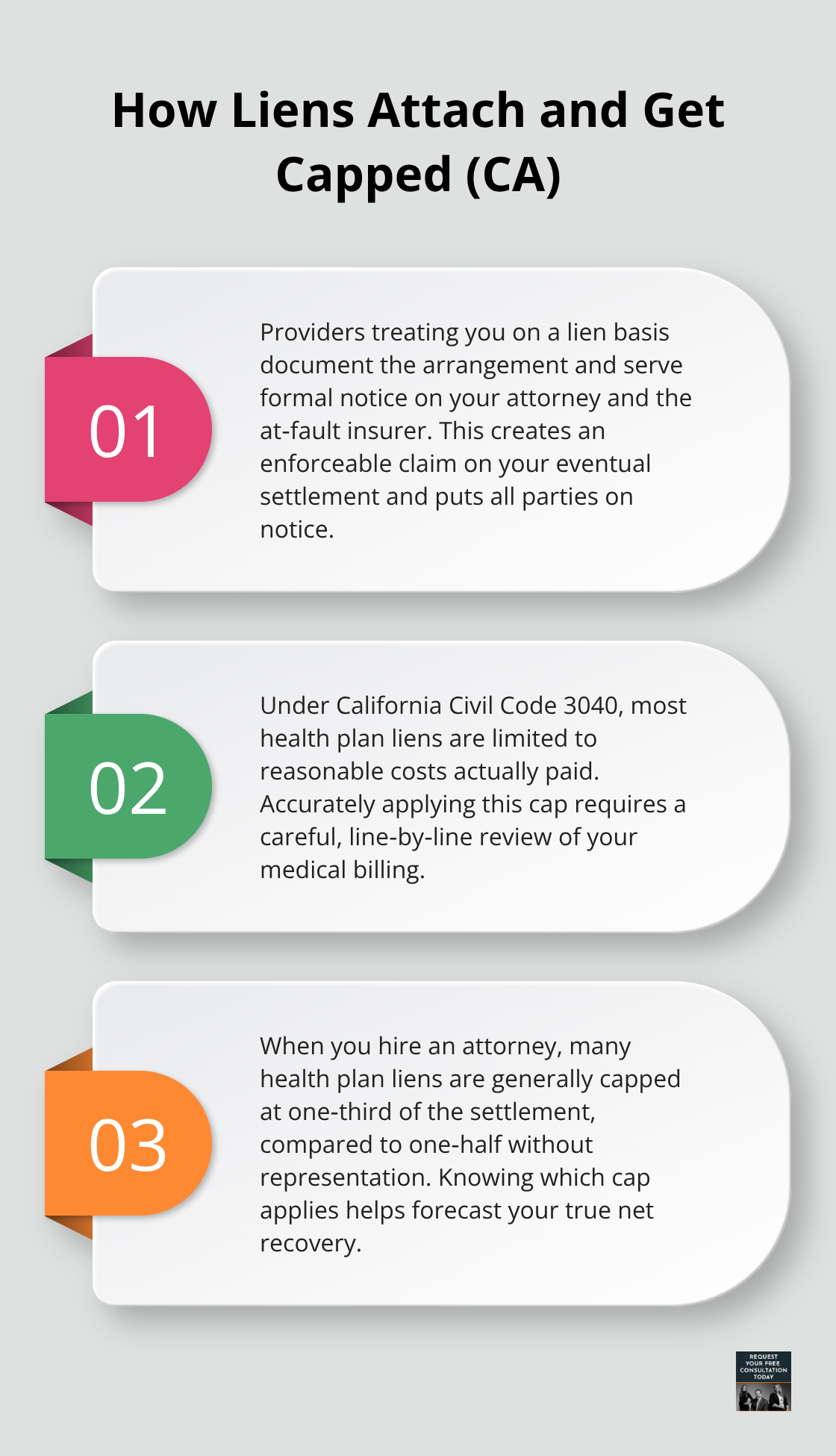
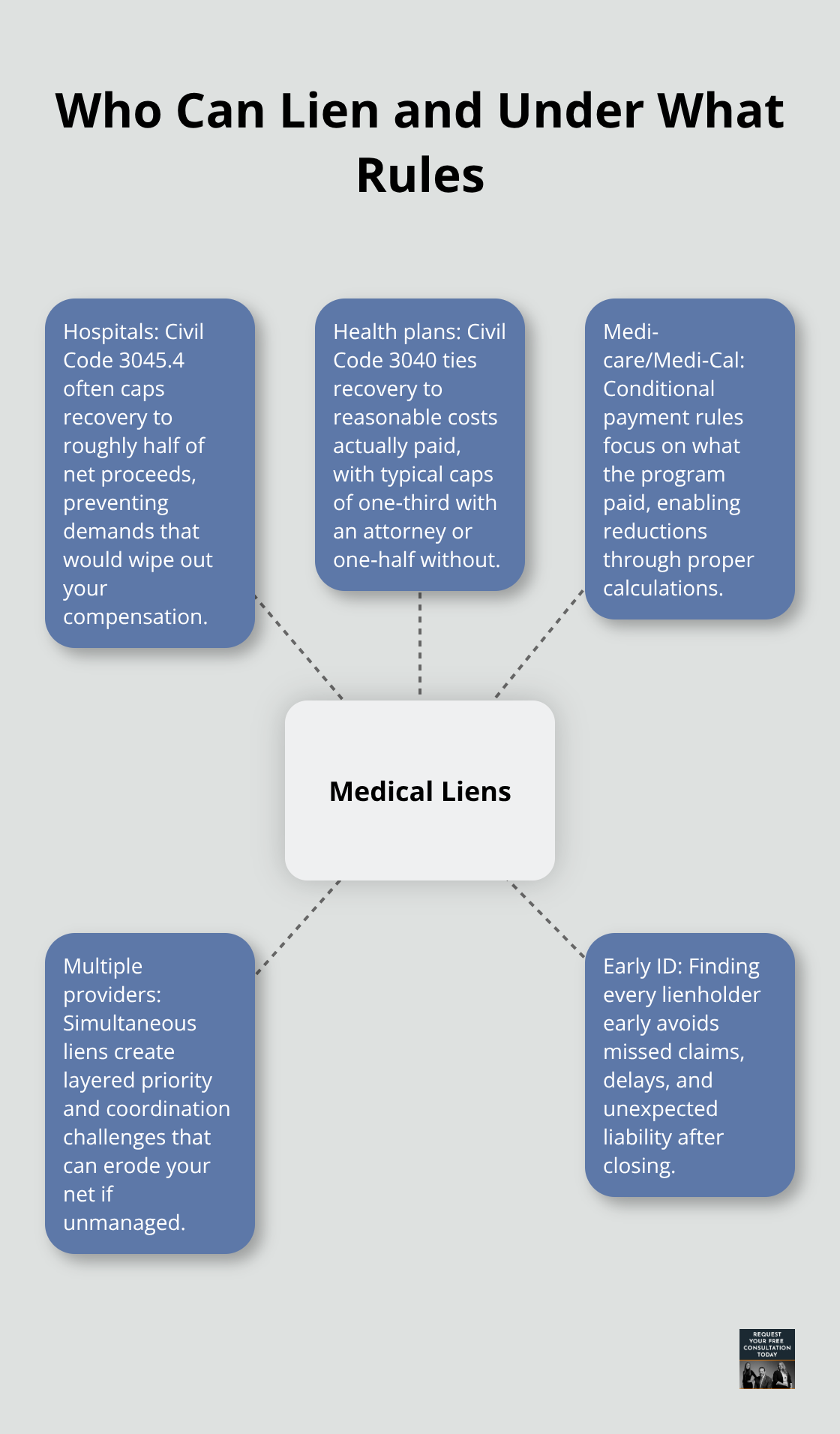
Multiple providers file liens simultaneously-your hospital, the emergency room physician, the ambulance service, your follow-up clinics-creating a complex web of claims against your recovery. Each lienholder operates under different rules and priorities depending on whether they’re a hospital, private provider, or government program like Medicare or Medi-Cal. This complexity is why identifying all liens early matters tremendously; missing even one can delay settlement and create unexpected liability after you thought your case was closed.
Why Early Identification Protects Your Recovery
The providers treating you after your accident hold significant leverage. They know you need medical care and that you likely cannot pay out of pocket. Once liens attach to your case, they become difficult to challenge or reduce without professional help. Your attorney must track down every lienholder, verify the amounts claimed, and confirm that charges align with the care you actually received. Some providers inflate bills or include non-billable items, and your attorney can identify these errors. The sooner you address liens, the sooner you can move toward a settlement that accounts for all these deductions and protects your actual take-home amount.
How Liens Shrink Your Settlement Payout
Medical liens directly reduce the amount of money you take home from your settlement. If you receive a $300,000 settlement and face $70,000 in health insurance liens plus $30,000 in hospital and provider liens, you walk away with $200,000 before attorney fees and costs. That $100,000 gap represents real money that goes to medical providers instead of compensating you for pain, suffering, lost wages, and future medical care.
Understanding Lien Caps and Calculations
California law under Civil Code 3040 caps most health plan liens to reasonable costs actually paid. The cap typically limits the lien to one-third of your settlement if you hired an attorney, or one-half if you didn’t, but this only applies if the actual charges don’t exceed those percentages. Calculating this correctly demands careful itemization of every charge on your medical bills.
Government programs like Medicare operate under different rules entirely. Medicare uses a conditional payment system that can demand reimbursement based on what Medicare paid rather than what providers billed. This distinction sometimes reduces the lien amount significantly through proper negotiation. The problem intensifies when multiple providers file liens simultaneously-your hospital files one lien, the emergency room physician files another, the ambulance service files a third, and your follow-up clinics file additional claims. Each operates under different priority rules depending on whether they’re hospitals, private providers, or government programs. Without aggressive negotiation from your attorney, you lose far more than necessary to these overlapping claims.
Negotiating Down Liens Before Settlement
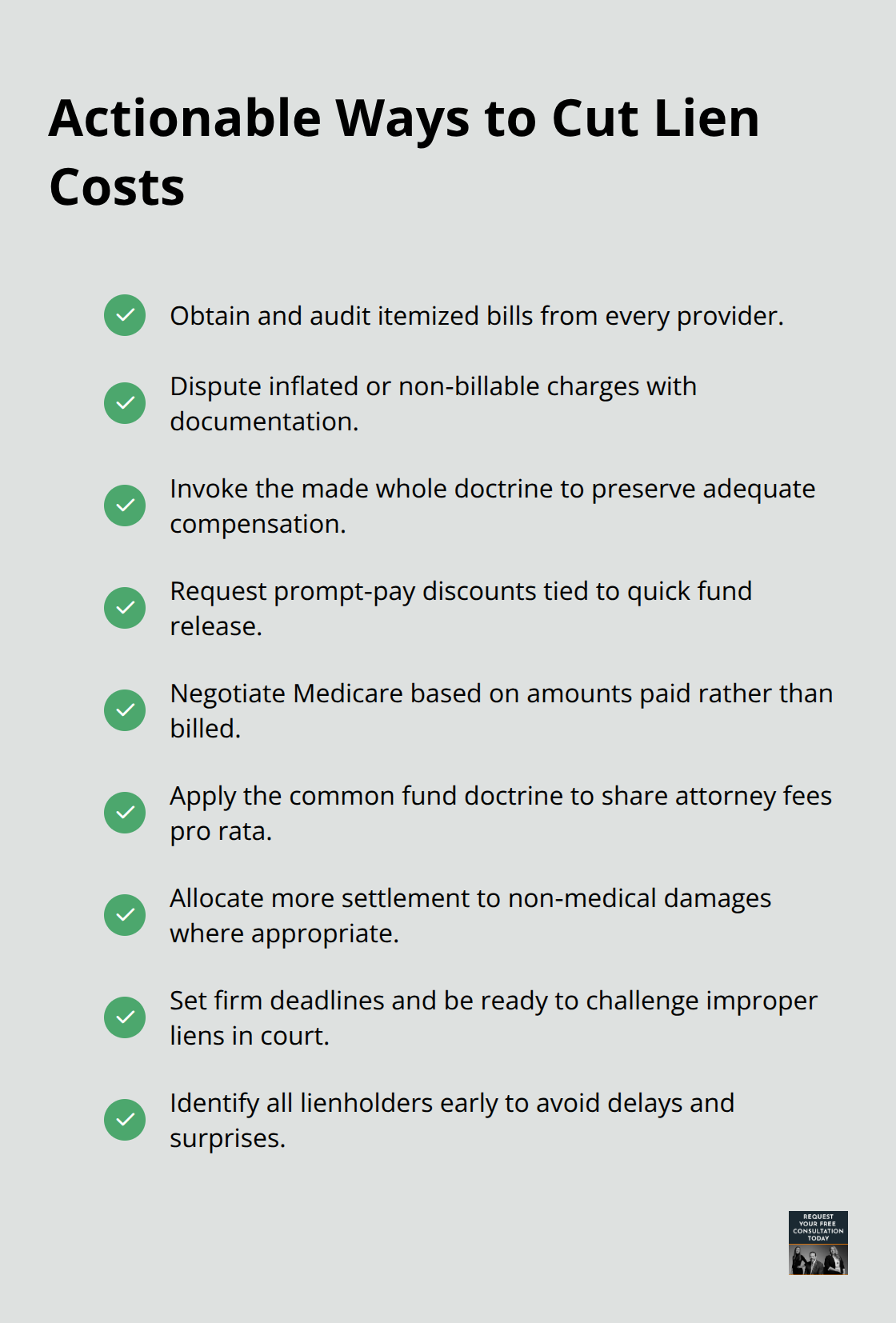
Most lien amounts are negotiable, yet many injured people never attempt to reduce them. Healthcare providers often inflate charges or include non-billable items, and your attorney can identify these errors and demand reductions. A hospital might bill $50,000 for treatment that reasonably costs $35,000 when you examine itemized records for duplicate charges or services never rendered. Negotiating that lien down to $35,000 immediately puts $15,000 more in your pocket.
Your attorney obtains itemized bills from every provider and verifies that charges align with care actually received. Some providers accept discounted payments if settlement funds arrive promptly, making timing crucial in these negotiations. The made whole doctrine, established in California case law, requires you to be fully compensated for your losses before lienholders recover anything. This principle gives your attorney leverage to argue that excessive liens prevent you from being made whole.
If a $300,000 settlement barely covers your medical bills, lost wages, and pain and suffering, the made whole doctrine can reduce liens proportionally so you receive adequate compensation.
Strategic Settlement Allocation
Settlement allocation strategy affects how much you retain after liens are paid. Directing more settlement funds toward non-medical damages like pain and suffering rather than medical costs can reduce the portion subject to liens, protecting more of your recovery. The common fund doctrine allows your attorney’s fees to be deducted from lien amounts on a pro rata basis, preventing medical providers from benefiting free from your attorney’s work that generated the settlement.
Managing Lien Resolution Timelines
Lien resolution typically takes weeks to months depending on complexity and the number of lienholders involved. Once your settlement reaches final agreement, your attorney identifies every lienholder, verifies amounts, and coordinates payments. Medicare liens require special handling because they involve government deadlines and specific calculation methods. Missing a Medicare deadline can trigger penalties that increase the amount owed.
Private health insurance liens move faster but require your attorney to negotiate with insurance companies directly. Some lienholders drag out negotiations intentionally, hoping you’ll accept their initial demand rather than wait. Your attorney pushes back by setting firm deadlines and preparing to challenge improper liens in court if necessary. The four-year statute of limitations in California to collect a breached medical lien creates pressure on providers to resolve claims quickly, giving your attorney negotiating power. Proactive lien management from the beginning of your case prevents these delays from derailing your settlement. The earlier your attorney identifies liens and begins negotiations, the sooner you receive your net recovery without surprises at closing.
Understanding how liens attach to your case and what strategies reduce their impact sets the foundation for protecting your compensation. The next section examines how you can work with your attorney to challenge excessive liens and explore additional avenues for reducing what you owe to healthcare providers.
How to Challenge and Reduce Medical Liens
Healthcare providers count on injured people accepting their initial lien amounts without question. Most liens contain errors, inflated charges, or items that should never have been billed in the first place. Your first actionable step involves obtaining itemized bills from every provider who treated you and reviewing them line by line for duplicate charges, services you never received, or procedures billed at rates far above market rates in your region. A hospital emergency room visit that lists $5,000 for a basic CT scan when the regional average runs $1,200 signals an opportunity for negotiation.
Challenge Inflated Charges with Documentation
Your attorney can challenge these inflated amounts directly with the provider’s billing department and demand reductions based on reasonable and customary charges in Santa Cruz, Sacramento, or Oakland. Many providers immediately reduce their claims when confronted with documentation showing their charges exceed regional standards. The made whole doctrine gives you legal ground to argue that liens preventing you from receiving adequate compensation for your injuries must be reduced proportionally. If your $250,000 settlement barely covers medical bills and lost wages after liens are deducted, this doctrine allows your attorney to negotiate liens down so you retain money for pain and suffering and future care.
Handle Government Program Liens Strategically
Government program liens like Medicare operate under conditional payment rules that often calculate reimbursement based on what Medicare actually paid rather than what providers billed. Negotiating Medicare liens down to actual payment amounts rather than billed charges can save thousands. Some providers accept 20 to 40 percent reductions if settlement funds arrive within 30 days, making timing critical in your negotiations.
Explore Payment Plans and Lien Release Agreements
Your attorney can explore payment plans and lien release agreements that satisfy providers while protecting your recovery. Rather than paying a $50,000 lien in full from settlement funds, your attorney might negotiate a $35,000 lump sum payment or a structured payment plan where the provider receives $2,500 monthly over 18 months. This approach keeps more money in your pocket immediately while the provider receives full repayment over time. The four-year statute of limitations for collecting breached medical liens in California gives providers incentive to accept negotiated settlements rather than risk you challenging the lien’s validity later.
Understand State-Specific Lien Laws and Priorities
Challenging excessive liens requires understanding state-specific lien law, which varies between California and other jurisdictions, and knowing which providers’ claims hold priority over others. Hospital liens under Civil Code 3045.4 cap recovery to roughly half of net settlement proceeds in many scenarios, meaning a hospital cannot demand the full billed amount if it would leave you without adequate compensation. Private provider liens follow different rules under Civil Code 3040 and can be reduced further if you hired an attorney, since attorney involvement typically limits liens to one-third of settlement rather than one-half (compared to one-half without representation).
Failing to challenge liens aggressively leaves money on the table that rightfully belongs in your pocket.
Final Thoughts
Auto medical liens reduce your settlement faster than most people realize, and a $300,000 award becomes $200,000 or less after hospitals, doctors, and insurance companies claim their share. The key takeaway is straightforward: medical liens are negotiable, and aggressive action from the start protects your recovery. Challenging inflated charges, understanding California’s lien caps, and exploring payment plans can put thousands of dollars back in your pocket.
We at Schaar & Silva LLP help clients in Santa Cruz, Sacramento, and Oakland navigate the complexity of auto medical liens from day one. Our team identifies every lienholder, verifies charges against itemized bills, and negotiates reductions based on reasonable and customary rates in your region. We understand that government program liens like Medicare follow different rules than private provider liens, and we handle each type strategically.
Contact us for a free case review to understand what liens might attach to your claim and how they’ll impact your net recovery. During this consultation, we’ll explain your rights under California law, discuss what we can negotiate on your behalf, and outline a timeline for resolving your case. The sooner you reach out, the sooner we can begin protecting your compensation from excessive lien claims.
