
An Oakland police report is one of the most important documents in your insurance claim. It establishes what happened, who was involved, and often determines how much compensation you receive.
At Schaar & Silva LLP, we’ve seen countless claims delayed or denied because people didn’t understand how to obtain or use their police report effectively. This guide walks you through everything you need to know.
Why Police Reports Shape Your Claim
An Oakland police report carries weight that most people underestimate. Insurance adjusters treat police reports as objective, third-party documentation of what happened at the scene. When an adjuster reviews your claim, they compare your account against what the responding officer documented.
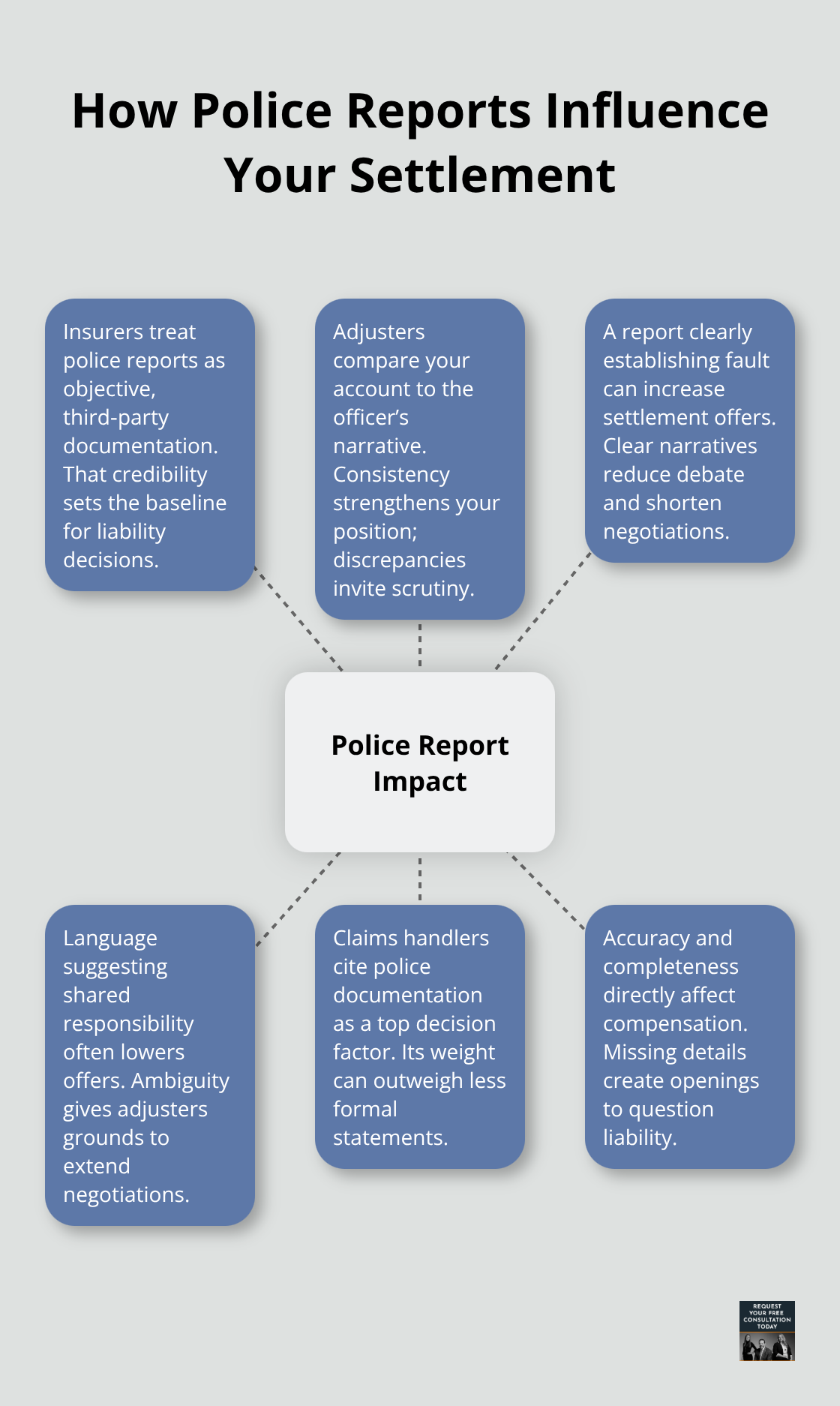
A report that clearly establishes fault in your favor can push settlement offers significantly higher. Conversely, a report that suggests shared responsibility or unclear circumstances gives adjusters reason to lower their offer or extend negotiations. Claims handlers consistently cite police documentation as one of the top three factors in their decisions. This means the accuracy and completeness of the report directly affects your compensation.
What Details Actually Matter in Your Report
Oakland police officers document specific information at the crash scene that becomes critical evidence. They record the date, time, exact location, weather conditions, and road surface conditions-details that establish context for how the crash occurred. Officers also note vehicle damage patterns, which indicate the direction of impact and which vehicle struck first. They collect statements from all parties involved and from witnesses, capturing immediate accounts before memories fade or stories shift. The officer’s own observations about traffic control devices, visibility, and driver behavior appear in the report. Citations issued at the scene carry substantial weight because they suggest the officer’s preliminary assessment of fault. If the other driver received a citation for unsafe speed or failure to yield, that becomes powerful evidence supporting your claim. The report also includes all parties’ insurance information and contact details, which streamlines the claims process. Missing or incomplete information in the report-such as a witness’s statement that wasn’t recorded or road conditions that weren’t documented-creates gaps that adjusters use to question liability.
How Report Inaccuracies Actually Hurt Your Settlement
A police report containing errors doesn’t automatically invalidate your claim, but inaccuracies create obstacles. If the report lists the wrong vehicle color or misidentifies which direction you were traveling, adjusters question whether the officer accurately observed other details. Simple factual errors are easier to correct than disputed conclusions about fault, but both types of mistakes slow down your claim. When witness statements contradict each other in the report, adjusters often interpret the inconsistency as reasonable doubt about what actually happened-and reasonable doubt works against the claimant. If the officer’s narrative suggests you shared fault or bears some responsibility, that language directly reduces your settlement value. Reports that lack specific details about the other driver’s actions-such as no mention of cell phone use or failure to check mirrors-leave room for adjusters to argue that fault wasn’t clearly established. Correcting these errors before settlement negotiations begin strengthens your position significantly.
Taking Action on Your Report
The next step involves obtaining your actual police report and reviewing it for accuracy. You’ll need to know how to request the document from Oakland Police Department and understand what timeline to expect.
Getting Your Oakland Police Report
Choose the Right Submission Method
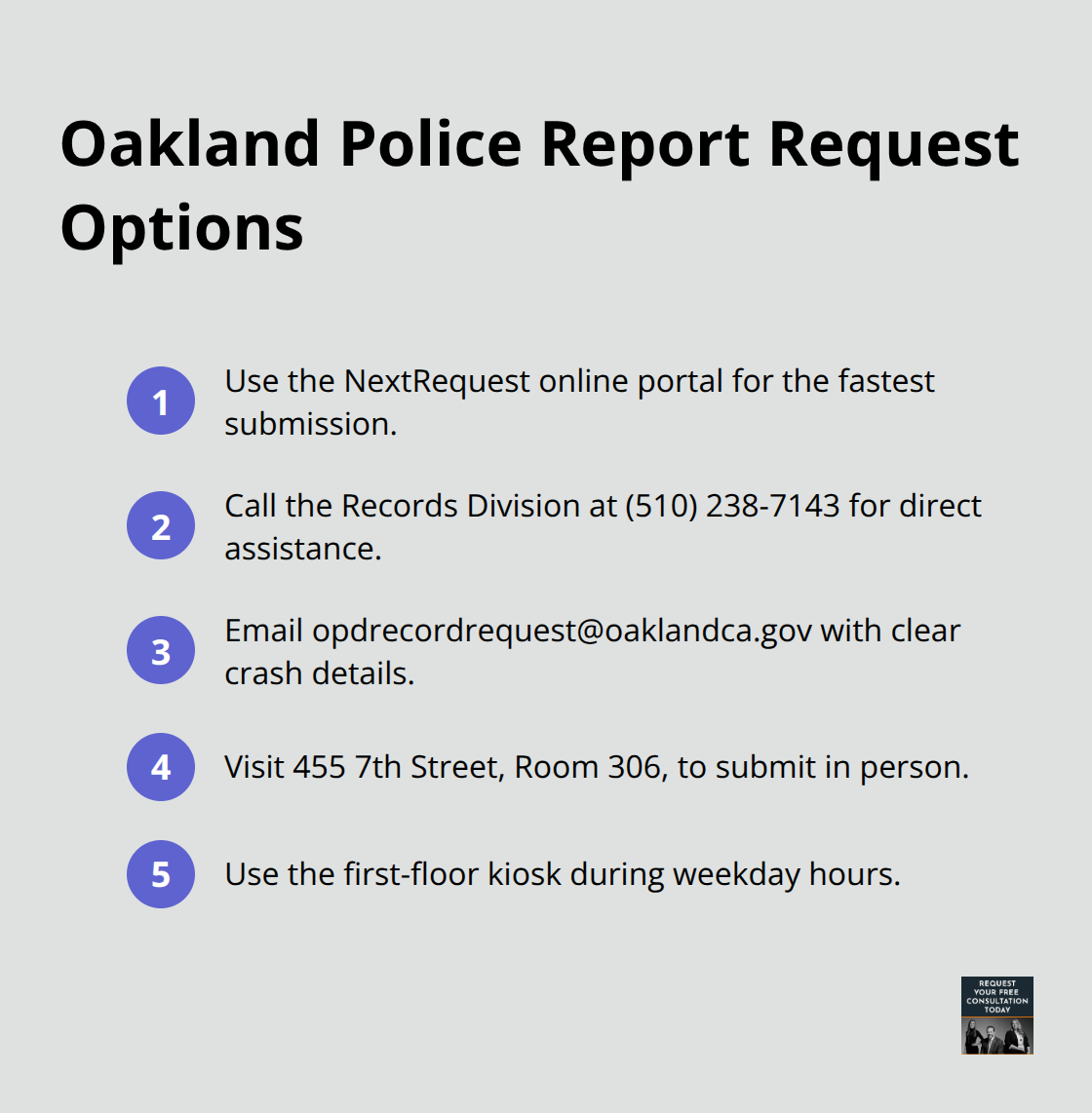
Obtaining your Oakland police report requires knowing which method works fastest for your situation. The Oakland Police Department Records Division processes requests through multiple channels, and selecting the right one saves you days of waiting. The online portal at https://oaklandca.nextrequest.com/requests/new offers the fastest option-you submit your request without visiting an office or making phone calls. If you prefer direct contact, call the Records Division at (510) 238-7143, email opdrecordrequest@oaklandca.gov, or visit in person at 455 7th Street, Room 306. In-person visits work Monday through Friday from 8:00 am to 3:00 pm, and the kiosk on the first floor of the Police Administration Building also accepts requests during those hours.
Provide Specific Details to Speed Up Your Request
When you submit your request, provide as much detail as possible about the crash: the exact date or approximate date if you’re unsure, the specific location, and the names of drivers involved. The more specific your information, the faster the Records Division locates your report. Paper documents cost nothing, but audio or video files on disk cost 5 dollars per disk. The Oakland Police Department typically provides a determination within 10 calendar days of receiving your request, though complex cases may extend to 14 days. Most reports become available within 3 to 5 days after the crash, so waiting too long before requesting actually delays your claim unnecessarily. Request your report immediately after the crash is documented, rather than waiting for the other driver’s insurance company to obtain it.
Maximize the Online Portal Advantage
The online NextRequest portal remains your strongest choice because it creates a timestamped record of your submission and eliminates miscommunication about what you requested. When submitting through the portal, enter the crash date, location, and vehicle information clearly. If you’re uncertain about exact details, provide what you know and let the Records Division staff help you locate the correct report. Mailing requests to PRR Unit, 455 7th Street, Room 306, Oakland, CA 94607 works but introduces delays in postal delivery and processing. Email requests to opdrecordrequest@oaklandca.gov also work, though phone requests may require follow-up confirmation in writing to prevent errors.
Prepare for the Next Step
The Records Division staff can advise you on practical steps to obtain disclosure and help identify where your specific report is located within their system. If your request involves restricted areas or requires physical retrieval of files, scheduling ahead through the phone line prevents unnecessary trips. Once you have your report in hand, the real work begins-you must review it carefully for accuracy and identify any gaps or errors that could weaken your position during settlement negotiations.
Finding and Fixing Police Report Errors
Police reports contain mistakes more often than people realize, and most of these errors directly reduce your settlement value. The Oakland Police Department documents hundreds of crashes monthly, and officers working under time pressure occasionally misrecord details, miss witness statements, or mischaracterize fault. Simple errors like listing the wrong vehicle color or transposing street names seem minor until an insurance adjuster uses them to question the officer’s overall accuracy. When an adjuster doubts the credibility of the report, they lower their settlement offer or demand additional evidence to support your claim.
Identify Serious Errors That Cost You Money
More serious mistakes involve the officer’s narrative suggesting shared fault when you bore no responsibility, or omitting critical details about the other driver’s actions that would clearly establish liability. These substantive errors can cost you thousands in reduced compensation. The challenge is that many people never review their police report thoroughly, so errors go uncorrected until settlement negotiations stall and it becomes harder to challenge what’s already in the official record.
Review Your Report Immediately After Receipt
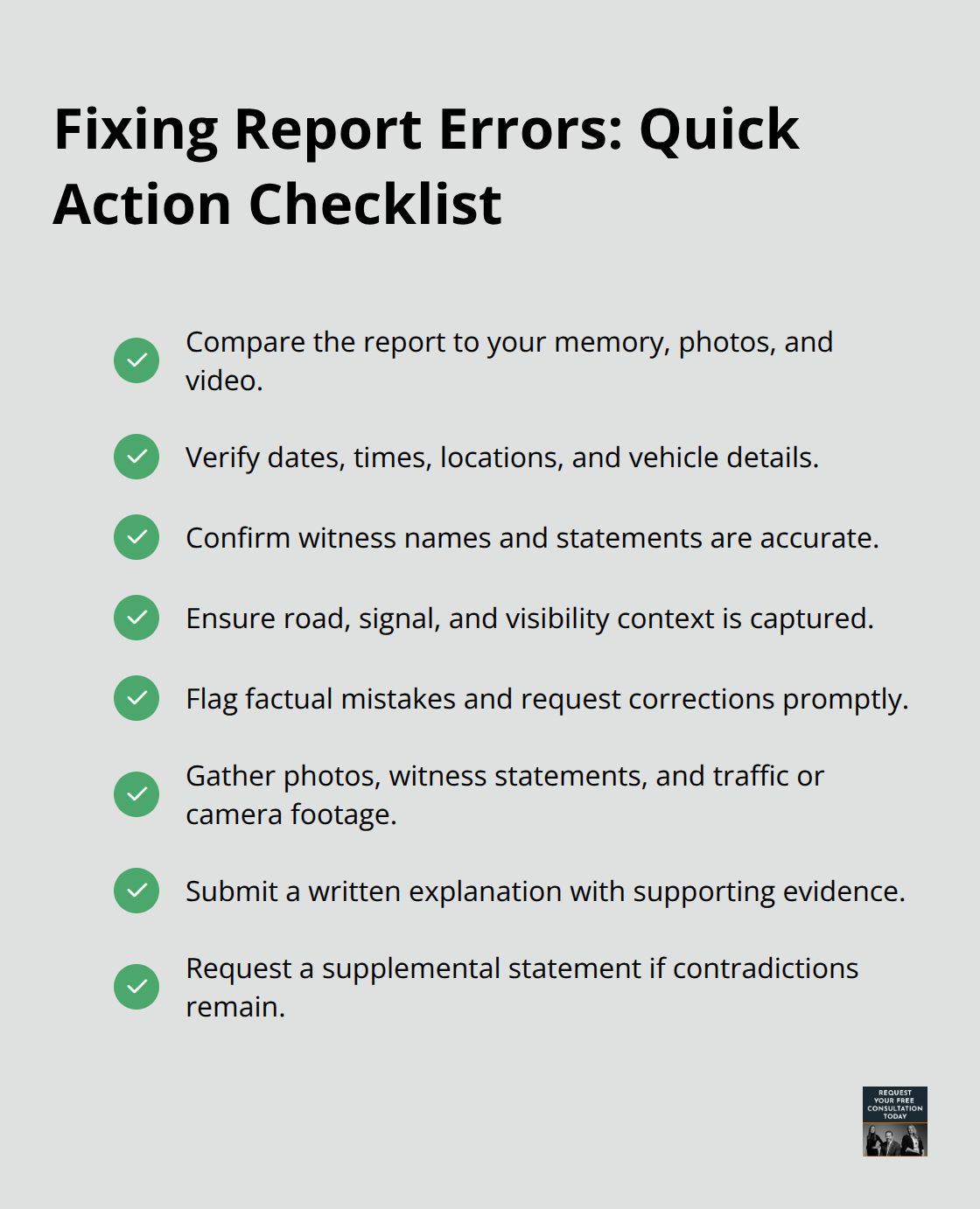
Start reviewing your report immediately after obtaining it, comparing the documented facts against your own memory and any photos or video you captured at the scene. Look specifically for discrepancies in dates, times, locations, vehicle descriptions, and the names or statements of witnesses. Check whether the officer accurately described how the crash occurred and whether they captured the full context of road conditions, traffic signals, and visibility. If you notice a factual error like an incorrect address or wrong vehicle year, contact the Oakland Police Department Records Division at (510) 238-7143 and request that the error be corrected.
Prioritize Simple Factual Corrections First
Simple factual mistakes require less evidence to fix than disputed conclusions about fault, so prioritize these corrections first. For contested details where the officer’s account contradicts yours, gather supporting evidence such as photographs showing vehicle damage patterns, witness contact information with their statements documented separately, or traffic camera footage if available. Submit this evidence to the Records Division along with a written explanation of why the report contains inaccuracies.
Request Supplemental Statements When Necessary
The department will not revise fault determinations or officer observations without compelling evidence, but if your supporting documentation clearly contradicts what’s in the report, request that your own account be attached as a supplemental statement. This supplemental approach creates an official record showing your version exists alongside the officer’s narrative, which strengthens your position during settlement discussions or litigation. The Records Division staff can advise you on what documentation they require to process your correction request efficiently, ensuring your submission meets their standards rather than facing rejection for insufficient evidence.
Final Thoughts
Your Oakland police report forms the foundation of your claim, and how you handle it determines whether you receive fair compensation or face unnecessary delays. Insurance adjusters rely heavily on police reports to make their initial decisions about liability and settlement value, so a clear, accurate report works in your favor while an incomplete or error-filled report gives adjusters reasons to lower their offer. After you obtain and review your report, address any errors through the Oakland Police Department Records Division, then compile your documentation alongside photographs, witness statements, or video evidence you gathered at the scene.
We at Schaar & Silva LLP recognize that navigating the claims process while recovering from an accident is overwhelming. Our team handles the legal complexities so you can focus on healing, and we assist with property damage claims, help direct you to medical lien services for bill assistance, and connect you with specialists for emotional support. If your claim faces resistance from an insurance company or if errors in your police report prevent fair settlement, contact us for guidance on your next steps.
