
An accident with an uninsured driver can leave you facing medical bills, vehicle repairs, and lost wages with no clear path to recovery. California law requires insurers to offer uninsured motorist coverage, yet many Oakland residents don’t understand what it covers or how to use it.
At Schaar & Silva LLP, we’ve helped countless accident victims navigate these claims and recover the compensation they deserve. This guide walks you through your UM and UIM options, the filing process, and how to build a strong demand letter.
What is Uninsured Motorist Coverage in California
An accident with an uninsured driver leaves you facing medical bills, vehicle repairs, and lost wages with no clear path to recovery. California law requires insurers to offer uninsured motorist coverage, yet many Oakland residents don’t understand what it covers or how to use it.
Definition and How UM Coverage Works
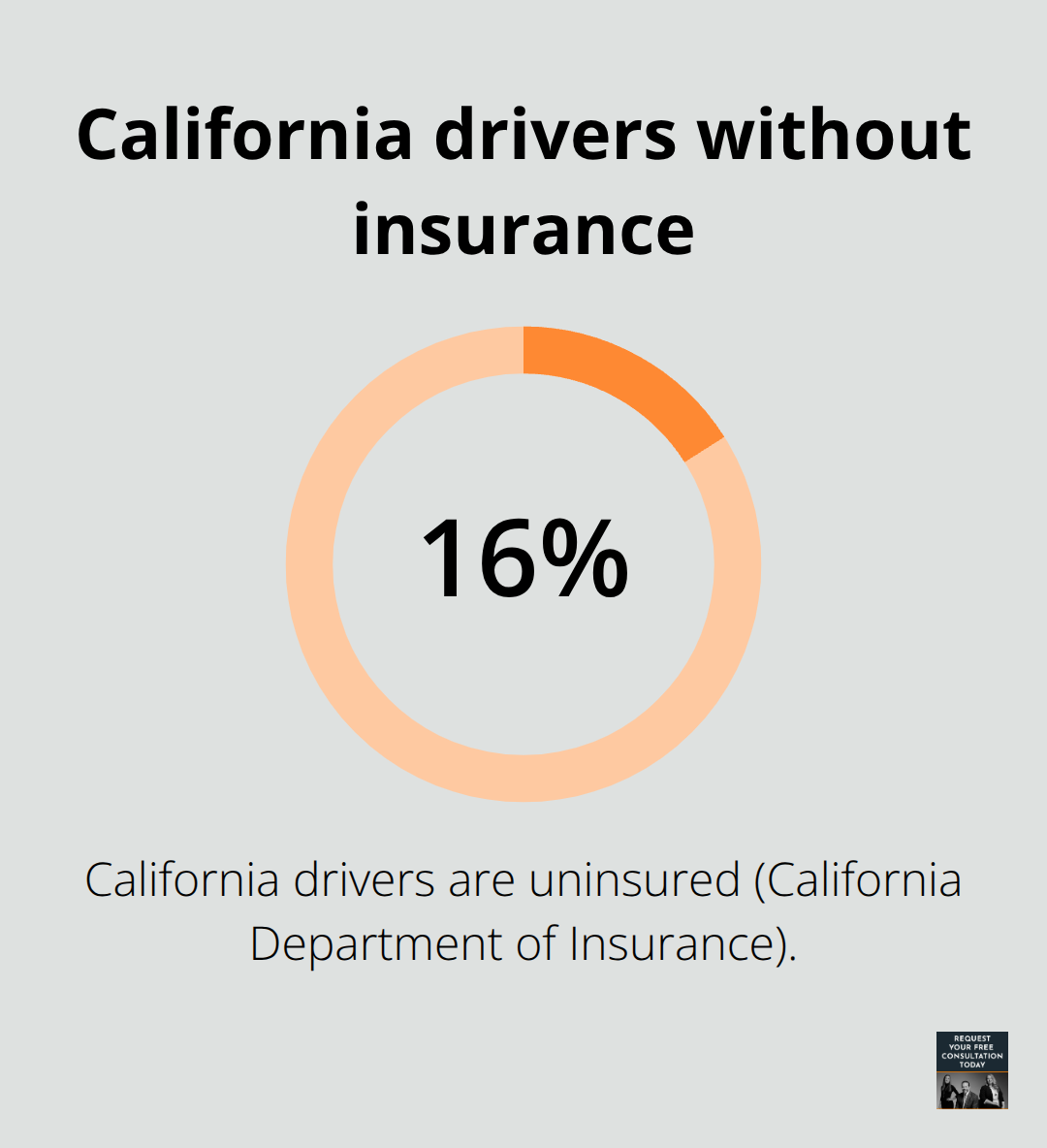
Uninsured motorist coverage protects you when the at-fault driver has no insurance at all. In California, insurers must offer this coverage to every policyholder, though you can decline it in writing. According to the California Department of Insurance, approximately 16% of California drivers are uninsured, and about half of all auto accidents involve uninsured or underinsured drivers. This means your chances of facing an uninsured motorist are genuinely high, especially on Oakland’s congested highways and city streets.
When you carry uninsured motorist coverage, your own policy steps in to cover your medical expenses, lost wages, property damage, and pain and suffering-up to your policy limits. Without it, you absorb these costs yourself, which can easily reach tens of thousands of dollars. Your liability coverage pays for damage you cause to others. Uninsured motorist coverage works in reverse: it pays for damage others cause to you when they lack insurance.
How UM Differs from Your Regular Liability Insurance
If you cause a crash and your liability limits are $30,000, you remain personally responsible for anything above that amount. But if an uninsured driver hits you and you have $100,000 in uninsured motorist coverage, your policy covers your injuries up to that limit, regardless of what the other driver doesn’t have. California’s minimum liability limits are $30,000 per person and $60,000 per accident for bodily injury, plus $15,000 for property damage. These minimums are often inadequate for serious accidents.
Uninsured motorist bodily injury coverage mirrors your liability limits, so if you carry higher limits, your UM protection increases proportionally. This is why carrying UM coverage at levels matching or exceeding your liability limits matters far more than the legal minimum. The distinction between these two coverages determines who pays when an accident occurs-and that difference can mean financial ruin or full recovery.
California’s Coverage Requirements and Minimum Limits
California law mandates that insurers offer uninsured motorist coverage at the same limits as your bodily injury liability coverage. The minimum UM limits in California are $30,000 per person and $60,000 per accident, but many accident victims find these amounts insufficient for serious injuries. An ambulance ride alone costs around $3,070 in some California regions, and medical treatment following a significant accident quickly exhausts modest coverage limits.
If you decline UM coverage, you must sign a written waiver acknowledging you understand the risks. This waiver proves you made an informed choice to go without protection. Uninsured motorist property damage coverage is separate and limited to $3,500, though it only applies if you identify the uninsured driver. Hit-and-run accidents often fall under UM claims since the at-fault driver remains unidentified, making this distinction important for Oakland residents in high-traffic areas.
We at Schaar & Silva LLP strongly recommend carrying UM limits equal to your liability coverage and considering additional umbrella coverage for serious accident scenarios. Understanding these coverage types sets the foundation for knowing what steps to take after an accident occurs.
Steps to File a UM Claim in Oakland
Act Immediately After the Accident
An uninsured driver’s impact on your finances happens fast, but your response determines your recovery. California law gives you two years from the accident date to file a personal injury lawsuit, yet waiting weakens your position. Call the police at the scene and request a report number-this document becomes your foundation for proving the other driver carried no insurance. Photograph everything: vehicle damage, accident location, street signs, traffic lights, the other driver’s vehicle, and their license plate. Collect the other driver’s name, phone number, address, and vehicle information directly. Ask witnesses for statements while their memories remain sharp, and record their contact details. Seek medical attention immediately, even for minor injuries, because delayed medical records undermine UM claims. Insurance adjusters scrutinize gaps between accident and treatment, so document every medical visit, prescription, and therapy session meticulously.
Verify Uninsured Status and Document Losses
The California Department of Insurance requires you to verify the other driver’s uninsured status using DMV forms 1A and SR19, which confirm whether they carried valid insurance. This verification proves critical because insurers will challenge your claim if you haven’t established the driver was truly uninsured. Keep receipts for vehicle repairs, rental cars, medications, and travel to medical appointments. Maintain detailed records of accident details, the police report, medical expenses, lost wages, property damages, and evidence of the other driver’s uninsured status. These documents form the backbone of your demand letter and settlement negotiations.
Report to Your Insurer Within the Required Timeframe
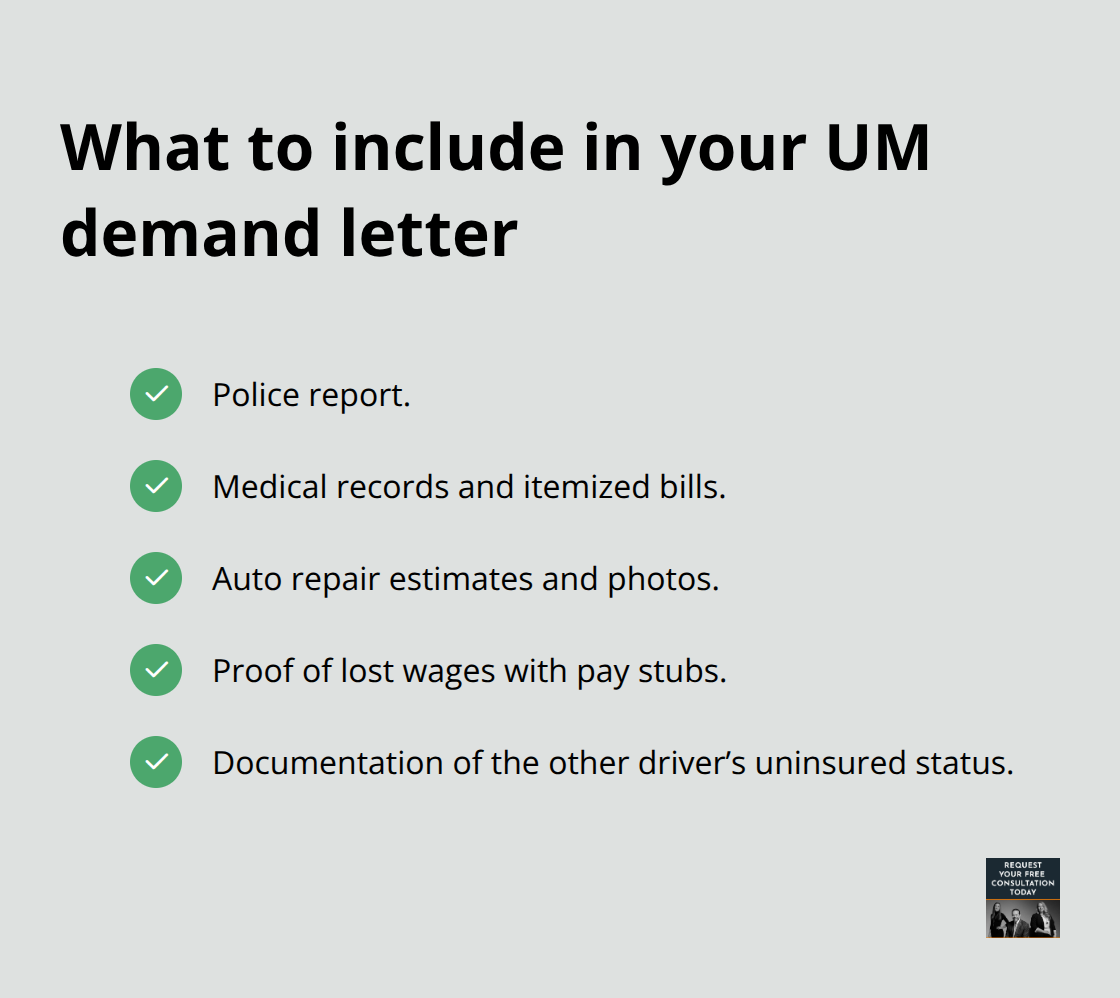
Report your accident to your own insurance company within the timeframe specified in your policy (typically 30 days). Provide your claim number and maintain records of every conversation, including dates, times, and names of adjusters. When you present your demand letter, include your police report, medical records, repair estimates, proof of lost wages, and documentation of the other driver’s uninsured status. Your demand letter should specify total medical expenses, lost income with pay stubs showing amounts, property damage with repair quotes, and pain and suffering calculated as a multiple of your economic damages.
Craft a Strong Demand Letter
Insurance companies often start with lowball offers, so present a demand at least 25–50% higher than your actual damages to leave room for negotiation. Include a deadline for response (typically 30 days), after which you indicate your intention to pursue arbitration or litigation. State your policy limits clearly and reference the specific coverage sections in your policy. Write factually and avoid emotional language, but remain firm about your damages. If the insurer denies your claim or offers inadequate compensation, you have the right to arbitration under California law, which often resolves disputes outside court without lengthy trials.
Know When to Escalate Your Claim
Delaying these steps allows insurers to argue your injuries were minor or unrelated to the accident, so act promptly throughout the process. When settlement negotiations stall or the insurer’s offer falls short of your documented losses, the next phase of your claim requires specialized legal guidance. Understanding underinsured motorist coverage becomes equally important at this stage, particularly if the at-fault driver carried some insurance but insufficient limits to cover your full damages.
Underinsured Motorist Coverage and When You Need It
How UIM Coverage Works
Underinsured motorist coverage steps in when the at-fault driver carries insurance but insufficient limits to cover your actual damages. This situation occurs far more frequently than most Oakland residents realize. According to the California Department of Insurance, roughly one in three California drivers are uninsured or underinsured, meaning the driver who hits you might have only $15,000 in liability coverage while your medical bills, lost wages, and vehicle repairs total $75,000. Your UIM coverage bridges that gap up to your policy limits.
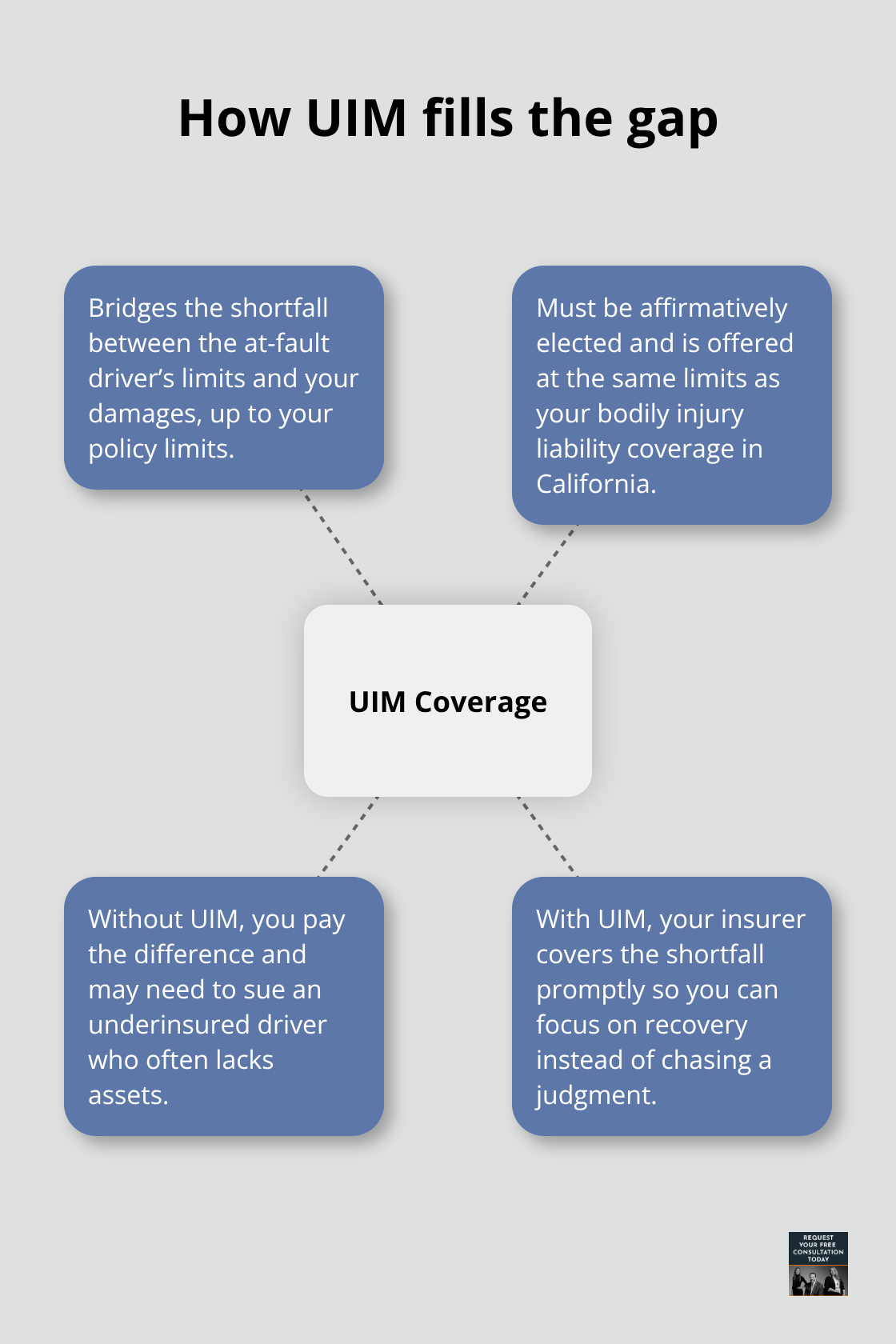
California law requires insurers to offer UIM at the same limits as your bodily injury liability coverage, though you must actively elect it rather than decline it in writing. The distinction matters enormously: without UIM, you absorb the difference from your own pocket and must pursue a lawsuit against the underinsured driver personally, which often proves fruitless since they lack sufficient assets. With UIM, your own policy covers the shortfall immediately, allowing you to focus on recovery rather than chasing a judgment against someone with no money.
Real Scenarios Where UIM Protects You
Imagine you carry $100,000 in liability coverage and the at-fault driver carries only $30,000. Your damages total $85,000 in medical expenses and lost income. The at-fault driver’s insurer pays their $30,000 limit, leaving you $55,000 short. Your UIM coverage pays up to $55,000 (the difference between your $100,000 limit and the $30,000 paid by their insurer), covering your full loss. Without UIM, that $55,000 gap becomes your responsibility.
Oakland’s congested streets and highways make underinsured drivers a constant threat. A single serious accident can generate medical bills exceeding $100,000, yet many drivers carry minimum liability limits of $15,000 to $30,000. UIM protection becomes your financial safety net in these situations.
Calculating Your Recovery Potential
When calculating your recovery potential, add your medical expenses, lost wages with documented pay stubs, property damage with repair estimates, and pain and suffering valued as a reasonable multiple of your economic damages. Insurance companies typically challenge UIM claims aggressively, denying them outright, disputing medical necessity, or assigning partial fault to you to reduce their payout. This resistance makes legal representation invaluable during negotiation and arbitration phases.
California’s statute of limitations for UIM claims is two years from the accident date, though this timeline can shift if injuries emerge later, making immediate legal consultation essential. Insurance adjusters often start with lowball offers, so present documentation of your full damages to support a stronger negotiating position. Keep detailed records of all medical treatment, repair estimates, and wage loss documentation to substantiate your claim amount.
Final Thoughts
Uninsured motorist coverage protects your financial stability when an at-fault driver lacks insurance, and underinsured motorist coverage fills the gap when their limits fall short of your actual damages. Oakland uninsured motorist claims happen frequently enough that carrying adequate UM and UIM protection at levels matching your liability coverage represents sound financial planning rather than optional add-ons. California’s requirement that insurers offer these coverages means you face a deliberate choice to accept or decline protection, making informed decisions essential.
The filing process demands immediate action and meticulous documentation. Report your accident to police, gather evidence at the scene, verify the other driver’s uninsured status through DMV forms, and notify your insurer within your policy’s timeframe. Your demand letter should present complete documentation of medical expenses, lost wages, property damage, and pain and suffering calculations, since insurance companies routinely deny or undervalue UM and UIM claims through tactics like disputing medical necessity or assigning partial fault.
Legal representation strengthens your position significantly because an attorney reviews your policy to confirm coverage, investigates the accident to establish liability, negotiates with your insurer to maximize compensation, and files lawsuits when necessary. The California statute of limitations gives you two years from the accident date to pursue legal action, but waiting weakens your claim as evidence fades and memories blur. We at Schaar & Silva LLP help accident victims navigate UM and UIM claims and recover the compensation they deserve-contact us for a free consultation to discuss your claim and understand your legal options after an accident.
