

A Sacramento truck accident can leave you facing serious injuries, property damage, and complex legal questions. Federal regulations, state negligence laws, and insurance procedures all play a role in determining who’s responsible and what compensation you deserve.
We at Schaar & Silva LLP have helped accident victims navigate these challenges. This guide walks you through liability rules, evidence collection, and the legal steps ahead.
Who Is Liable in a Sacramento Truck Accident
Federal Regulations Create Clear Standards for Liability
Truck accidents in Sacramento involve multiple layers of regulation and potential defendants. The Federal Motor Carrier Safety Administration sets strict standards through the Code of Federal Regulations, and drivers must comply with hours-of-service rules, vehicle maintenance requirements, and cargo securement standards. When a driver violates these federal rules, it creates evidence of negligence. Electronic logging device data that shows a driver exceeded the 11-hour daily driving limit directly supports your liability claim. California negligence law requires proving that the defendant owed you a duty of care, breached that duty, and caused your damages. In truck cases, this means identifying not just the driver but also the trucking company, maintenance providers, cargo loaders, or vehicle manufacturers who failed to meet their responsibilities.
Major Causes Point to Specific Defendants
The FMCSA publishes annual Large Truck and Bus Crash Facts, and recent data shows that brake failures, driver fatigue, and improper cargo securement rank among the leading causes of commercial vehicle crashes. Sacramento sits on major freight corridors including I-5, I-80, and SR 99, where high truck volume increases accident frequency and the complexity of determining fault.
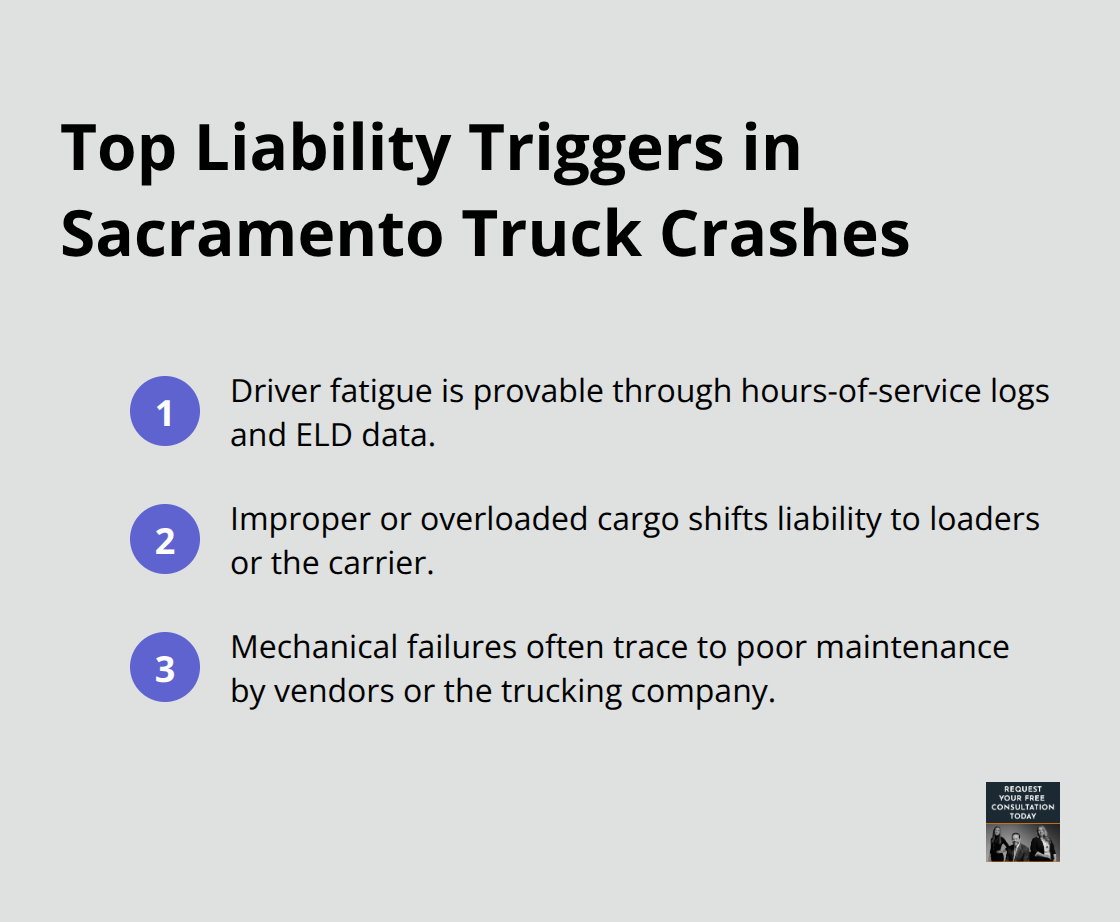
Driver fatigue stands out as one of the most provable violations in Sacramento truck accidents. Hours-of-service violations leave a clear paper trail through logbooks and ELD data, making it straightforward to prove negligence. Overloaded or improperly secured cargo destabilizes trucks and reduces braking efficiency, creating rollover and brake-failure risks that shift liability to cargo loaders or the carrier. Mechanical failures such as brake problems or tire blowouts often trace back to inadequate maintenance, pointing liability toward maintenance vendors or the trucking company.
Geographic and Operational Risk Factors
Reckless driving, speeding, and distracted driving reflect employer pressure and unsafe corporate practices, which means the carrier shares liability for prioritizing speed over safety. The Grapevine segment of I-5 and Cajon Pass on I-15 present steep grades where brake failures occur more frequently, and poor road conditions or missing signage may implicate state or local agencies. Multiple defendants typically appear in Sacramento truck cases, which increases potential compensation but demands specialized legal knowledge to navigate.
How Evidence Reveals Fault
Accident reconstruction experts analyze vehicle damage, skid marks, and event data recorders to pinpoint exactly how the crash occurred and who caused it. This evidence directly influences settlement negotiations and litigation strategy.
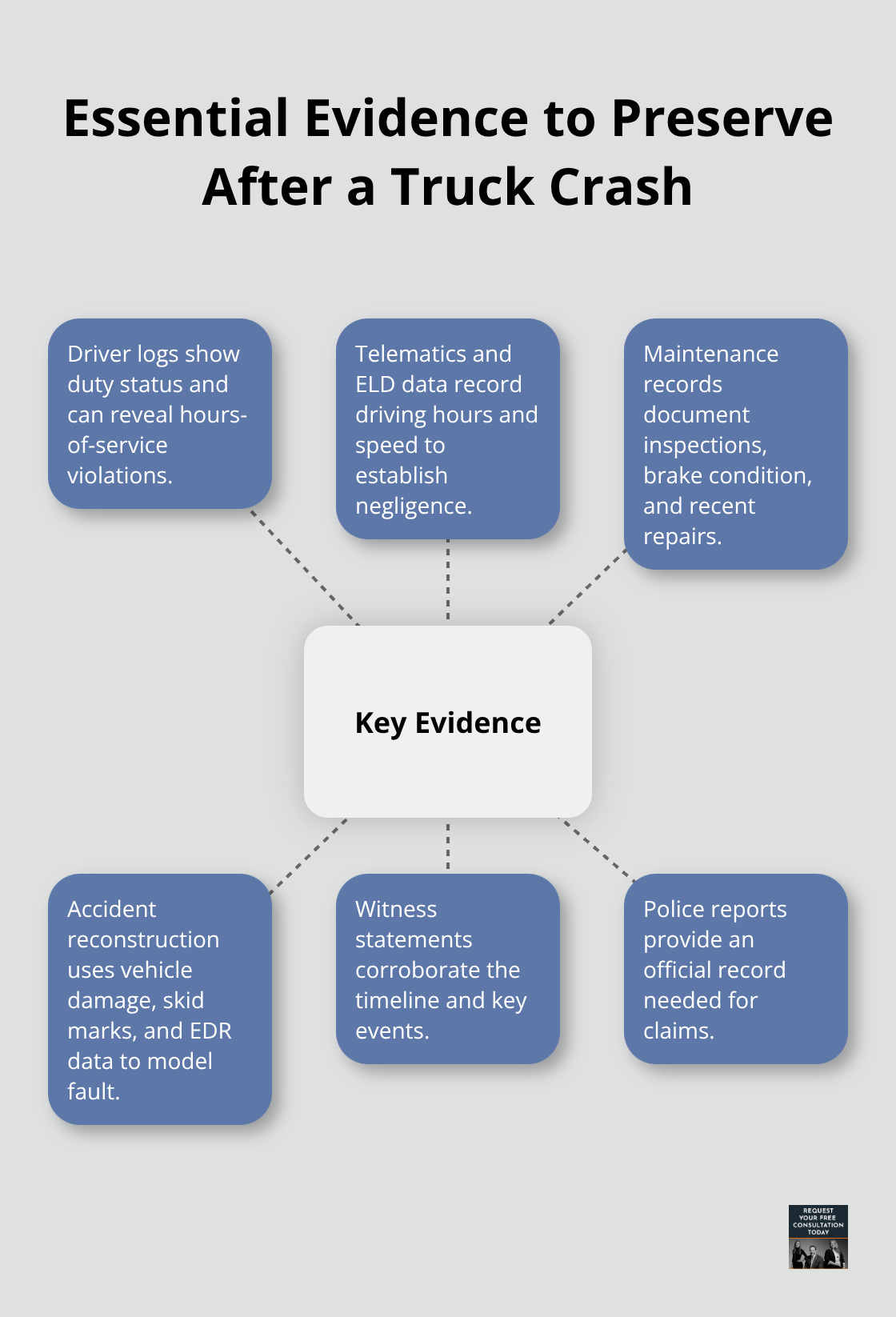
The investigation process requires preserving driver logs, telematics data, and maintenance records immediately after the accident-details that become critical when multiple parties share responsibility for your injuries.
What Evidence Matters Most After a Sacramento Truck Accident
Act Quickly at the Scene
The first hours after a truck accident determine whether you’ll have strong evidence or a weakened claim. Photograph everything at the scene: the truck’s position, cargo condition, road markings, traffic signals, weather, and all vehicle damage from multiple angles. Obtain the truck driver’s name, company, license number, and insurance details directly. Collect contact information from at least three witnesses and document their accounts of what happened while memory remains fresh. Police reports filed in Sacramento typically arrive within 10 business days, and you need that report number for insurance claims. Avoid discussing fault or liability with the truck driver, company representative, or insurance adjuster at the scene.
Preserve Critical Data Before It Disappears
The FMCSA requires that electronic logging device data, which records driving hours and vehicle speed, be preserved within 30 days after a crash. Contact the trucking company immediately to prevent data destruction. Request preservation of driver logs, maintenance records, and telematics data in writing. Brake fluid samples, tire condition, and vehicle inspection records from the weeks before the accident reveal mechanical negligence that shifts liability to maintenance providers or the carrier. These documents don’t exist forever, and delays cost you leverage in negotiations.
Select the Right Tow Service and Inspectors
Local Sacramento tow companies often maintain direct relationships with truck fleets and insurance companies, so choose a tow service that photographs the scene independently and secures the vehicle at a neutral facility, not the defendant’s preferred location. Epika offers DOT inspections in Sacramento and coordinates with certified inspectors trained to FMCSA standards, which helps establish whether mechanical failures contributed to the crash. Independent inspection data strengthens your position when multiple defendants share responsibility.
Document Your Injuries and Losses
Your medical records, emergency room reports, and ongoing treatment documentation quantify your damages and form the foundation of your compensation claim. Insurance companies in Sacramento receive thousands of claims annually and move quickly to settle low-value cases; your documentation either supports a higher valuation or forces them to defend a weak position.
Hire Legal Representation Before Settlement Talks Begin
Hire a lawyer before the insurance company contacts you, because initial statements made without legal guidance often limit your recovery. We at Schaar & Silva LLP recommend preserving evidence systematically and refusing early settlement offers that don’t account for future medical costs or lost wages. The investigation process requires specialized knowledge of FMCSA regulations and Sacramento’s freight corridors to identify all responsible parties and maximize your claim value.
Moving Your Claim Forward After a Truck Accident
Insurance Companies Move Fast-You Need to Move Faster
The trucking company’s insurer will contact you within 48 to 72 hours after a Sacramento truck accident, and their first goal is to gather a statement that limits your claim value. Never speak to an insurance adjuster without legal representation, because anything you say becomes part of the official record and can be used to reduce your settlement. When you file your claim, provide only factual information: the date, time, location, and parties involved. Do not speculate about how the accident happened or accept blame for any portion of it.
Your medical records, police report, photographs, and witness statements form the foundation of your claim file. Submit these documents in an organized package that demonstrates the severity of your injuries and the defendant’s liability. The insurance company will assign a claims adjuster who may seem friendly and reasonable, but their job is to minimize what they pay, not to compensate you fairly.
Early Settlement Offers Undervalue Your Damages
Wait at least 30 days after the accident before discussing settlement, because early offers typically undervalue long-term medical costs, lost wages, and pain and suffering by 40 to 60 percent compared to what the case is actually worth. Insurance companies in Sacramento receive thousands of claims annually and move quickly to settle low-value cases; your documentation either supports a higher valuation or forces them to defend a weak position.

Negotiation with insurance companies requires understanding their settlement formula and refusing lowball offers that don’t account for your actual damages. Sacramento truck accident claims settle faster when you have a lawyer on file, because insurers know that litigation costs them far more than a reasonable settlement.
Litigation Becomes Necessary When Insurers Refuse Fair Offers
If the insurance company refuses to negotiate fairly or denies your claim outright, litigation becomes necessary to recover what you deserve. Court cases take 18 to 36 months in Sacramento County, but that timeline gives you leverage to reject inadequate settlement proposals early in the process.
Pursuing litigation means the defendant’s legal team will challenge your evidence, question your medical treatment, and argue that you bear some responsibility for the accident. You need an attorney experienced in FMCSA regulations and accident reconstruction to counter these tactics effectively. The decision to litigate depends on the severity of your injuries, the strength of liability evidence, and whether the insurance company’s settlement offer covers your documented losses and projected future medical needs.
Local Representation Matters for Sacramento Cases
For Sacramento truck accident claims, consult with a local firm that understands the freight corridors, local court procedures, and the specific carriers operating in your area. A lawyer familiar with I-5, I-80, and SR 99 traffic patterns and the carriers that use these routes will identify all responsible parties more effectively than an attorney unfamiliar with regional operations.
Final Thoughts
A Sacramento truck accident demands immediate action on evidence collection, swift legal representation, and a clear understanding of federal regulations that govern liability. The investigation process reveals fault through driver logs, electronic data, maintenance records, and accident reconstruction-details that separate strong claims from weak ones. Multiple defendants typically share responsibility, which increases your potential recovery but requires specialized legal knowledge to navigate effectively.
Your role after the accident is straightforward: photograph the scene, preserve all data within 30 days, refuse early settlement offers, and hire a lawyer before the insurance company contacts you. The trucking company’s insurer will move fast to minimize what they pay, and you need legal representation to counter their tactics and demand fair compensation for your injuries, lost wages, and medical costs. Contact Schaar & Silva LLP today for a consultation, because the sooner you secure legal representation, the sooner we can begin preserving evidence and building your case.
Your recovery depends on taking action now, not waiting for the insurance company to dictate the terms of your settlement. We at Schaar & Silva LLP work with you to identify all responsible parties, challenge inadequate settlement offers, and pursue litigation when insurers refuse to negotiate fairly. Our experience with FMCSA regulations, local freight corridors, and Sacramento County court procedures gives you the advantage you need to maximize your recovery.
