

A concussion from a car accident can change your life in seconds, leaving you with headaches, memory problems, and medical bills that pile up fast.
If you’ve suffered a concussion in an auto accident, you’re probably wondering what your case is worth and how long the settlement process takes. We at Schaar & Silva LLP help accident victims in Santa Cruz, Sacramento, and Oakland understand their rights and get fair compensation.
This guide walks you through everything you need to know about concussion auto accident settlements.
What Happens to Your Brain in a Car Crash
How Impact Forces Trigger Brain Injury
A concussion is a type of traumatic brain injury caused by a sudden blow or violent movement that makes your brain shift inside your skull. In car accidents, this happens in multiple ways: a direct impact to your head against the steering wheel or dashboard, whiplash that jerks your head backward and forward, or rotational forces when your vehicle spins. The National Highway Traffic Safety Administration reports that about 1 in 61 occupants in tow-away crashes sustain a mild traumatic brain injury, though the actual number is likely higher because many people don’t recognize they’re concussed. You don’t need to lose consciousness to have a concussion-in fact, most people with concussions remain awake during the accident. What matters is that the impact or movement causes your brain to move within your skull, disrupting normal function.
When Symptoms Appear and Why Timing Matters
Symptoms appear immediately or hours to days after the crash, and this delayed onset is why many accident victims miss early medical care. Headaches, dizziness, brain fog, memory problems, difficulty concentrating, fatigue, blurred vision, nausea, and mood changes are standard warning signs. Some people experience sleep disturbances or sensitivity to light and noise.
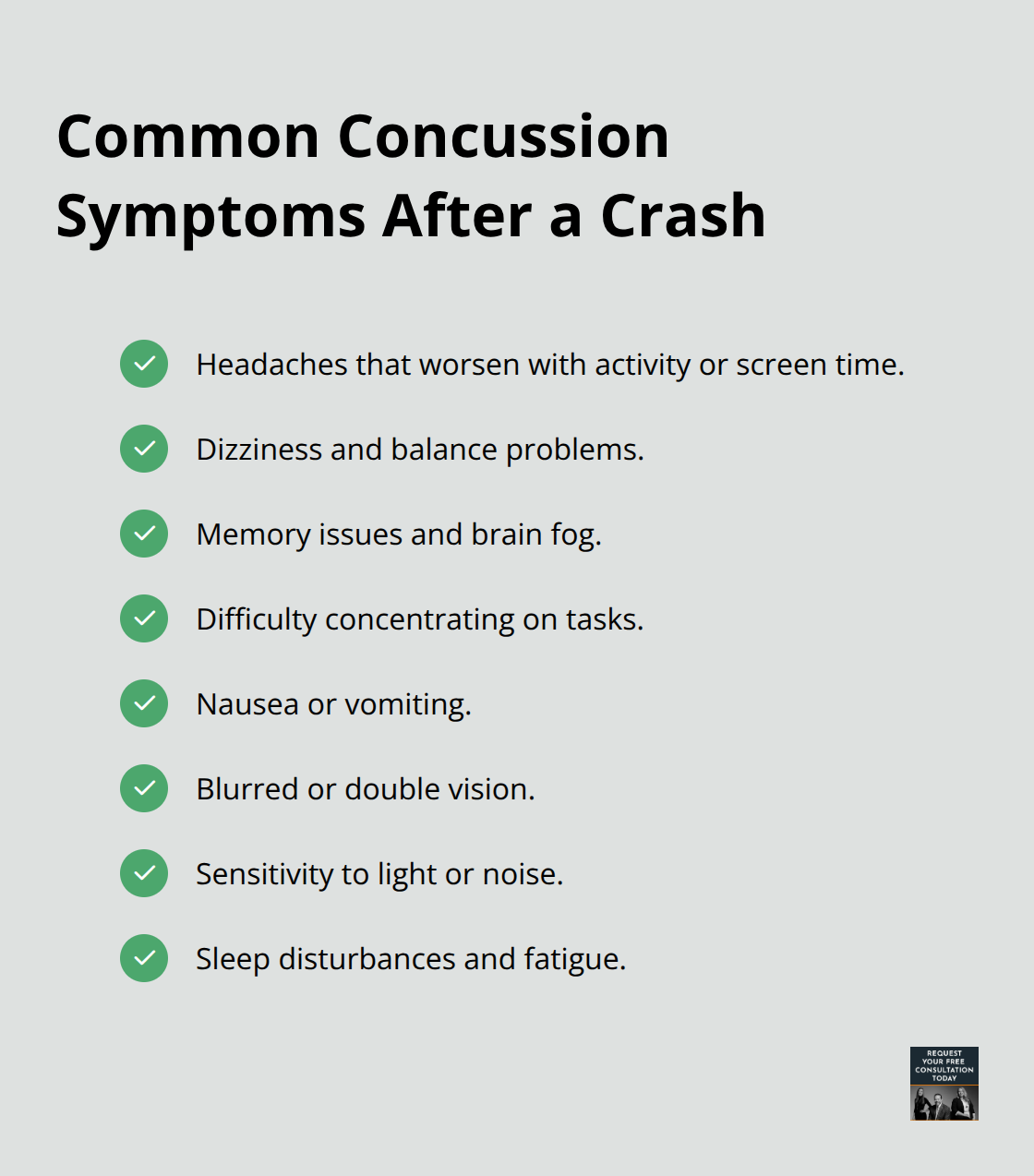
The Centers for Disease Control and Prevention emphasizes that seeking medical evaluation within the first 24 to 48 hours after a head impact is critical because the brain can swell or bleed silently over hours, and early documentation strengthens your settlement claim.
Why Rest Alone Isn’t Enough
A common misconception is that a concussion is minor or that rest alone will fix lingering symptoms. Research from Archives of Physical Medicine and Rehabilitation found that most mild traumatic brain injury symptoms persist for a year or more in many patients, making active, multidisciplinary rehabilitation far more effective than rest alone. Another dangerous myth is that you can wait to see if symptoms go away before visiting the hospital. That delay creates a gap in your medical timeline that insurance adjusters exploit to argue your injury wasn’t serious.
Taking Action Immediately After Your Accident
Go to an emergency room or urgent care immediately after any head impact in a Santa Cruz, Sacramento, or Oakland accident-even if you feel fine. Collect copies of imaging reports, CT scans, and initial assessments before leaving the medical facility; these documents form the foundation of your settlement claim. Follow up with a neurologist or concussion clinic within one to two weeks, and insurance adjusters scrutinize gaps in your medical timeline, so schedule and attend every follow-up appointment to demonstrate ongoing impact. The strength of your settlement depends on how thoroughly you document your injury from day one, which is why understanding what factors influence your settlement amount becomes your next priority.
What Determines Your Settlement Value
Medical Documentation Forms Your Foundation
Your settlement amount hinges on three concrete factors: what you’ve documented medically, how your injury affects your future, and how much insurance coverage is actually available. Medical records are the foundation of everything. The Insurance Services Office reports that average auto liability claim payouts sit around $18,417, but concussion cases vary wildly depending on your medical documentation.
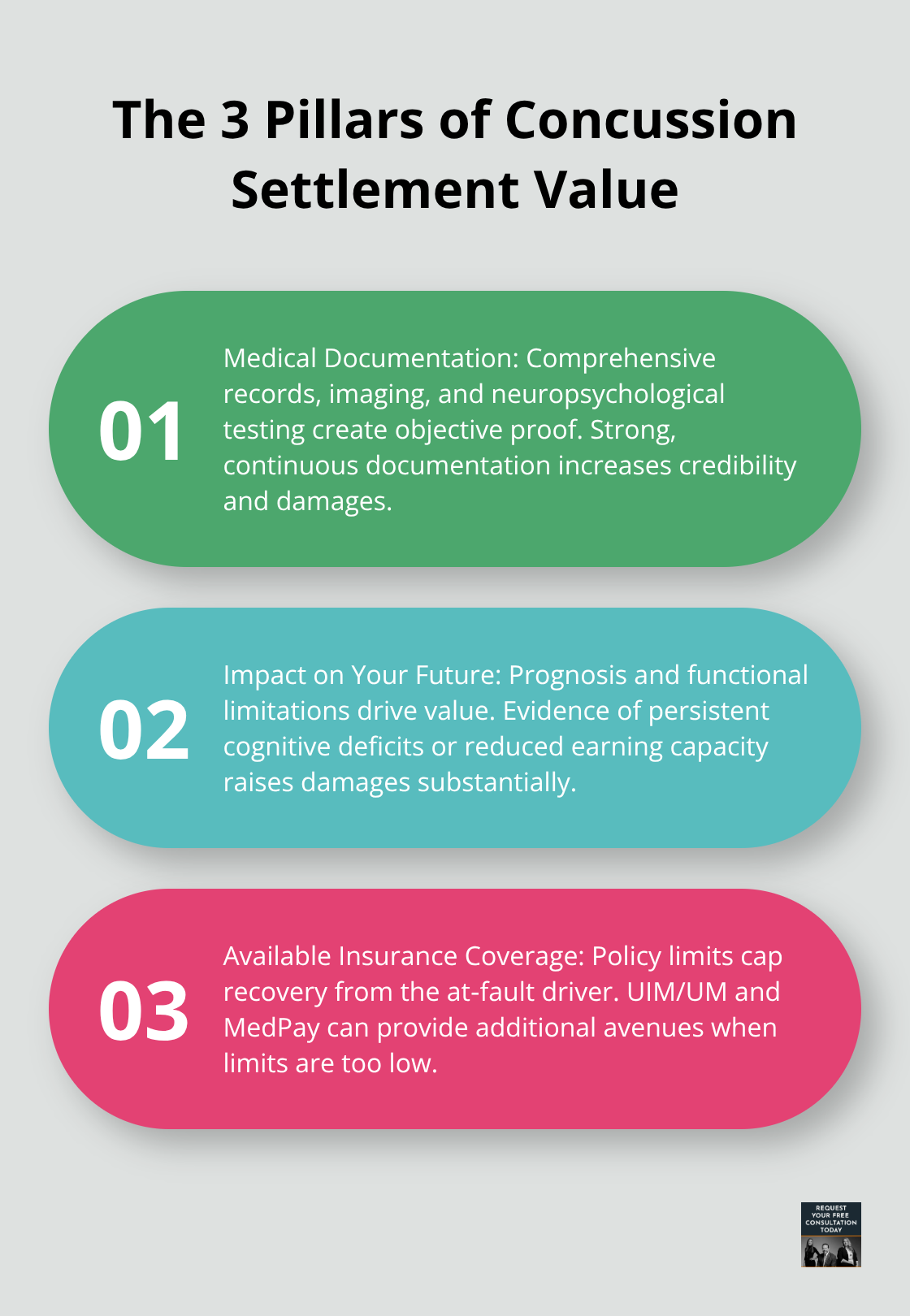
Start collecting every receipt, imaging report, and treatment note the day of your accident. A neuropsychological test showing cognitive decline is worth far more than your word alone. If you have CT or MRI scans, keep them. If a neurologist examined you, get that report in writing. Gaps in your medical timeline are red flags to insurance adjusters-they’ll argue your injury wasn’t serious if you waited weeks between the crash and your first doctor visit. The more thorough your medical file, the higher your settlement tends to be.
Medical Expenses Set Your Settlement Baseline
Medical expenses themselves anchor your settlement’s baseline value. If you spent $50,000 on emergency care, imaging, neurologist visits, and rehabilitation, your pain-and-suffering damages are calculated as a multiplier of those costs, typically ranging from 2 to 5 times your medical expenses depending on symptom duration and severity. That means $50,000 in medical costs could justify $100,000 to $250,000 in total settlement value. Insurance adjusters scrutinize every bill, so organize your costs by category (emergency care, diagnostic imaging, specialist visits, therapy) to make your damages clear and defensible.
Long-Term Prognosis Significantly Increases Value
Long-term prognosis matters enormously. If your neurologist’s notes state you’ll recover fully in six weeks, your settlement will be modest. If the prognosis indicates persistent cognitive deficits, chronic headaches, or reduced earning capacity, the value climbs significantly. A 2014 study in Archives of Physical Medicine and Rehabilitation showed most mild traumatic brain injury symptoms persist for a year or more in many patients, so document every ongoing symptom and how it affects your work and daily life. Neuropsychological testing provides objective evidence of cognitive changes by measuring memory, attention, processing speed, and executive function-evidence that strengthens your claim far more than subjective complaints alone.
Insurance Policy Limits Create a Hard Ceiling
Insurance policy limits are the hard ceiling on what you can recover from the at-fault driver’s policy. California’s minimum liability coverage is $15,000 per person and $30,000 per accident for bodily injury, which is often insufficient for serious concussion cases. If your documented damages exceed the policy limit, you’ll need to pursue underinsured motorist coverage or uninsured motorist coverage if available on your own policy. Some policies include medical payments coverage that covers your costs regardless of fault.
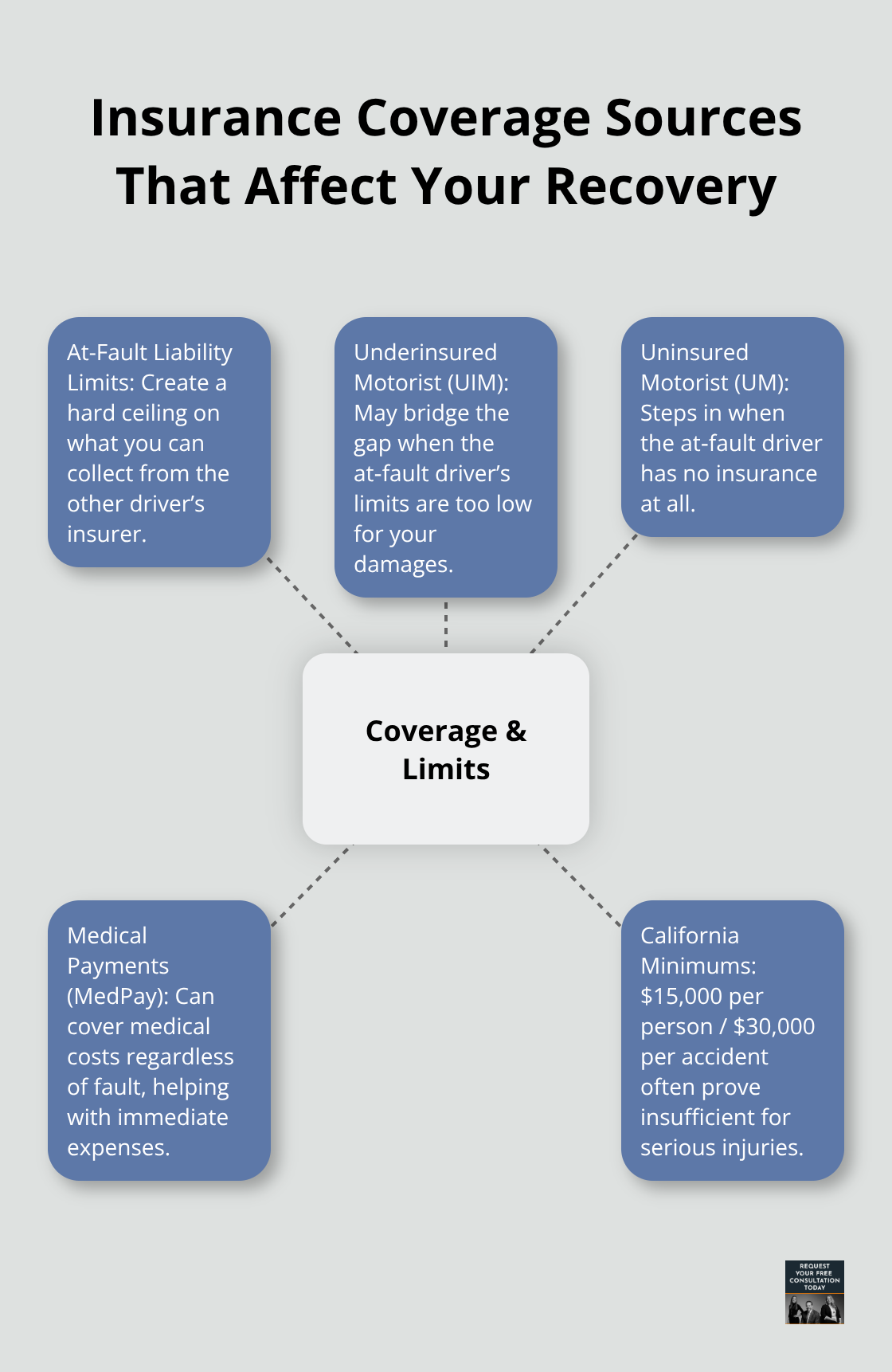
Without adequate coverage limits, even a strong case gets capped at whatever the policy holds. Understanding these coverage gaps early in your claim process allows you to explore all available recovery sources-a step that becomes critical when you move into the actual settlement negotiation process.
How Settlement Negotiations Actually Work
What Happens When You File Your Claim
Your claim starts the moment you report the accident to the at-fault driver’s insurance company, but don’t expect quick action. The Fair Claims Settlement Practices Regulations require insurers to acknowledge your claim within 15 days and investigate within 15 days, yet many adjusters stretch the investigation phase to months. You submit a demand letter with organized medical records, police report, imaging results, and a calculation of your damages broken down by category. The adjuster reviews your file, often requesting additional medical records or asking you to sign broad authorization forms-never sign these without legal review because they can access unrelated medical history the insurer will use against you.
The Initial Offer and Counter Strategy
The adjuster then makes an initial offer, which is almost always far below what your case is worth. This opening offer is a negotiation tactic, not a reflection of fair value. If your documented medical expenses total $40,000 and your long-term prognosis shows ongoing cognitive deficits, an insurer’s first offer of $35,000 is deliberately low to see if you’ll accept fast cash rather than fight. You counter with a detailed response that explains why their valuation ignores your neuropsychological testing results or future earning loss. This back-and-forth typically takes two to four months, with each side adjusting positions incrementally. The key is refusing early lowball offers and presenting evidence strategically-lead with neuropsychological testing results and imaging rather than subjective complaints, because adjusters weight objective clinical findings far more heavily than your description of symptoms.
When Litigation Becomes Necessary
If the gap between your demand and their offer remains large after several rounds, litigation becomes necessary, and that’s when legal representation becomes essential because court proceedings involve filing a complaint, discovery exchanges, depositions, and potentially trial, all requiring experience navigating California’s civil procedure rules and personal injury law. A lawsuit filed in Santa Cruz, Sacramento, or Oakland Superior Court typically takes 18 to 36 months to resolve because courts manage heavy dockets and discovery phases where both sides exchange documents and take depositions of medical providers, witnesses, and yourself. Your neurologist may be deposed by the insurance company’s attorney, who will challenge the severity of your injury and attempt to attribute symptoms to pre-existing conditions or other causes.
Discovery, Mediation, and Trial Preparation
During discovery, you provide detailed financial records showing lost wages, and the defendant’s team will scrutinize gaps in your employment history or attempt to minimize your earning capacity projections. Mediation often occurs before trial, where a neutral third party facilitates settlement discussions, and many cases resolve at this stage once both sides understand litigation costs and trial uncertainty. If mediation fails, trial occurs where a judge or jury hears evidence and decides liability and damages. A jury verdict can exceed insurance policy limits in theory, but you’ll still collect only what the policy allows unless you pursue a bad faith claim against the insurer for unreasonable settlement refusal-a separate legal action requiring proof the insurer acted in bad faith, which demands experienced counsel.
Medical Liens and Timeline Factors
Throughout this process, medical liens from treatment providers allow you to receive care now and pay from settlement proceeds later, easing financial strain while your case progresses. The timeline and outcome depend heavily on your documentation quality, the clarity of liability, and whether you have adequate legal representation to counter the insurer’s tactics and present your damages compellingly.
Final Thoughts
A concussion auto accident settlement depends on three things: how thoroughly you document your injury, how aggressively you present your evidence, and whether you have someone fighting for your interests when insurance adjusters lowball you. Medical records, neuropsychological testing, and imaging create the foundation, while long-term prognosis and lost earning capacity drive the value higher. Insurance policy limits set the ceiling, and settlement negotiations typically take months because adjusters count on victims accepting quick cash rather than fighting for fair compensation.
What separates successful settlements from undersettlements is legal representation. Insurance companies employ adjusters trained to minimize payouts, and they exploit gaps in your medical timeline, challenge the severity of invisible injuries, and attribute symptoms to pre-existing conditions. An attorney levels that playing field by organizing your damages strategically, presenting medical evidence compellingly, and countering the insurer’s tactics with knowledge of California’s comparative fault rules, statute of limitations requirements, and settlement valuation standards (all factors that significantly impact your concussion auto accident settlement outcome).
Your next step is straightforward: gather your medical records, organize your expenses by category, and contact a legal team that understands concussion cases. The two-year statute of limitations in California means time matters, and waiting months to seek legal guidance costs you leverage in negotiations and risks missing the filing deadline entirely. Contact Schaar & Silva LLP for a consultation about your case and what your settlement might be worth based on your specific circumstances and documented damages.
