

Rear end auto accidents happen fast, but the settlement process doesn’t have to be complicated. Getting fair compensation requires knowing what your claim is worth and how to negotiate effectively with insurance companies.
We at Schaar & Silva LLP have helped Santa Cruz County residents recover what they deserve after rear end collisions. This guide walks you through the essential steps to maximize your settlement.
What to Document Right After Your Rear End Accident
Capture the Scene with Photos and Details
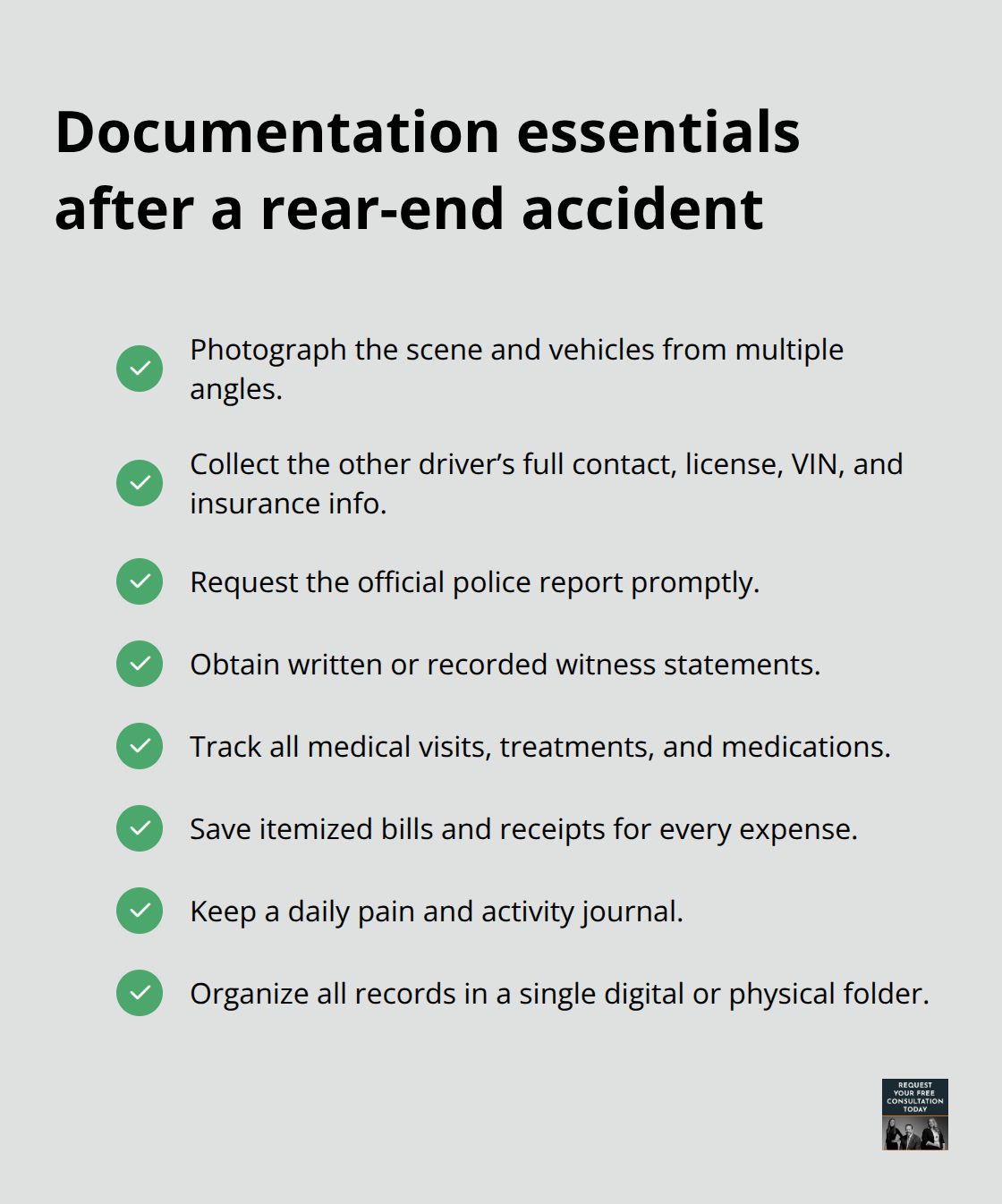
The first hours after a rear end collision determine how strong your settlement claim becomes. Most people focus on exchanging insurance information and calling their insurer, but that’s not enough. You need to build a documentation record that insurance companies can’t dispute. Take photos of the accident scene from multiple angles, capturing the position of both vehicles, visible damage, road conditions, and traffic signs. Include close-ups of the license plates and vehicle identification numbers. If you’re injured, photograph any visible injuries before they fade.
According to the National Highway Traffic Safety Administration, rear end collisions account for nearly 29% of all multi-vehicle crashes, and insurers handle thousands of these claims annually. That volume means they’ve developed sophisticated methods to minimize payouts. Your documentation counters that by creating an undeniable record.
Collect Critical Information from All Parties
Get the other driver’s full name, phone number, address, driver’s license number, vehicle identification number, and insurance details. Write down the exact time, date, and location of the accident immediately. If other vehicles were involved or witnessed the collision, collect their contact information and a brief statement about what they saw. Don’t rely on memory later-write these details down while they’re fresh.
Obtain the Police Report and Witness Statements
Your next step is obtaining the police report, which typically arrives within 5 to 10 business days in Santa Cruz County. The report includes the officer’s assessment of fault, which carries significant weight in settlement negotiations. Request it from the California Highway Patrol or local police department that responded. Many agencies now allow online requests through their websites.
If witnesses provided statements at the scene, follow up with them within days while details remain clear. A written statement or recorded conversation documenting what they observed strengthens your position significantly.
Document Every Medical Record and Treatment
Document all medical treatment you receive, even if injuries seem minor. Keep records of every doctor visit, prescription, physical therapy session, and medication. Insurance companies scrutinize medical records carefully, so gaps in treatment weaken your claim. If you delay seeking treatment, they’ll argue your injuries weren’t serious.
Collect itemized medical bills, not just summaries. These bills show exactly what was charged for each service. Photographs of medical records, discharge summaries, and diagnostic imaging results should be organized chronologically. Maintain a dedicated folder-digital or physical-containing every document related to your accident and recovery (medical bills, police reports, photos, and witness statements). This organized approach makes presenting your claim substantially more compelling when you move forward with settlement negotiations.
What Your Rear End Accident Claim Is Actually Worth
Economic Damages: Calculate Every Cost
Your settlement value depends on two distinct categories of damages, and understanding the difference between them prevents insurance companies from lowballing your claim. Economic damages are straightforward to calculate because they represent actual out-of-pocket costs. Add up your medical bills, vehicle repair or replacement costs, lost wages from time missed at work, and any other direct expenses resulting from the accident. If you earned $25 per hour and missed 40 hours of work during medical appointments and recovery, that’s $1,000 in lost wages you should recover.
Transportation costs to medical appointments, prescription medications, and medical equipment all count. Keep every receipt and invoice because insurance companies won’t accept rough estimates. Most people stop calculating expenses too early, missing ongoing costs like physical therapy sessions that extend weeks or months after the accident. This mistake costs you thousands in legitimate compensation.
Non-Economic Damages: Value Your Pain and Suffering
Non-economic damages compensate you for suffering that doesn’t have a price tag, such as pain, emotional distress, and reduced quality of life. This is where many Santa Cruz County residents leave money on the table because they undervalue their own experience. If the rear end collision caused chronic neck pain that prevents you from exercising or spending time with family, that has real value in settlement negotiations.
Insurance adjusters use formulas to assign multipliers to economic damages, typically ranging from 1.5 to 5 times your medical expenses depending on injury severity. A claim with $10,000 in medical bills and significant ongoing pain might reasonably value non-economic damages at $25,000 to $50,000. However, insurers often propose multipliers closer to 1.5, which undercompensates you substantially.
Document Your Pain to Support Your Claim
The National Highway Traffic Safety Administration reports that rear end collisions cause whiplash injuries in approximately 80% of cases, yet many victims accept settlements that don’t reflect the long-term impact of these injuries. Document your pain levels daily using a simple scale from one to ten, note which activities became impossible, and track any lifestyle changes. This written record provides concrete evidence when negotiating your claim value.

Avoid accepting the insurance company’s first valuation without independent research. Gather comparable settlement amounts for similar rear end accidents in Santa Cruz County to establish realistic benchmarks before you respond to any settlement offer. This preparation positions you to negotiate from a position of strength rather than accepting whatever figure the adjuster initially proposes.
How to Negotiate Your Settlement Effectively
Calculate Your Claim Value Before Talking to Insurance Companies
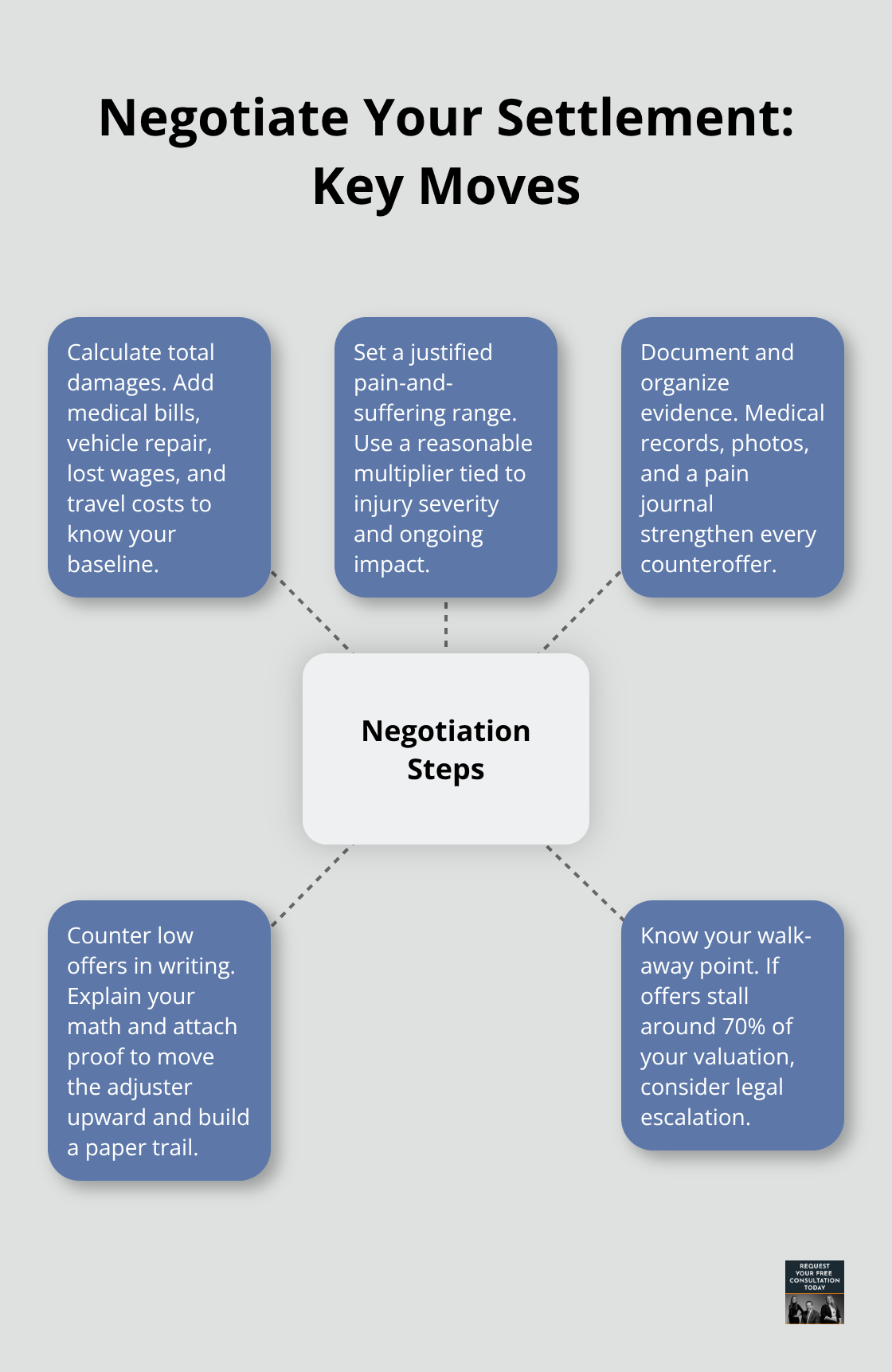
Insurance adjusters count on you accepting their first offer without question. Most people don’t know their claim’s actual value, which gives adjusters tremendous leverage. Before you speak with anyone at the insurance company, calculate your total economic damages precisely and research comparable rear end accident settlements in Santa Cruz County. This preparation transforms you from a passive claimant into someone negotiating from strength.
Start by adding medical bills, vehicle repair costs, lost wages, and transportation expenses. Then multiply your medical expenses by 1.5 to 5 depending on injury severity to establish a reasonable non-economic damages range. If your medical bills total $8,000 and you experienced significant ongoing pain, a multiplier of 3 to 4 is reasonable, putting non-economic damages between $24,000 and $32,000.
Document Your Pain and Lifestyle Changes
Document your pain daily and gather evidence of lifestyle changes caused by the injury. Insurance companies deliberately lowball first offers, expecting you to negotiate upward. A common tactic involves offering 50 to 60 percent of what your claim actually warrants.
When the insurance company makes their initial offer, don’t respond immediately. Take time to review whether it covers all your documented expenses and fairly compensates your suffering. This pause prevents emotional reactions that lead to accepting inadequate settlements.
Respond to Low Offers with Written Documentation
If you receive an offer that falls short, respond in writing with your calculation showing total economic damages and your reasoning for non-economic damages. Include medical records supporting ongoing pain and any evidence of lifestyle impact (photographs of medical appointments, journal entries documenting pain levels, or statements from family members about activity restrictions).
Most adjusters will increase their offer when presented with organized documentation and clear reasoning. The written response also creates a paper trail that protects you if the claim moves toward legal action later.
Recognize When to Stop Negotiating
Know when the negotiation becomes futile. If the insurance company refuses to move beyond 70 percent of your calculated claim value after multiple exchanges, continuing to negotiate wastes your time. At this point, the company has shown their position, and further discussion rarely produces results.
If you’ve documented everything thoroughly, calculated your damages accurately, and the insurance company still refuses fair compensation, you’ve gathered everything needed to pursue your claim through legal channels. We at Schaar & Silva LLP can evaluate whether your case warrants legal action to recover the full amount you deserve.
Final Thoughts
Maximizing your rear end auto accident settlement requires you to take three concrete actions immediately. First, you must document everything after the collision-photos, police reports, witness statements, and medical records form the foundation for your claim. Second, you need to calculate your actual damages by adding economic costs and applying realistic multipliers to non-economic damages rather than accepting whatever figure an insurance adjuster proposes.
Most Santa Cruz County residents undervalue their claims because they lack this systematic approach, and insurance companies exploit that gap by offering settlements that cover only 50 to 60 percent of what claims actually warrant. You now understand how to close that gap through organized documentation and informed negotiation. If you’ve gathered your documentation and calculated your damages but haven’t contacted the insurance company yet, start that process armed with the knowledge from this guide.
If you’ve already negotiated and received an inadequate offer, we at Schaar & Silva LLP can evaluate whether your case warrants legal action to recover what you deserve. Contact us to review your documentation and determine whether pursuing your claim through legal channels will recover the full amount owed to you.
