

Losing someone in a car or truck crash in Santa Cruz County turns a family’s world upside down in an instant. In the weeks that follow, grieving relatives are often surprised to learn that California law decides exactly who may bring a wrongful death claim, how that claim differs from the claim that belonged to the person who died, and how quickly certain steps must be taken. Understanding those rules early gives your family real control over what happens next.
At Schaar & Silva LLP, we help families across Santa Cruz County work through the legal side of a fatal collision while they focus on each other. This guide explains how wrongful death claims actually work in California, who has the right to file, and the deadlines and evidence that shape these cases so you can move forward with confidence.
How Wrongful Death Claims Actually Work in Santa Cruz County
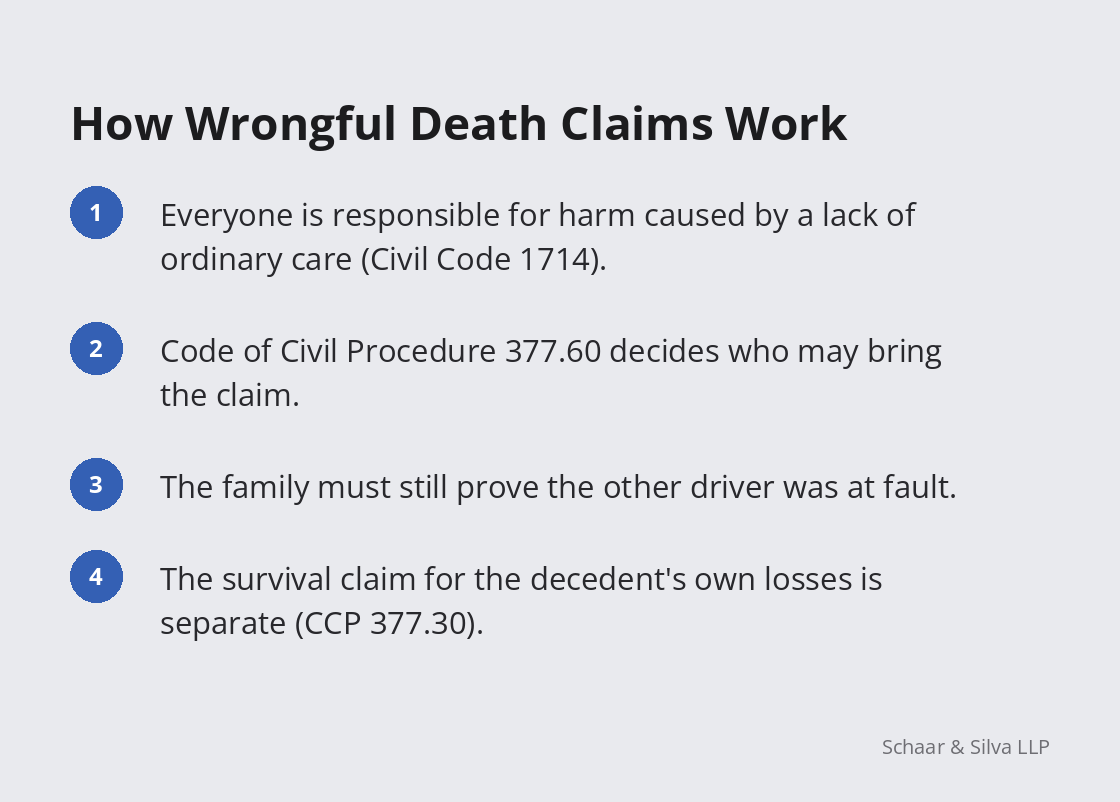
A wrongful death claim is a civil case brought by certain family members when a person dies because of another person’s wrongful act or neglect. California’s general negligence rule, found in Civil Code section 1714, says that everyone is responsible for an injury caused to another by a lack of ordinary care. When a driver’s carelessness on Highway 1, Highway 17, or a rural county road causes a death, that same principle can support a claim by the people the law allows to sue.
The Statute That Controls Who Can Sue
The right to bring a wrongful death claim comes from Code of Civil Procedure section 377.60. It lists the people who may assert the claim, and it also allows the decedent’s personal representative to bring the case on their behalf. Because the statute creates the right, families cannot simply decide among themselves who should file. The court will look at whether each person seeking to recover fits one of the categories the Legislature wrote into the law.
A Claim for the Family’s Own Loss
A wrongful death claim focuses on what the surviving family members lost. That usually includes the love, companionship, comfort, guidance, and support the person who died would have provided. It is different from a claim for the injuries the decedent suffered before death, which is handled through a separate legal path discussed below. Keeping these two claims straight matters, because they can belong to different people and follow different rules.
Why Fault Still Has to Be Proven
A fatal crash does not automatically mean the other driver is legally responsible. The family still has to show that the other driver failed to use reasonable care and that this failure caused the death. Police reports, scene photographs, vehicle data, witness statements, and reconstruction work all help answer that question. In crashes involving commercial trucks, the trucking company’s records can also play an important role in showing what went wrong.
Insurance companies sometimes argue that the person who died was partly to blame, for example by claiming they were speeding or distracted. Under California’s comparative fault approach, as described in the state’s official civil jury instructions, a share of responsibility assigned to the person who died generally reduces the amount recovered rather than wiping out the claim entirely. That is one more reason to build a clear, well-documented picture of the crash from the start, before those arguments take hold.
How Local Roads Shape These Cases
Santa Cruz County’s mix of winding mountain routes, busy coastal highways, and farm roads around Watsonville creates its own crash patterns. Head-on collisions on two-lane roads, rear-end crashes in stop-and-go Highway 1 traffic, and loss-of-control crashes on curves each raise different questions about speed, visibility, and driver attention. Knowing which agency responded and where the crash happened helps determine which reports, photographs, and records exist and how to request them.
Who Can File and What the Process Looks Like
Section 377.60 sets out several groups of people who may bring the claim. Knowing where each family member fits helps avoid confusion and conflict later in the case.
Spouses, Domestic Partners, and Children
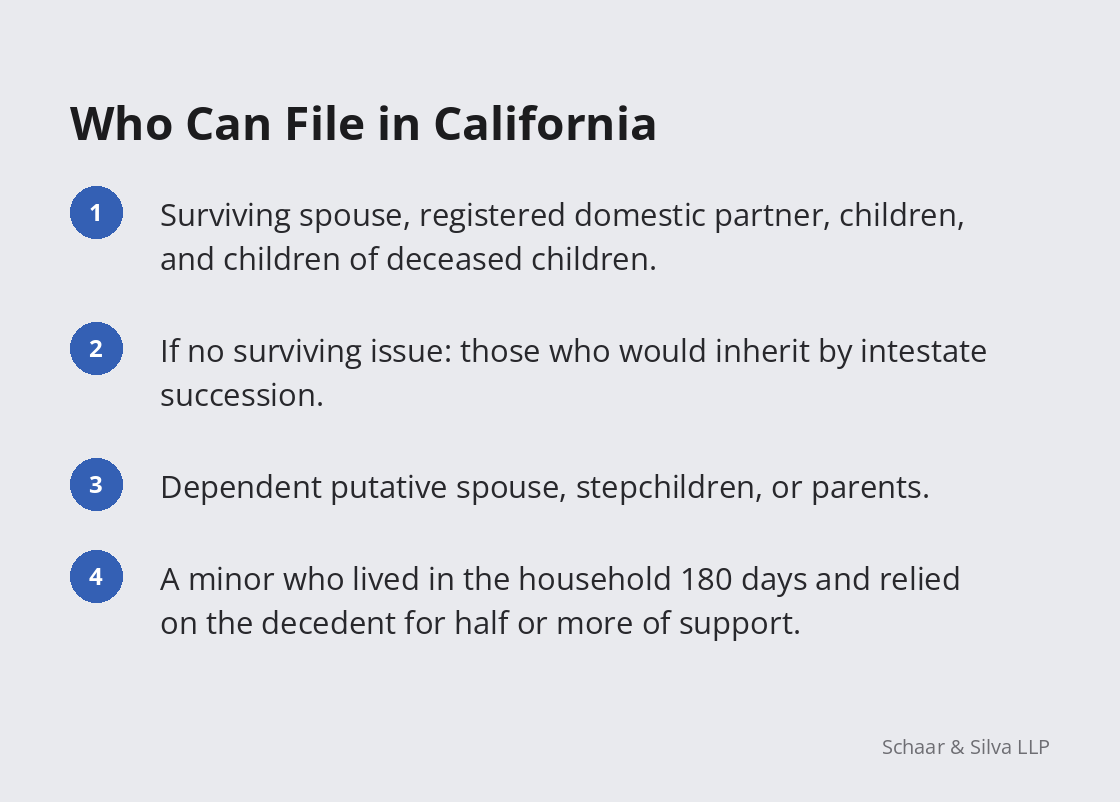
The first group named in the statute is the decedent’s surviving spouse, registered domestic partner, children, and the children of any deceased children. If the decedent left no surviving issue, the statute instead allows the people who would be entitled to the decedent’s property under California’s intestate succession rules, including the surviving spouse or domestic partner, to bring the claim. The statute also contains a special rule allowing legal guardians to step into the place of deceased parents in certain situations.
Dependents and Minors in the Household
Section 377.60 also allows certain people to file if they were dependent on the decedent, whether or not they qualify under the first group. This includes a putative spouse, the children of a putative spouse, stepchildren, and parents. A putative spouse is someone the court finds believed in good faith that their marriage to the decedent was valid, even though the marriage was void or voidable. A separate provision covers a minor who, at the time of death, had lived in the decedent’s household for the previous 180 days and depended on the decedent for at least half of the minor’s support.
The Survival Claim for the Decedent’s Own Losses
California also allows certain claims that belonged to the person who died to continue after death. Under Code of Civil Procedure section 377.30, a cause of action that survives the death passes to the decedent’s successor in interest, and the case may be started by the decedent’s personal representative or, if there is none, by the successor in interest. This survival claim is separate from the family’s wrongful death claim, and in many fatal crash cases both are pursued together.
What Derails Wrongful Death Claims After a Fatal Crash
Families rarely lose these cases because they lacked a strong claim. More often, problems come from missed deadlines, lost evidence, or decisions made before anyone understood the rules.
Missing the Filing Deadline
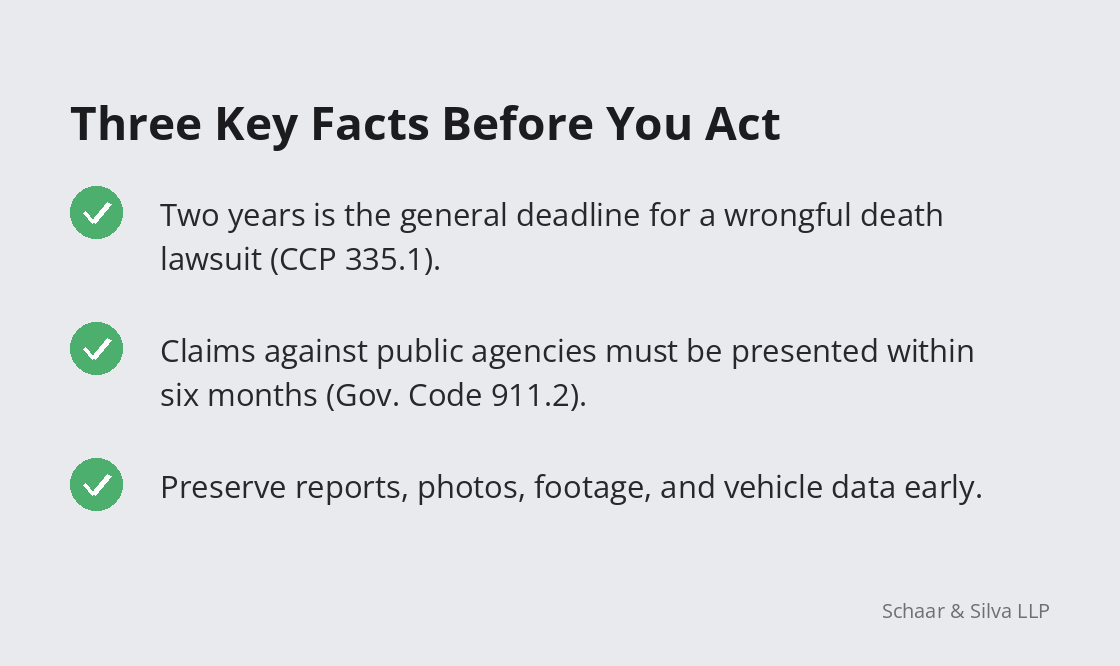
Code of Civil Procedure section 335.1 sets a two-year deadline for an action for the death of a person caused by the wrongful act or neglect of another. Two years can pass quickly while a family is grieving, settling an estate, and handling everyday responsibilities. Waiting until the end of that window also leaves little time to investigate, locate witnesses, and gather records before filing.
Overlooking a Claim Against a Public Agency
Some fatal crashes involve a government vehicle or a dangerous condition on public property, such as a poorly maintained road. In those cases, Government Code section 911.2 requires a claim relating to a death or injury to be presented to the public entity no later than six months after the cause of action accrues. That claim must be presented before a lawsuit can move forward against the agency, so families who assume they have two years can lose important rights.
Letting Evidence Disappear
Vehicles are repaired or scrapped, surveillance footage is recorded over, and memories fade. Families can protect their claim by keeping copies of the collision report, saving photographs and messages, writing down the names of witnesses, and avoiding recorded statements to the at-fault driver’s insurance company before getting legal advice. Early action helps preserve the evidence needed to show what happened on the road. In truck crashes, the company’s driver logs, maintenance files, and onboard data can be especially important, and sending a written request to preserve them early can make a real difference.
Disagreements Among Family Members
Grief affects everyone differently, and relatives do not always agree about whether or how to pursue a claim. Because the statute decides who has standing, open conversations about who qualifies and how decisions will be made can prevent misunderstandings. When a minor child or a dependent who lived outside the home is involved, it is especially important to make sure everyone with a potential right to recover is identified early in the process.
Final Thoughts
A wrongful death claim cannot undo a loss, but it can hold a careless driver accountable and give a family stability during an incredibly hard time. California law spells out who may bring the claim, separates the family’s losses from the decedent’s own claim, and sets firm deadlines that do not pause for grief. Understanding those rules early helps protect your family’s options.
Every case is different, and the right steps depend on your family’s relationships, the facts of the crash, and who was involved. Talking with a trusted attorney early can help you avoid the mistakes that weaken these claims.
If you lost a loved one in a car or truck crash in Santa Cruz County, contact Schaar & Silva LLP to speak with our team. We will listen to your family’s story, explain your options, and help you take the next step with confidence.