

A Watsonville car accident often happens on the kind of road that defines south Santa Cruz County: a two-lane highway running past strawberry fields, orchards, and packing sheds, shared by commuters, delivery vans, and slow farm vehicles. When a driver loses patience behind a tractor on Highway 129 or tries to pass on a blind curve on Highway 152, the result can be a serious collision with little warning. If you were hurt in one of these crashes, understanding how fault works on two-lane roads gives you real control over what happens next.
At Schaar & Silva LLP, we help people across Santa Cruz County, including Watsonville and the Pajaro Valley, who have been injured in car and truck accidents. This guide explains how responsibility is decided in a two-lane road crash, the steps that protect your claim, and the mistakes that most often weaken a case, so you can move forward with confidence.
How Two-Lane Road Crashes Actually Happen Around Watsonville
Two-lane highways leave very little room for error. There is no second lane to absorb a mistake, and oncoming traffic is only a painted line away. California’s Vehicle Code includes specific rules for passing, keeping right, and letting faster traffic go by, and those rules often decide who is responsible when something goes wrong.
Unsafe Passing on Rural Highways
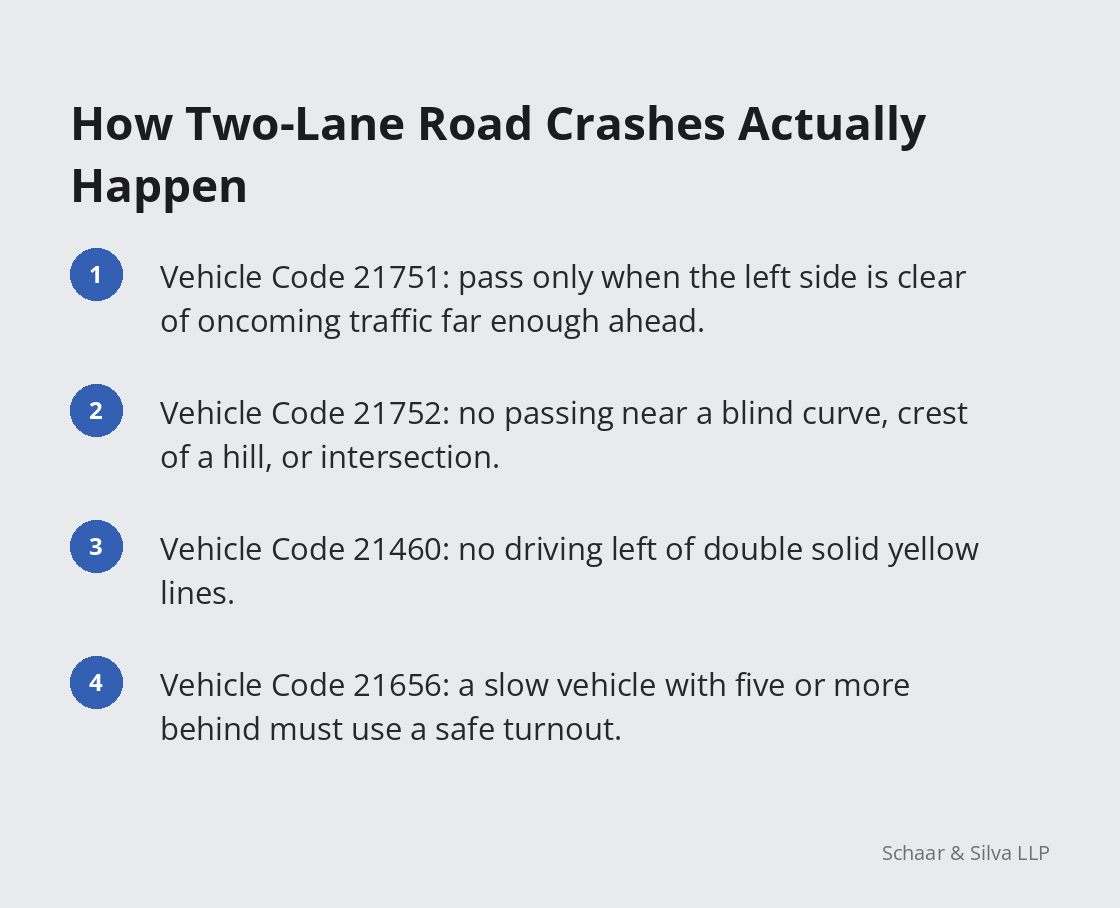
Passing is one of the riskiest moves a driver can make on a two-lane road. Vehicle Code 21751 provides that on a two-lane highway, no vehicle shall be driven to the left side of the center of the roadway to pass another vehicle unless the left side is clearly visible and free of oncoming traffic for a sufficient distance ahead to permit the passing to be completely made without interfering with the safe operation of any vehicle approaching from the opposite direction. Vehicle Code 21752 adds that no vehicle shall be driven to the left side of the roadway when approaching or upon the crest of a grade or a curve where the driver’s view is obstructed, or when approaching within 100 feet of or traversing any intersection. A driver who swings out to pass near a farm road entrance or on a curve and strikes an oncoming car has usually broken at least one of these rules.
Double Yellow Lines and Keeping to the Right
Pavement markings carry legal weight. Under Vehicle Code 21460, if double parallel solid yellow lines are in place, a person driving a vehicle shall not drive to the left of the lines, with limited exceptions such as turning left into a driveway or private road. Vehicle Code 21650 requires that upon all highways a vehicle shall be driven upon the right half of the roadway, except in situations such as lawful passing or when the right half is closed for construction. When a driver drifts over the center line while distracted, tired, or taking a curve too fast, these sections help establish that the driver left their side of the road.
Slow Vehicles, Farm Traffic, and Turnouts
Slow traffic is a normal part of driving in an agricultural area, and the law expects both slow and fast drivers to act responsibly. Vehicle Code 21654 requires a vehicle moving slower than the normal speed of traffic to be driven in the right-hand lane or as close as practicable to the right-hand edge or curb, except when passing or preparing for a left turn. Vehicle Code 21656 states that on a two-lane highway where passing is unsafe, a slow vehicle behind which five or more vehicles are formed in line shall turn off the roadway at the nearest designated turnout or wherever sufficient area for a safe turnout exists. A slow driver who ignores these duties may share responsibility, but frustration with a slow vehicle never excuses an unsafe pass by the driver behind it.
Steps to Protect Your Claim After a Watsonville Car Accident
Rural crashes create their own challenges. Help may take longer to arrive, there may be few witnesses, and evidence such as tire marks on the shoulder or debris in a field can disappear quickly. Taking a few organized steps early keeps the important facts within reach.
Making Sure the Crash Is Documented
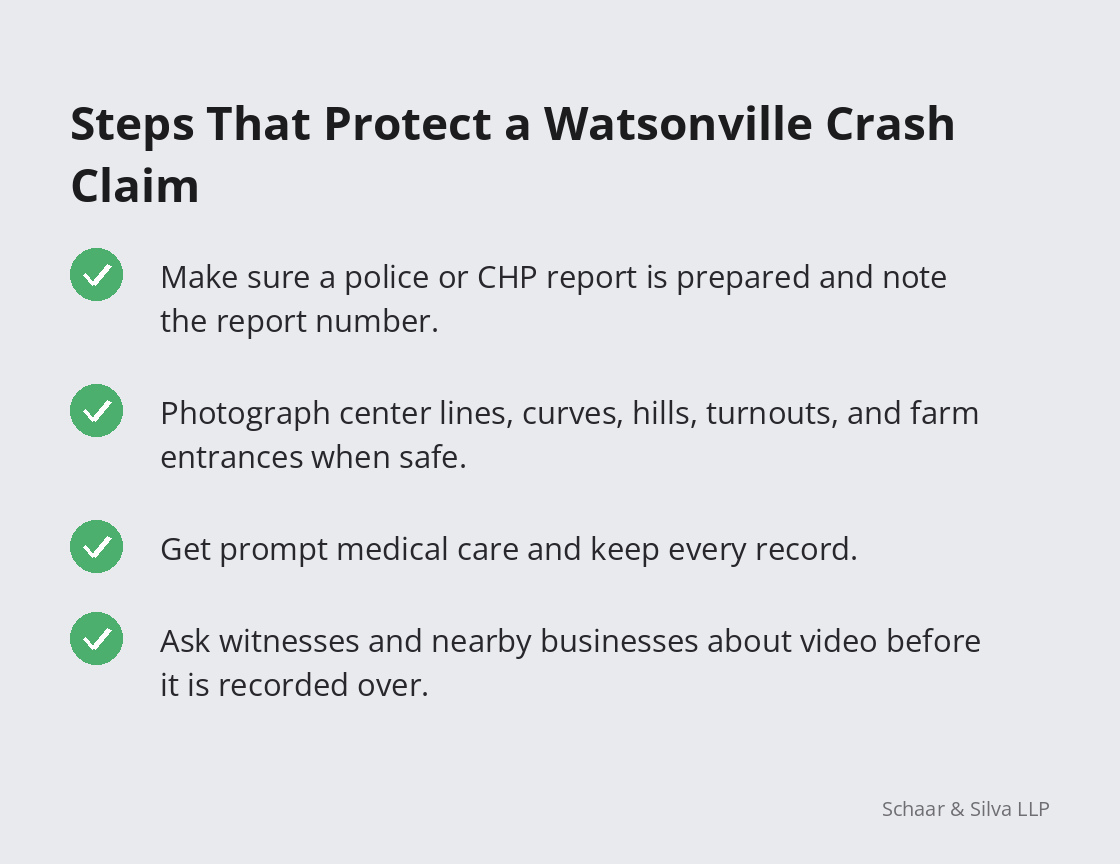
Call for help and make sure a law enforcement report is prepared. Depending on where the crash happened, the responding agency may be the Watsonville Police Department or the California Highway Patrol. On state highways built as freeways, such as Highway 1 near Watsonville, Vehicle Code 2400 gives the CHP primary jurisdiction for the investigation of traffic accidents. Write down the officer’s name, the agency, and any report number, and ask how to request a copy of the report. The report often records statements, vehicle positions, and the officer’s observations about lane markings and road conditions.
Capturing Road Markings and Sight Lines
In a two-lane road crash, the layout of the road can matter as much as the damage to the cars. When it is safe, photograph the center line, any no-passing zone markings, nearby curves or hills that limit visibility, turnouts, intersections, and farm driveways. Note the closest cross street or landmark. These details help show whether a passing driver had a clear view ahead or whether a curve, grade, or intersection made the pass unlawful under the Vehicle Code sections described above.
Getting Medical Care Right Away
Two-lane crashes are often head-on or sideswipe collisions, and injuries from these impacts can be severe even when you feel shaken but functional at the scene. Prompt medical care protects your health and creates a clear record linking your injuries to the collision. Keep copies of visit summaries, imaging, therapy notes, and any work restrictions. A short daily journal about pain, sleep, and missed activities helps show how the injury has changed your daily life.
Finding Witnesses and Nearby Video
Witnesses on rural roads are often other drivers, farm workers, or people at nearby businesses and produce stands. Ask for names and phone numbers before they leave. Some homes, businesses, and packing facilities have cameras that may have captured the road, and that footage is often recorded over within days or weeks. Asking early, or having someone ask on your behalf, gives you the best chance of preserving it.
Mistakes That Weaken a Watsonville Car Accident Claim
Many strong claims are weakened by avoidable missteps after the crash rather than by the facts of the collision itself. Knowing the most common problems helps you keep the focus on the driver who caused the harm.
Accepting the Other Driver’s Version of Events
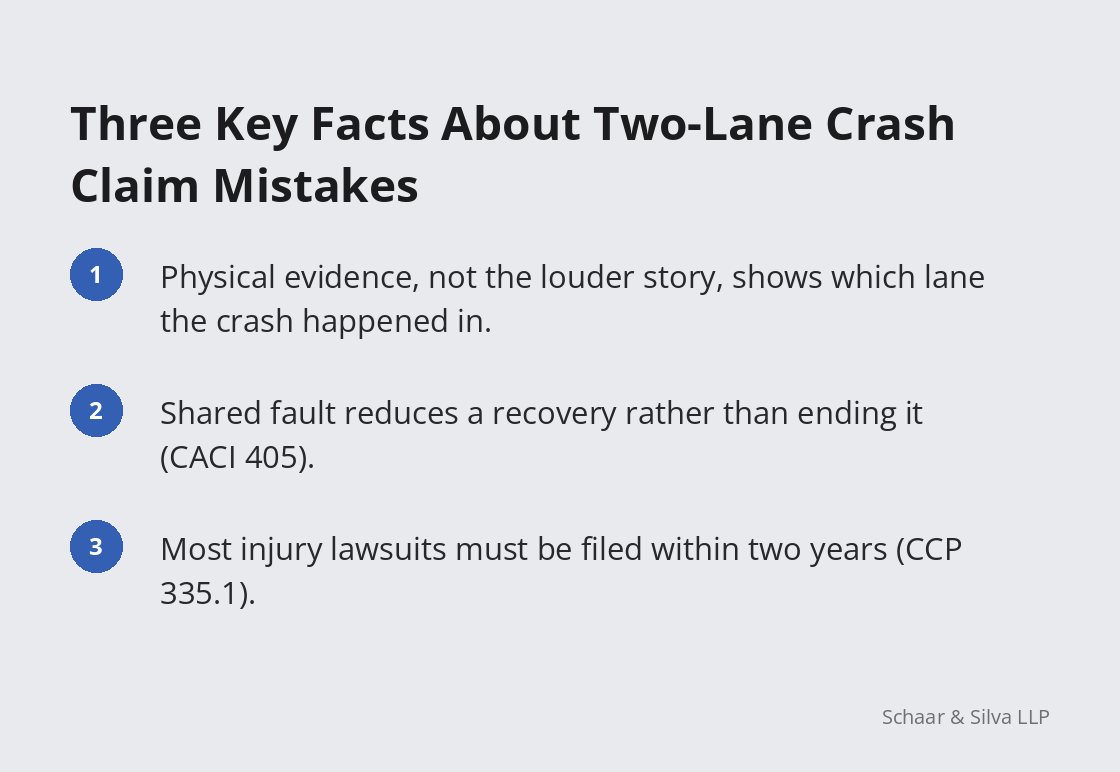
After a head-on or sideswipe crash, each driver may claim the other one crossed the center line. Without evidence, that becomes a contest of memories. Physical evidence such as the point of impact, gouge marks, debris location, and vehicle damage patterns can show which lane the collision happened in. Every driver owes a duty of care: California Civil Code 1714 states that everyone is responsible for an injury occasioned to another by his or her want of ordinary care or skill in the management of his or her property or person. Letting the evidence, not the louder story, decide who failed that duty protects your claim.
Assuming Partial Fault Ends the Case
You may worry that you share some blame, perhaps because you were driving slowly or did not pull into a turnout. California does not use an all-or-nothing rule. Under the comparative fault principle reflected in California Civil Jury Instruction 405, a jury that finds an injured person partly responsible reduces that person’s damages by their percentage of responsibility rather than eliminating the claim. Insurers sometimes exaggerate a driver’s share of fault, so it is worth having the evidence reviewed before accepting their position.
Speaking Too Soon With the Other Insurer
The other driver’s insurance company may call quickly and ask for a recorded statement. Those calls can feel routine, but early statements made while you are in pain or still learning the extent of your injuries can be taken out of context later. It is reasonable to report the crash to your own insurer while waiting to give detailed statements to the other side until you understand your rights and the full picture of your injuries.
Waiting Until a Deadline Is Close
California law limits how long you have to file an injury lawsuit. Code of Civil Procedure 335.1 sets a two-year period for an action for injury to, or for the death of, an individual caused by the wrongful act or neglect of another. Evidence on rural roads also fades quickly, from skid marks to video footage to witness memories. Acting early gives you the strongest foundation for your claim.
Final Thoughts
A Watsonville car accident on a two-lane road can change your life in seconds, whether it involved an unsafe pass on Highway 152, a driver crossing the center line on Highway 129, or a collision near a busy farm entrance. California’s rules on passing, center lines, slow vehicles, and turnouts give injured people a clear framework for showing who was responsible. Careful documentation, prompt medical care, and attention to deadlines keep that framework working in your favor.
You do not have to handle the investigation, the insurance calls, and your recovery on your own. Our team can review the report, the road layout, and the physical evidence, and explain your options in plain language. If your crash was a head-on collision, our page on head-on collisions in Santa Cruz offers more background.
If you were hurt in a car or truck accident in Watsonville or anywhere in Santa Cruz County, contact Schaar & Silva LLP to speak with our team. We will listen to your story, answer your questions, and help you move forward with confidence.