
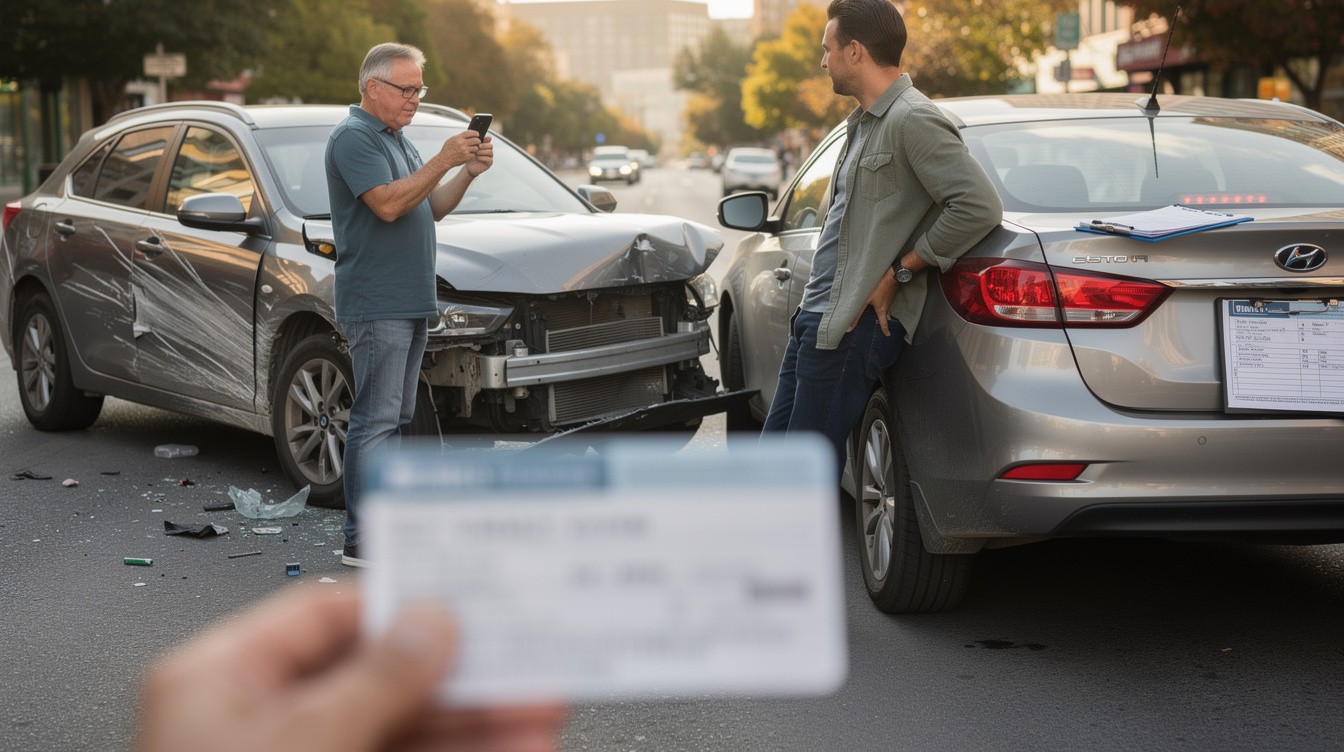
A car accident with an uninsured driver can leave you facing medical bills, vehicle repairs, and lost income with no clear path to compensation. California law requires drivers to carry minimum liability insurance, yet roughly 15% of motorists on state roads drive without it.
Uninsured motorist claims exist specifically to protect you when the at-fault driver has no insurance. We at Schaar & Silva LLP help accident victims in Santa Cruz County, Sacramento, and Oakland navigate these claims and recover the compensation they deserve.
What Counts as an Uninsured Motorist
Understanding Uninsured and Underinsured Drivers
An uninsured motorist is someone operating a vehicle without active liability insurance coverage, which California law mandates for all drivers. Underinsured motorists carry insurance, but their policy limits fall short of your actual damages. California requires minimum liability coverage of $15,000 for injury to one person, $30,000 for injuries to multiple people, and $5,000 for property damage. When an at-fault driver lacks these minimums, your uninsured motorist coverage steps in to cover your losses.
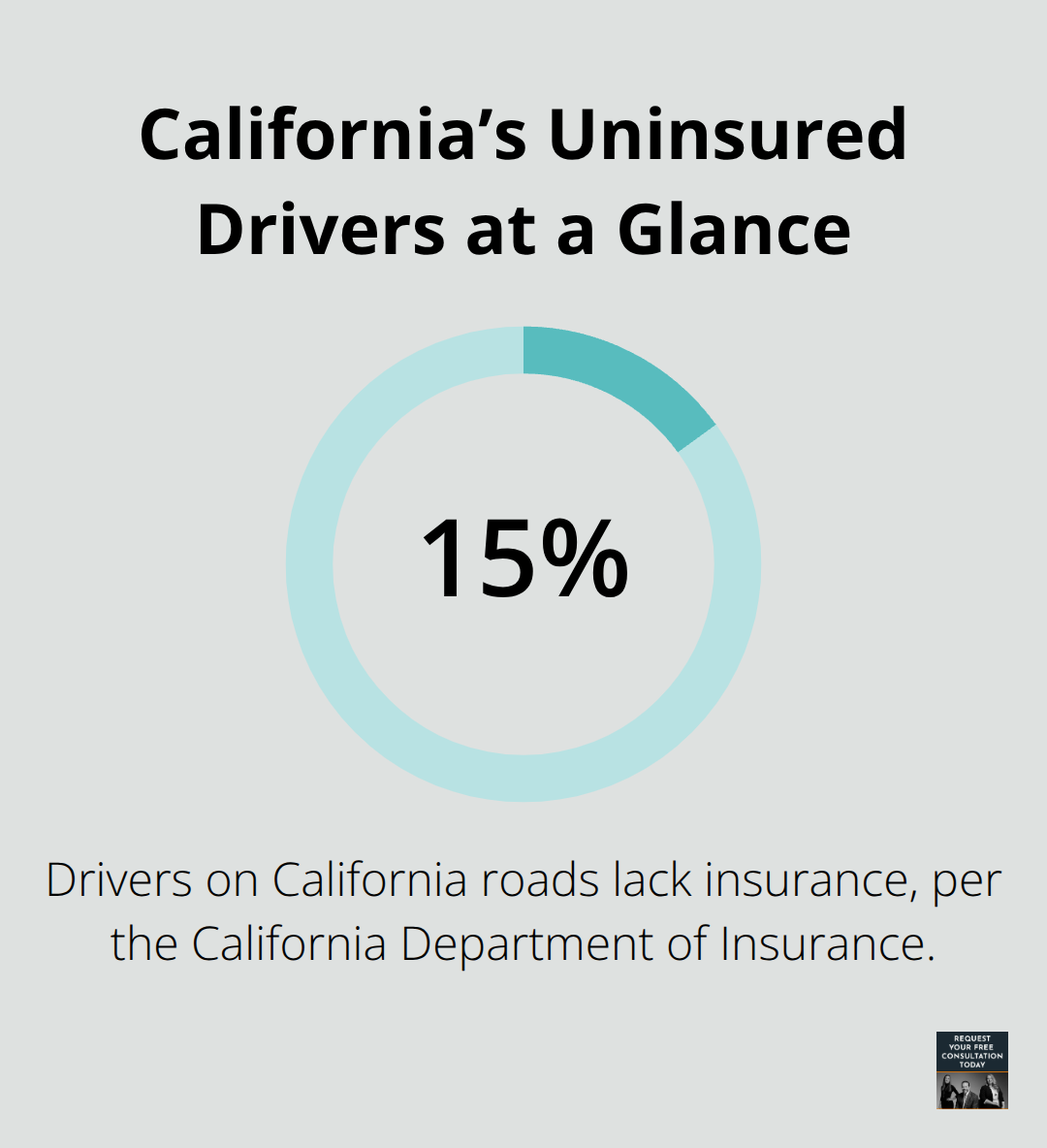
The California Department of Insurance reports that approximately 15% of drivers on California roads lack insurance, which translates to roughly 2 million uninsured motorists operating vehicles across the state. In Santa Cruz County, Sacramento, and Oakland, accident victims frequently encounter uninsured drivers, making your own uninsured motorist protection genuinely essential rather than optional.
How Uninsured and Underinsured Coverage Differs
The distinction between uninsured and underinsured matters because your coverage responds differently to each situation. If the at-fault driver carries $15,000 in liability coverage but your injuries total $50,000, your underinsured motorist coverage fills that $35,000 gap. California law also allows stacking, meaning if you own multiple vehicles with uninsured motorist coverage, you can combine those limits to increase recovery.
The Reality of California’s Insurance Minimums
California’s minimum insurance requirements are inadequate for serious injuries. A single accident requiring hospitalization, surgery, and rehabilitation easily exceeds the $15,000 minimum. This gap between what drivers carry and what victims actually need makes uninsured motorist claims one of the most valuable protections available to you.
How Your Claim Works
When you file this type of claim, you use your own insurance policy to recover damages from your own carrier, which then handles pursuing the at-fault uninsured driver. Understanding these mechanics positions you to take the right steps after an accident, which brings us to how the actual claims process unfolds.
How Your Claim Gets Processed
Filing Your Claim Immediately
After an accident with an uninsured driver, you file a claim directly with your own insurance company, not the other driver’s policy. Contact your insurer within days of the accident, not weeks. Insurance companies track claim filing dates closely, and delays can complicate your case. When you call, provide your policy number, the date and location of the accident, and a clear description of what happened. Many insurers allow you to file online through their app or portal, which creates an immediate timestamp. Request a claim number and the name of your assigned adjuster.
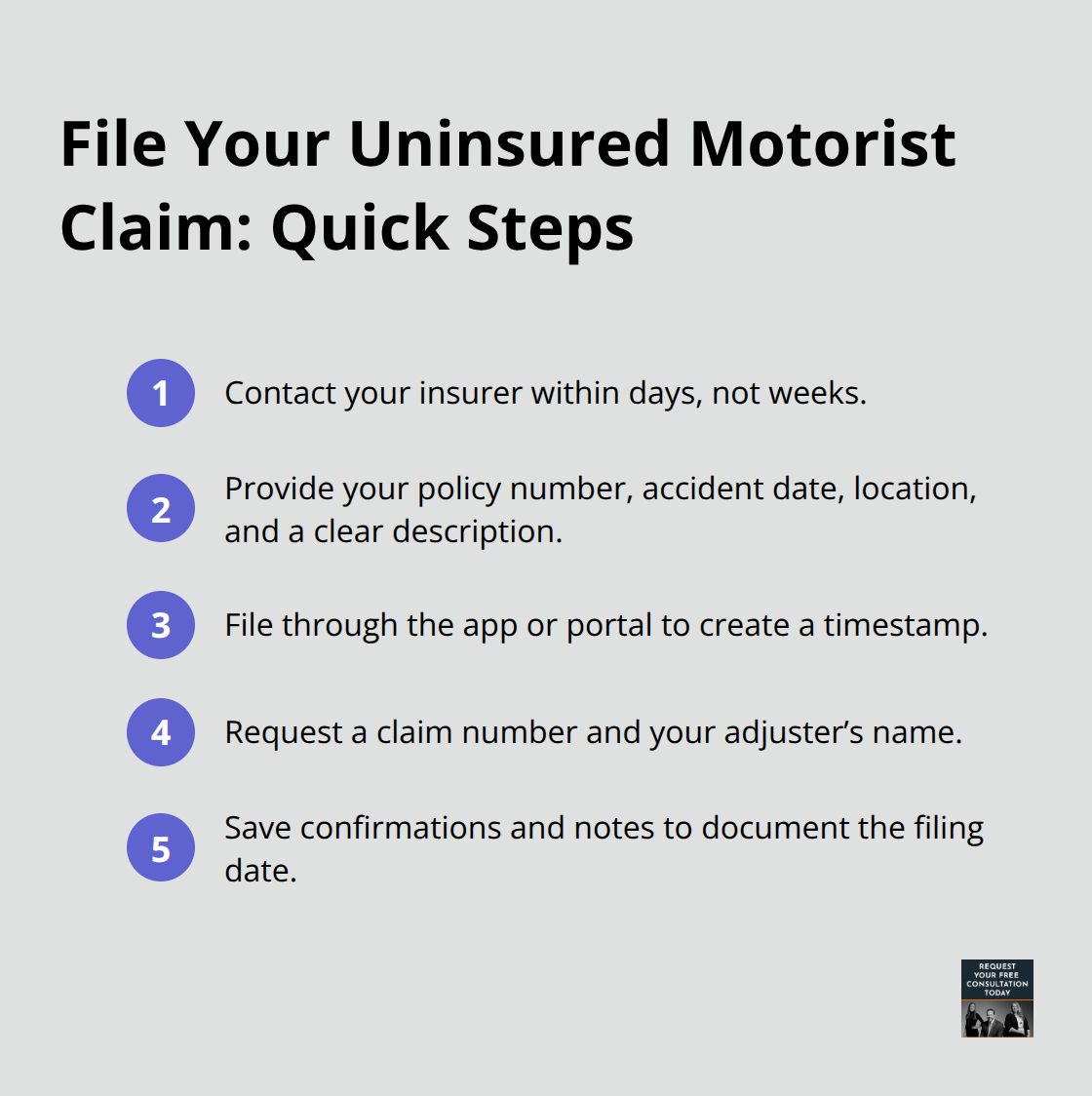
This documentation protects you if disputes arise later about when you filed.
Gathering Required Documentation
Your adjuster will request police reports, medical records, repair estimates, and photos of vehicle damage. You must gather these materials quickly because insurers typically expect them within 30 days. The California Department of Insurance reports that claims processed with complete documentation resolve 40% faster than those missing key materials. Organize everything in a single folder and submit copies to your adjuster rather than originals. Keep your own records as backup in case documents get lost in the claims process.
Understanding Your Timeline and Compensation
The timeline from filing to settlement varies significantly based on injury severity and liability complexity. Simple property-damage-only claims often resolve in 4 to 8 weeks, while injury claims involving multiple medical treatments extend to 6 to 12 months. Your compensation covers medical expenses, lost wages, vehicle repairs, and pain and suffering damages. California law allows you to recover up to your policy limits, which you should set as high as possible when you purchase coverage.
Negotiating Settlement Offers
If your damages exceed your uninsured motorist limit, you have additional options, including pursuing the uninsured driver directly through civil court (though collecting from an uninsured motorist proves difficult in practice). Insurers frequently undervalue pain and suffering claims initially, offering 30 to 50% less than reasonable settlements. Negotiating these offers requires detailed documentation of your injuries, treatment records showing ongoing care, and proof of income loss. Accident victims who provide comprehensive medical documentation receive settlements 25 to 35% higher than those with minimal records. Keep copies of every medical bill, receipt, and wage statement related to your accident.
What Happens When Disputes Arise
When liability questions emerge or your insurer resists your claim, the situation becomes more complex. Understanding how to handle these conflicts determines whether you recover fair compensation or accept an inadequate offer.
What Stops Insurers From Paying and What Works
Why Insurers Resist Uninsured Motorist Claims
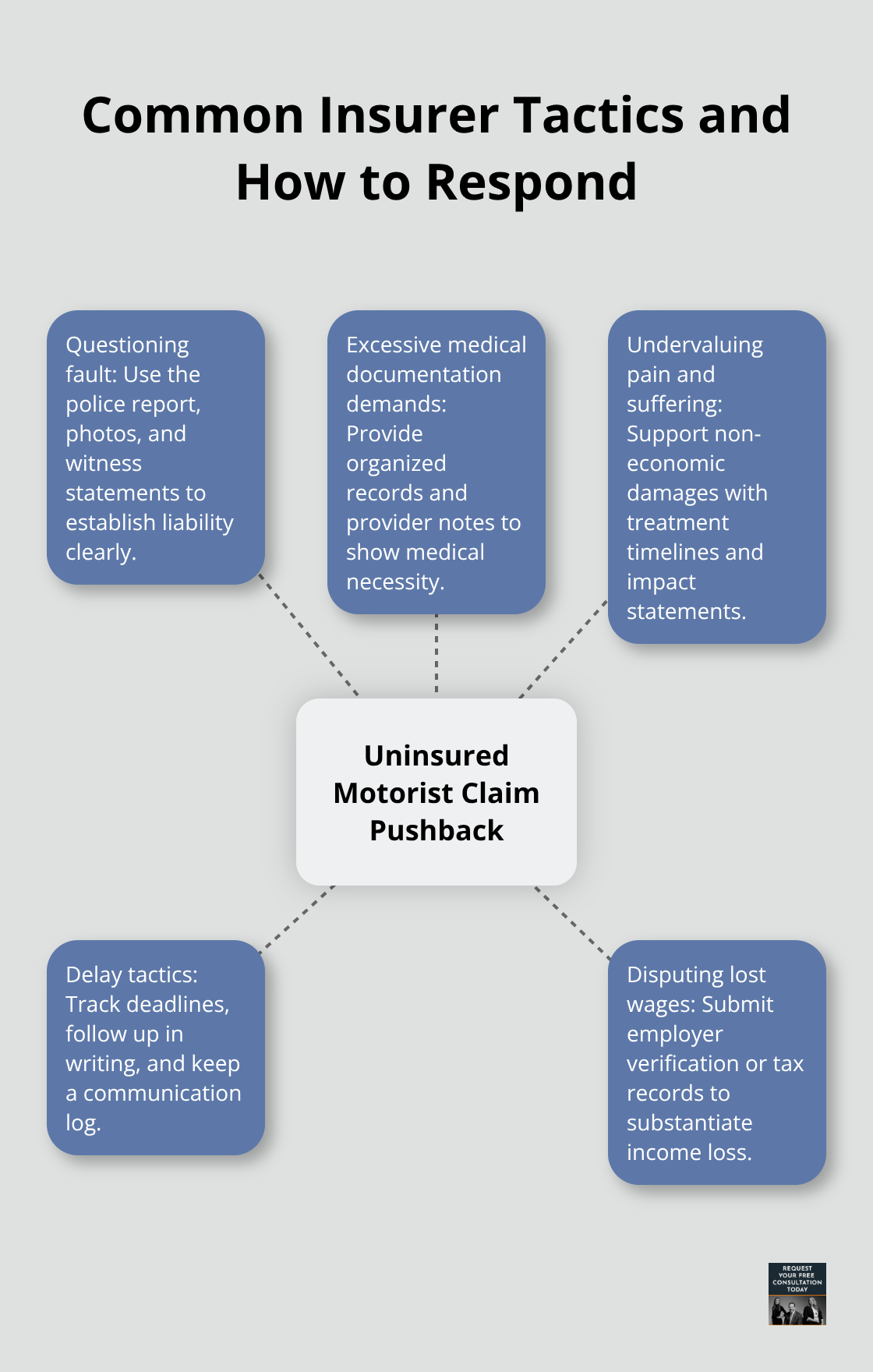
Insurance companies resist uninsured motorist claims far more aggressively than standard liability claims because they pay from their own pocket rather than another driver’s policy. The California Department of Insurance received over 12,000 complaints about claim denials in 2024, with uninsured motorist disputes representing roughly 18% of those complaints. Insurers employ three primary tactics to reduce payouts: questioning fault, demanding excessive medical documentation, and undervaluing non-economic damages like pain and suffering. You need to understand each tactic and counter it with solid evidence before accepting any settlement offer.
Countering Fault Disputes with Evidence
When fault becomes disputed, insurers claim the accident resulted from shared negligence, allowing them to reduce your recovery proportionally under California’s comparative negligence rules. They’ll argue you failed to avoid the collision or that both drivers contributed equally to the accident. Police reports carry significant weight here, so if the officer documented fault clearly in their report, that becomes your strongest weapon. Request the accident report immediately after filing your claim and provide it to your adjuster without delay.
Witness statements also shift disputes in your favor, so exchange contact information with anyone who saw the accident happen. If no police report exists or fault remains unclear, dash cam footage or surveillance video from nearby businesses becomes invaluable. Many accident victims don’t realize they can request video from gas stations, restaurants, or parking lots adjacent to accident locations. This documentation typically shifts settlements upward by 40 to 60% compared to cases lacking visual evidence.
Handling Medical Bill Disputes
Medical bill disputes represent the second major resistance point, and insurers use this strategically to delay settlements. Your insurer will demand records from every medical provider you visited, then scrutinize whether each treatment was medically necessary and reasonably priced. They’ll argue that certain treatments were excessive, that you waited too long between appointments, or that your injuries weren’t as severe as claimed.
Document your treatment timeline meticulously by keeping every medical bill, prescription receipt, and provider note organized chronologically. Include any imaging results, lab work, or diagnostic testing that supports your injury claims. California accident victims with complete medical records recover settlements averaging 35% higher than those with gaps in documentation. If your insurer denies coverage for specific treatments, request a detailed written explanation of their denial reasoning. Many denials lack legal merit, and pushing back with your medical provider’s clinical justification often reverses the decision.
Proving Lost Wages and Income
Lost wages create another documentation challenge that insurers frequently minimize. Provide your employer’s written verification of time missed and hourly rate rather than relying on your own statements. If self-employed, tax returns and business records demonstrating your actual income become essential. Insurers commonly offer 50 to 70% of claimed lost wages initially, expecting victims to accept inadequate settlements rather than fight. Negotiate with documented proof of your actual earnings during the accident recovery period, and don’t accept their first offer without thorough documentation supporting your claim.
Final Thoughts
Uninsured motorist claims protect you when someone else’s negligence leaves you without a clear path to compensation. The reality in Santa Cruz County, Sacramento, and Oakland is that roughly 15% of drivers operate without insurance, making this protection genuinely necessary rather than optional. Your own uninsured motorist coverage becomes your financial lifeline when the at-fault driver carries no policy or insufficient limits.
The steps you take immediately after an accident determine your recovery outcome. File your claim within days, gather complete documentation, and organize medical records chronologically. Insurance companies will test your resolve by questioning fault, demanding excessive medical proof, and undervaluing your pain and suffering-counter these tactics with police reports, witness statements, dash cam footage, and comprehensive medical records.
Don’t accept initial settlement offers without negotiation, as your insurer’s first proposal typically falls 30 to 50% below what reasonable settlements should cover. Push back with documented proof of your medical treatment, lost wages, and vehicle damage. Contact Schaar & Silva LLP to discuss your uninsured motorist claim and learn how we can help you recover fair compensation.