
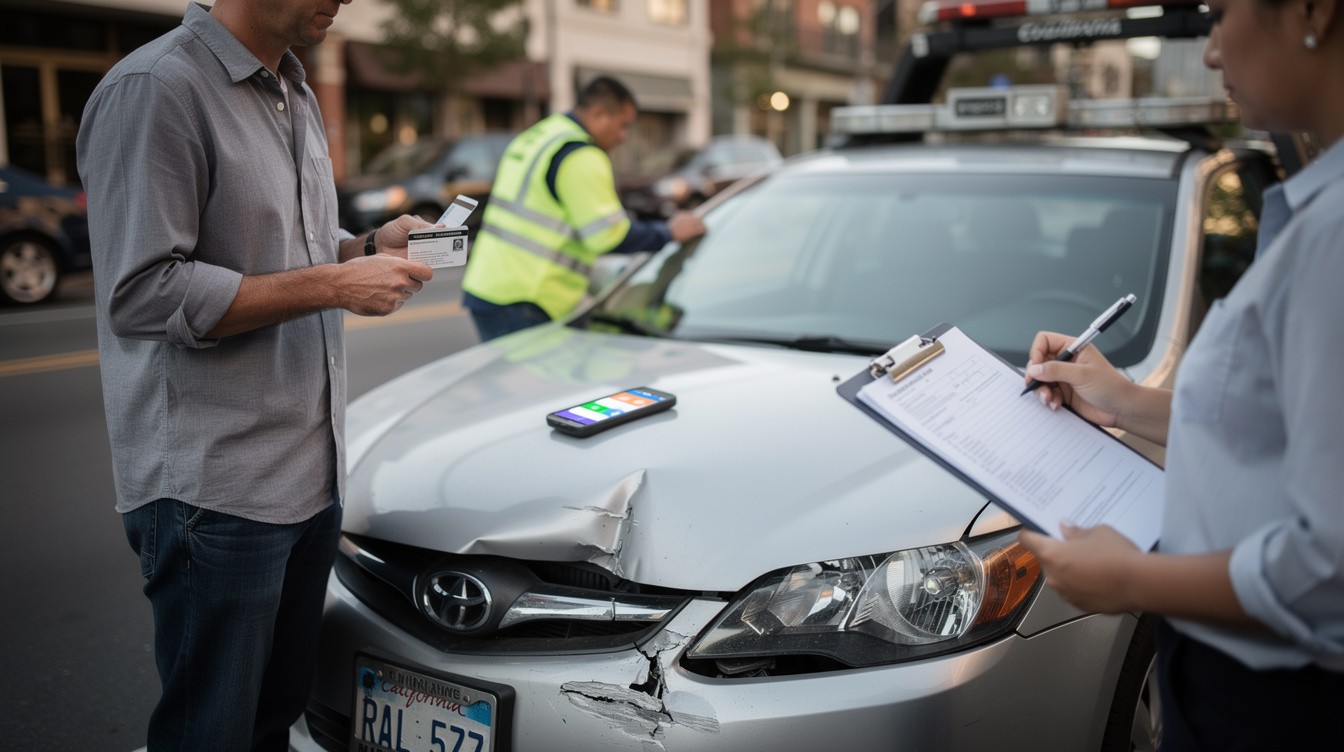
A car accident can leave you facing medical bills, lost wages, and vehicle damage that far exceed what the at-fault driver’s insurance will cover. In California, underinsured motorist coverage fills that gap, protecting your finances when liability limits run out.
At Schaar & Silva LLP, we’ve seen how quickly accident victims face financial hardship without this protection. This guide walks you through what underinsured motorist California coverage means, how to file a claim, and how to strengthen your policy today.
What Underinsured Motorist Coverage Actually Means
The Gap Between Coverage and Reality
Underinsured motorist coverage protects you when the at-fault driver’s liability insurance limits cannot cover your full damages. California law distinguishes between uninsured motorist coverage, which applies when a driver has zero insurance, and underinsured motorist coverage, which applies when a driver carries some insurance but not enough. According to the National Association of Insurance Commissioners, the average liability claim exceeds $20,000, yet California’s minimum liability requirement is only $15,000 per person and $30,000 per accident. This gap creates real financial exposure.
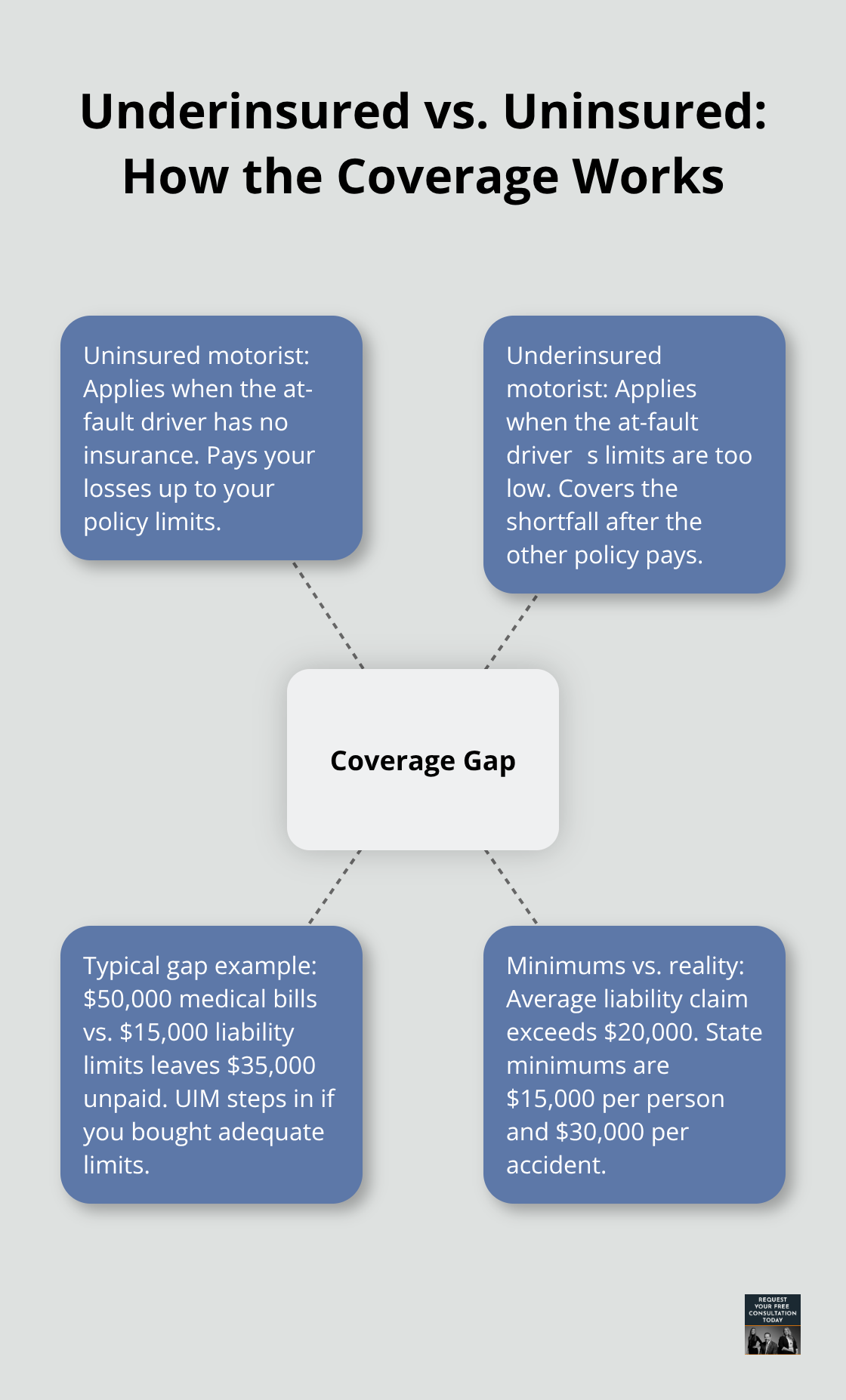
If a driver carrying minimum limits hits you and your medical bills total $50,000, your underinsured motorist coverage fills the $35,000 shortfall, assuming you purchased adequate limits.
California’s Legal Requirements
California law requires insurance companies to offer underinsured motorist protection, though you can reject it in writing. Most drivers who reject this coverage later regret that decision when they face substantial out-of-pocket costs after an accident. The state recognizes that liability limits often fall short of actual injury expenses, which is why this protection exists as a standard offering rather than a luxury add-on.
Why Standard Liability Policies Fall Short
Standard liability policies are fundamentally designed to protect the driver carrying the policy, not accident victims. Insurers set liability limits based on cost, not on realistic injury expenses. A policy with $15,000 in liability coverage might cost $40 monthly, while $100,000 in coverage costs roughly $65 monthly. Many drivers choose minimum coverage without understanding the consequences. When a driver with low limits causes your accident, their insurance covers only a fraction of your losses, leaving you responsible for thousands in unpaid medical bills and lost income.
The gap between what insurance covers and what you actually owe grows wider with serious injuries. Purchasing underinsured motorist coverage matching or exceeding your own liability limits provides a safety net that standard policies simply cannot offer. This coverage represents a practical necessity rather than an optional add-on for California residents.
Moving Forward With Your Protection
Understanding this coverage gap is the first step. The next section walks you through exactly how to file an underinsured motorist claim and what obstacles you might face along the way.
How Underinsured Motorist Claims Work in California
Report Your Accident Immediately
You must report your accident to your own insurance company, not just the at-fault driver’s insurer. California law requires notification within a reasonable timeframe, typically within 30 days, though earlier notification protects your claim. Collect the police report number, the at-fault driver’s insurance information, photos of vehicle damage, medical records, and receipts for all accident-related expenses. Your insurance company will assign a claims adjuster who reviews whether the at-fault driver’s liability limits truly fall short of your damages.
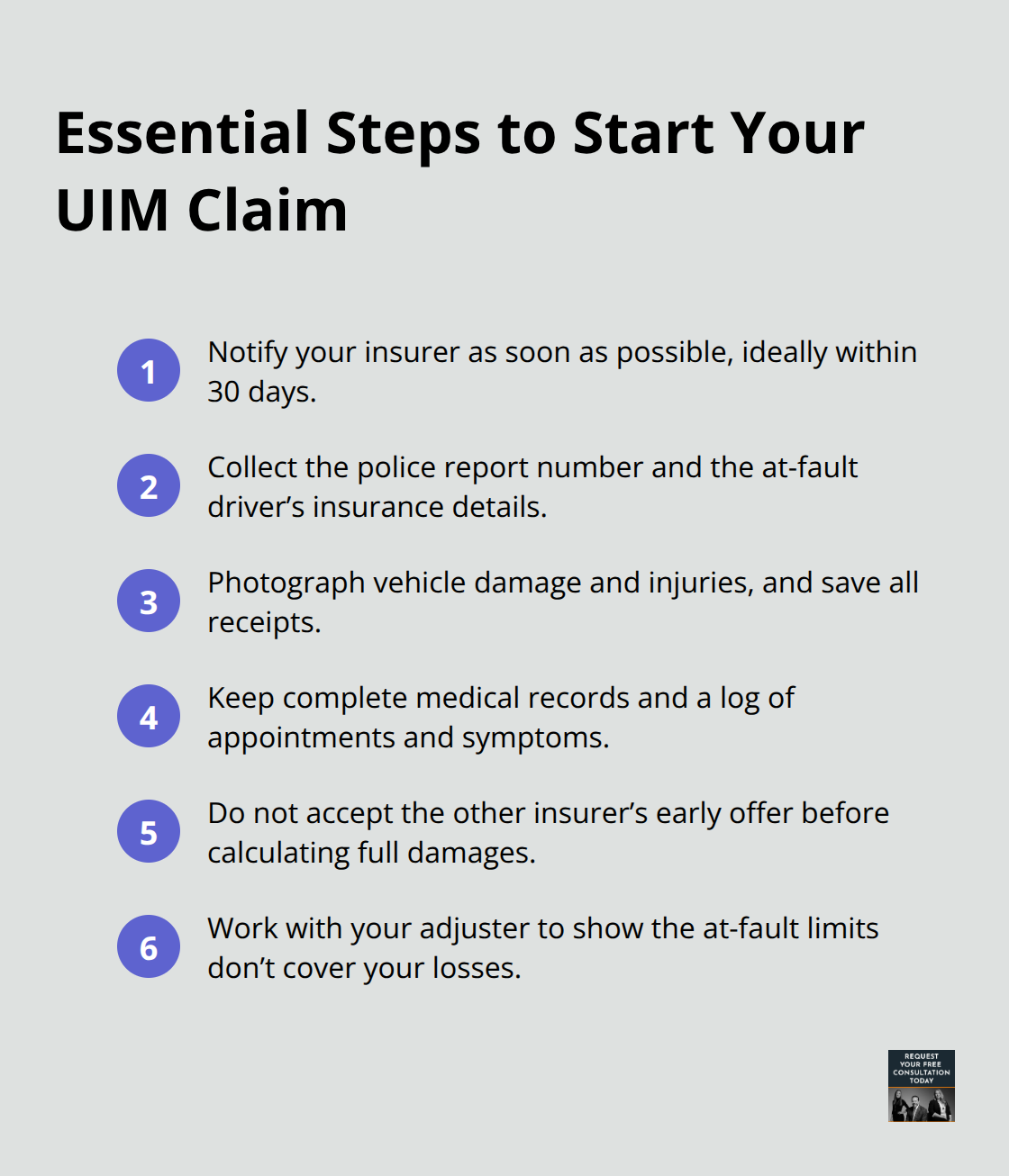
Do not accept the at-fault driver’s insurer’s settlement offer before calculating your full damages, as accepting it may bar your underinsured motorist claim. Document every medical appointment, prescription cost, and lost wage from missed work. The National Highway Traffic Safety Administration reports that the average serious injury accident generates medical expenses exceeding $100,000, yet most drivers carry liability limits between $15,000 and $50,000. Your claim must demonstrate that the at-fault driver’s coverage cannot cover your documented losses.
Calculate Your Actual Damages With Precision
Calculating your actual damages requires you to itemize medical treatment, lost income, property damage, and pain and suffering. Request itemized bills from all healthcare providers rather than accepting summary statements. If you earned $60 per hour and missed eight weeks of work due to recovery, that represents $19,200 in lost wages alone.
Include future medical treatment your doctors project you will need. Many accident victims underestimate their damages by failing to account for ongoing physical therapy, mental health treatment, or reduced earning capacity. Your underinsured motorist coverage limit cannot exceed your own policy limits, so if you carry $100,000 in underinsured motorist coverage but your damages total $150,000 and the at-fault driver has $25,000 in liability coverage, your maximum recovery is $100,000.
Recognize Common Insurer Tactics
Insurance companies frequently dispute damage calculations and offer lowball settlements, hoping you will accept rather than pursue litigation. Resist initial settlement offers until your medical treatment stabilizes and you have complete documentation of all losses. Common obstacles include insurers claiming your injuries preexisted the accident, disputing causation between the collision and your symptoms, or arguing you failed to mitigate damages by refusing recommended treatment.
Combat these tactics with medical records clearly linking your injuries to the accident and documentation showing you followed all medical advice. Insurance companies test your resolve with aggressive negotiation strategies, but solid evidence defeats their arguments. The next section addresses the obstacles you will face and how to overcome them strategically.
How Much Underinsured Motorist Coverage Do You Actually Need
Coverage Limits That Match Your Financial Reality
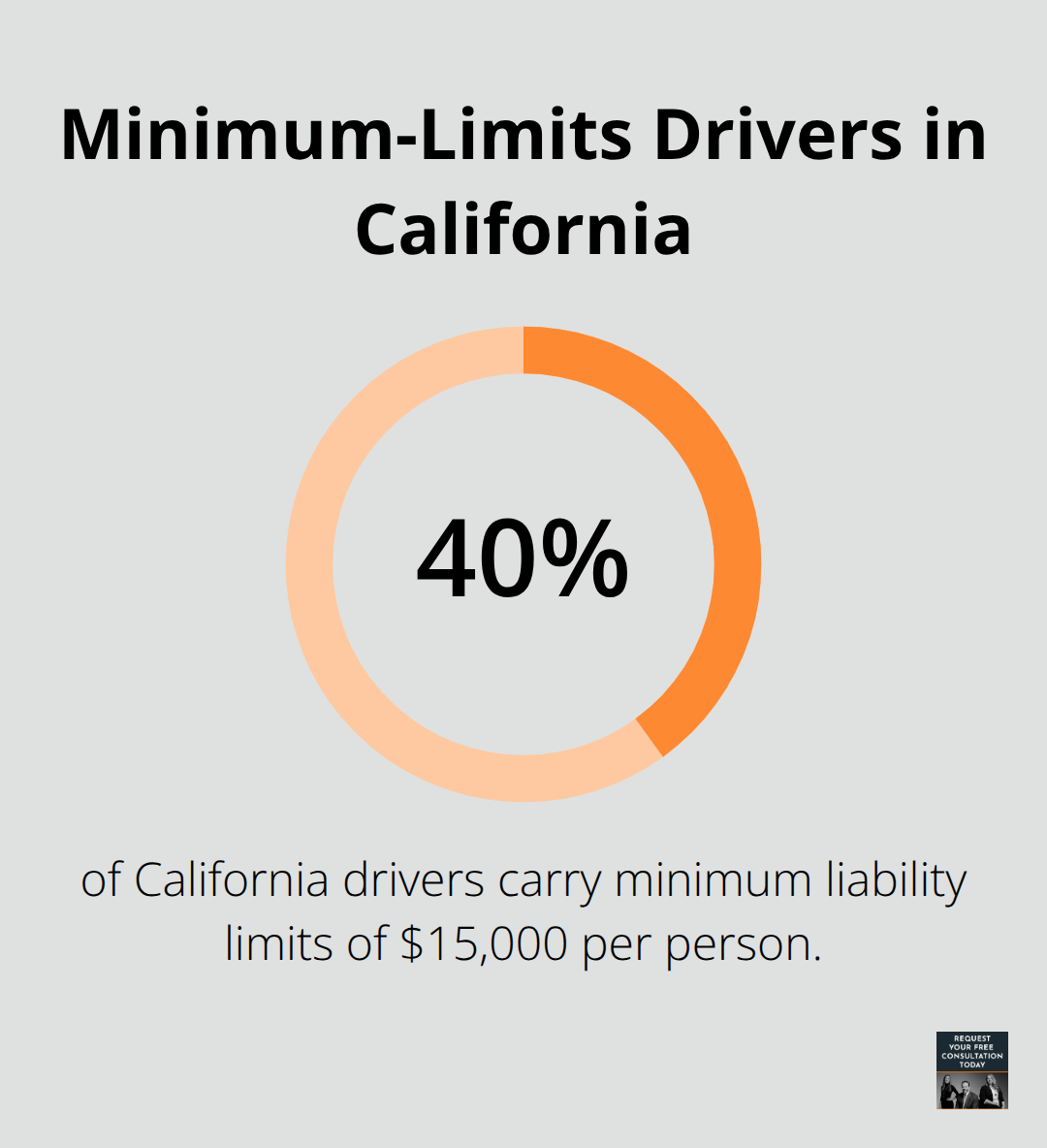
California law allows you to carry underinsured motorist coverage up to your policy limits, but many residents choose inadequate amounts without understanding the financial consequences. The Insurance Information Institute reports that the average injury claim from a moderate accident exceeds $25,000, yet roughly 40 percent of California drivers carry minimum liability limits of $15,000 per person. If you purchase underinsured motorist coverage matching only your liability limits, you face a critical gap when the at-fault driver carries even lower coverage.
We recommend carrying underinsured motorist limits of at least $100,000 per person and $300,000 per accident, particularly if you have significant assets or dependents relying on your income.
This coverage costs approximately $15 to $25 monthly for most drivers, a modest expense that prevents financial devastation after a serious accident. The National Highway Traffic Safety Administration data shows that serious injury accidents generate average medical costs exceeding $100,000, making minimum coverage insufficient for realistic protection. If you earn $50,000 annually and cannot work for six months due to accident injuries, you lose $25,000 in income alone before accounting for medical bills and vehicle damage.
Review Your Current Policy in Fifteen Minutes
Examining your policy document and contacting your insurance agent directly reveals your current underinsured motorist limits, which typically appear under optional coverage sections rather than mandatory protection. Request a full policy breakdown showing your liability limits, uninsured motorist coverage, and underinsured motorist coverage side by side, then compare these amounts to your actual financial exposure. If you own a home, carry substantial retirement savings, or have dependents, your underinsured motorist coverage should reflect these assets and responsibilities.
Higher Protection for High-Risk Areas
High-risk areas including downtown Oakland, central Sacramento, and coastal Santa Cruz County experience higher accident frequencies according to California Highway Patrol data, making adequate underinsured motorist protection non-negotiable for residents in these regions. Drivers in these areas face substantially greater exposure to underinsured motorists, which means your coverage limits must account for this elevated risk.
Stack Coverage Across Multiple Vehicles
Consider stacking coverage if your insurer allows it, which means combining underinsured motorist limits across multiple vehicles to increase your total available protection. This strategy particularly benefits families with multiple cars, effectively doubling or tripling available coverage without purchasing separate policies.
Final Thoughts
Underinsured motorist coverage in California protects your finances when an at-fault driver’s insurance falls short of your actual damages. Without this protection, you absorb thousands in medical bills, lost wages, and vehicle repair costs that liability insurance cannot cover. The gap between minimum liability limits and realistic injury expenses creates genuine financial hardship for accident victims who lack adequate protection.
Acting now to strengthen your coverage prevents catastrophic financial consequences later. The cost difference between minimum and adequate underinsured motorist limits amounts to roughly $15 to $25 monthly, yet this modest investment shields you from six-figure losses after a serious accident. California residents in Santa Cruz County, Sacramento, and Oakland face elevated accident exposure, making this protection particularly important for your financial security.
If you have already been injured in an accident and face disputes with insurance companies over underinsured motorist California claims, Schaar & Silva LLP provides legal guidance for accident victims throughout Santa Cruz County. Our team handles the legal complexities while you focus on recovery, including assistance with medical bill management and property damage evaluation.
