

Vehicle accidents happen daily across Santa Cruz County, with each crash type presenting unique challenges and consequences. Understanding different types of vehicle collisions helps drivers recognize risks and know what to expect if an accident occurs.
We at Schaar & Silva LLP see how collision type directly impacts injury severity, fault determination, and insurance claims. This guide breaks down the most common crash scenarios and their legal implications.
Which Crash Types Cause the Most Damage
Rear-End Collisions Dominate Local Roads
Rear-end collisions account for roughly 40% of all traffic accidents nationwide according to the National Highway Traffic Safety Administration. These crashes happen when drivers follow too closely or fail to brake in time, with speeds often determining injury severity. Highway 1 through Santa Cruz sees frequent rear-end accidents during morning and evening commutes, particularly near the 41st Avenue and Soquel Drive exits where traffic patterns shift rapidly. Whiplash injuries from rear-end impacts cost victims thousands in medical bills, even at speeds as low as 15 mph.
Head-On Collisions Present the Greatest Risk
Head-on crashes represent the deadliest collision type, with fatality rates reaching 58% higher than other accident categories. These accidents frequently happen on winding mountain roads like Highway 9 between Santa Cruz and Saratoga, where narrow lanes and sharp curves create dangerous passing situations. The US Department of Transportation found that median barriers reduce head-on collisions by 70%, yet many rural Santa Cruz County roads lack these safety features.

Speed differentials in head-on crashes often exceed 100 mph combined, making survival difficult even with modern safety equipment.
Side-Impact Crashes Target Vehicle Weak Points
T-bone accidents strike vehicles at their most vulnerable points, with 71% of fatal intersection crashes occurring in rural areas according to the Fatality Analysis Reporting System. Santa Cruz intersections like Water Street and Ocean Street experience higher T-bone accident rates due to limited sight lines and heavy pedestrian traffic. Side-impact crashes cause severe injuries because vehicle doors provide minimal protection compared to front and rear crumple zones. Passengers on the impact side face injury rates 40% higher than other occupants.
The severity of these collision types depends heavily on several physical factors that determine how much damage occurs during impact.
What Determines How Severe Your Crash Will Be
The physics of vehicle collisions follow predictable patterns that directly affect injury outcomes and property damage. Speed remains the single most important factor in collision severity, with crash forces that increase exponentially rather than linearly. A collision at 35 mph generates four times more force than one at 17.5 mph, according to crash test data from the Insurance Institute for Highway Safety.
Speed Creates Exponential Force Increases
Santa Cruz County drivers face particular risks on Highway 17, where speed-related crashes jumped 23% between 2019 and 2022 despite reduced traffic volumes. The relationship between speed and impact force follows mathematical principles that make small speed increases dramatically more dangerous. At 50 mph, stopping distance reaches 125 feet compared to just 40 feet at 25 mph, which explains why highway accidents cause more severe injuries than city crashes.

Mass and Momentum Create Unequal Outcomes
Vehicle weight dramatically affects crash severity, with heavier vehicles that transfer more force to lighter ones during impact. A 6,000-pound SUV that strikes a 2,800-pound sedan creates a 53% greater force transfer to the smaller vehicle compared to crashes between similar-weight cars. This explains why pickup truck versus car collisions in Santa Cruz County result in hospitalization rates 67% higher for car occupants.
Safety Features Reduce but Don’t Eliminate Risk
Modern safety features like crumple zones and airbags reduce fatality risk by 45% for front-seat occupants, but these systems work best when vehicles match in size and weight. Older vehicles that lack electronic stability control face rollover risks three times higher than newer models (particularly dangerous on curved roads like Empire Grade where several fatal rollovers occurred in recent years). Vehicle design advances continue to improve crash outcomes, yet they cannot overcome the fundamental physics of high-speed impacts.
These physical factors work together with legal and insurance considerations that vary significantly based on how your accident occurs.
How Does Collision Type Affect Your Legal Case
Fault Determination Follows Collision Patterns
Fault determination in vehicle accidents follows specific patterns that vary dramatically based on collision type. Rear-end crashes create the strongest presumption of trailing driver liability while head-on and T-bone accidents require more complex analysis. California Vehicle Code Section 21703 establishes that drivers must maintain safe distances, which makes rear-end collision cases straightforward for victims who face automatic fault presumption against the driver who strikes them. Side-impact crashes at intersections present complicated liability scenarios where traffic signal status, right-of-way violations, and visibility factors create disputed fault situations that require extensive investigation.
Insurance Coverage Changes with Accident Severity
California’s minimum insurance requirements of $15,000 per person and $30,000 per accident often prove inadequate for head-on and T-bone collisions where medical costs regularly exceed $50,000 (according to the California Department of Insurance). Uninsured motorist coverage becomes critical in Santa Cruz County where approximately 16% of drivers lack proper insurance, particularly for hit-and-run accidents that account for 13 incidents annually in local collision data. Property damage claims face different challenges based on collision type, with total loss determinations in head-on crashes that require gap insurance to cover loan balances while rear-end damage often stays within policy limits.
Documentation Requirements Increase with Crash Complexity
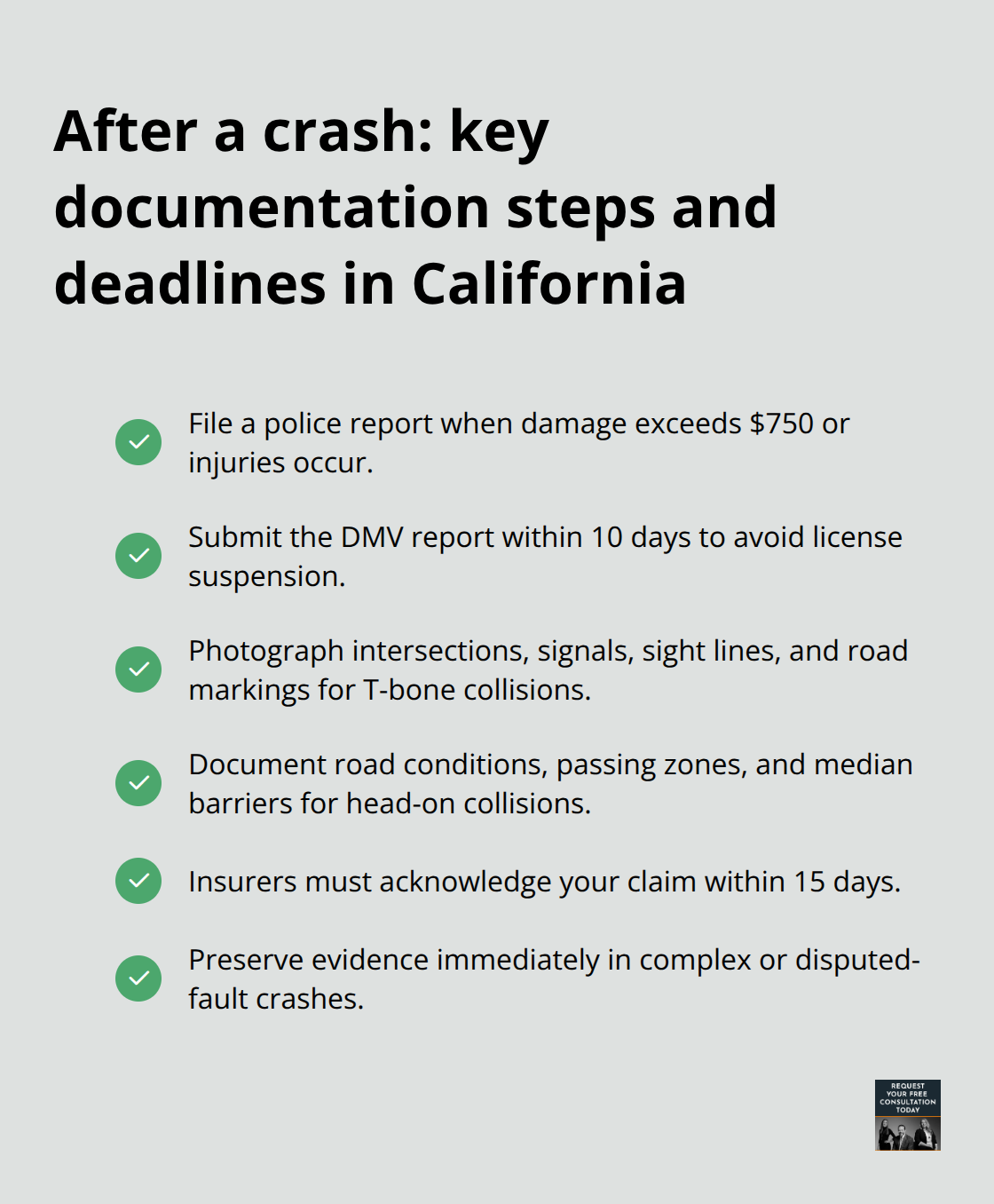
Police reports become mandatory when damage exceeds $750 or injuries occur, with victims who have just 10 days to file DMV reports or face license suspension under California law. T-bone accidents require intersection photographs that show traffic signals, sight lines, and road markings while head-on collisions need documentation of road conditions, zones where drivers can pass, and any median barriers present. Insurance companies must acknowledge claims within 15 days according to California Fair Claims Settlement Practices Regulations, but complex collision scenarios that involve multiple vehicles or disputed fault can extend investigation periods significantly (which makes immediate evidence preservation critical for successful claims).
Final Thoughts
Different types of vehicle collisions present unique risks and legal challenges for Santa Cruz County drivers. Rear-end crashes dominate local roads with their 40% accident rate, while head-on collisions create the highest fatality risk at 58% above other crash types. Side-impact accidents strike vehicle weak points where doors provide minimal protection compared to front and rear crumple zones.
Speed drives collision severity more than any other factor, with crash forces that multiply exponentially rather than linearly. A 35 mph impact creates four times more force than one at 17.5 mph (making small speed increases dramatically more dangerous). Vehicle weight differences produce unequal outcomes, particularly when SUVs strike smaller cars and transfer greater force to lighter vehicles.
After any accident, call 911 immediately and document the scene with photographs. Gather witness information and avoid recorded statements to insurance companies. We at Schaar & Silva LLP help Santa Cruz County accident victims navigate complex legal situations while they focus on recovery.
