

A truck accident can leave you facing massive medical bills while you’re still recovering. Medical liens allow you to get the treatment you need without paying out of pocket right now.
At Schaar & Silva LLP, we help accident victims understand how truck accident medical liens work and protect their rights. This guide walks you through the process so you can focus on healing instead of worrying about doctor payments.
How Medical Liens Actually Work
A medical lien is a legal claim that a healthcare provider places on your settlement or judgment to recover the cost of treating your injuries. When you’re injured in a truck accident and need immediate medical care, hospitals and doctors won’t turn you away while waiting years for payment through litigation. Instead, they treat you now and place a lien against whatever money you recover later. This arrangement protects you from collection agencies or credit damage while your truck accident claim moves forward. The provider becomes a creditor with a guaranteed claim on your settlement proceeds, positioned ahead of most other debts you might owe.
Understanding the Filing Process
Medical providers file liens through a formal legal notice that gets recorded with the court handling your case. In California, healthcare providers typically file what’s called a hospital lien under California Code of Civil Procedure Section 481.5, or they use a general medical lien agreement. Your hospital or medical facility documents the treatment they provided, calculates the total cost, and submits the lien paperwork to the court. Once filed, the lien becomes official and your settlement funds are held in reserve to pay that obligation. You’ll receive notification of the lien, and it becomes part of your case file. Multiple providers can file liens, meaning you might have claims from an emergency room, an orthopedic surgeon, a physical therapy clinic, and an imaging center all stacked against your eventual recovery. The more serious your injuries from the truck accident, the more medical providers typically get involved and file liens.
The Timeline Reality
Medical lien resolution doesn’t happen quickly. From the date your case settles until all liens are paid and you receive your net proceeds typically takes 30 to 90 days, depending on how many providers filed claims and whether disputes exist over the lien amounts. During this period, your attorney’s office coordinates with each medical provider, verifies the amounts owed, and negotiates any reductions. California law actually allows healthcare providers to charge more than what insurance companies would pay, which is why negotiation matters significantly. If a provider treated you for $8,000 but Medicare would have paid $4,200, they might initially demand the full $8,000 as a lien amount. The negotiation phase is where your legal representation becomes valuable. Once all liens are negotiated and agreed upon, the funds get distributed according to California’s priority rules, with medical liens typically paid before you receive your portion.
Why Lien Negotiation Protects Your Recovery
Healthcare providers often inflate lien amounts because they know most accident victims lack the knowledge to push back effectively. A provider might claim $12,000 in charges when the actual reasonable cost was $7,500. Without someone advocating for you, that extra $4,500 comes directly out of your pocket. Negotiating liens requires understanding what similar treatment costs in your area and knowing which charges are actually reasonable. Your attorney can challenge inflated amounts and work with providers to reduce liens to fair market rates. This negotiation directly increases the money you actually take home from your settlement.
Moving Forward with Your Case
Understanding how medical liens work puts you in a stronger position as your truck accident case progresses. The next section covers the specific benefits these liens provide to accident victims like you, and how they actually protect your ability to recover without financial stress during litigation.
Why Medical Liens Let You Heal Without Financial Panic
The Problem Medical Liens Solve
Medical liens solve a problem that would otherwise force you into an impossible choice: skip treatment to avoid debt, or get treated and face collection agencies while recovering. When you’re injured in a truck accident, waiting months or years for your case to settle shouldn’t mean postponing necessary surgery, physical therapy, or specialist care. Medical liens eliminate that pressure entirely. Healthcare providers treat you now because they know they’ll get paid from your settlement later. This arrangement means you can pursue aggressive treatment without watching your credit score tank or receiving collection calls at home.
The American Hospital Association reports that medical debt remains the leading cause of personal bankruptcy in the United States, with over 530,000 families filing annually due to healthcare costs. Medical liens keep you out of that statistic by removing the financial barrier between you and the care your injuries actually require.
How Medical Liens Protect Your Recovery Speed
Accident recovery involves more than physical healing. Research from the Journal of Trauma & Acute Care Surgery shows that financial stress during recovery significantly delays healing and increases depression and anxiety in injured patients. When you’re not constantly worrying about how you’ll pay the emergency room bill, the orthopedic surgeon, or the imaging center, your body can focus on actual recovery.
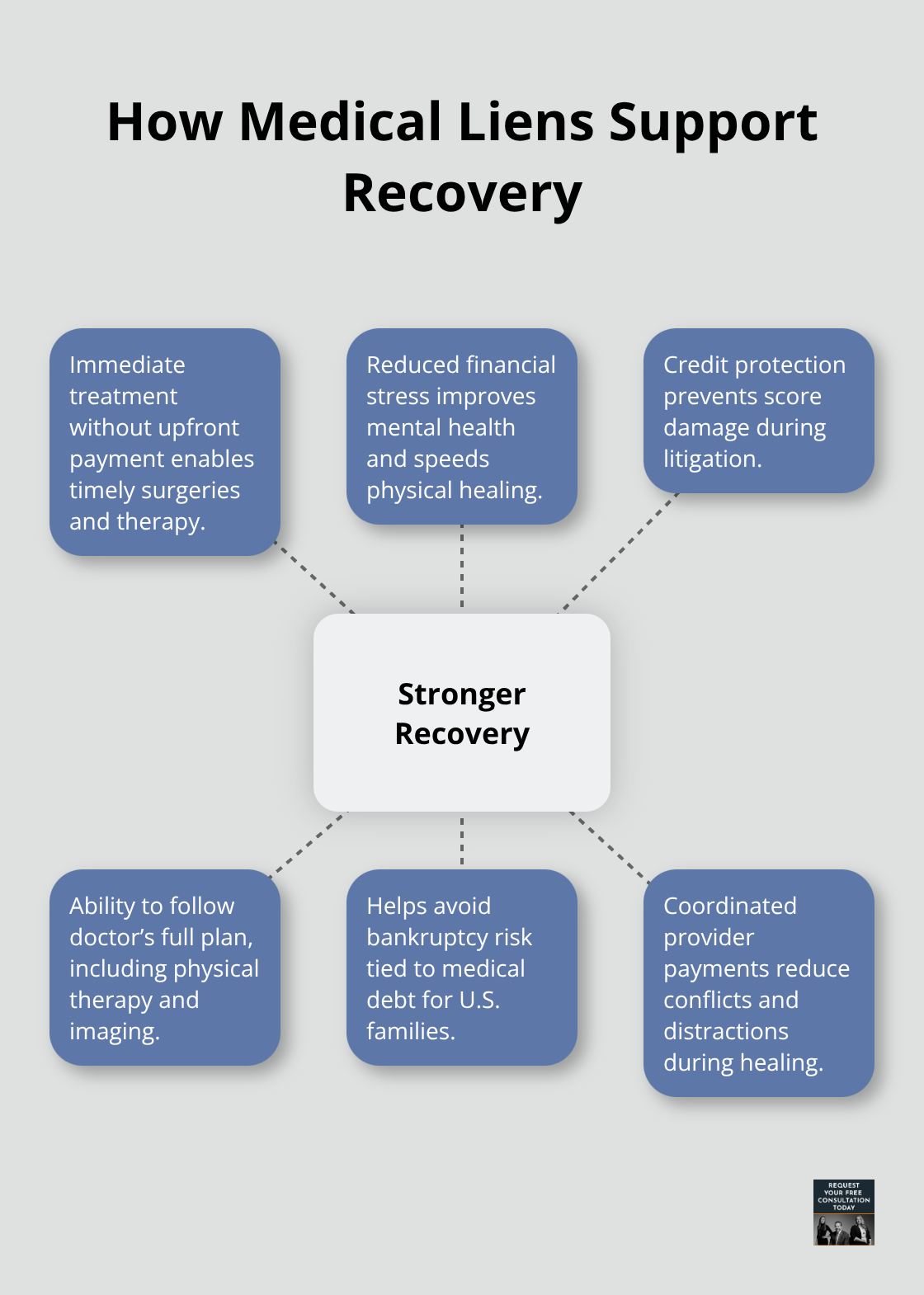
You can attend every physical therapy appointment without calculating whether you can afford it. You can follow your doctor’s recommendations without compromise. Patients with medical lien protection recover faster and more completely than those juggling multiple medical debts.
Protecting Your Credit During Litigation
Medical liens protect your credit during the litigation process. Your settlement typically takes 6 to 18 months to resolve. Without a lien arrangement, those medical bills would go unpaid during this entire period, destroying your credit rating and making it harder to get loans, housing, or employment. The lien keeps providers satisfied that payment is coming while your credit stays clean and your focus stays on healing, not financial survival.
This protection matters because your credit score affects far more than just borrowing capacity. Landlords check credit reports, employers sometimes review them, and insurance companies use them to set rates. A truck accident shouldn’t derail your financial life for years after you recover physically.
Managing Multiple Medical Providers
Serious truck accidents often involve treatment from multiple providers (emergency rooms, orthopedic surgeons, imaging centers, and rehabilitation facilities). Each one can file a separate lien against your settlement. Medical liens handle this complexity by creating a clear priority system. Your attorney coordinates with all providers, verifies amounts owed, and negotiates reductions where appropriate. This coordination prevents providers from competing against each other or demanding unreasonable amounts. Without this structure, you’d face collection calls from five different facilities simultaneously while trying to heal.
The next section covers the real challenges that arise when managing these liens and how to navigate them effectively.
The Real Obstacles You’ll Face with Medical Liens
Healthcare Providers Inflate Charges Without Accountability
Medical liens sound straightforward until you negotiate them. Healthcare providers know most accident victims won’t fight back on inflated charges, so they demand amounts far above what the treatment actually cost. A hospital might bill $15,000 for emergency room care and imaging that costs $6,000 at another facility across town. Providers leverage this knowledge because they understand you’re injured, desperate for treatment, and unlikely to comparison shop while bleeding in an ambulance.
California law permits healthcare providers to charge rates that far exceed insurance reimbursement rates, which creates a massive gap between what they bill and what’s reasonable. The negotiation phase separates victims who recover their full settlement from those who lose thousands to unnecessary medical debt. Without someone pushing back with concrete data about regional costs, you’ll simply accept whatever number the provider demands and watch that money disappear from your settlement. An attorney who knows the actual market rates for treatment in Santa Cruz County, Sacramento, and Oakland can challenge these inflated amounts effectively.
Coordinating Multiple Liens Requires Strategic Management
A serious truck accident generates liens from an emergency room, orthopedic surgeon, neurologist, physical therapy clinic, imaging center, and possibly a rehabilitation facility. Each provider files independently and wants priority in the payment queue. Some refuse to negotiate while others become reasonable when presented with evidence that their charges exceed regional standards.
The payment order matters tremendously because California prioritizes certain liens over others, and your net recovery depends entirely on how these competing claims get resolved. One provider might accept a 40 percent reduction while another demands full payment, creating an unequal negotiation landscape that requires careful strategy. Coordinating across five or six different medical facilities while managing your own recovery is practically impossible without professional help. The difference between passive acceptance and active negotiation typically ranges from $3,000 to $8,000 in your favor, depending on the severity of your injuries and the number of providers involved in your treatment.
Understanding Priority and Payment Order
California establishes clear rules about which liens get paid first and which ones wait. Hospital liens under California Code of Civil Procedure Section 481.5 receive priority over general medical liens in many situations. This priority system means some providers get paid in full while others receive partial payment or wait longer for their money. Understanding these rules prevents you from making agreements that inadvertently harm your recovery. A provider filing a hospital lien might receive payment before one filing a standard medical lien, even if both treated you for similar injuries. Your settlement funds must satisfy liens in the correct order, and mistakes in this process cost you money directly.
Final Thoughts
Medical liens create a balanced system that protects both you and the healthcare providers who treated your injuries. Providers receive payment for their services without waiting years for your case to settle, while you obtain necessary medical care without facing collection agencies or credit damage during litigation. This arrangement removes the financial barrier between injured accident victims and the treatment they need to recover properly.
The complexity of truck accident medical liens demands professional guidance, as California’s priority rules, negotiation strategies, and lien reduction opportunities require someone who understands the system and knows regional market rates for medical services in your area. We at Schaar & Silva LLP help accident victims navigate these complexities by coordinating with healthcare providers, challenging inflated charges, and protecting your net recovery. Our team handles the lien negotiations so you can focus entirely on healing rather than managing multiple medical facilities and their competing payment demands.
If you’re facing medical bills from a truck accident in Santa Cruz County, Sacramento, or Oakland, contact Schaar & Silva LLP to discuss your specific situation and learn how we can protect your recovery while keeping your medical providers satisfied. The difference between passive acceptance and active negotiation on your medical liens typically ranges from thousands of dollars in your favor, and that money belongs in your pocket, not going to unnecessary charges.
