
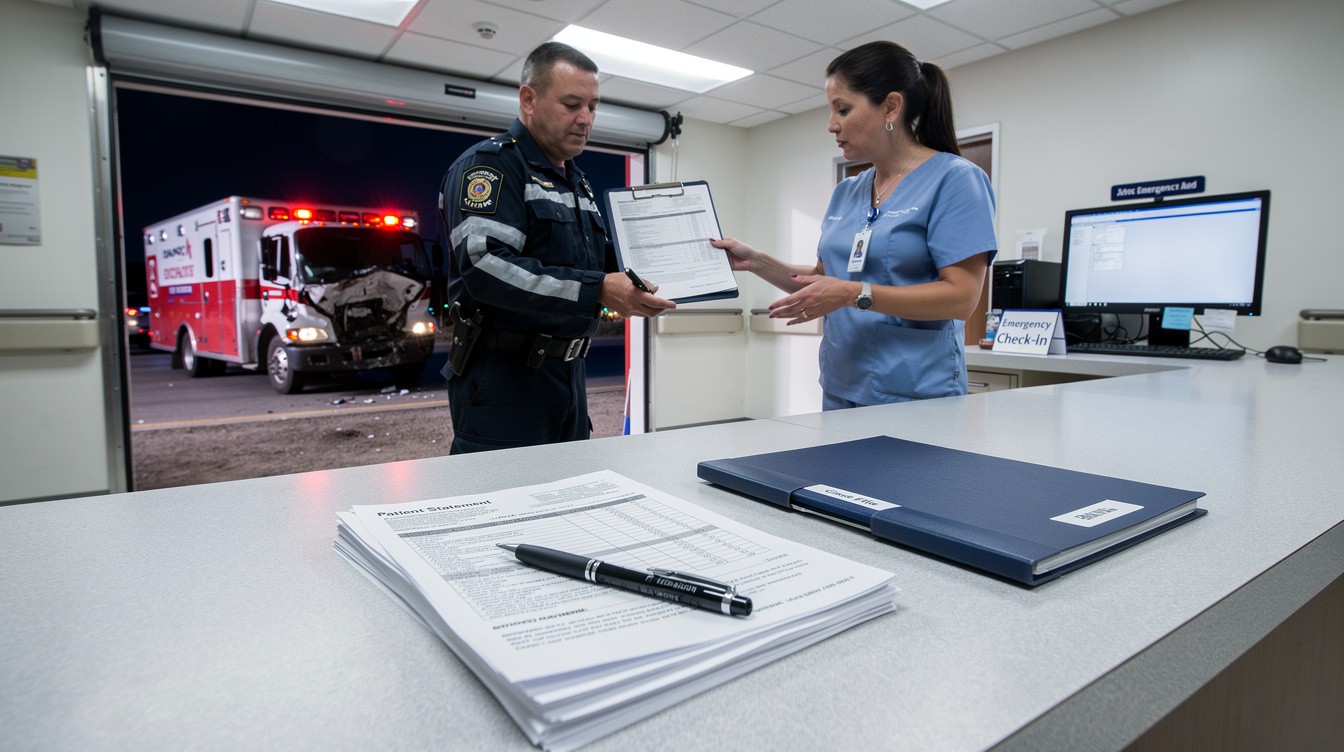
Truck accidents often leave victims facing massive medical bills while they’re still recovering. Medical liens offer a way to get the care you need without paying out of pocket right now.
At Schaar & Silva LLP, we help accident victims understand how these financial tools work and how to use them effectively during settlement negotiations.
How Medical Liens Actually Work
A medical lien is a legal claim that a healthcare provider places on your future settlement to secure payment for treatment you received after a truck accident. When you cannot pay medical bills upfront, hospitals and doctors treat you now and recover their costs later from your settlement or verdict. This arrangement lets you access care immediately without depleting savings or going into personal debt. The provider files a lien notice with the at-fault driver’s insurance company and tracks the claim through your case. Once your settlement arrives, the lien amount is paid directly from those funds before you receive your portion, which is why understanding lien mechanics matters for your final recovery.
Three Main Types of Liens You’ll Encounter
Statutory liens come from government programs like Medi-Cal and Medicare, which have specific rules about how much they can recover. Medi-Cal liens are governed by Welfare and Institutions Code Section 14124.70 and must be reduced by 25 percent to account for attorney fees and case costs. Hospital liens, created under California Civil Code Section 3045.1, are capped at 50 percent of your net recovery after legal fees and costs are deducted. Private insurance subrogation applies when your health insurer pays bills and demands repayment from your settlement. Contractual liens from private providers and ERISA plans follow different rules than statutory liens. Consensual liens occur when you agree with an out-of-network provider to treat you on credit. Each type has different caps, reduction formulas, and negotiation opportunities.
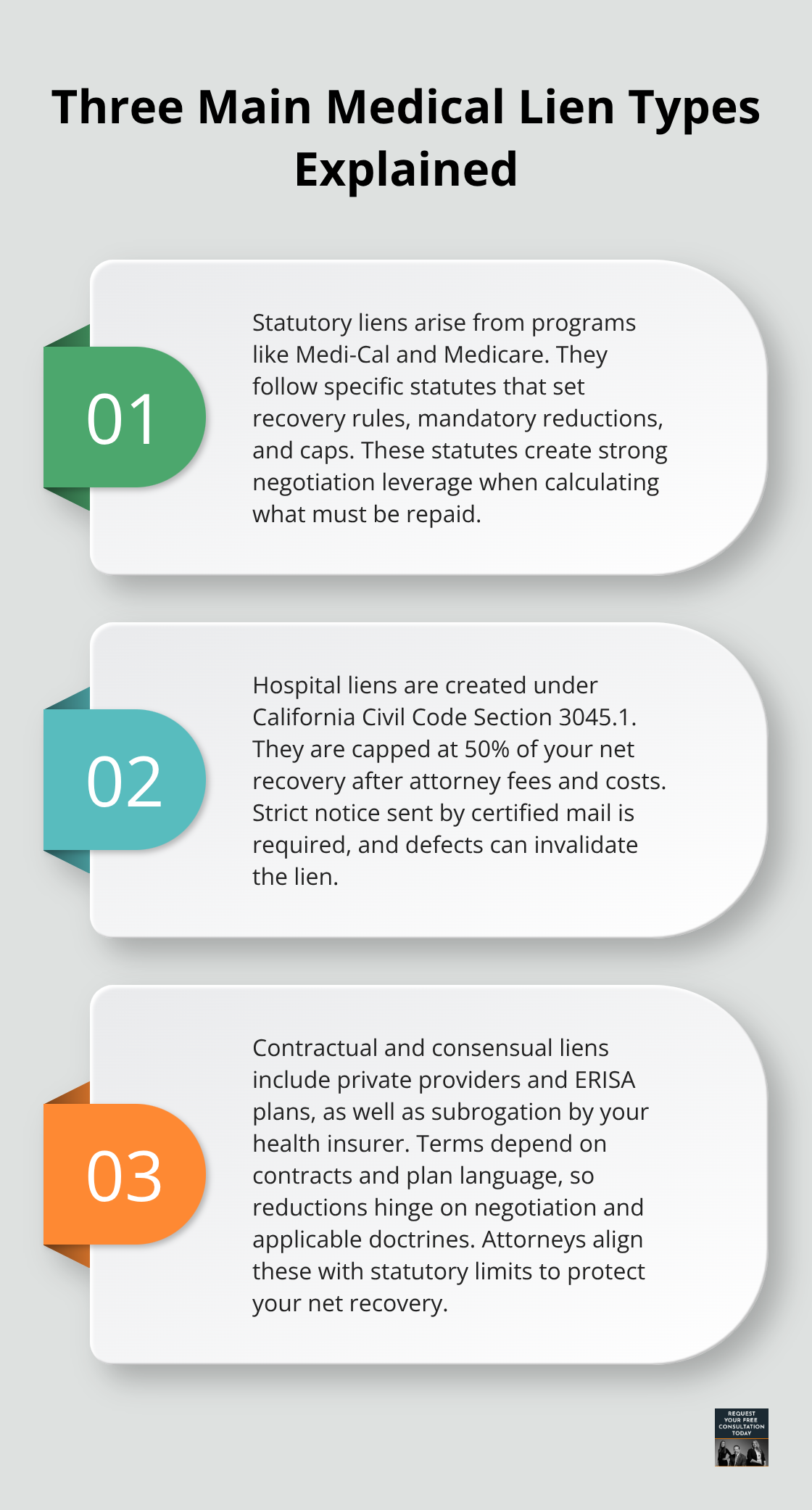
The Hospital Lien Act requires strict notice procedures sent by certified mail to the liable party and their insurer; failure to follow these rules can invalidate the entire lien claim. Medi-Cal’s 50 percent cap strengthens your position by preventing them from taking more than half your net recovery regardless of bill amounts.
Why Lien Amounts Often Don’t Match Your Bills
Hospital bills for truck accident injuries are frequently inflated compared to what insurance companies and settlement negotiations actually recognize as reasonable value. Under the Howell v. Hamilton Meats framework, courts and settlement negotiations anchor recovery to the market value or reasonable cash value of care, not the original billed amount. A hospital might bill $85,000 for emergency and surgical care, but the lien claim can be negotiated down significantly when an experienced attorney handles the reduction discussions. This is why the difference between representing yourself and hiring counsel matters so much. Unrepresented claimants recover approximately 3.5 times less than those with legal representation, according to Insurance Research Council data. Lien holders know that many accident victims do not understand negotiation rights and will accept inflated amounts. Medical providers are willing to settle liens for cash-out offers that pay a percentage of the bill immediately in exchange for closing the claim faster. Pro-rata distribution ensures that when total medical claims exceed the settlement amount, you do not bear the entire shortfall alone. When you work with an attorney who understands lien reduction strategies, you can coordinate with healthcare providers to maximize your net recovery from the settlement-a critical step that determines how much money you actually take home after your case resolves.
Why Medical Liens Let You Access Care Now
The Problem Medical Liens Solve
Medical liens solve a problem that crushes most truck accident victims: you need treatment immediately, but the at-fault driver’s insurance won’t pay for months. Without a lien, you face three bad options-drain savings to pay out of pocket, skip treatment and worsen your injuries, or rack up personal debt while waiting for settlement. A medical lien eliminates this trap. Your doctor or hospital treats you now and collects payment later from your settlement, which means you can start physical therapy, imaging, specialist visits, and surgery without paying a dime upfront.
This matters because delaying treatment after a truck accident often makes injuries worse. The longer you wait for an MRI or surgery, the harder recovery becomes, and courts recognize this through the concept of maximum medical improvement, which determines when your case is truly ready to settle. Accessing care immediately positions your case for better outcomes because your medical records show consistent, timely treatment rather than gaps that insurance companies use to argue injuries are less serious than they actually are.
Real Costs You Avoid With a Lien
After a truck accident in California, emergency room visits run $1,500 to $3,000, hospitalizations exceed $50,000, and ongoing physical therapy adds thousands more. Without a lien, you would need health insurance to cover these costs, and your health insurer would then demand repayment from your settlement through subrogation. A medical lien shifts this burden to the provider instead of you. The provider absorbs the risk while you focus on healing without financial panic.
How California Law Protects Your Recovery
California law builds in protections that prevent medical providers from consuming your entire settlement. Government program liens like Medi-Cal must be reduced by 25 percent for attorney fees and face a hard 50 percent cap on recovery, meaning Medi-Cal cannot take more than half your net settlement no matter how large the original bills were. Hospital liens under California Civil Code Section 3045.1 also cap at 50 percent of net recovery after legal fees.
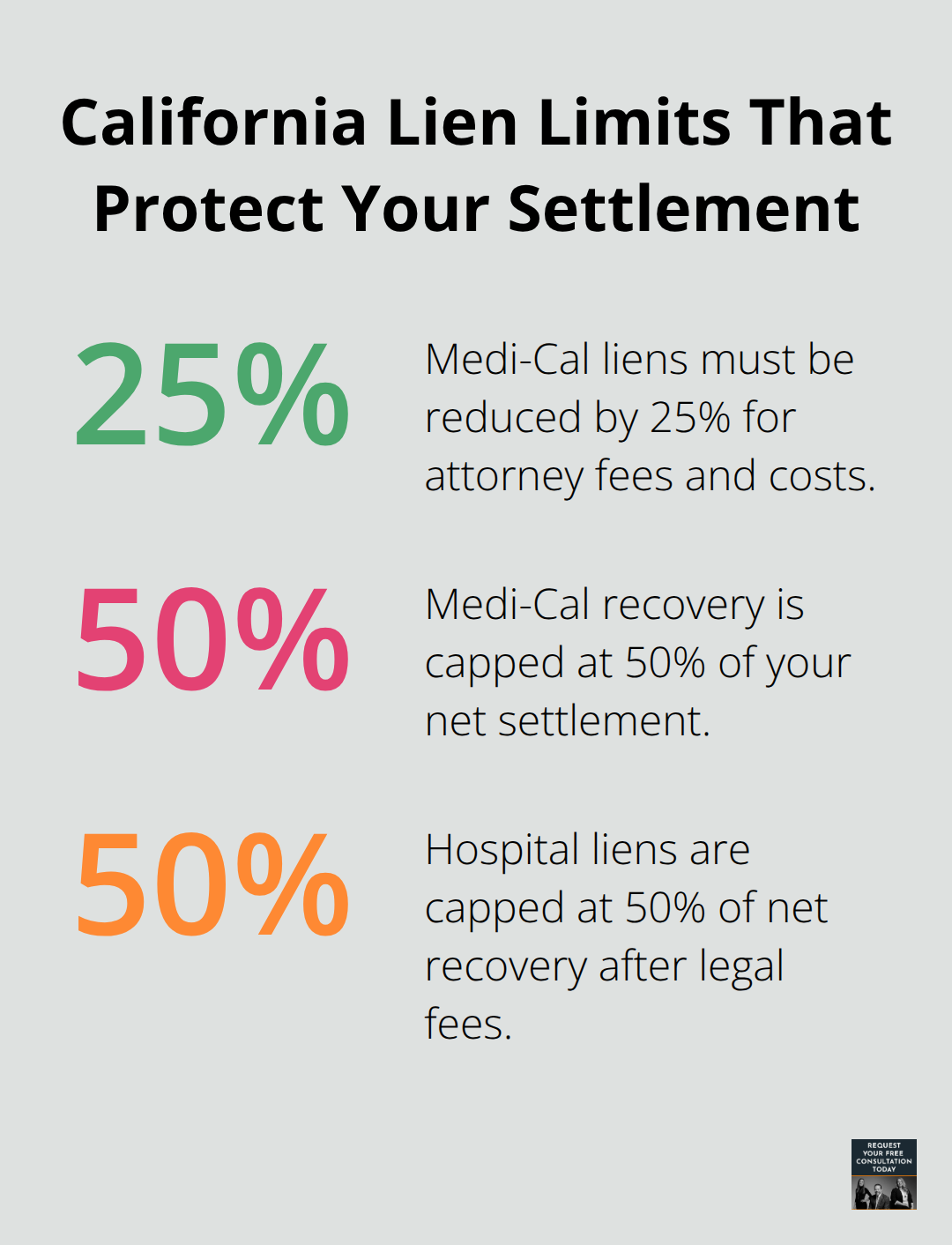
Private insurers pursuing subrogation can also be reduced through the Common Fund Doctrine, which requires them to share in the cost of litigation.
The Howell v. Hamilton Meats framework anchors lien negotiations to reasonable market value rather than inflated hospital billing. A hospital might bill $85,000 for emergency and surgical care, but experienced attorneys negotiate these amounts down significantly. This is why representation matters so much-unrepresented claimants recover approximately 3.5 times less than those with legal counsel, according to Insurance Research Council data. Medical providers know that many accident victims do not understand negotiation rights and will accept inflated amounts without question.
Moving Forward With Your Case
The financial protection a lien provides extends far beyond avoiding upfront costs. It positions you to heal while the legal process unfolds. Once you understand how liens work and what protections California law provides, the next step involves coordinating with your healthcare providers to ensure they understand the lien process and can document your treatment in ways that support your case value.
How to Manage Liens Before Settlement
Healthcare providers file liens against your settlement with clear expectations for payment, but those expectations do not lock you into accepting their initial demands. The real work happens in the months between your accident and settlement when you coordinate with providers, understand what they actually owe, and negotiate reductions that protect your recovery. Most truck accident victims never contact their lien holders to discuss payment terms, which costs them significantly because liens are negotiable and providers know this.
Request Itemized Bills and Identify Errors
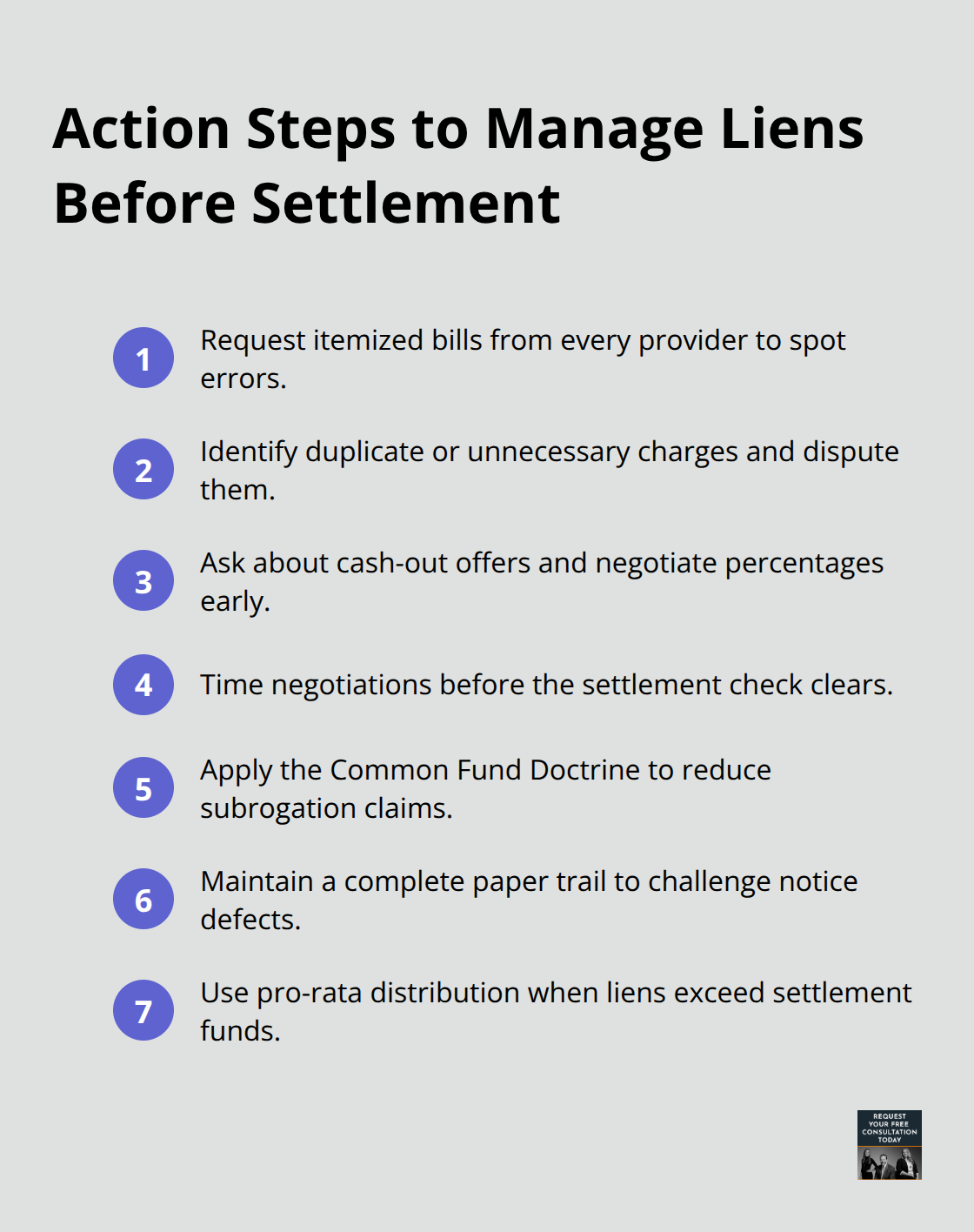
Start by requesting an itemized bill from every provider who treated you after the accident. Do not accept summary statements or estimates. Itemized bills break down every service, imaging study, procedure, and follow-up visit with dates and costs, which gives you the information needed to identify billing errors or inflated charges. Many hospital bills contain duplicate charges, services that were not medically necessary, or fees that far exceed what insurance companies recognize as reasonable value. Once you have itemized records in hand, you can spot problems that reduce the actual lien amount owed.
Negotiate Cash-Out Offers With Providers
Contact each provider directly and ask about cash-out offers. A cash-out means paying a percentage of the bill now in exchange for closing the lien, and providers often accept 40 to 60 percent of the original amount because they avoid litigation costs and receive immediate payment instead of waiting for settlement. This negotiation becomes easier when you have legal representation because providers know that an attorney will pursue reductions through the Howell framework and statutory caps anyway. If you represent yourself, providers may not take your reduction requests seriously. Timing also matters-challenge liens before your settlement is finalized, because once the check clears, providers have already extracted their money. Waiting until settlement is imminent puts you in a weaker position because providers know the money is coming and will resist reductions.
Understand the Full Settlement Math
Understanding what liens actually cost you requires looking at the full settlement picture, not just the lien amount in isolation. A truck accident settlement in California covers medical bills, lost wages, pain and suffering, and other damages, but multiple claims compete for the same funds. If your settlement is $325,000 and you have medical liens totaling $85,000, health insurance subrogation of $28,000, and attorney fees at 33 percent, the math shows why lien reduction strategy matters.
Statutory caps protect you significantly here. Medi-Cal liens face a mandatory 25 percent reduction for attorney fees and costs, plus a hard 50 percent cap on total recovery. Hospital liens under California Civil Code Section 3045.1 also cap at 50 percent of your net recovery after legal fees are deducted. This means if your settlement is $325,000 and attorney fees are $107,250, your net before liens is $217,750. Medi-Cal cannot take more than $108,875 no matter how large the original bills were. Private insurance subrogation claims can be reduced through the Common Fund Doctrine, which requires health insurers to share in the cost of your attorney’s work.
In real settlements, experienced attorneys negotiate these reductions down significantly. A case with $85,000 in medical liens often settles with liens reduced to $42,000 or less, and subrogation of $28,000 negotiated down to $14,000. That difference of $57,000 stays in your pocket instead of going to lien holders. The providers are willing to accept these reductions because they understand that if you receive nothing from settlement, they receive nothing either.
Protect Yourself Through Pro-Rata Distribution
Pro-rata distribution also protects you when total liens exceed available settlement funds. If liens add up to $100,000 but your settlement is only $80,000, the law prevents any single lien holder from taking the entire amount. Instead, each lien holder receives a proportional share based on their bill amount, ensuring you do not absorb the entire shortfall. Coordinating this process requires documentation. Keep copies of all lien notices, bills, and correspondence with providers. Track which liens are statutory versus contractual because they reduce differently. Note the dates each provider filed their lien and whether proper notice was given to the at-fault driver’s insurance company. Defects in notice procedures can invalidate liens entirely, which is why reviewing the lien paper trail early matters.
Final Thoughts
Truck accident medical liens serve a clear purpose: they let you access the care you need immediately while your case develops, without draining savings or accumulating personal debt. The financial protections California law provides-statutory caps, reduction formulas, and pro-rata distribution-mean liens do not have to consume your entire settlement. What matters most is understanding how they work and negotiating strategically before settlement arrives.
The real value of truck accident medical liens emerges when you coordinate with healthcare providers, request itemized bills, and challenge inflated amounts through the Howell framework. Statutory liens from Medi-Cal and Medicare face mandatory reductions, hospital liens cap at 50 percent of net recovery, and private insurance subrogation can be reduced through the Common Fund Doctrine. Unrepresented claimants recover approximately 3.5 times less than those with legal representation, according to Insurance Research Council data, because they do not know how to negotiate these reductions.
If you have been in a truck accident in Santa Cruz County, Sacramento, or Oakland, the next step is a free consultation to assess your case and discuss how medical liens and other financial tools can support your recovery. We at Schaar & Silva LLP handle the legal intricacies so you can focus on healing.
