
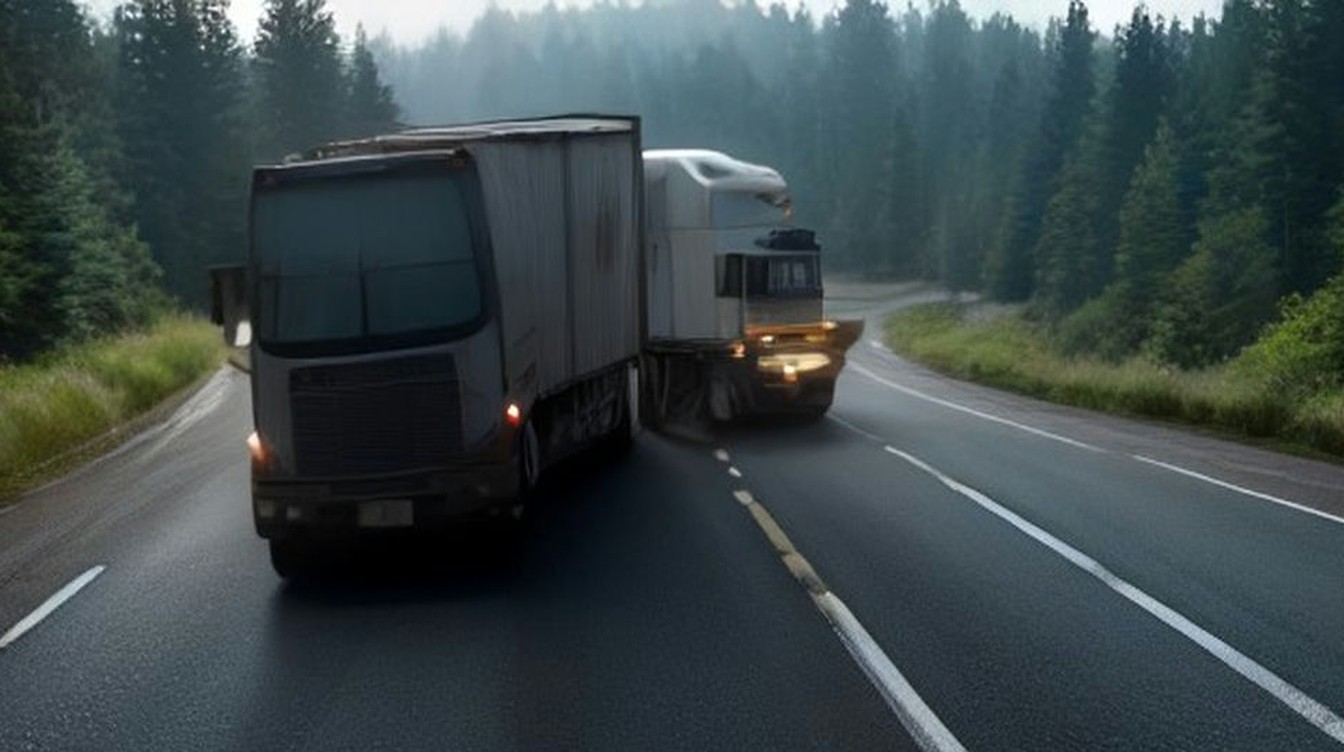
A truck accident in Santa Cruz County can change your life in the time it takes a loaded big rig to cross the center line or drift into your lane. Commercial trucks share Highway 1, Highway 17, and the narrow two-lane roads that connect farms, quarries, and mountain communities with commuters, tourists, and families. When a vehicle that weighs many times more than a passenger car collides with you, the injuries are often serious, and the questions about who is responsible can become complicated quickly.
At Schaar & Silva LLP, we help people across Santa Cruz County who have been hurt in car and truck accidents so you can move forward with confidence. This guide explains the California truck speed and lane rules that often decide fault, how responsibility can extend beyond the driver to the company behind the truck, and the mistakes that most often weaken a truck accident claim.
How Truck Accidents Actually Happen on Santa Cruz County Roads
Santa Cruz County combines steep mountain grades, sharp curves, coastal fog, and busy commuter corridors in a small area. Large trucks need more room to stop, more space to turn, and more time to change lanes than passenger vehicles, and those physical limits leave very little margin for error on local roads.
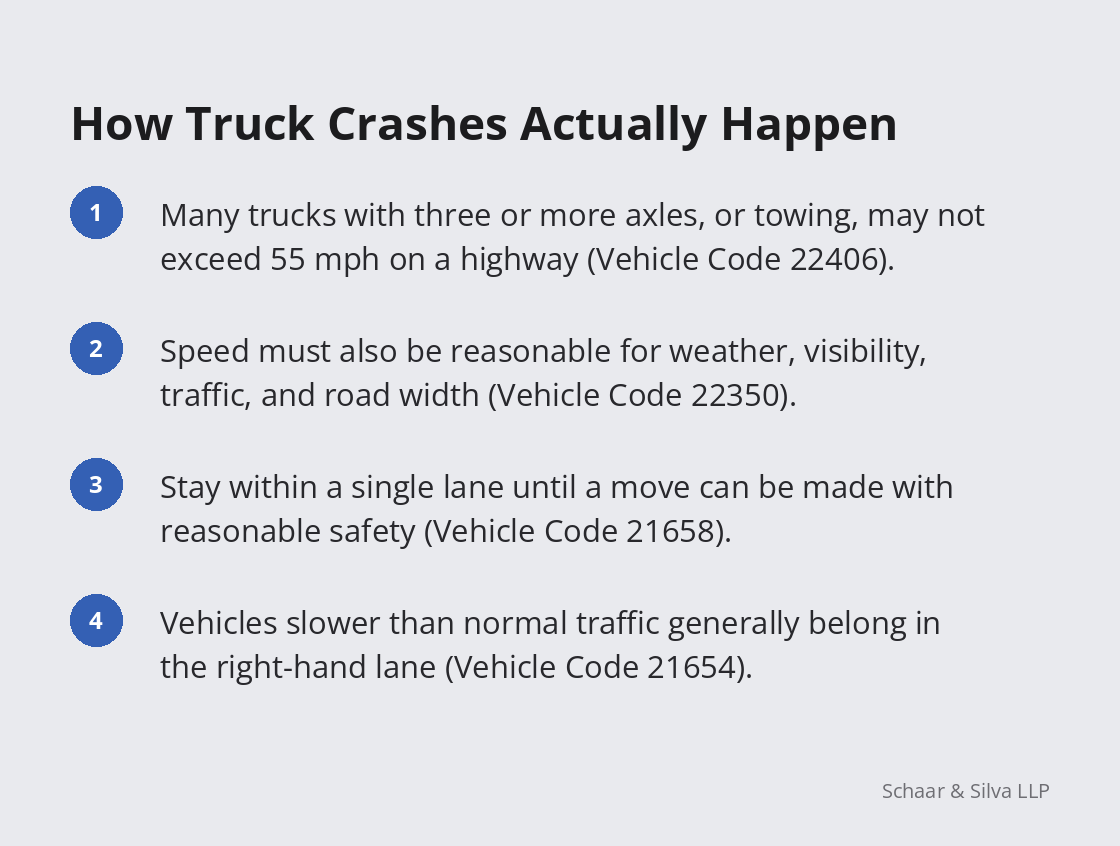
Most truck crashes trace back to a handful of driving decisions. Identifying the specific rule a truck driver broke is often the first step toward proving fault in your claim.
Speeding on Grades and Curves
California sets a separate maximum speed for many commercial vehicles. Vehicle Code Section 22406 provides that no person may drive a motortruck or truck tractor having three or more axles, or any motortruck or truck tractor drawing another vehicle, on a highway at a speed in excess of 55 miles per hour. That limit applies even where passenger cars may legally travel faster.
Staying under that number is not the end of the inquiry. Vehicle Code Section 22350, the basic speed law, prohibits driving at a speed greater than is reasonable or prudent given the weather, visibility, traffic, and the surface and width of the highway, and in no event at a speed that endangers the safety of persons or property. A truck descending a winding grade in fog or rain may be traveling too fast for conditions even when it is below the posted limit.
Unsafe Lane Changes and Blind Spots
Trucks have large blind spots along both sides and directly behind the trailer. Vehicle Code Section 21658 requires that on a roadway divided into clearly marked lanes for traffic in one direction, a vehicle be driven as nearly as practical entirely within a single lane and not be moved from that lane until the movement can be made with reasonable safety. Vehicle Code Section 22107 adds that a driver may not move right or left on a roadway until the movement can be made with reasonable safety, and then only after giving an appropriate signal when another vehicle may be affected.
A truck driver who merges into a lane without confirming it is clear may violate both rules, and the resulting sideswipe or underride crash can be devastating for the occupants of a smaller car.
Slow-Moving Trucks and the Right-Hand Lane
Heavily loaded trucks often climb hills well below the speed of surrounding traffic. Vehicle Code Section 21654 requires a vehicle traveling at less than the normal speed of traffic moving in the same direction to be driven in the right-hand lane or as close as practicable to the right-hand edge or curb, except when passing another vehicle or preparing for a left turn. The statute also states that driving slower than normal traffic outside the right-hand lane is prima facie evidence of a violation.
When a slow truck lingers in a left or center lane, faster traffic is forced to brake suddenly or weave around it, creating the kind of chain reaction that injures drivers who did nothing wrong.
How Fault Is Proven After a Santa Cruz County Truck Accident
Proving fault in a truck accident usually involves more evidence and more parties than an ordinary car crash. The truck driver, the trucking company, and their insurers often begin building their version of events right away, which makes an early, organized response important.
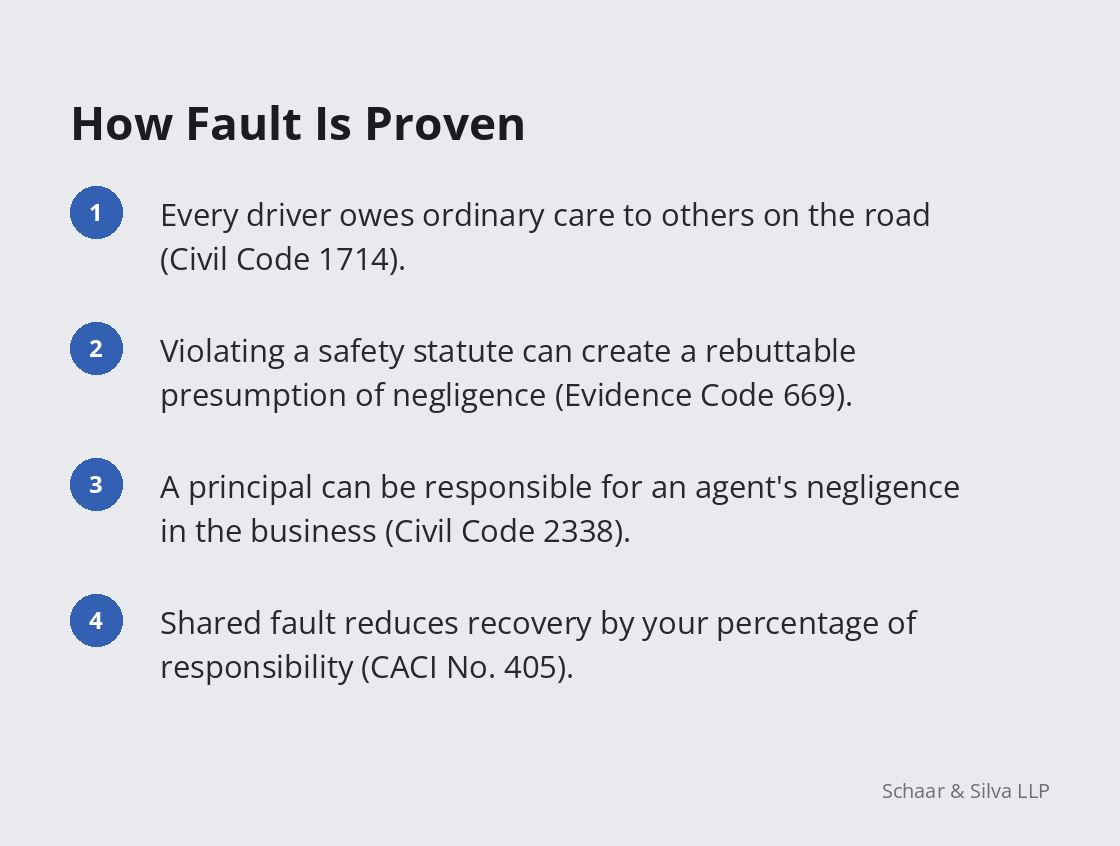
Courts and insurers look at the driving rules involved, the physical evidence at the scene, and the conduct of every driver to decide how responsibility should be shared.
The Duty of Ordinary Care
California Civil Code Section 1714 provides that everyone is responsible for an injury caused to another by a want of ordinary care or skill in the management of his or her property or person. For a professional truck driver, ordinary care means keeping a safe speed, checking mirrors and blind spots, leaving enough room to stop, and adjusting to fog, rain, and heavy traffic.
Because a loaded truck takes so much longer to slow down, a driver who follows too closely or looks away from the road for even a few seconds can lose the ability to avoid a collision entirely.
When a Traffic Violation Creates a Presumption of Negligence
California Evidence Code Section 669 allows a presumption that a person failed to exercise due care when that person violated a statute, the violation caused the injury, the injury resulted from the kind of occurrence the statute was designed to prevent, and the injured person was among those the statute was meant to protect. That presumption can be rebutted, but it gives injured people a powerful starting point.
In a truck case, a violation of the truck speed limit, the lane-change rules, or the right-hand lane rule can support this presumption when the facts fit each element.
Holding the Trucking Company Responsible
Many truck drivers operate on behalf of a business. California Civil Code Section 2338 provides that a principal is responsible to third persons for the negligence of an agent in the transaction of the business of the agency, including wrongful acts committed by the agent as part of that business. Depending on the facts, this rule may allow an injured person to pursue a claim against the company that directed the driver’s work, not only the driver.
Identifying the correct companies requires careful investigation of the truck’s ownership, the driver’s working relationship, and who controlled the trip. Our commercial truck accident lawyer in Santa Cruz page explains more about how we approach these cases.
Shared Fault Does Not End Your Claim
Trucking insurers often argue that the injured driver was partly to blame. Under California’s comparative fault rule, reflected in jury instruction CACI No. 405, an injured person’s damages are reduced by their own percentage of responsibility rather than eliminated. Even if you made a small mistake, you may still recover for the share of harm caused by the truck driver and the company.
This is why insurers work hard to shift percentages, and why clear evidence about speed, lane position, and timing matters so much.
Mistakes That Can Weaken a Truck Accident Claim
Truck accident claims can be strong on the facts and still falter because of avoidable missteps in the days and weeks after the crash. Knowing the most common problems helps you protect your health and your claim at the same time.
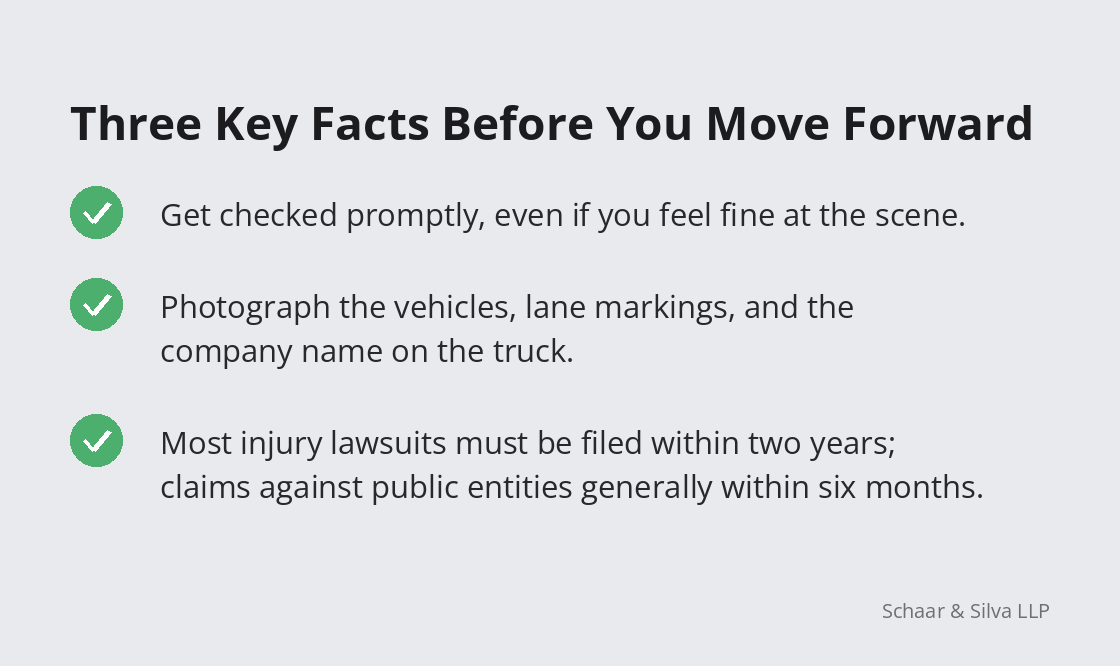
Each of the mistakes below is easier to prevent than to repair later in the process.
Waiting to Get Medical Care
Adrenaline can mask pain after a violent collision, and some neck, back, and head injuries become more noticeable over the following days. Getting evaluated promptly protects your health and creates a medical record that connects your injuries to the crash. Gaps in treatment are often used by insurers to argue that an injury was minor or caused by something else.
Follow your provider’s recommendations, keep your appointments, and save every record, discharge note, and referral you receive.
Letting Evidence Disappear
Physical evidence in a truck crash does not last long. Skid marks fade, damaged vehicles are repaired or salvaged, and video from nearby businesses may be recorded over. If you are able, photograph the vehicles, the road, lane markings, signs, and any debris, and write down the names of witnesses and the trucking company shown on the cab or trailer.
Trucking companies often keep records about the driver, the trip, and the vehicle’s condition. Moving quickly to request that this information be preserved can make a meaningful difference in proving how the crash happened.
Missing Reports and Deadlines
California Vehicle Code Section 20001 requires a driver involved in an accident resulting in injury to another person or death to immediately stop at the scene and fulfill the duties set out in the related statutes. Vehicle Code Section 16000 also requires a driver involved in a crash that caused bodily injury or death, among other situations, to report the accident to the Department of Motor Vehicles within 10 days on an approved form, which is separate from any police report.
Most injury lawsuits in California must be filed within two years under Code of Civil Procedure Section 335.1. If a public agency vehicle or a dangerous public road condition was involved, Government Code Section 911.2 generally requires a claim to be presented no later than six months after the cause of action accrues. Waiting too long can end a valid claim before it begins.
Final Thoughts
A truck accident in Santa Cruz County is rarely a simple fender bender. Truck speed limits, lane rules, the right-hand lane requirement, and the responsibility of the company behind the driver can all shape how fault is decided and who may be held accountable for your injuries.
You do not have to sort through the insurance adjusters, trucking company representatives, and deadlines on your own while you are trying to recover. Taking a few careful steps early, including prompt medical care, preserving evidence, and tracking the reporting and filing deadlines, puts you in a far stronger position.
If you were hurt in a truck accident anywhere in Santa Cruz County, contact Schaar & Silva LLP to speak with our team in Santa Cruz. We will review what happened, explain your options in plain language, and help you take the next step with confidence.