
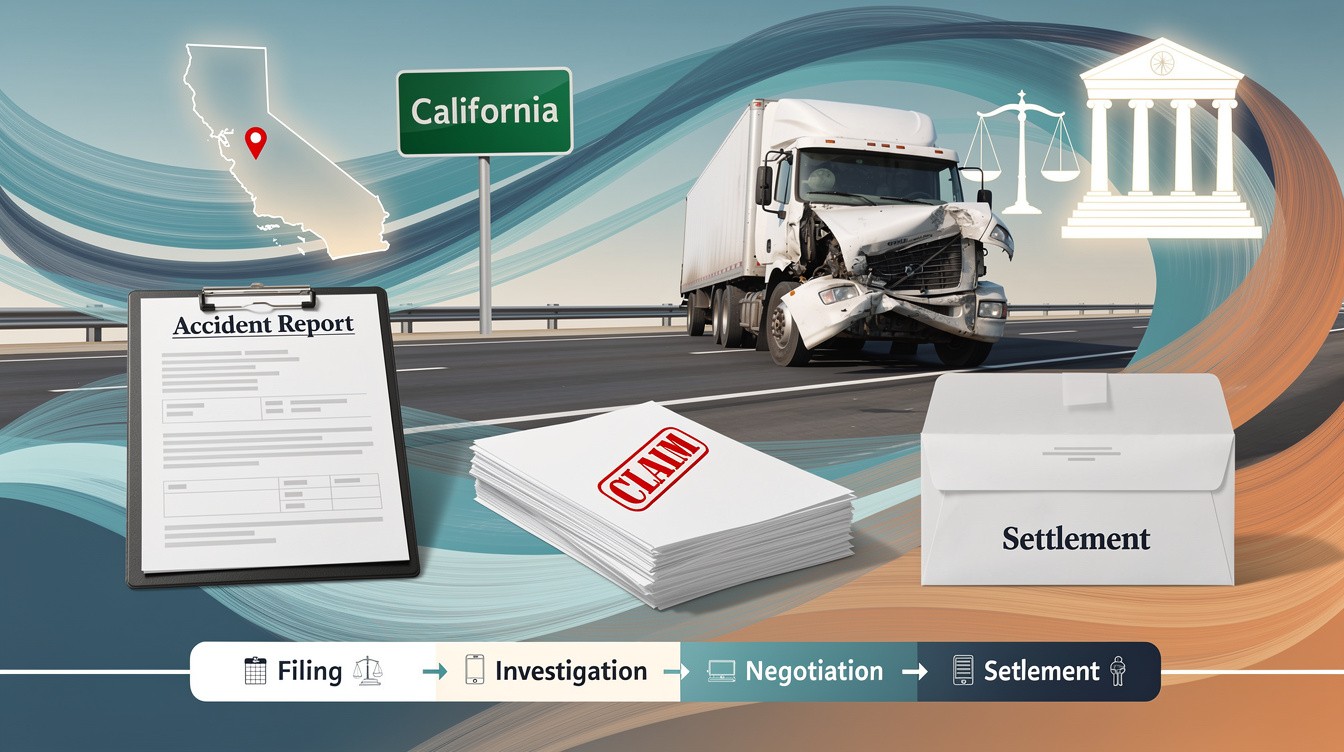
A truck accident can turn your life upside down in seconds. Medical bills pile up, insurance companies call constantly, and you’re left wondering what happens next.
We at Schaar & Silva LLP help people in Santa Cruz County, Sacramento, and Oakland navigate the truck accident claim process from start to finish. This guide walks you through each stage so you know exactly what to expect.
What to Do Immediately After a Truck Accident
Preserve Evidence at the Scene
The first hours after a truck accident are critical. Your actions during this window directly affect the strength of your claim and your ability to recover full compensation. Most people focus on calling insurance, but that’s backward. Your priority is evidence preservation and medical documentation. Insurance companies know that people who gather strong evidence early settle for significantly more than those who don’t.
The Insurance Research Council found that represented claimants recover about 3.5 times more than unrepresented ones in comparable trucking cases, and much of that advantage comes from early, thorough evidence collection.
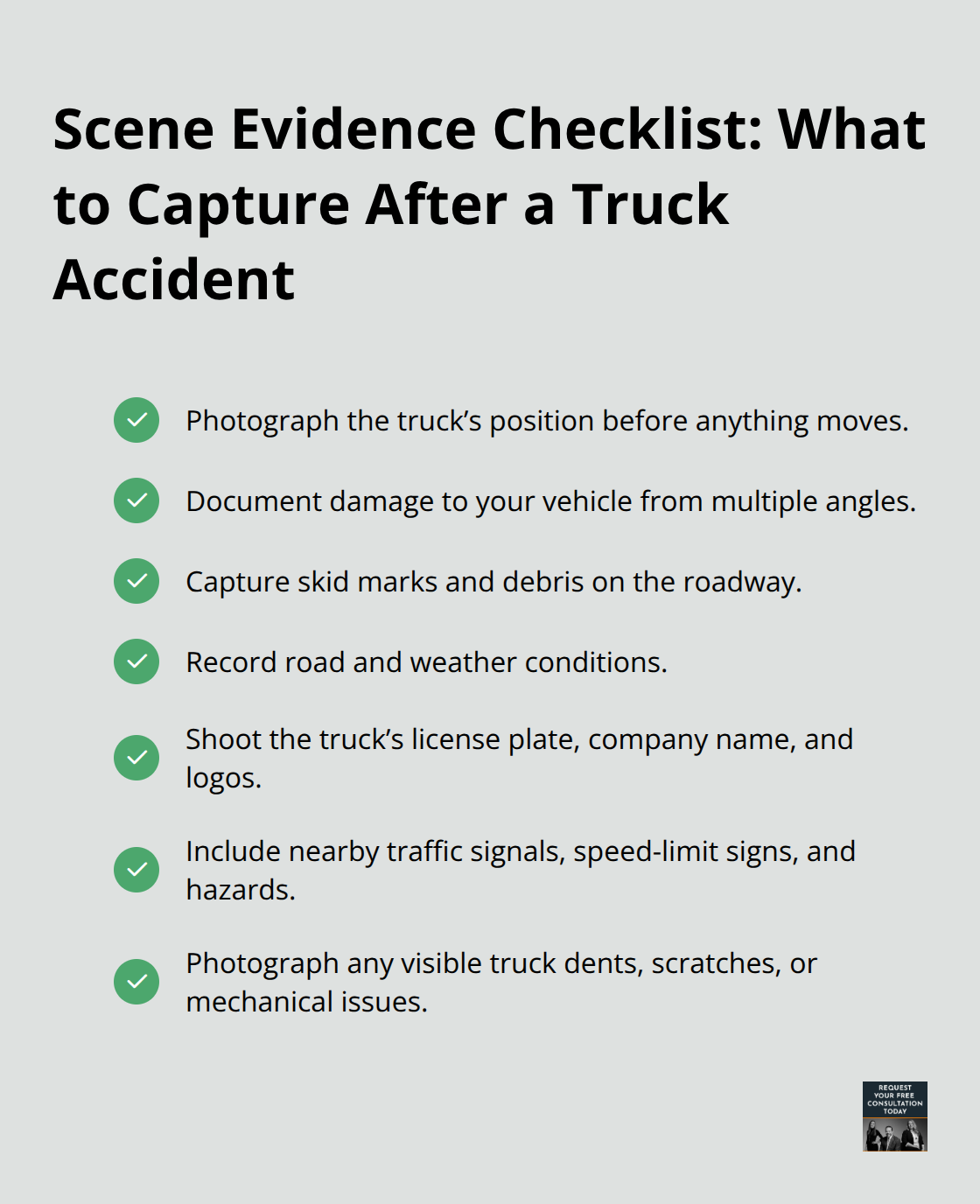
Start by recording the scene with your phone camera before anything moves. Photograph the truck’s position, the damage to your vehicle, skid marks, road conditions, and any visible truck damage. Capture the truck’s license plate, company name, and any logos. Take photos of the surrounding area showing traffic signals, speed limit signs, and road hazards. If the truck has a visible dent, scratch, or mechanical failure, photograph it. These images become irreplaceable if the truck is repaired or hidden away.
Collect Critical Information from the Driver and Witnesses
Get the truck driver’s name, phone number, and address. Write down the trucking company name, the truck number, and the trailer number if visible. Ask for the driver’s commercial license number and the company’s insurance information. Do not discuss fault or injuries with the driver. Keep your statements factual and brief.
If witnesses are present, collect their full names, phone numbers, and addresses immediately. People disappear quickly after accidents, and memories fade within days. Write down what they saw, not your interpretation of what happened. If anyone recorded video on their phone, ask for their contact information and request they preserve the footage.
Seek Medical Care and Report the Accident
Seek medical attention immediately, even if you feel fine. Truck accident injuries often develop over hours or days. A visit to the emergency room creates an official medical record linking your injuries to the accident, which is essential for your claim. Report the accident to police and obtain the police report number. In California, this report becomes key evidence because it documents the scene, statements, and preliminary findings. Request a copy of the report once it’s available.
Do not delay medical care to handle phone calls or insurance paperwork. Hospitals and urgent care clinics document timestamps, symptoms, and injuries, creating a chain of evidence that insurers cannot dispute.
Contact an Attorney Before Accepting Any Offer
If you are injured seriously, you cannot handle the claim yourself while recovering. Contact an attorney who handles truck accidents in your area. Early legal involvement prevents costly mistakes like accepting a lowball offer or missing California’s strict deadlines. Personal injury claims must be filed within two years of the accident date under California Code of Civil Procedure Section 335.1, and property damage claims within three years under Section 338. These deadlines are absolute. Missing them results in permanent loss of your right to compensation, regardless of the strength of your case.
An attorney will help you understand the differences between truck and auto accident claims, which involve multiple liable parties, federal regulations, and significantly higher insurance coverage limits than typical car accidents.
Why Truck Accidents Differ From Car Crashes
The Scale and Regulatory Framework
Truck accidents operate under a completely different legal and financial framework than car crashes, and this distinction determines how much compensation you’ll recover. An 80,000-pound truck hitting your vehicle involves federal regulations, multiple insurance layers, and employer liability that simply don’t exist in typical car accidents. The Federal Motor Carrier Safety Administration (FMCSA) governs trucking companies through strict rules on driver hours, vehicle maintenance, and safety protocols. When a truck driver violates these federal standards-working beyond legal hours, skipping required inspections, or falsifying electronic logbook data-the violation becomes direct evidence of negligence that multiplies your claim’s value.
Insurance Coverage and Settlement Amounts
Insurance coverage reflects the reality of truck accident risk. Federal minimum limits for interstate trucking start at $750,000 to $5,000,000, while many large fleets carry $5,000,000 to $25,000,000 in primary and umbrella coverage. A typical car accident policy tops out at $100,000 to $250,000. This means truck accident settlements and verdicts in California run dramatically higher than car crashes. Public verdicts illustrate the gap: an $85 million wrongful death verdict from a 405 Freeway collision in Los Angeles in 2025, a $35 million verdict involving a Caltrans road defect combined with truck negligence, and a $22.5 million verdict for traumatic brain injury from a left-turn collision. Median truck settlements in California range from $250,000 to $500,000, compared to typical car accident medians of $30,000 to $50,000.
Multiple Liable Parties and Expanded Claims
Liability in truck cases extends far beyond the driver alone. You can pursue claims against the truck driver, the motor carrier (the trucking company), the truck owner, the trailer owner, the cargo loader, maintenance providers, component manufacturers, and sometimes brokers or shippers. This multi-defendant structure creates multiple insurance policies and settlement opportunities that don’t exist in car crashes.
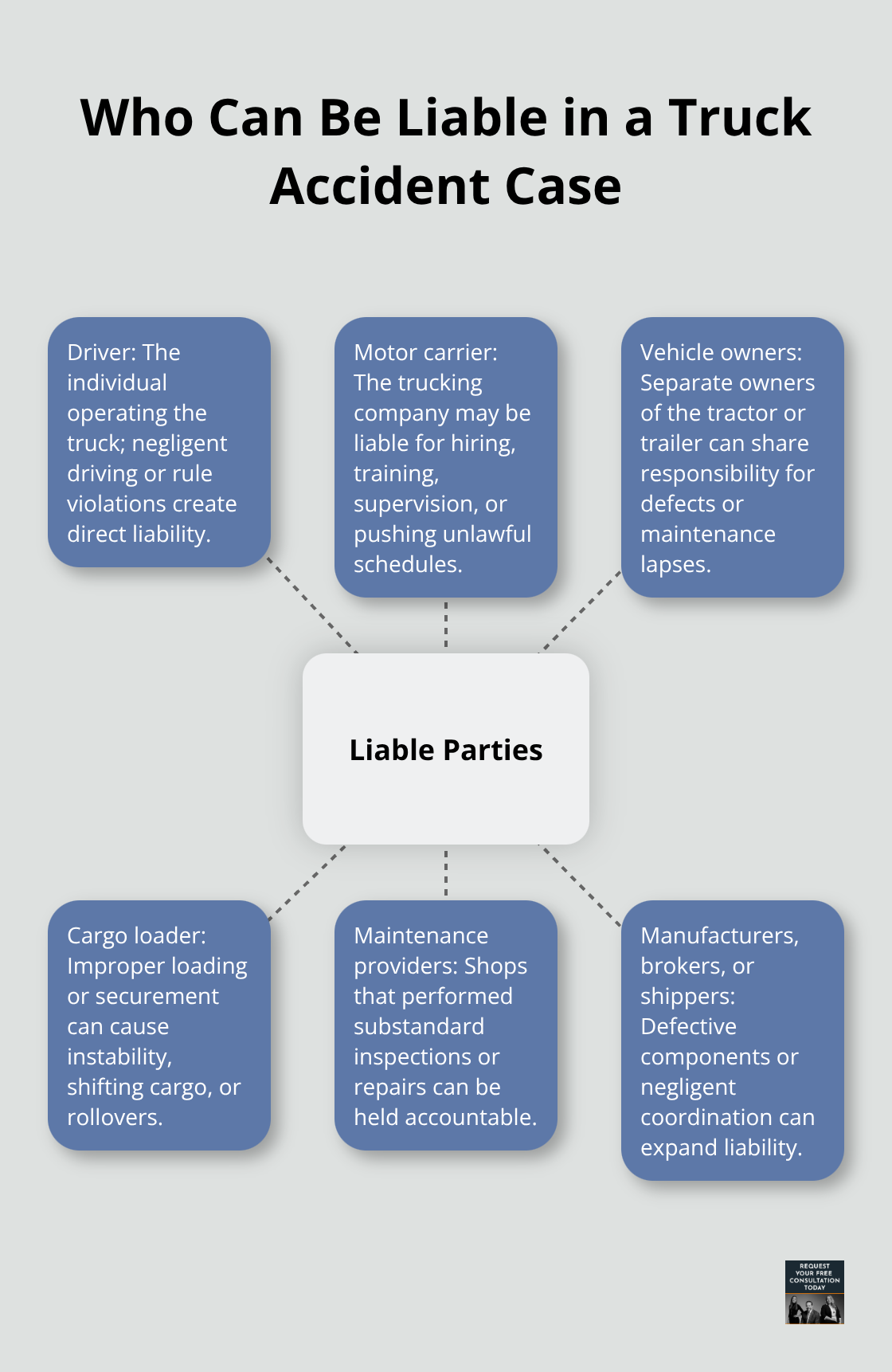
FMCSA violations dramatically strengthen your case: hours-of-service violations, failed drug or alcohol testing, inadequate driver training, maintenance failures, and electronic logbook tampering all support higher valuations and can support punitive damages under California Civil Code Section 3294. Documented FMCSA violations can increase a case’s settlement value by 50% to 200% depending on severity.
Liability Strength and Comparative Fault
The strength of liability matters enormously in California because the state follows pure comparative fault rules-even if you’re found 30% at fault, your recovery reduces by exactly 30%. This makes accident reconstruction, electronic control module data from the truck, dashcam footage, and witness statements critical investments from day one. These investigations require understanding both personal injury law and federal trucking regulations simultaneously. The complexity of multi-layered truck accident cases means that early legal involvement separates those who recover full compensation from those who accept inadequate settlements.
How Long Does a Truck Accident Claim Take to Resolve
Timeline Phases and Settlement Pressure Points
Most truck accident claims in California resolve within 12 to 36 months, but the timeline depends heavily on injury severity, liability complexity, and whether the case settles or goes to trial. Understanding these pressure points helps you plan financially and manage expectations. The typical case follows four distinct phases where settlement negotiations intensify: the pre-suit demand phase between 6 and 12 months after you retain an attorney, the post-filing phase before depositions around 12 to 18 months, the post-deposition phase around 18 to 24 months after key witness testimony, and mediation sessions typically occurring between 24 and 36 months. Insurance companies use these phases strategically, making their initial offers lowest when you’re most desperate for money and your case documentation remains incomplete. Most settlements occur at mediation or shortly before trial when both sides have invested heavily in discovery and understand the real cost of litigation.
Eight Factors That Determine Settlement Value
The settlement value itself depends on eight measurable factors that determine whether you recover $100,000 or $5,000,000. First, total available insurance coverage sets the absolute ceiling on recovery regardless of injury severity. A catastrophic spinal cord injury worth $8,000,000 in economic and non-economic damages means nothing if the trucking company carries only $750,000 in primary coverage plus $2,000,000 in umbrella policies.
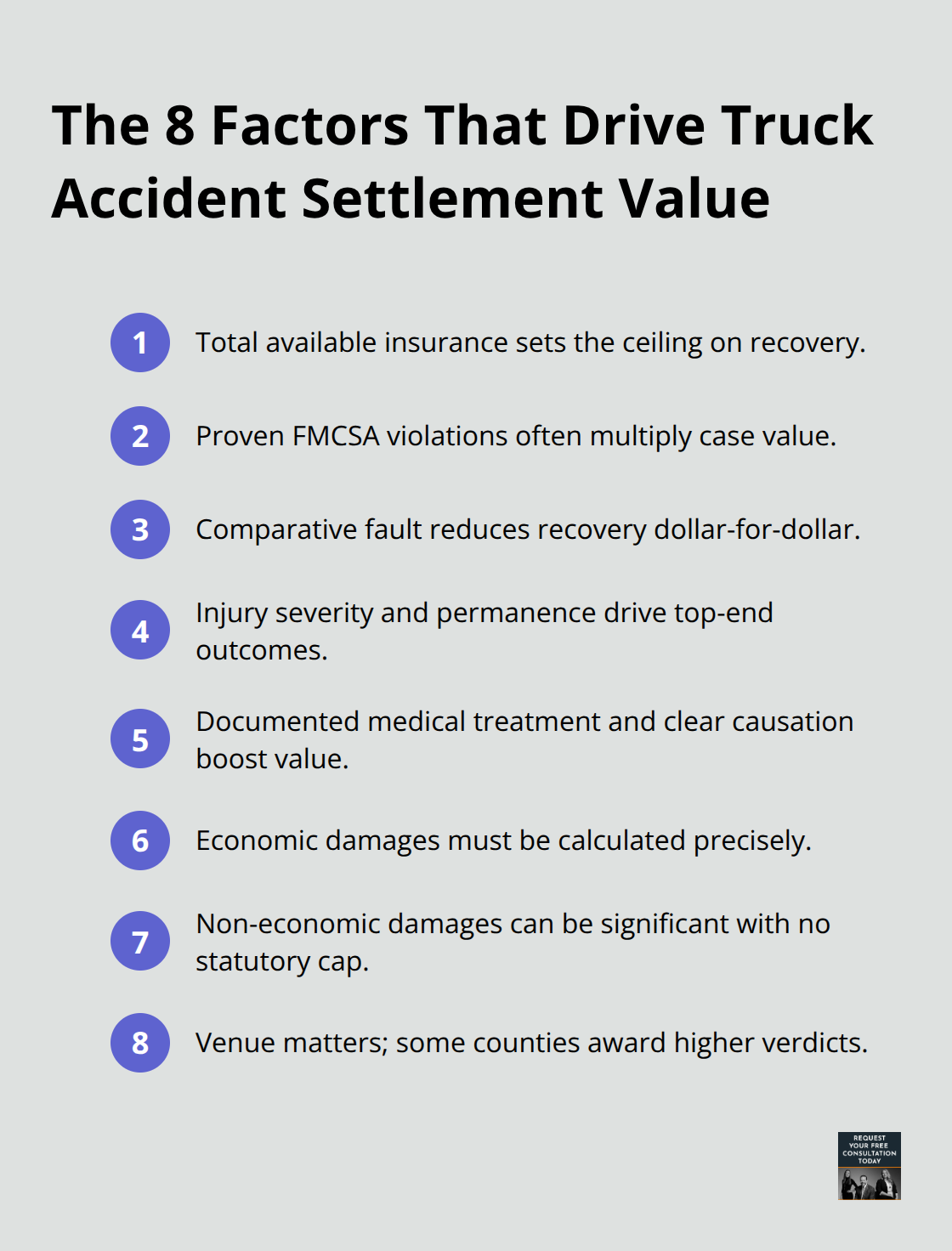
Second, documented FMCSA violations multiply case value dramatically. A truck driver working 16 hours when federal law limits drivers to 11 hours per day, combined with failed drug screening or falsified electronic logbooks, increases settlement value by 50 to 200 percent.
Third, liability strength matters in California because pure comparative fault rules mean a 30 percent fault finding reduces a $5,000,000 case to $3,500,000. Fourth, injury severity and permanence drive the highest values. Permanent spinal cord injury, traumatic brain injury with lasting cognitive deficits, amputation, and chronic pain generate settlements in the $750,000 to $25,000,000 range depending on age and lost earning capacity. Fifth, documented medical treatment and clear causation between the accident and your injuries strengthen value considerably.
Economic and Non-Economic Damages
Sixth, economic damages including past and future medical expenses, lost wages, and future earning capacity must be calculated precisely. Seventh, non-economic damages for pain and suffering, emotional distress, and loss of enjoyment have no cap in California truck cases and typically apply multipliers of 1 to 5 times economic damages in catastrophic cases. Eighth, venue matters significantly. Los Angeles County juries historically award higher plaintiff verdicts than Orange County, San Diego, or rural Central Valley counties.
How Factors Work Together in Real Cases
These factors work together, not separately. A moderate orthopedic injury with surgery in Los Angeles County involving clear FMCSA violations and $3,000,000 in available coverage typically settles between $150,000 and $750,000, while the same injury in a rural county with weaker liability evidence might settle for $100,000 to $300,000. Insurance companies apply a multi-step internal valuation process: they verify coverage across all layers, assess liability with documented FMCSA violations, compute economic damages (past and future medical costs, lost wages), apply non-economic damages multipliers, assess punitive exposure, set reserves, and often require home-office approval for large settlements. Understanding this process helps you recognize when an early offer undervalues your claim and when settlement discussions have reached their realistic ceiling.
Final Thoughts
A truck accident claim process in California demands speed, documentation, and legal guidance from the moment the collision happens. The steps you take in the first hours-photographing the scene, collecting witness information, seeking medical care, and contacting an attorney-directly determine whether you recover $50,000 or $500,000. California’s two-year deadline for personal injury claims and three-year deadline for property damage claims are absolute, and missing these deadlines eliminates your right to compensation permanently.
The truck accident claim process differs fundamentally from car accident claims because of federal regulations, multiple liable parties, and insurance coverage that runs 10 to 100 times higher. FMCSA violations like hours-of-service breaches or falsified logbooks multiply your settlement value substantially, and insurance companies know this reality. They pressure injured people to settle quickly before evidence is fully gathered and liability is fully documented, which is why represented claimants recover approximately 3.5 times more than unrepresented ones in comparable cases.
We at Schaar & Silva LLP help people in Santa Cruz County, Sacramento, and Oakland navigate this process from filing through settlement. Contact us for a free case evaluation to understand your claim’s real value and the timeline you’re facing. Your recovery depends on decisions made today.
