

A shoulder injury from a car accident can derail your life, affecting everything from your job to basic daily tasks. At Schaar & Silva LLP, we’ve helped countless clients in Santa Cruz County, Sacramento, and Oakland navigate shoulder injury settlement negotiations and recover what they deserve.
This guide walks you through shoulder injury settlement tips that actually work, from understanding your injury type to countering insurance company lowball offers.
What Shoulder Injuries Result from Car Accidents
Car accidents generate tremendous force that transfers directly to your shoulder joint, often causing injuries that worsen over weeks or months. The shoulder’s complex structure makes it vulnerable to multiple injury types, each with different recovery timelines and settlement values. Understanding which injury you sustained matters enormously because insurance companies pay vastly different amounts depending on the specific diagnosis and its long-term consequences. A rotator cuff tear requiring surgery settles for substantially more than a simple strain, yet many accident victims don’t grasp this distinction when negotiating with insurers.
Rotator Cuff Damage Demands Serious Settlement Attention
Rotator cuff injuries range from minor strains to complete tears, and this spectrum dramatically affects your claim value. The American Academy of Orthopaedic Surgeons reports that rotator cuff tears affect approximately 2 million people annually in the United States, with car accidents contributing significantly to this number. A partial tear heals with physical therapy within 3 to 6 months, while a full-thickness tear typically requires arthroscopic surgery followed by 6 to 12 months of recovery. Surgical cases generate medical bills exceeding $30,000 to $50,000, which insurance companies initially resist covering fully. If your MRI shows a tear requiring surgery, document this aggressively and resist any settlement offer that doesn’t account for the full surgical cost plus rehabilitation expenses.
Shoulder Dislocation and Subluxation Create Ongoing Instability
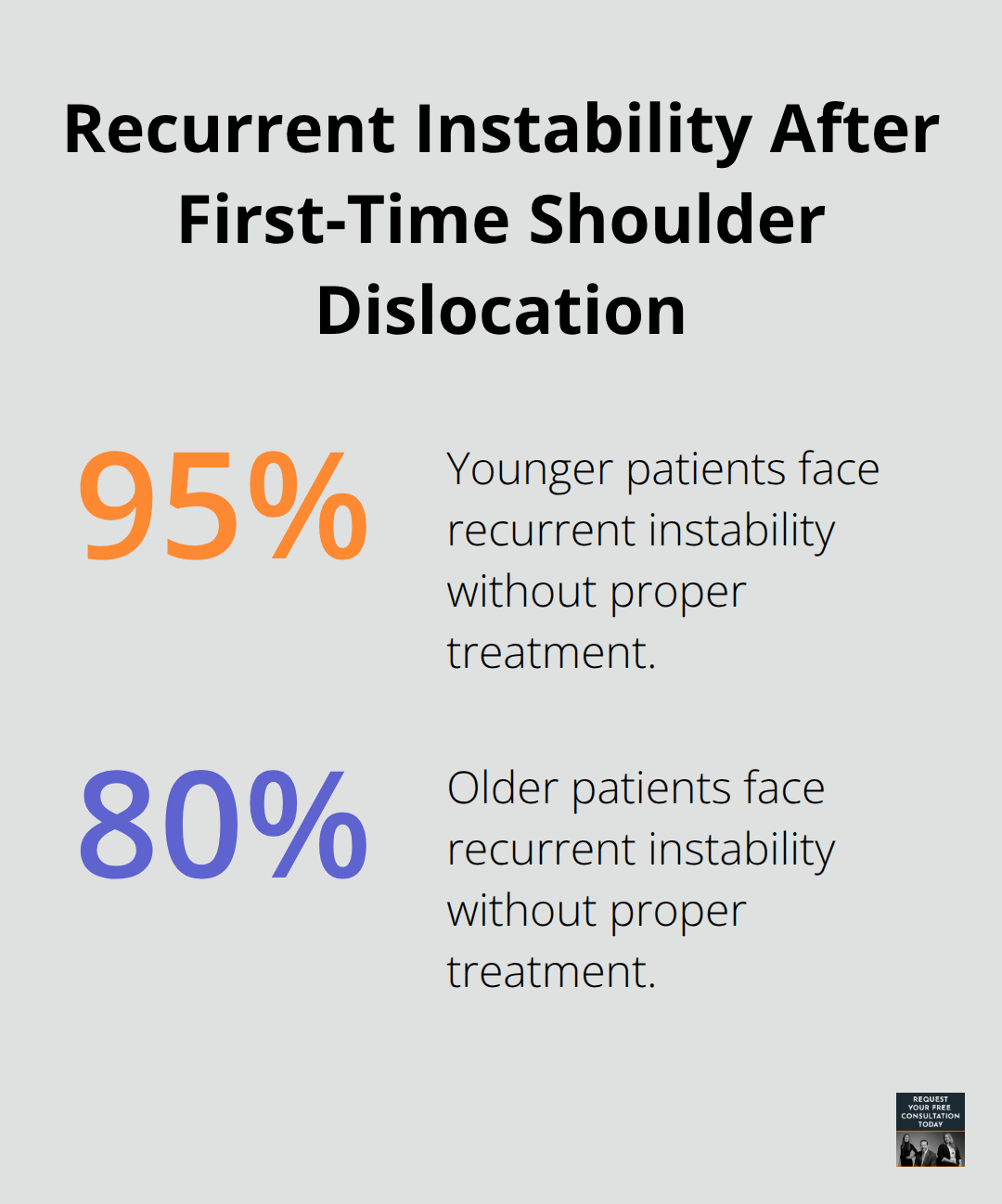
When your shoulder dislocates in a crash, the ball of your upper arm bone pops out of its socket, causing immediate severe pain and requiring emergency reduction. Subluxation occurs when the shoulder partially dislocates and then relocates on its own, which many people mistakenly consider minor because it self-corrects. Neither injury is minor. Orthopedic research shows that approximately 95% of first-time shoulder dislocations in younger patients and 80% in older patients experience recurrent instability without proper treatment. This recurrence risk means you’ll likely need imaging studies to prove the vulnerability, and insurance companies must account for potential future surgery costs in their settlement calculations. Demand that any settlement includes provisions for future treatment because repeat dislocations are statistically probable.
Labrum Damage and Impingement Syndrome Require Long-Term Documentation
The labrum is cartilage surrounding your shoulder socket that deepens the joint and stabilizes the ball. Labrum injuries from accidents often go undiagnosed initially because standard X-rays don’t show cartilage damage; you need an MRI or CT arthrogram for definitive diagnosis. Impingement syndrome develops when shoulder structures compress nearby tendons and nerves, causing pain that worsens with certain arm movements. Both conditions affect your work capacity permanently in ways that insurance adjusters frequently underestimate. If your job requires overhead work or repetitive arm movement, these injuries can end your career in that position. Document every functional limitation through physical therapy records and have your treating physician specify which work activities you can no longer perform safely.
These specific injury types form the foundation of your settlement strategy. The next section examines how insurance companies calculate compensation based on these diagnoses and what factors push your claim value higher or lower during negotiations.
What Determines Your Shoulder Settlement Amount
Insurance companies calculate shoulder injury settlements using a formula that multiplies your medical expenses by a damage multiplier, typically ranging from 1.5 to 5 depending on injury severity. A rotator cuff tear requiring surgery with $40,000 in medical bills might receive a 4x multiplier, yielding a $160,000 settlement before negotiation, while a simple strain with $5,000 in treatment costs receives only a 1.5x multiplier for $7,500. The severity multiplier hinges on three concrete factors that you must document relentlessly: surgical necessity, imaging confirmation, and functional limitation duration. Insurance adjusters deliberately lowball initial offers because they know most injured people accept settlements without understanding how these multipliers work.
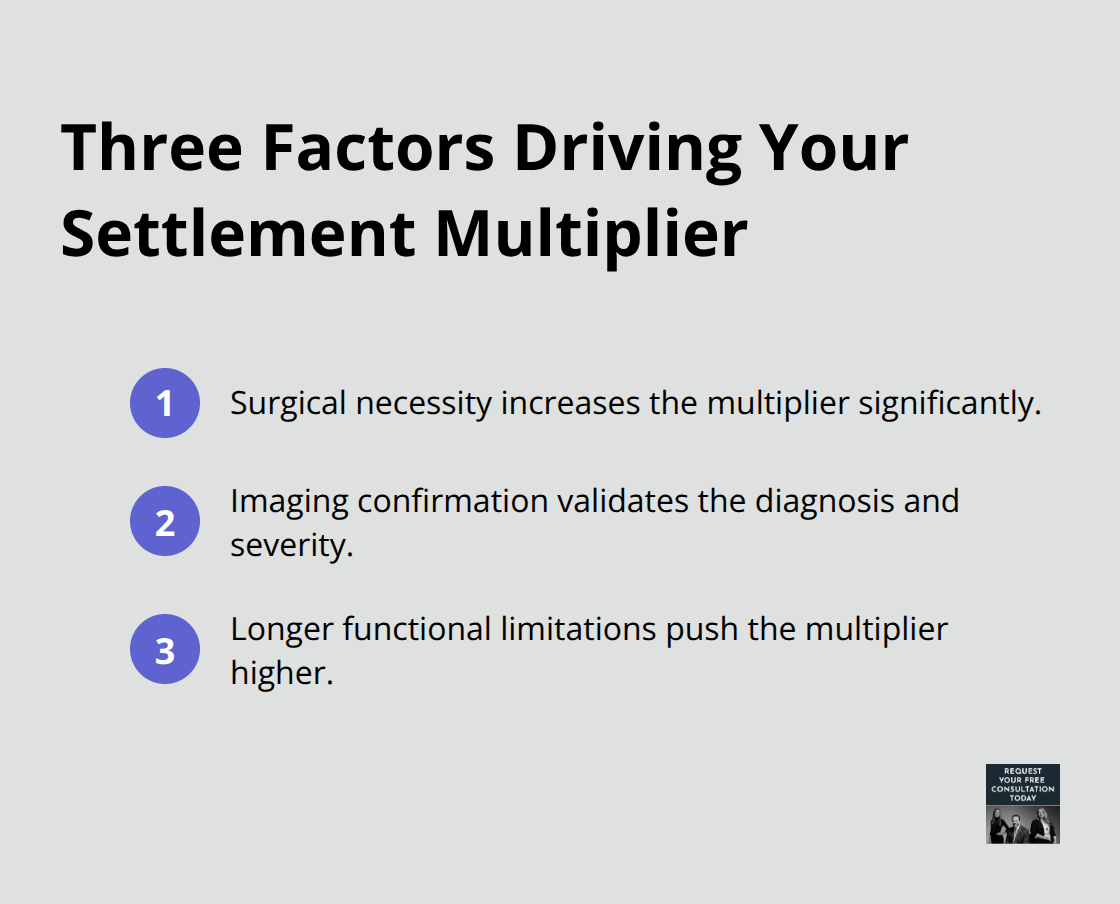
Your MRI results, surgical reports, and physical therapy records directly influence which multiplier bracket your claim falls into, making medical documentation your most powerful negotiation tool.
How Medical Expenses Drive Settlement Multipliers
The multiplier your claim receives depends almost entirely on what your medical records show. Surgical cases trigger higher multipliers than conservative treatment because surgery proves the injury’s severity in ways that physical therapy alone cannot. Insurance companies assign multipliers based on established injury patterns: a torn rotator cuff requiring arthroscopic repair justifies a 3.5 to 5x multiplier, while a strain treated with therapy and anti-inflammatory medication receives only 1.5 to 2x. Collect every medical bill, imaging report, and treatment note from your accident date forward. These documents form the foundation of your multiplier argument during settlement negotiations.
Work Disruption Separates Adequate from Substantial Settlements
Long-term work disruption separates substantial settlements from inadequate ones. If your shoulder injury prevents you from returning to your pre-accident job, your settlement value increases dramatically because insurers must compensate for lost earning capacity. Workers with permanent upper extremity injuries earn approximately 15 to 25 percent less over their remaining career compared to uninjured workers in the same field. Document every job duty you can no longer perform safely through written statements from your employer and detailed notes from your physical therapist about functional restrictions.
Career Impact Justifies Higher Settlement Demands
If you worked as a carpenter, electrician, or in any overhead-intensive role, that career impact alone justifies substantially higher settlement demands than a desk worker would receive for the identical injury (insurance companies know this and will resist acknowledging permanent work loss unless you provide concrete evidence). Request a functional capacity evaluation from your treating physician that explicitly states which work activities remain unsafe, then use that evaluation to counter any settlement offer that ignores your diminished earning capacity. Your physician’s written statement about permanent restrictions carries tremendous weight during negotiations because it establishes objective limitations rather than subjective complaints.
Insurance companies calculate what you should receive, but they open negotiations far below that number. Understanding these calculation methods positions you to counter their initial offers with confidence and demand the compensation your injury actually warrants.
How to Counter Insurance Company Tactics
Insurance adjusters deploy predictable tactics to minimize what they pay on shoulder injury claims, and understanding these moves lets you respond strategically rather than emotionally. The most common tactic is the early lowball offer, typically 30 to 40 percent below what your claim actually warrants, sent within weeks of your accident before you fully understand your injury’s severity or long-term implications. Adjusters know that injured people under financial pressure often accept these offers without recognizing the manipulation.
Reject Lowball Offers with Medical Evidence
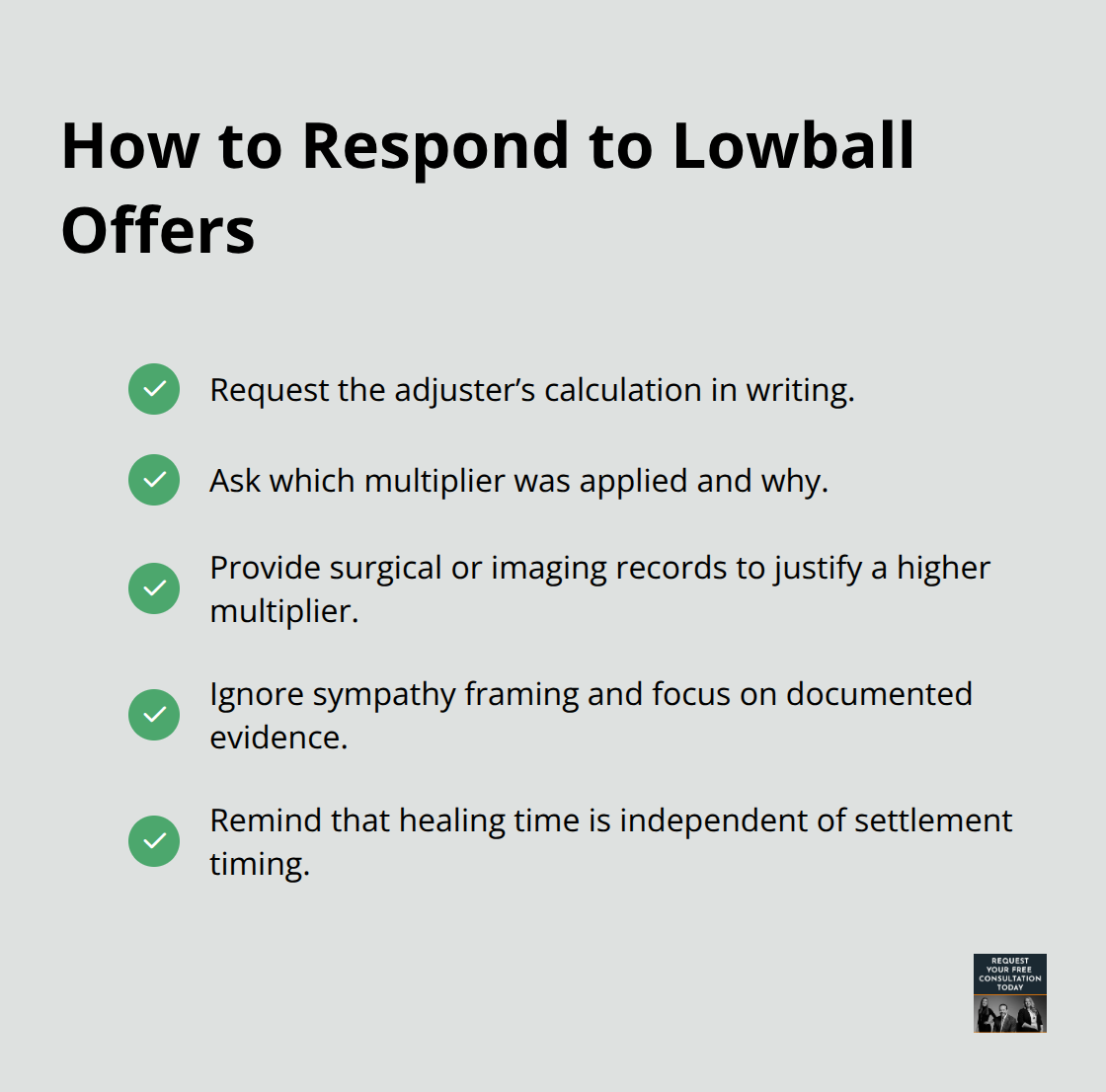
Your medical records form your strongest defense against lowball tactics. When an adjuster presents an initial settlement figure, request their calculation in writing and demand they specify which multiplier they applied and why. If they claim a 1.5x multiplier on a rotator cuff tear requiring surgery, reject that immediately and provide your surgical report showing the injury warrants 3.5 to 5x. Adjusters also employ the sympathy redirect tactic, expressing concern about your recovery while simultaneously suggesting that accepting their offer will help you move forward faster. This framing is deliberate manipulation. Your recovery timeline should never influence settlement adequacy. A torn rotator cuff requires 6 to 12 months of healing regardless of when you settle, and accepting an inadequate settlement doesn’t accelerate that healing.
Protect Yourself from Recorded Statements
Insurance companies request recorded statements from you early in the claims process when you may still be in pain, confused about your injuries, or emotionally overwhelmed. Anything you say during these early conversations can be used later to undermine your claim. Do not provide recorded statements without legal representation present. This protection matters enormously because adjusters will cite your own words against you months later when you’ve learned more about your injury’s severity.
Counter Independent Medical Examinations
Adjusters weaponize independent medical examinations by hiring physicians who work repeatedly for insurers and have financial incentives to downplay injury severity. These exams often contradict your treating physician’s findings, and adjusters cite them to justify lower settlement offers. Counter this by having your treating physician document why your injury warrants higher compensation and requesting that your medical records clearly show your functional limitations. Your treating physician has examined you multiple times and understands your actual condition, whereas the insurance company’s physician conducts a single examination with predetermined conclusions.
Document Delay Tactics and Bad Faith Patterns
Adjusters use delay tactics deliberately, hoping you’ll become frustrated and accept inadequate offers to end the process. They request additional documentation repeatedly, claim they need more time to review your file, or propose unreasonably low figures while suggesting they’ll increase them if you remain patient. Document every communication, including dates and what was discussed, so you can demonstrate patterns of bad faith if negotiations stall. This documentation becomes powerful evidence if your case eventually requires litigation because it shows the adjuster acted in bad faith rather than negotiating reasonably.
Final Thoughts
Shoulder injury settlement tips ultimately rest on one reality: documentation forces insurance companies to pay fairly. Your medical records, imaging studies, and functional limitation assessments create evidence that prevents insurers from exploiting your injury through lowball offers. We at Schaar & Silva LLP have watched clients recover substantially more compensation simply because they understood multiplier calculations and refused inadequate settlements backed by solid medical proof.
Negotiating alone against experienced insurance adjusters puts you at a significant disadvantage because these professionals deploy calculated tactics to minimize payouts, from early lowball offers to weaponized independent medical examinations. They understand settlement multipliers, damage calculations, and psychological pressure points while you recover from a serious injury. Professional legal representation changes this dynamic by handling negotiations while you focus on healing, and we at Schaar & Silva LLP manage the entire process from medical documentation through final settlement.
Contact us for a consultation to review your medical records and calculate what your claim actually warrants. We handle negotiations from there so you can concentrate on recovery rather than battling insurance adjusters over compensation you deserve.
