

A severe injury can transform your life in seconds, leaving you facing mounting medical bills, lost income, and uncertain recovery. Santa Cruz severe injury claims involve complex calculations of both immediate and lifelong care needs that many people underestimate.
We at Schaar & Silva LLP help clients understand what compensation they’re entitled to and how to document long-term damages properly. This guide walks you through life-care planning, local rehabilitation resources, and the legal framework that protects your recovery.
What Qualifies as a Severe Injury Claim in Santa Cruz
Severe injury claims in Santa Cruz cover a wide range of conditions, from spinal cord damage and traumatic brain injuries to permanent disfigurement and loss of limb function. The distinction matters because California courts recognize that some injuries demand compensation far beyond immediate medical costs. Fractures requiring surgery, burns affecting multiple body areas, and injuries resulting in permanent disability all qualify for substantial claims. The key factor is whether the injury creates long-term or permanent impairment that affects your ability to work, perform daily activities, or enjoy life as you did before. Santa Cruz County courts take these determinations seriously, and documentation from medical professionals about the permanence and severity of your condition becomes the foundation of your case.
How California Law Protects Your Right to Compensation
California’s personal injury law gives you three years from the date of injury to file a claim, according to California Code of Civil Procedure Section 335.1. This statute of limitations is strict, and missing the deadline eliminates your right to pursue compensation entirely. For claims involving minors or cases where the injury wasn’t immediately apparent, different rules may apply, but waiting weakens your position significantly. The sooner you document your injuries and begin the claims process, the stronger your case becomes. Medical records fade, witness memories blur, and evidence deteriorates over time. Acting quickly preserves critical details that support your claim.
The Three Categories of Compensation
Compensation in Santa Cruz breaks into three distinct categories. Special damages cover your actual out-of-pocket expenses: property repair, lost wages, medical costs, and other documented expenses directly tied to your injury. Medical damages include ambulance services, doctor visits, X-rays, medications, and rehabilitation costs. California’s Howell v. Hamilton Meats & Provisions ruling limits medical damages to amounts actually paid by your insurer, not the inflated billed amounts hospitals often claim.
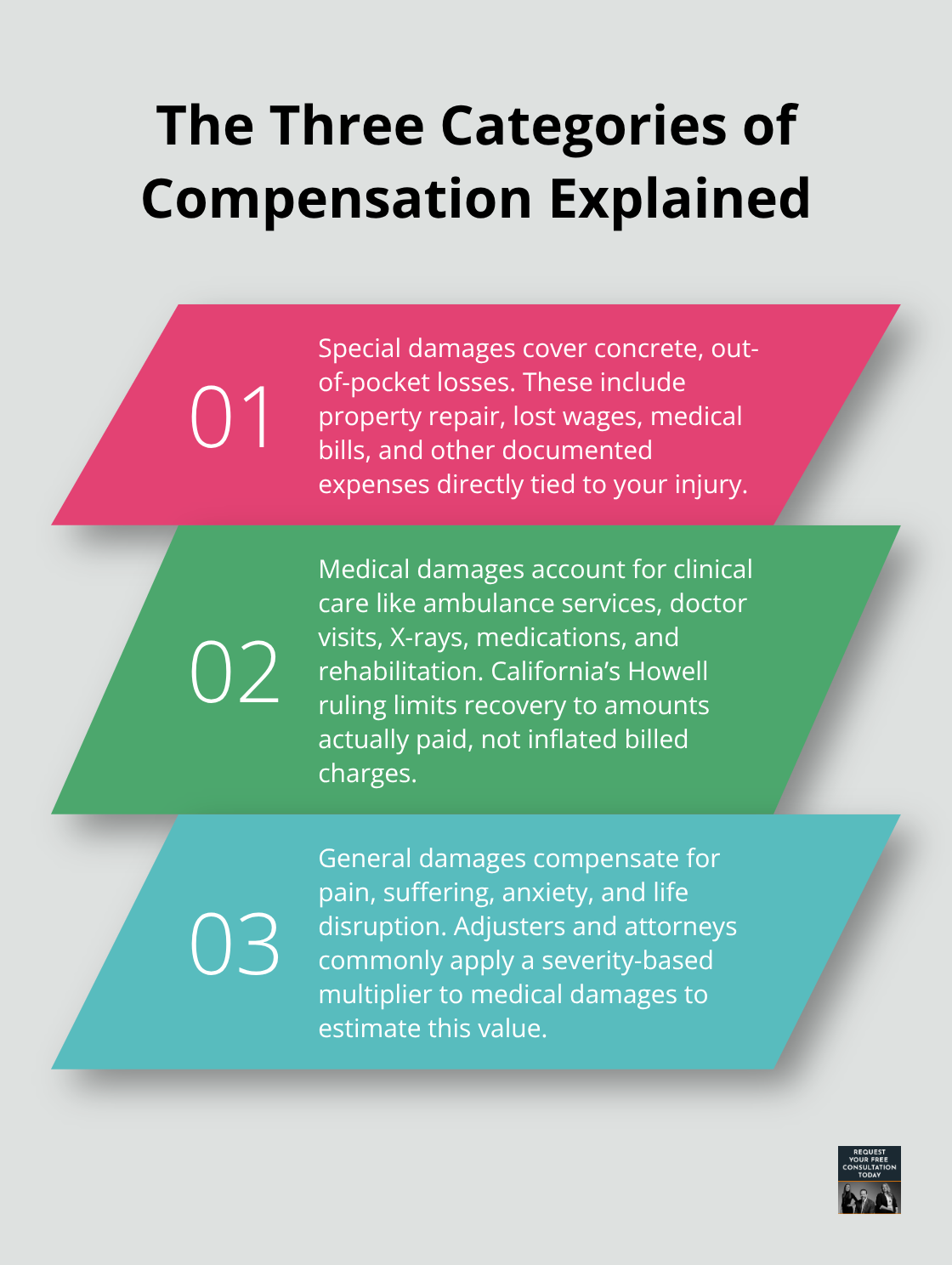
General damages compensate for pain, suffering, anxiety, and life disruption. Most attorneys and insurers start with a multiplier approach, multiplying your medical damages by 1.5 to 5 depending on injury severity. A straightforward fracture might use a 1.5 multiplier, while permanent spinal cord damage could justify a 5 or higher multiplier. This means $50,000 in documented medical expenses could yield $75,000 to $250,000 in general damages alone.
How Juries Evaluate Your Claim
The total starting point for negotiations combines all three compensation categories, though juries ultimately decide awards if your case proceeds to trial. Witness credibility, the invasiveness of required treatments, and the permanence of your injury all influence what juries actually award. Accurate documentation from day one strengthens your position significantly (medical records, receipts, and proof of lost time all matter). The permanence of your condition and the extent of ongoing care you’ll need directly impact the multiplier courts apply to your medical damages. Understanding these calculation methods helps you recognize whether a settlement offer reflects the true value of your long-term recovery needs. Life-care plans document exactly what your future holds medically and financially, transforming abstract pain and suffering into concrete, defensible numbers that juries respect.
Life-Care Plans Transform How Courts Value Your Future
A life-care plan is not theoretical speculation about your medical future-it’s a detailed roadmap of exactly what your body will need, what treatments cost, and how much money you’ll require over your lifetime. Settlement offers have been rejected because claimants failed to present comprehensive life-care documentation, only to watch juries award substantially higher damages once proper medical expert testimony filled that gap. Your life-care plan becomes the foundation for calculating future damages, the category that often represents 60 to 80 percent of total compensation in severe injury cases. Without it, you’re asking a jury or insurance adjuster to guess at your medical needs, and they’ll consistently underestimate.
A spinal cord injury patient requires ongoing physical therapy, pain management medications, adaptive equipment, and eventual assisted living-costs that accumulate to hundreds of thousands of dollars over decades. Santa Cruz’s long-term care expenses from the Genworth Cost of Care Survey show homemaker services at roughly $35 per hour and home health aides at around $36 per hour, translating to approximately $5,320 to $5,450 monthly for basic home support. Assisted living averages about $6,500 monthly in Santa Cruz, while nursing home care ranges from $12,000 for a semi-private room to over $14,000 for a private room. Annual spending for comprehensive long-term care in our county typically spans $60,000 to $150,000 depending on care intensity. These aren’t hypothetical numbers-they’re market rates your jury will recognize as realistic.
Medical Experts Document Your Specific Needs
A qualified rehabilitation physician or physiatrist examines your injury, reviews your medical records, and projects what treatments you’ll actually need over time. Dominican Hospital’s orthopedic rehabilitation program in Santa Cruz offers comprehensive services including physical therapy, sports-specific conditioning, pre- and post-surgical rehabilitation, and fall prevention training-services that become line items in your life-care plan with documented costs. Your expert creates a timeline showing when you’ll need intensive therapy versus maintenance care, when equipment replacement occurs, and how your condition may progress. This specificity matters enormously because it transforms abstract pain into concrete medical interventions.
A traumatic brain injury plan includes neuropsychological testing, cognitive rehabilitation, vocational retraining support, and ongoing medication management. A permanent burn injury plan addresses wound care, scar revision procedures, psychological counseling for body image issues, and compression garment replacement. Courts respect these detailed projections because they’re grounded in actual medical science and regional pricing data, not speculation.
How Expert Credentials Strengthen Your Claim
The expert’s credentials and experience directly influence whether a jury accepts their projections, making the selection of your medical documentation team as important as the legal strategy itself. A physiatrist with 20 years of spinal cord injury experience carries more weight than a general practitioner offering opinions outside their specialty. Board certification, published research, and testimony history all matter when juries evaluate whether to trust the expert’s cost projections and medical timeline.
Your expert witness must understand Santa Cruz’s specific care landscape and pricing. An expert familiar with Dominican Hospital’s rehabilitation services and local assisted living facilities can speak credibly about realistic costs and available treatment options in our region. This local knowledge transforms generic projections into region-specific evidence that resonates with Santa Cruz juries.
Building Your Life-Care Plan Timeline
Life-care plans span decades, not months. They account for immediate post-injury rehabilitation, the transition to maintenance care, and the eventual shift toward long-term custodial support as you age. A 35-year-old with a permanent spinal cord injury faces 50+ years of care needs, requiring projections that account for inflation, equipment advances, and changing care requirements across different life stages.
The plan identifies when you’ll transition from intensive physical therapy to home-based maintenance exercises, when you’ll need assistive devices, and when professional care becomes necessary. These transitions have real costs attached to them. Equipment replacement cycles, medication adjustments, and care level changes all appear in the timeline with associated expenses. Your medical expert projects these changes based on similar injury patterns and medical literature, not guesswork.
Connecting Your Life-Care Plan to Compensation
Once your life-care plan is complete, it becomes the evidence that transforms general damages from abstract pain and suffering into defensible numbers. A jury sees the detailed medical timeline, understands the specific treatments required, and recognizes the regional costs involved. They can then apply appropriate multipliers to your medical damages with confidence that they’re compensating real, documented future needs rather than speculation.
The life-care plan also protects you in settlement negotiations. Insurance adjusters cannot dismiss documented future care costs as inflated or unrealistic when a qualified medical expert has projected them based on your specific injury and Santa Cruz’s actual market rates. This documentation shifts the burden to the insurer to explain why they believe your expert’s projections are wrong, rather than allowing them to simply lowball an offer based on incomplete information. With your medical needs clearly mapped out and costs documented, the next step involves identifying the local rehabilitation providers who will actually deliver this care and understanding how coordinating their services maximizes both your recovery and your claim’s value.
Local Rehabilitation Providers and Recovery Resources
Dominican Hospital’s Orthopedic Rehabilitation Program
Dominican Hospital’s orthopedic rehabilitation program stands as Santa Cruz’s most comprehensive resource for serious injury recovery. The facility offers physical therapy, sports-specific conditioning, pre- and post-surgical rehabilitation for hip, knee, shoulder, and ankle procedures, vestibular disorder treatment, and fall prevention training. The program coordinates care among patients, therapists, and physicians to optimize outcomes, which directly strengthens your injury claim through documented collaboration and measurable progress.
Active Release Techniques, adaptive equipment training, aquatic therapy, certified manual therapy, instrument-assisted soft tissue mobilization, Kinesio taping, the McKenzie Method, myofascial decompression, and custom splints or braces represent the specific modalities available at this facility. Functional Movement Analysis and gait training document measurable improvements that your medical experts will reference when projecting future care needs in your life-care plan. The facility’s pain management services address chronic pain from serious injuries, an essential component of ongoing care documentation.
Understanding Santa Cruz’s Long-Term Care Costs
Santa Cruz’s long-term care landscape extends beyond acute rehabilitation to include assisted living facilities averaging about $6,500 monthly and nursing home care ranging from $12,000 for semi-private rooms to over $14,000 for private rooms (according to the Genworth Cost of Care Survey). Home health aides cost around $36 per hour and homemaker services around $35 per hour in Santa Cruz, translating to roughly $5,320 to $5,450 monthly for basic home support. These regional pricing figures become essential evidence in your life-care plan because they demonstrate to juries that your projected future care costs reflect actual Santa Cruz market rates, not inflated estimates.
Connecting Care Providers to Your Life-Care Plan
After completing formal rehabilitation, Dominican Hospital’s community-based classes help you maintain strength and reduce re-injury risk, which matters significantly for your long-term care projections and compensation calculations. Securing detailed cost quotes and treatment timelines from Dominican Hospital and local long-term care providers before your life-care plan is finalized ensures your medical expert projects realistic expenses that withstand insurance company scrutiny and jury evaluation. Contact Dominican Hospital’s orthopedic rehabilitation program directly to understand their specific treatment protocols and costs (information that feeds directly into your life-care plan’s accuracy).
Final Thoughts
Santa Cruz severe injury claims demand a comprehensive strategy that documents your immediate needs, projects your lifetime care costs, and connects you with actual providers who support your recovery. The three-part compensation framework (special damages, medical damages, and general damages) only works when you build a detailed life-care plan backed by qualified medical experts and regional pricing data. Without this foundation, insurance companies will underestimate what your future costs, and settlement offers will fall far short of what you truly deserve.
Dominican Hospital’s orthopedic rehabilitation program and Santa Cruz’s long-term care landscape provide the concrete resources and pricing information your claim needs. When your medical expert projects future care costs using actual facility rates and documented treatment protocols from local providers, juries recognize those numbers as realistic rather than inflated. This specificity transforms abstract pain and suffering into defensible compensation that reflects your genuine long-term needs.
Contact Schaar & Silva LLP to discuss your specific injury and begin documenting your long-term care needs. The sooner you start this process, the stronger your position becomes. Medical records, rehabilitation timelines, and expert projections all strengthen over time as your recovery unfolds.
