
A seat belt injury after a car accident in Santa Cruz County can be confusing. The belt very likely kept you from far worse harm, yet you may now have deep bruising across your chest or abdomen, sore ribs, or a stiff neck that gets worse in the days after the crash. You may also hear from an insurance adjuster who asks, almost casually, whether you were buckled in. Understanding what these injuries are, how California law treats seat belt use, and which mistakes to avoid will help you protect both your health and your claim.
At Schaar & Silva LLP, we help people hurt in car and truck accidents across Santa Cruz County so you can move forward with confidence. This guide explains how seat belt injuries happen, why insurers ask about your belt, what the law actually says, and the practical steps that keep your case on solid ground.
What a Seat Belt Injury Actually Is
A seat belt works by holding your body against the seat while the vehicle stops suddenly. That is exactly why it saves lives, and it is also why it can cause injury. In a hard collision, the force of your body moving forward is transferred into the belt, and the belt presses into your shoulder, chest, and hips. On roads like Highway 1, Highway 17, and the winding routes through the Santa Cruz Mountains, even a moderate impact can create enough force to leave a mark.
Common Seat Belt Injuries After a Crash
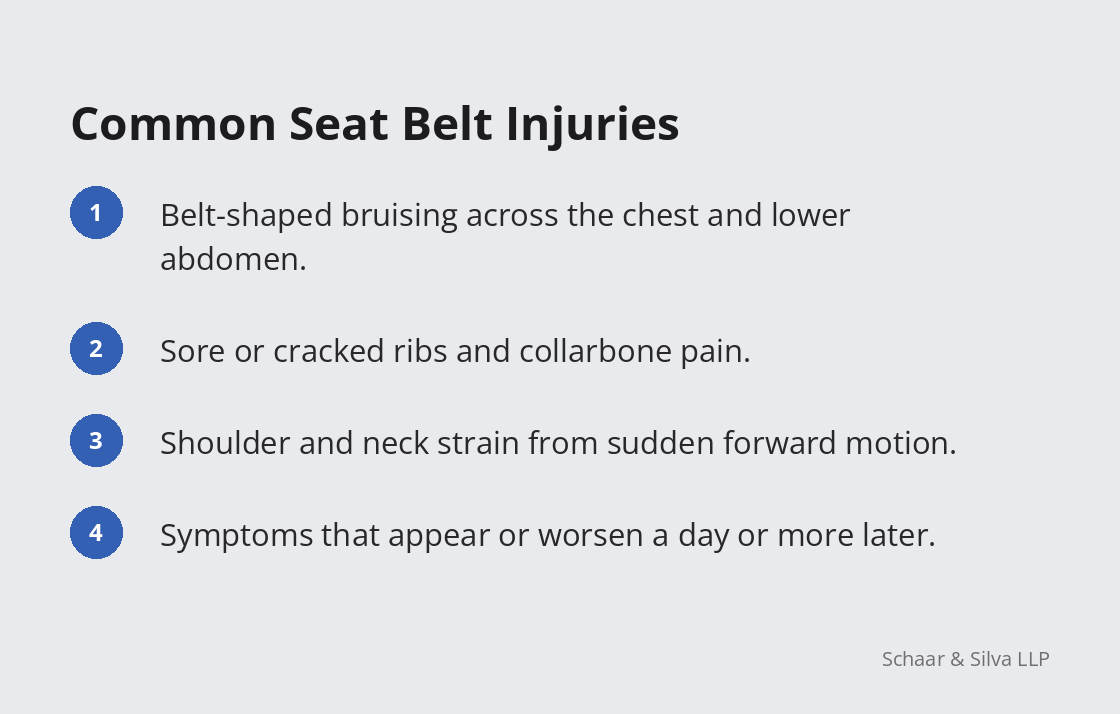
The most familiar sign is a bruise in the shape of the belt, running diagonally across the chest and horizontally across the lower abdomen. People also report sore or cracked ribs, collarbone pain, shoulder strain, and neck injuries caused by the head moving forward while the torso is held in place. Some injuries are not visible at all. Pressure from the lap belt can affect the organs and structures beneath it, which is one reason doctors pay close attention to abdominal pain after a crash. A bruise on the skin can be a signal that something deeper needs to be checked.
Why Some Symptoms Appear Later
Adrenaline and shock can mask pain in the first hours after a collision. Many people feel only shaken at the scene and wake up the next morning with tight muscles, a painful chest, or trouble taking a deep breath. Soreness that spreads or worsens, new abdominal discomfort, or dizziness are reasons to return to a doctor rather than wait. Delayed symptoms are common, and they are not a sign that you were not truly hurt. What matters is that you get them evaluated and documented as soon as they appear.
How Long Healing Can Take
Recovery time depends on the type of injury, your age and health, and the force of the collision. A surface bruise may fade in a few weeks, while a rib, shoulder, or soft tissue injury can take much longer and may require physical therapy. Only your treating providers can give you a reliable estimate for your own body. For your claim, the best evidence of how long healing takes is a consistent medical record that follows your progress from the first visit until you are released from care.
How California Law Treats Seat Belts in an Injury Claim
Insurance adjusters ask about seat belts for a reason. If they can show you were not buckled in, they may argue that some of your injuries are your own responsibility. If you were wearing your belt, the injuries it caused are part of the harm from the crash, and the driver who caused the collision is responsible for them. Knowing the rules helps you answer those questions accurately and with confidence.
The Motor Vehicle Safety Act
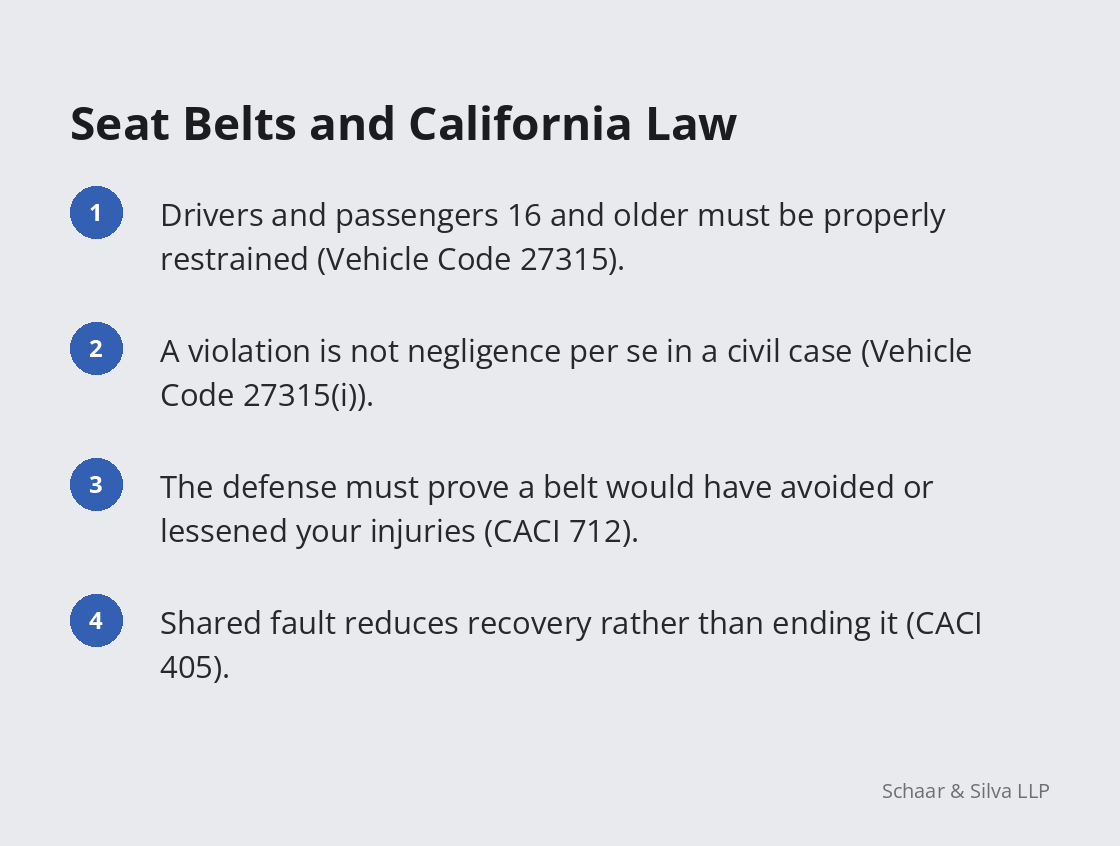
California’s seat belt law is found in Vehicle Code section 27315, known as the Motor Vehicle Safety Act. It provides that a person shall not operate a motor vehicle on a highway unless that person and all passengers 16 years of age or over are properly restrained by a safety belt. The statute also says a person 16 or older shall not be a passenger on a highway unless properly restrained. The law defines proper restraint as the lap portion of the belt crossing the hips or upper thighs and the shoulder portion, if present, crossing the chest in front of the occupant.
Not Wearing a Belt Does Not Automatically Defeat a Claim
Many people assume that if they were unbuckled, they have no case. That is not how California law works. Vehicle Code section 27315(i) states that in a civil action, a violation of the seat belt requirement does not establish negligence as a matter of law or negligence per se for comparative fault purposes, although negligence may still be proven as a fact. In other words, the other side cannot simply point to the statute and win the argument. The driver who caused the crash remains responsible for causing it.
What the Defense Must Prove
California’s civil jury instructions describe the seat belt defense in CACI No. 712. Under that instruction, the defendant must prove that a working seat belt was available, that a reasonably careful person in your situation would have used it, that you failed to wear it, and that your injuries would have been avoided or less severe if you had used it. That last element is important. Even if a belt was not worn, the defense still has to show that wearing it would have made a real difference to the specific injuries you suffered.
How Shared Responsibility Works
California follows comparative fault. Under CACI No. 405, if the defendant proves that your own negligence was a substantial factor in causing your harm, your recovery is reduced in proportion to your share of responsibility rather than eliminated. That is why an honest, careful account of the crash matters so much. A belt that was worn properly removes this argument entirely, and a belt that was not worn does not automatically end your case.
Common Mistakes That Weaken a Seat Belt Injury Claim
Most problems in seat belt injury cases come from small decisions made in the first days and weeks after the collision. The good news is that each of them can be avoided with a little planning.
Waiting Too Long to See a Doctor
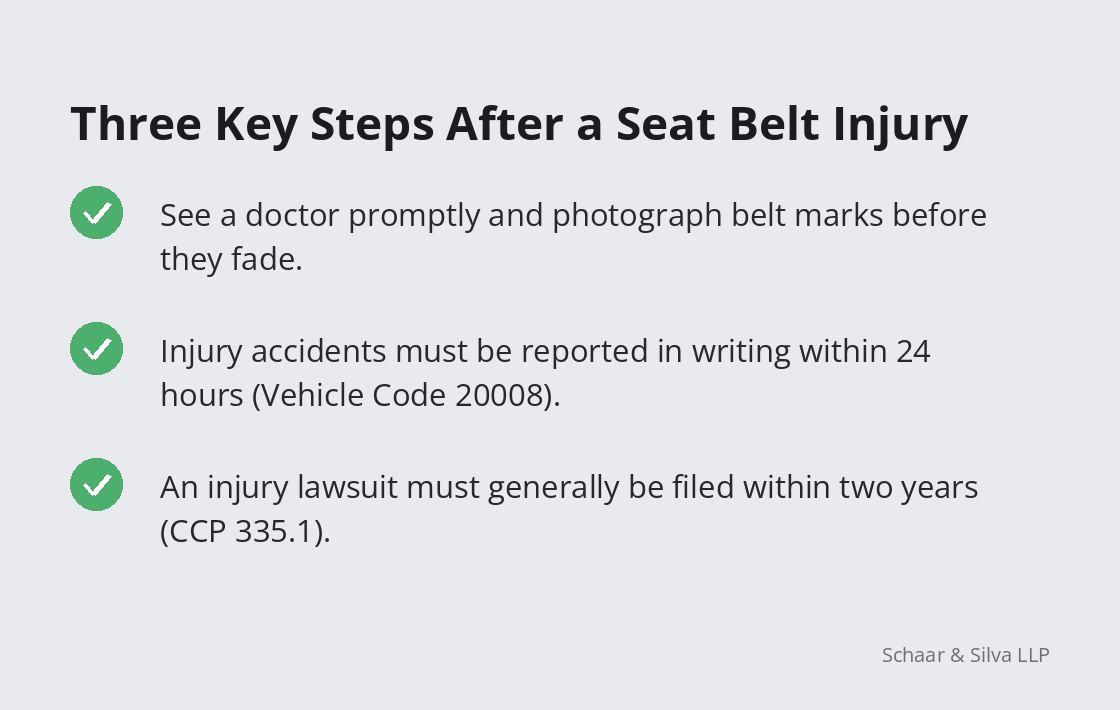
A gap between the crash and your first medical visit gives the insurer an opening to argue that something else caused your pain. Go to urgent care, an emergency room, or your primary doctor promptly, and tell them you were in a collision and wearing a seat belt. Describe where the belt crossed your body and any marks or soreness you noticed. Photographs of belt bruising taken in the first few days are also valuable, because those marks fade.
Guessing When Asked About Your Belt
If an adjuster asks whether you were wearing your seat belt, answer truthfully and only with what you know. Do not guess about speeds, distances, or how the belt performed. A police report may note seat belt use, and photographs of the belt marks, the condition of the belt, and the vehicle interior can support your account. If the belt locked, frayed, or failed, keep the vehicle or at least photograph it before it is repaired or sold, because the belt itself may become evidence.
Missing the Reporting Requirement
Vehicle Code section 20008 requires the driver of a vehicle involved in an accident that results in injury or death to make a written report within 24 hours to the California Highway Patrol or, if the accident happened within a city, to either the Highway Patrol or the city police department. In Santa Cruz County, that generally means the CHP for a crash outside city limits, or either the CHP or the local city police department for a crash inside a city. Getting a copy of the report also helps you confirm what the officer recorded about seat belt use.
Losing Track of the Two-Year Deadline
California Code of Civil Procedure section 335.1 sets a two-year limit for an action for injury to an individual caused by the wrongful act or neglect of another. Two years can pass quickly while you are focused on recovery and trading calls with insurers. Shorter deadlines can apply in some situations, such as a claim involving a public agency, so it is wise to have your case reviewed early rather than late.
Final Thoughts
Seat belt injuries are a reminder that the belt did its job and that the crash still caused real harm. Bruised ribs, a painful chest, and an injured shoulder deserve the same careful attention as any other injury. California law does not let an insurer treat seat belt questions as an automatic win, and the person who caused the collision remains responsible for the harm it caused.
The steps that protect you are simple: get prompt medical care, describe your belt use honestly, photograph the marks and the vehicle, report the accident on time, and keep the two-year deadline in view. Those habits build a record that speaks for itself.
If you were hurt in a car accident in Santa Cruz County and are dealing with seat belt injuries or questions about your belt, contact Schaar & Silva LLP to speak with our team in Santa Cruz. We will review what happened, explain your options, and help you move forward with confidence. We serve Santa Cruz County and surrounding areas.