
A Santa Cruz County car accident with an out-of-state driver can feel more complicated than a crash with a neighbor. The driver may be a visitor heading to the Boardwalk, a traveler on Highway 1, or someone passing through on Highway 17 who will be back home in another state within days. You may wonder whether California law applies, whose insurance is involved, and whether you can hold someone accountable once they leave. Understanding how these claims work gives you real control over what happens next.
At Schaar & Silva LLP, we help people across Santa Cruz County who have been hurt in car and truck accidents, including crashes with drivers who live outside California. This guide explains how a claim against an out-of-state driver actually works, the steps that protect your claim, and the mistakes that most often get in the way, so you can move forward with confidence.
How a Claim Against an Out-of-State Driver Actually Works
Santa Cruz County welcomes visitors all year, and many of them arrive by car. Beach traffic, mountain curves, and unfamiliar roads can lead to crashes involving drivers who do not know the area. The good news for injured people is that a driver’s home address does not decide whether they had to follow California’s rules of the road while driving here.
California’s Duty of Care Applies on California Roads
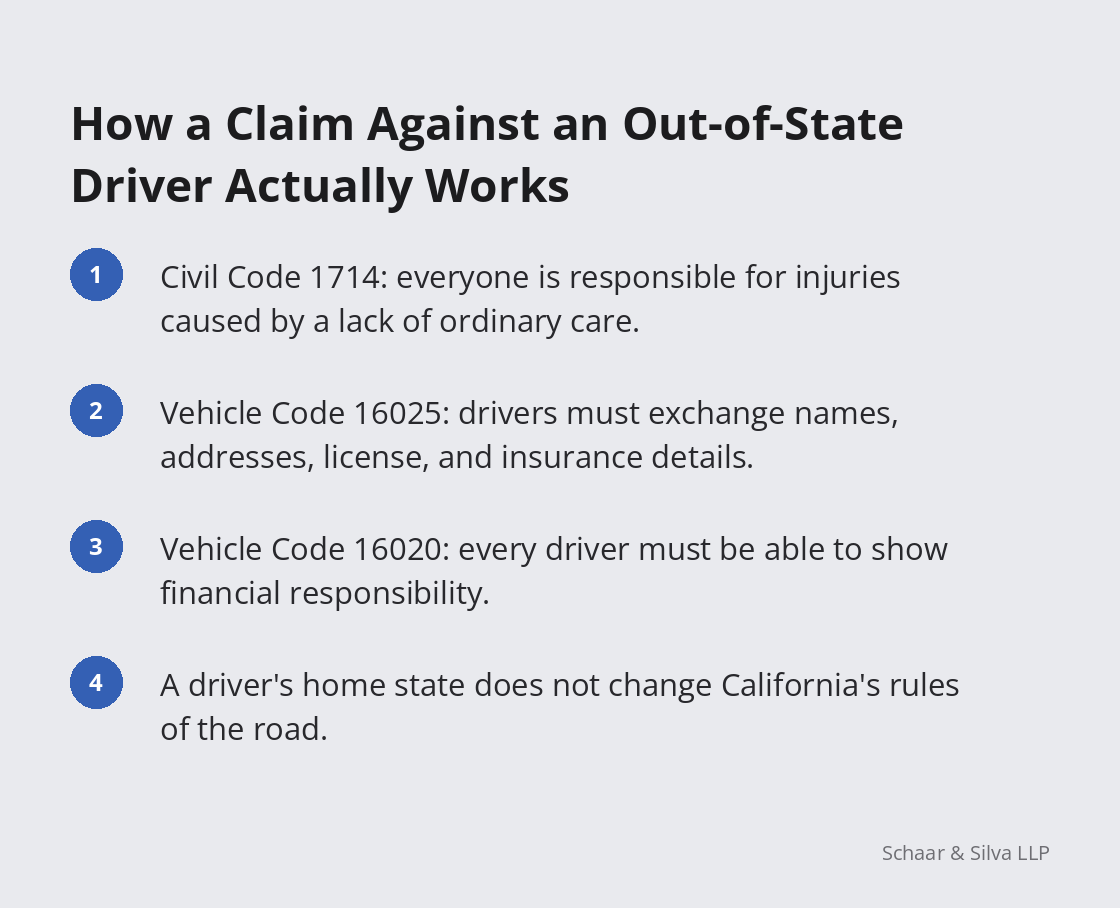
Every driver on a Santa Cruz County road is expected to drive with reasonable care. Civil Code 1714 states that everyone is responsible for an injury occasioned to another by his or her want of ordinary care or skill in the management of his or her property or person. That basic negligence rule is the foundation of most car accident claims in California. A visiting driver who was speeding on Ocean Street, following too closely on Highway 1, or turning without looking is measured against the same standard of care as a local driver.
Exchanging Information at the Scene
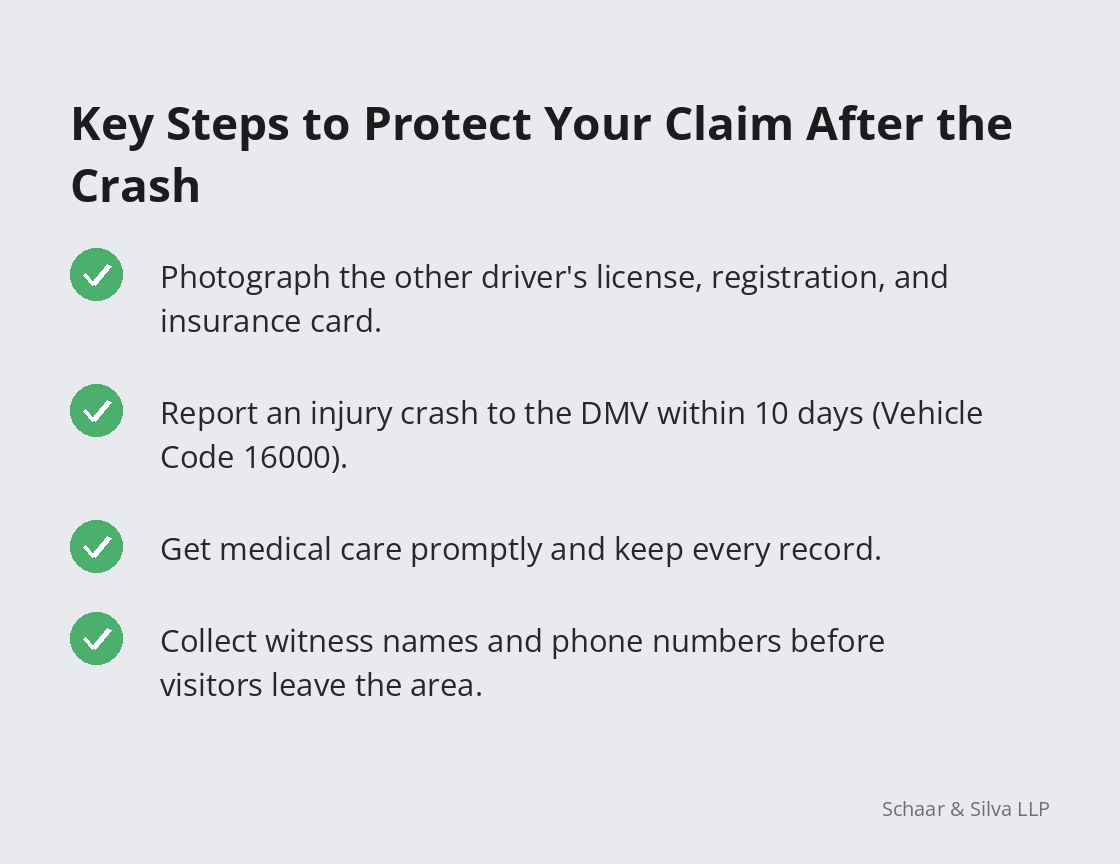
California requires drivers involved in a crash to share key information. Under Vehicle Code 16025, every driver involved in the accident must, unless rendered incapable, exchange with any other driver or property owner involved and present at the scene the driver’s name and current residence address, driver’s license number, vehicle identification number, and the current residence address of the registered owner. The driver must also share evidence of financial responsibility, and if that is insurance, the name and address of the insurance company and the policy number. With an out-of-state driver, taking a clear photo of the license, the registration, and the insurance card is especially important because the driver may be hard to reach later.
Proof of Insurance Rules for Every Driver
Out-of-state drivers are not exempt from California’s financial responsibility rules while they drive here. Vehicle Code 16020 provides that all drivers and all owners of a motor vehicle shall at all times be able to establish financial responsibility and shall carry evidence of it in the vehicle. In many cases, the visiting driver’s coverage comes from a policy issued in their home state. Knowing exactly which insurer and which policy applies is one of the first practical questions in a claim against a visitor.
Steps to Protect Your Claim After the Crash
The first days after a crash with a visiting driver matter even more than usual, because the driver and their vehicle may soon be hundreds of miles away. Taking a few organized steps early keeps the evidence and the contact information you need within reach.
Reporting the Accident
California has its own reporting rules that apply no matter where the other driver lives. Vehicle Code 20001 requires the driver of a vehicle involved in an accident resulting in injury to another person to immediately stop at the scene and fulfill the requirements of the code. In addition, Vehicle Code 16000 requires a driver involved in an accident that results in bodily injury or death to report it to the Department of Motor Vehicles within 10 days. Calling law enforcement to the scene also creates an official record that identifies the other driver, which can be invaluable when that person no longer lives nearby.
Getting Medical Care and Keeping Records
Injuries from a crash are not always obvious at the scene. Soreness, headaches, and back pain can grow over the following days. Getting checked promptly, following your provider’s recommendations, and keeping every visit summary and record creates a clear connection between the crash and your injuries. That record matters in any claim, and it carries extra weight when the insurer handling the claim is far from Santa Cruz County and knows little about you beyond your file.
Identifying the Right Insurance
Claims involving visitors often involve more than one source of coverage. The other driver may have a personal policy from another state, the car may be a rental with its own coverage arrangements, or the driver may have been working for a company at the time. Your own auto policy may also include coverage that applies depending on its terms. Sorting out which policies apply, and in what order, helps you avoid delays and makes sure no available coverage is overlooked.
Preserving Evidence Before the Driver Goes Home
Photograph both vehicles, the license plates, the scene, and any skid marks or debris before anything is moved. Ask witnesses for their names and phone numbers, because visitors and tourists who saw the crash may also be leaving the area soon. If the crash happened near a business, a parking lot, or a busy beach area, video from nearby cameras may exist for only a short time before it is recorded over. Acting quickly helps keep that evidence available.
Mistakes That Derail Claims Against Visiting Drivers
Many people who are hit by an out-of-state driver assume their options shrink the moment the driver crosses the state line. That assumption, along with a few other common missteps, can weaken a claim that would otherwise be strong. Knowing what to avoid helps you keep your claim on track.
Assuming You Cannot Sue Someone Who Lives Elsewhere
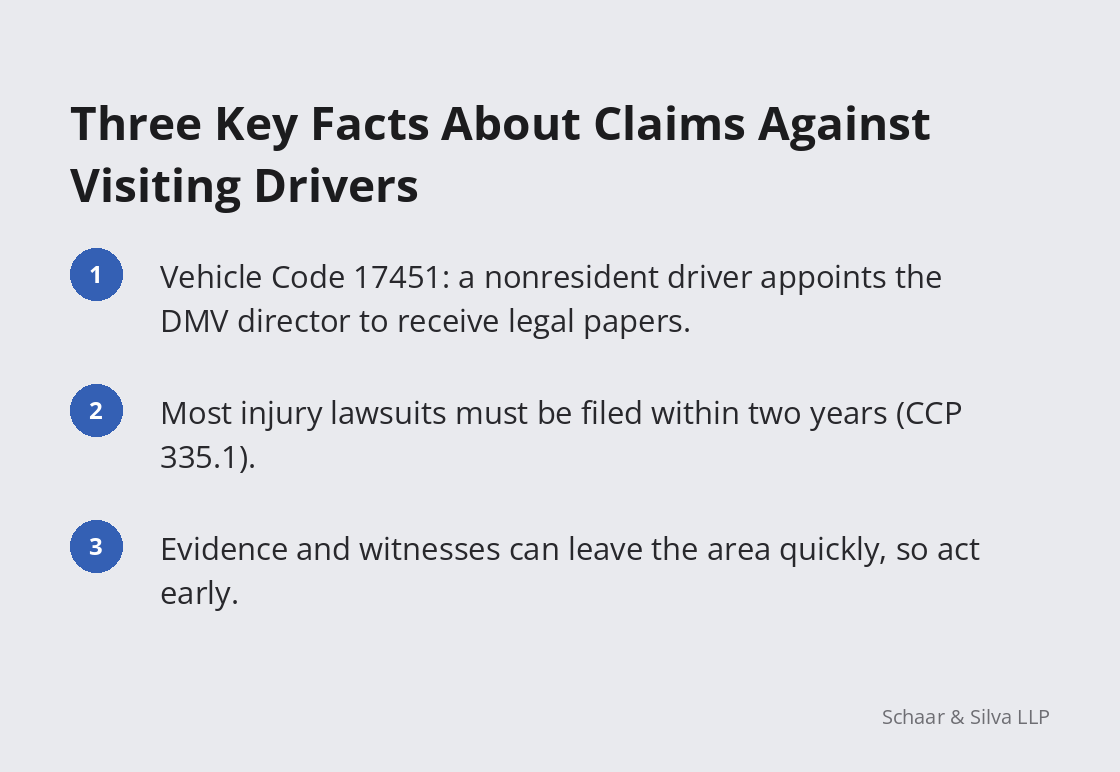
California law anticipated this situation decades ago. Under Vehicle Code 17451, a nonresident who operates a motor vehicle anywhere in California, or whose vehicle is driven here with their permission, is treated as having appointed the director of the Department of Motor Vehicles as their attorney to receive legal papers in any action growing out of an accident or collision in this state. Vehicle Code 17454 explains that service can be made on the director, and Vehicle Code 17455 requires a notice of service and a copy of the summons and complaint to be sent to the defendant. In short, a visiting driver’s return home does not put them beyond the reach of a California court for a California crash.
Waiting Until Witnesses and Records Are Gone
Distance makes delay more harmful. A local driver’s car can be inspected next week, but a visitor’s car may be repaired in another state before anyone sees it. Witnesses on vacation may be difficult to locate once they leave. Starting the claim process early and sending clear requests to preserve evidence helps protect the facts that show what happened.
Missing California’s Filing Deadline
California generally gives injured people two years to file a lawsuit for a personal injury. Code of Civil Procedure 335.1 sets a two-year limit for an action for injury to, or for the death of, an individual caused by the wrongful act or neglect of another. Claims against visitors can take longer to organize because of the distance involved, so it is wise to start well before that deadline approaches.
Talking Too Freely With an Unfamiliar Insurer
An adjuster from an out-of-state insurance company may call soon after the crash and ask for a recorded statement. That adjuster may not know Santa Cruz County roads, and your words can later be used to suggest you were partly at fault or that your injuries are minor. It is usually wise to understand which coverage applies, and the full extent of your injuries, before you give a detailed account.
Final Thoughts
A Santa Cruz County car accident with an out-of-state driver adds distance and unfamiliar insurers to an already stressful situation. California law still holds visiting drivers to the same duty of care, requires them to share information and carry proof of financial responsibility, and gives injured people a way to bring them into a California court after they go home.
Getting medical care, capturing the other driver’s information and the evidence at the scene, and keeping the filing deadline in view are the steps that protect your claim the most. With the right information, you can focus on healing while the facts of your case are preserved.
If you were hurt in a crash with an out-of-state driver anywhere in Santa Cruz County, contact Schaar & Silva LLP to speak with our team. We’ll review what happened, identify the coverage that applies, and help you take the next step with confidence. We serve Santa Cruz County and surrounding areas.